
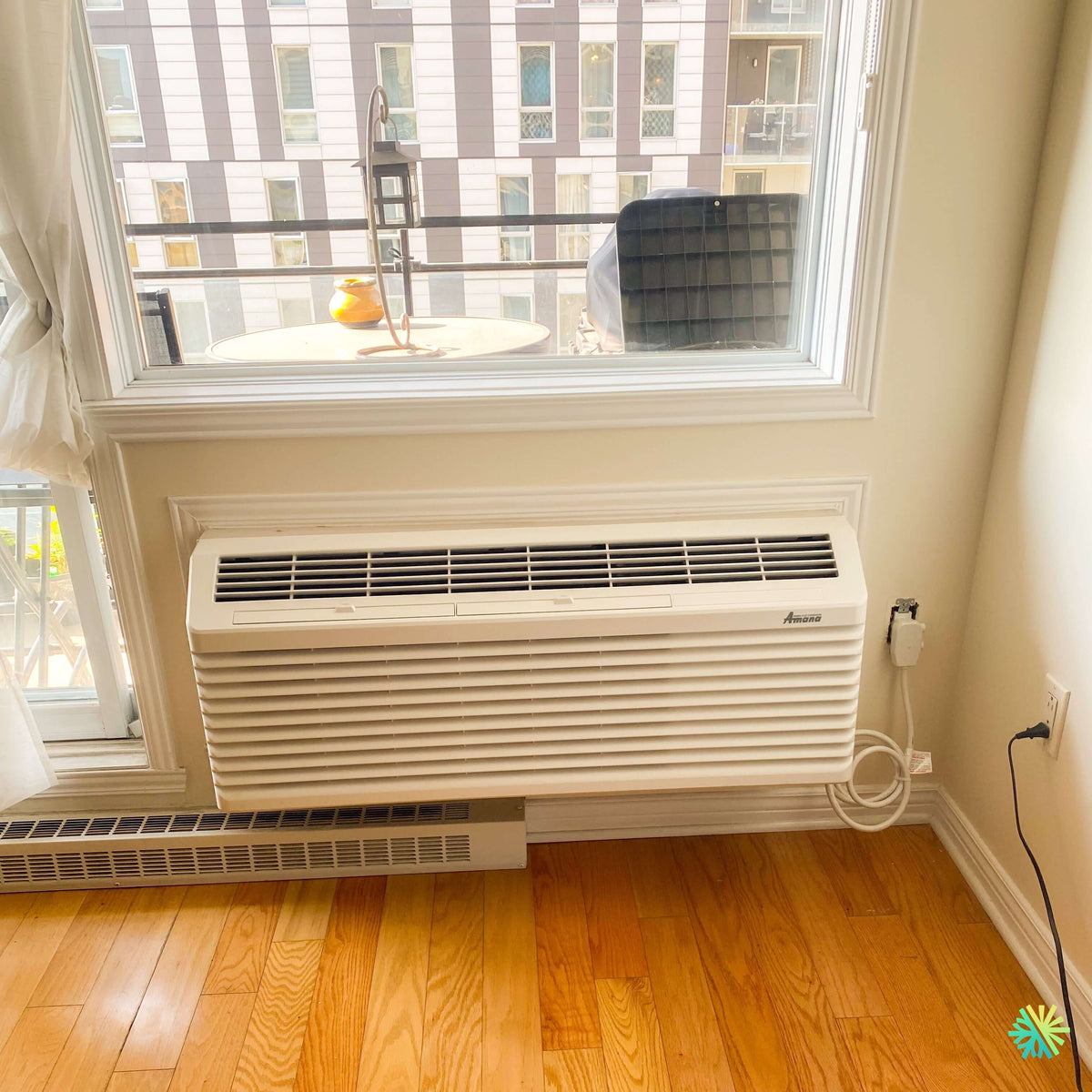
Installation of an AMANA PTAC unit beneath a large window in Candiac, on Montreal’s South Shore
Installation of an AMANA PTAC under a large window in Candiac: compact integration, sleeve inspection, drainage, electrical power, and maintenance advice from AirGreen on the South Shore.
Take a tour of the installation
Each number is a point we check on site. Switch between summer and winter to watch air and heat move.
Generic illustration of this type of installation, not a survey of this job site. Tap a number.
All-in-one: it heats and cools from inside the room, with no separate outdoor unit.
A box that goes through the wall and holds the unit. It is installed following the manufacturer's instructions so water drains to the outside.
This is where the unit exchanges heat with the outdoor air. It must stay clear.
A dedicated connection matched to the unit's voltage and amperage.
On the unit or through a wall thermostat, depending on the model.
Under a window, the unit must leave curtains, sill and opening free, and let air move through the room.
A compact HVAC solution integrated into a residential space with a balcony
This AMANA PTAC installation in Candiac perfectly illustrates the particular constraints we encounter in apartments, condominiums, and multi-unit buildings on the South Shore of Montreal. The space available beneath the window was limited, the wall opened directly onto a balcony, and an electric baseboard already occupied part of the lower area. The unit therefore had to be integrated without interfering with the window opening, movement through the room, or the access required for maintenance.
The visible result features an AMANA PTAC installed beneath a large window, immediately next to a door leading to the balcony. Its front panel remains fully accessible, the upper supply grille is unobstructed, and the unit fits into the wall opening without unnecessarily encroaching on the living space.
For this type of project, the quality of an HVAC installation does not depend solely on the equipment's operation. The airtightness of the wall penetration, condensate drainage, sleeve strength, electrical supply, clearance in front of the grilles, and vibration management all play a decisive role in long-term comfort.
What is an AMANA PTAC?
A PTAC, or packaged terminal air conditioner, combines several air-conditioning components in a single cabinet. Unlike a wall-mounted mini-split air conditioner, it does not require the installation of a separate outdoor unit connected by refrigerant lines.
The rear of the unit connects directly to the outdoors through a sleeve installed in the wall. The outdoor air used for heat rejection circulates through the rear, while room air is drawn in, conditioned, and redistributed through the interior-facing front.
Depending on the series and configuration selected, an AMANA PTAC may offer:
- air conditioning;
- auxiliary electric heating;
- heat pump heating on certain models;
- multiple fan speeds;
- an integrated control on the unit;
- compatibility with certain wall-mounted thermostats;
- diagnostic features that facilitate maintenance.
The AMANA brand is frequently used in hotels, senior residences, rental housing, institutional buildings, and residential units where installing central ductwork or a wall-mounted heat pump with an outdoor unit is not practical.
An installation adapted to the configuration visible in Candiac
The environment for this installation included several elements that had to be considered before the PTAC was installed.
The large window extends relatively low down the wall. The PTAC therefore had to remain compact enough to preserve clearance beneath the frame and avoid interfering with the decorative trim. The balcony's proximity also made the exterior part of the sleeve accessible, but required particular attention to water drainage and sealing against infiltration.
An electric baseboard heater is installed near the floor. The PTAC's positioning had to avoid problematic interaction between the two heat sources while maintaining adequate clearance for airflow. The power cord is routed to an outlet on the adjacent wall without crossing the main walkway in front of the unit.
The hardwood floor, window frames, and white trim also required careful work. During this type of job, we protect the surfaces to prevent scratches, handling marks, and residue from the sleeve or wall opening.
Why the location beneath the window makes sense
Installing a PTAC beneath a window is common, but it must be done precisely. This location generally helps limit the wall space occupied and preserve more room for furniture.
In this room in Candiac, the unit is positioned against an exterior wall, directly beneath the window overlooking the balcony. This configuration offers several advantages:
- the path between the indoors and outdoors remains very short;
- no ductwork is required;
- no separate outdoor unit needs to be installed on the balcony;
- the filters and front panel remain easily accessible;
- air is distributed from an unobstructed location;
- maintenance can be performed from inside for several routine tasks.
Air is blown upward from the upper grille. This orientation helps the cooled or heated air gradually mix with the ambient air rather than blowing directly at occupants' legs.
Essential technical checks before installation
Before installing or replacing an AMANA PTAC, we must confirm several specifications. Two units that appear identical in a photograph may have different power ratings, electrical voltages, heating capacities, and sleeve requirements.
The nameplate must be checked, in particular, to confirm:
- the exact model number;
- the serial number;
- the rated capacity in BTUs;
- the supply voltage;
- the circuit's minimum amperage;
- the type of built-in heating;
- the electrical heating-element capacity, when applicable;
- compatible sleeve dimensions;
- the manufacturer’s clearance requirements.
Since the complete model number is not legible in the image, we avoid assigning unconfirmed capacity or efficiency ratings to this specific unit. This precaution is important. An estimate based solely on the width of the front panel could lead to an error in capacity, electrical connection, or controls.
During an AirGreen service call, we record the information on the rating plate before ordering a replacement unit or parts. This step reduces the risk of receiving a PTAC that is incompatible with the existing sleeve.
The importance of the wall sleeve
The sleeve is the metal structure that passes through the wall and supports the PTAC. It is not merely a decorative frame. It must support the weight of the unit, maintain its alignment, and protect the building against water infiltration.
We check in particular:
-
Support strength
The sleeve must not move when the unit is operating or when the front panel is removed. -
Proper slope
A controlled slope toward the outside promotes condensate drainage and limits the risk of water flowing back into the room. -
Condition of the sleeve regarding corrosion
A rusted or deformed sleeve can compromise the seal and make future removal of the unit difficult. -
Dimensional compatibility
Some sleeves have similar dimensions without being perfectly interchangeable. -
Peripheral sealing
The joints between the sleeve and the building must withstand air, water, and the temperature variations typical of Quebec’s climate.
In Candiac, as throughout the South Shore, freeze-thaw cycles can worsen sealing defects. A small gap around the sleeve can become a source of cold air, condensation, outdoor noise, or water infiltration.
Condensate management and wall protection
A PTAC extracts moisture from the air when operating in cooling mode. This water must be directed outside or managed according to the system specified by the manufacturer.
An incorrect slope, a clogged drain, or a deformed sleeve can cause:
- water running onto the floor;
- stains beneath the unit;
- deterioration of the trim;
- odors coming from the condensate pan;
- corrosion;
- an increase in humidity around the wall opening.
The proximity of the hardwood floor makes this check particularly important in the installation shown. Even a small recurring leak can damage the wood finish and the lower part of the wall.
After installation, we therefore check the unit’s operation in cooling mode, verify that there are no abnormal vibrations, and confirm that the condensate is draining properly.
Power supply and safety
A PTAC must not be connected to an outlet chosen solely because it is nearby. The circuit must meet the requirements listed on the nameplate.
Depending on the model, the unit may require a power supply different from that of a conventional residential outlet. The shape of the plug is not always sufficient to confirm the circuit’s capacity, since an outlet may have been replaced without the wiring or breaker being checked.
We pay particular attention to the following elements:
- required voltage;
- wire gauge;
- breaker capacity;
- type of outlet;
- condition of the cord;
- absence of an extension cord;
- clearance around the plug;
- protection against mechanical damage.
In the photo, the cord is gathered near the right side of the unit. It remains important that it not be pinched behind the PTAC, exposed to a hot surface, or placed where it could be snagged.
Coexistence with the electric baseboard heater
The presence of an electric baseboard heater near the PTAC requires careful planning. The two units must not interfere with each other or cause localized overheating.
A baseboard heater generates warm airflow through convection. If its clearance is reduced by a unit, piece of furniture, or curtain, its performance may decrease and the temperature of certain surfaces may increase.
In this Candiac installation, the PTAC’s main front remains unobstructed and the baseboard remains visible. An on-site inspection confirms the actual clearances, the operation of both units, and the control logic used during the winter.
When a PTAC has its own heating system, we also explain to the customer how to coordinate the settings with other heat sources. Two thermostats set to different temperatures can lead to unnecessary cycles and increased energy consumption.
A successful PTAC installation depends on invisible details
The steps followed during this type of service
A professional installation is not simply a matter of sliding a new unit into an existing opening. Our method includes a series of checks before, during, and after commissioning.
Location inspection
We inspect the wall, sleeve, electrical connection, surrounding surfaces, exterior section, and the space required to remove the front panel.
We also check for curtains, furniture, baseboards, outlets, doors, and window frames that could restrict airflow.
Sleeve and exterior grille inspection
The rear grille must allow adequate airflow. A grille blocked by debris, a cover, balcony furniture, or accumulated dust can reduce performance and increase the compressor’s operating temperature.
In a space with a balcony, we recommend keeping a clear area in front of the outdoor section of the PTAC. Decorative objects, storage boxes, and furniture covers must not block the air intake or outlet.
Unit installation
The PTAC is carefully inserted into the sleeve to avoid damaging the seals, fins, or power cord. The unit must be stable and properly seated in its support.
The front panel is then put back in place so that the filters, controls, and fasteners remain accessible.
Operational test
We test the modes available on the unit:
- ventilation;
- air conditioning;
- heating, when available;
- speed change;
- control response;
- shutdown and restart;
- fan noise;
- compressor vibration;
- condensate drainage.
We also check the temperature difference between the return air and supply air when ambient conditions allow for a meaningful measurement.
Common mistakes to avoid with a PTAC
Several problems attributed to the unit are actually caused by installation or maintenance.
The most common errors are as follows:
- choosing capacity based solely on area without considering windows and solar exposure;
- reusing an incompatible sleeve;
- installing the unit without the proper slope;
- neglecting the seals around the opening;
- using an extension cord;
- blocking the outdoor grille with balcony furniture;
- placing curtains in front of the return air intake;
- allowing the filters to become clogged;
- ignoring a vibration that appeared after installation;
- announcing eligibility for a subsidy without checking the model number.
In the photographed room, the large glazed area may increase heat gain during sunny periods. Capacity calculations must therefore take into account the window’s orientation, glazing quality, insulation, area, and the room’s actual use.
Recommended maintenance to preserve performance
Regular HVAC maintenance helps maintain airflow and limit dust buildup in the unit.
The owner or occupant can generally clean washable filters after following the manufacturer’s instructions. Frequency depends on usage, the presence of pets, dust levels, and operating time.
More comprehensive maintenance includes:
- cleaning the coils;
- inspecting the condensate pan;
- clearing the water drainage paths;
- checking the fans;
- checking the sleeve;
- inspecting the outdoor grille;
- checking the cord and outlet;
- listening to the bearings and compressor;
- checking the perimeter seal.
A persistent odor, reduced airflow, a rubbing noise, a water leak, or frequent shutdowns warrants a professional inspection.
PTAC or wall-mounted heat pump: two different solutions
A PTAC and a wall-mounted heat pump do not meet exactly the same needs.
A PTAC offers compact installation in a wall opening and does not require a separate outdoor unit. It is particularly suitable for buildings already designed with individual sleeves.
The wall-mounted mini-split heat pump uses a lighter indoor unit and a separate outdoor unit. It can provide quieter operation in the room and high seasonal efficiency, but its installation requires refrigerant lines, a drain, communication wiring, and an authorized location for the outdoor unit.
In condominiums, the choice may also depend on the condominium association’s bylaws, the exterior appearance, the space available on the balcony, and restrictions on facade penetrations.
We therefore assess each project based on the building rather than automatically recommending the same equipment to every customer.
Rebates and eligibility
Eligibility for financial assistance depends on the program in effect, the exact type of equipment, its reference number, its performance, and the nature of the building.
A unit bearing only the designation PTAC or AMANA should not be presented as eligible without documentary verification. Several programs target specific heat pump categories and exclude units that do not meet their technical criteria.
Before confirming a rebate, we specifically verify:
- the indoor and outdoor models, when there are two units;
- the recognized equipment category;
- the heating capacity;
- the applicable certification;
- the installation address;
- the building type;
- the purchase and installation date;
- the program rules in effect at the time of the application.
This diligence prevents a property owner from basing their decision on an amount that ultimately could not be claimed.
AirGreen serving Candiac and Greater Montreal
At AirGreen, we carry out air conditioning, heating, and ventilation projects in residences, businesses, condominiums, and multi-unit buildings in Candiac, Longueuil, Montreal, Laval, the South Shore, and the North Shore.
Our approach is based on a thorough inspection of the location, verification of electrical specifications, equipment compatibility, and complete commissioning. In the case of a PTAC, we pay as much attention to the sleeve and airtightness as we do to the unit itself.
This installation of an AMANA PTAC in Candiac shows that a compact system can be integrated neatly into a room with a large window, a balcony, and an electric baseboard heater. However, the comfort achieved depends on several technical decisions: properly matched capacity, a stable support, unobstructed airflow, functional drainage, a compliant electrical circuit, and accessible maintenance.
The big day, step by step
The main steps of this kind of job at AirGreen. Every house has its quirks: the estimate brings them out.
We look at the outside wall, the window, the space in the room and the power supply.
The unit, the sleeve and the price, in writing.
Installed following the manufacturer's instructions, so water drains to the outside.
A dedicated connection matched to the unit's voltage and amperage.
The unit slides into the sleeve; the outdoor grille stays clear.
Start-up and a check of heating and cooling.
Controls, filter, what to keep clear.
- The on-site estimateWe look at the outside wall, the window, the space in the room and the power supply.
- The quoteThe unit, the sleeve and the price, in writing.
- The wall sleeveInstalled following the manufacturer's instructions, so water drains to the outside.
- The electrical workA dedicated connection matched to the unit's voltage and amperage.
- Unit and grilleThe unit slides into the sleeve; the outdoor grille stays clear.
- TestsStart-up and a check of heating and cooling.
- The walkthroughControls, filter, what to keep clear.
Four mistakes we do not make
Flip each card to see what we do instead.
Your own project, step by step
What to do, season by season
Three habits per season for this unit. They take a few minutes and prevent many calls.
- Clean the filter.
- Clear the outdoor grille.
- Test cooling.
- Clean the filter more often.
- Check water drainage.
- Let air move in front of the unit.
- Test heating.
- Check the seal around the sleeve.
- Book maintenance.
- Keep the outdoor grille free of snow.
- Do not cover the unit with a curtain.
- Note any unusual noise.
Is your home ready?
Check what applies at your place. A "no" is not a refusal: it is what we sort out during the estimate.
Four statements: true or false?
It all comes down to details you have just seen.
1. A PTAC needs a separate outdoor unit.
It is an all-in-one unit that goes through the wall.
2. The outdoor grille must stay clear.
That is where the unit exchanges heat with the outdoor air.
3. Any electrical outlet will do.
It needs a connection matched to its voltage and amperage.
4. A PTAC can heat and cool a room.
That is its job: all-in-one, under the window, through the wall.
0 / 4 right answers
What people ask us about this kind of work
What is a PTAC?
Where does it go?
What does it need electrically?
Can the existing sleeve be reused?
Does a PTAC cool the whole house?
Does AirGreen hold the required licences?
Is the estimate free?
No question matches. Write to us: we answer.
More jobs to see, near you
By town, by equipment or by region: browse more than 4,700 published projects.
Each dot: a town where AirGreen has published projects. The glowing dot: this job.
Every house has its constraints. We see them before we install.
The on-site estimate is free and the quote follows within 24 hours.
Text and photo: a real AirGreen Climatisation & Chauffage job. The diagrams are generic illustrations of the type of installation, not a survey of this job site. Sources of the added figures: airgreen.ca product pages (NEEP / AHRI performance), Hydro-Québec (Heat pumps page, LogisVert, read on 13 October 2026), Régie de l’énergie (rate D as of 1 April 2026).