
Installation of a MIDEA EVOX G3 electric furnace in Saint-Eustache, on Montreal’s North Shore
In Saint-Eustache, AirGreen installs a MIDEA EVOX G3 electric furnace in an extremely tight mechanical space, with existing ductwork, condensate drainage, R-454B, and precise airflow optimization.
- City
- Region
- Equipment
- Brand
- Challenges
- Published
The job on one screen
The article, chapter by chapter
In Saint-Eustache, a MIDEA EVOX G3 installed in a mechanical room where every available inch served a purpose
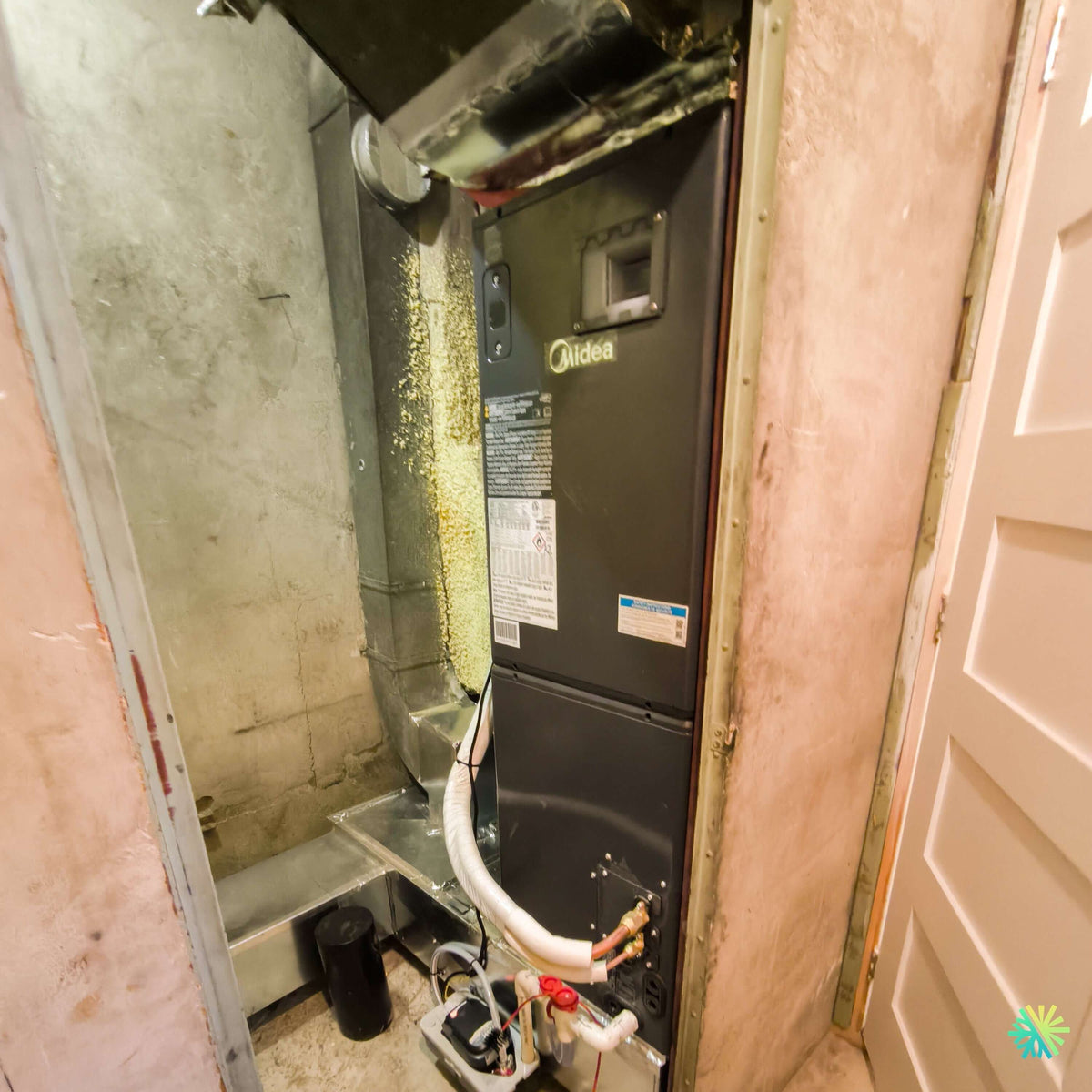
This MIDEA EVOX G3 electric furnace installation in Saint-Eustache illustrates a situation we regularly encounter in existing homes on the Montreal’s North Shore : the best location for a new central system is often also the most difficult to access. On this job, the mechanical room was particularly narrow. The new unit had to be integrated between a wall, a large metal ductwork system, and a doorway leaving very little room to maneuver.
The photograph taken after our work clearly shows this reality. The MIDEA EVOX G3 is installed vertically, with its front facing the only area that truly allows access to the components. On the left, the ventilation ductwork descends almost to the floor before changing direction. Above the unit, the sheet metal and plenum occupy practically all the available space. On the right, the door frame is just a few inches from the furnace.
In such an environment, installing a central unit is not simply a matter of finding a machine that “fits.” We must think from the outset about what will happen after installation: opening the panels, changing the filter, servicing the coil, performing electrical diagnostics, cleaning the drain, and potentially servicing the refrigerant lines.
That is precisely what makes this project interesting.
The main challenge: integrating a modern system into a mechanical room built around an old ductwork system
An existing home does not offer us the freedom of a new construction. We must work around what is already there.
In Saint-Eustache, the existing ductwork occupied a significant portion of the room. Several changes of direction were required in the sheet metal before even reaching the unit. The available floor workspace was also limited.
We therefore planned theHVAC installation while considering all of the following simultaneously:
- the vertical positioning of the MIDEA EVOX G3;
- connection to the existing ductwork;
- front access for servicing;
- the route for the refrigerant lines;
- condensate drainage;
- clearance near the door;
- the system’s static pressure;
- control and power wiring.
The final photograph notably shows a large insulated refrigerant line running down along the lower part of the machine before joining the coil connections. The smaller-diameter copper line is also visible. At the base of the unit, we can see the condensate drainage system as well as a small pump assembly used to route the water produced in cooling mode when direct gravity drainage is not the most practical solution.
These are details that are less visible in a sales brochure, but they are part of the day-to-day operation of a central system.
A compact vertical unit, but above all, a design intended for difficult spaces
The MIDEA EVOX G3 uses a modular design called Block N Lock. MIDEA offers six installation options, including upflow, downflow, right-horizontal, left-horizontal configurations, and variants low-boy suited to locations where ceiling height is limited. The manufacturer also describes this design as making handling easier in basements, attics, and other challenging spaces.
At this Saint-Eustache job site, we kept a vertical configuration that made efficient use of the room’s height.
The benefit is very tangible: rather than rebuilding a large part of the mechanical room to accommodate a machine with incompatible dimensions, we can choose a configuration that genuinely matches the available space.
Modularity, however, never replaces taking measurements. Before this type of installation, we must confirm not only the unit’s width and height, but also the space required for the connections, sheet metal, and future service work.
Sizes designed to facilitate the replacement of older furnaces
MIDEA also designed the dimensions of the EVOX G3 to facilitate modernization projects. Depending on the capacity, the documentation lists cabinets approximately 14 ½ in, 17 ½ in, and 21 ½ in wide. The manufacturer presents this product line as a solution designed to facilitate the replacement of existing central systems.
In a room like the one at our Saint-Eustache installation, a few extra inches would have had significant consequences.
The door located to the right of the unit clearly illustrates the problem. A wider machine could have:
reduce access to the mechanical room, make it harder to open the panels, force a relocation of the ductwork, or require a much more extensive modification to the sheet metal.
An HVAC contractor should therefore never look only at the nominal capacity. The physical dimensions of the unit are part of the project sizing.
The visible refrigeration connections remind us that this is not a simple resistance furnace
Even though we are talking here about MIDEA EVOX G3 electric furnace, the indoor unit is a component of a central system that can be paired with a heat pump.
The lower part of the photo also clearly shows the refrigerant circuit connections.
The central system can therefore provide primary heating using the heat pump, summer cooling, and, when necessary, use an auxiliary electric heating kit.
MIDEA offers multistage auxiliary heating kits rated up to 25 kW, with configurations listed at 10, 15, and 25 kW. The manufacturer provides for activation and adjustment according to temperature changes to achieve more precise control of auxiliary heating and its energy consumption.
The exact capacity of the electric heating element installed in this Saint-Eustache home is not sufficiently legible in the photo for us to state it with certainty.
Why we never automatically select the largest electric heating element
Higher auxiliary heating capacity is not necessarily an advantage.
Before determining the appropriate capacity, we must consider the home's available electrical capacity, conductor sizing, heat pump sizing, the home's heat loss, and the selected operating strategy.
The goal is not to use electric resistance heating as often as possible. In a properly configured installation, we instead aim to take advantage of the efficiency of the central heat pump and reserve electric backup for conditions in which it actually adds value.
This is particularly relevant on the North Shore, where a system must handle both relatively mild periods in the fall and much colder winter nights.
A product range designed to operate down to -30°C
The EVOX G3 documentation specifically emphasizes winter performance.
MIDEA indicates continuous operation down to -30°C. The manufacturer also reports, under certain test conditions and for certain combinations, up to 100% heating capacity at -25°C, with a COP of up to approximately 1.9.
These features are particularly relevant for a central heat pump installation in Saint-Eustache, since actual performance during extreme cold is much more valuable than a simple summer air-conditioning rating.
The range presented in the brochure covers nominal capacities ranging from approximately 18,000 to 54,000 BTU/h and reports performance of up to 19 SEER2, 12.5 EER2, and 10.8 HSPF2, with a stated maximum COP of 2.14 at 5°F, or approximately -15°C.
The technical table for the product range includes 18,000, 24,000, 30,000, 36,000, 48,000, and 54,000 BTU/h configurations, each with its own efficiency characteristics.
We therefore cannot infer the exact capacity of this installation simply from the appearance of the furnace.
The BTU rating must match the house, not just the old machine.
When replacing equipment, a common mistake is to automatically copy the tonnage of the old system.
However, the old system itself may have been oversized or undersized.
Instead, we must consider the heating load, insulation, windows, the actual heated area, air distribution, and the capacity of the ductwork.
An oversized heat pump can cause improper cycling and affect comfort. An undersized heat pump, on the other hand, may rely too often on auxiliary heating.
At AirGreen, sizing is therefore part of the installation, even when we are working in a space where physical constraints seem to be the main problem.
The defining detail of this installation in Saint-Eustache: ensuring proper airflow despite a very compact ductwork layout
The photograph places the MIDEA EVOX G3 in the foreground, but much of the system's performance actually depends on the sheet metal surrounding it.
On the left, the existing ductwork includes several sections and changes in shape. Above, the plenum must also adapt to the geometry of the space. Each transition creates some resistance to airflow.
That is why static pressure must be part of our considerations from the design stage.
Computational Constant Airflow 2.0
The EVOX G3 uses a technology called Computational Constant Airflow 2.0.
According to MIDEA, the blower can adapt its operation to different ductwork and filtration conditions. The manufacturer presents scenarios in which an airflow of 1,200 CFM is maintained between static-pressure conditions of 0.4 and 1.2 in. of water column.
MIDEA also indicates up to 60 airflow adjustment levels, allowing the fan settings to be adapted to the installation's needs.
This capability is particularly useful in renovation projects where the ductwork is already in place.
However, it does not justify ignoring poor design.
If a return-air opening is too small or a transition is excessively restrictive, the blower will have to work harder. This can increase noise and energy consumption while reducing the available operating range.
In this space, service access was part of the design.
The door frame visible on the right side of the photo is very close to the unit.
We therefore positioned the service panel to preserve the necessary access to the main sections of the MIDEA EVOX G3.
This is a consideration homeowners should always check when comparing quotes.
A central electric furnace can operate perfectly at the time of installation, then become extremely expensive to maintain if a technician has to dismantle ducts or move other equipment to access a component.
For us, a truly successful installation must also be serviceable.
Condensate: a few poorly managed litres of water can become a costly problem
At the bottom of the installation, the condensate drainage network is clearly visible.
When the system operates in cooling mode, moisture removed from the air turns into water on the indoor coil. In this mechanical room, the drainage configuration requires organized removal in an already very limited space.
Poorly executed drainage can lead to overflow, moisture, floor damage, and potentially problems around the unit.
We therefore give these small pipes just as much attention as the large metal ducts.
R-454B and A2L: what the pictogram on the front means
On the EVOX G3 nameplate, the symbol associated with the category can be seen A2L.
The EVOX range uses R-454B refrigerant. MIDEA indicates that this refrigerant has a global warming potential of 466.
For an HVAC company, this refrigerant change entails installation, servicing, and handling methods adapted to A2L equipment.
The homeowner does not need to become a refrigerant specialist, but should make sure the chosen company genuinely understands this new generation of systems.
Filtration: MERV 13 should not be chosen without considering airflow
MIDEA supports compatibility with filters measuring 1, 2, and 4 inches, including MERV 13 options. The documentation mentions their ability to capture more dust, pollen, particles, and contaminants while helping keep the coil cleaner.
However, a higher-performance filter is only useful if the system can still move the required airflow.
In an installation like the one in Saint-Eustache, where the network includes several transitions, we need to look at the complete system before unnecessarily increasing filter resistance.
Useful control flexibility when replacing an existing system
The EVOX G3 can operate with different control architectures.
MIDEA indicates compatibility with a communication 485, its communicating controller, and certain configurations using third-party thermostats in 24 VThe range also includes solutions that reduce the need to redo all the communication wiring in certain renovations.
In an existing home, this can avoid opening finished walls simply to add a new thermostat wire.
The best choice nevertheless depends on the system's exact configuration and the features the homeowner actually wants to use.
LogisVert in 2026: how to check the incentive for a MIDEA central heat pump
For a recent installation in Quebec, the question of subsidies naturally arises.
Hydro-Québec currently indicates that heat pumps installed since November 26, 2025 must be certified ENERGY STAR to be eligible for the heat pump incentive under the LogisVert program. When all conditions are met, the incentive is $50 per 1,000 BTU/h at -8 °C for an ENERGY STAR heat pump, or $120 per 1,000 BTU/h at -8 °C for an ENERGY STAR cold-climate heat pump.
This does not mean that the commercial name MIDEA EVOX G3 is enough to guarantee an amount.
For a central system, we must verify the exact combination of the indoor and outdoor units, their certification, and the official heating capacity used by Hydro-Québec at -8 °CHydro-Québec also specifies that replacing only one indoor or outdoor unit is not eligible for this measure.
We therefore avoid promising an amount based solely on the nominal tonnage.
What this Saint-Eustache installation teaches homeowners shopping for a central system
This project clearly shows why two quotes apparently offering the same MIDEA EVOX G3 electric furnace can lead to very different results.
The machine is only one part of the project.
The ductwork, transitions, drainage, refrigerant lines, electrical connections, static pressure, thermostat, and space reserved for servicing must also be considered.
In this Saint-Eustache property, the most obvious constraint was space. But our goal was not simply to manage to install the furnace between the walls. We had to create an installation capable of operating properly while remaining accessible.
That is precisely what we seek in our projects in Saint-Eustache, Blainville, Terrebonne, Laval, and throughout the North Shore, as well as Montreal, Longueuil, and the South Shore.
A good HVAC installation is not judged solely by the cleanliness of the final photo. It is judged by how the equipment operates with the building in the years that follow.
In this project, the compactness of the MIDEA EVOX G3with its modular design, airflow management, and low-temperature operating capabilities, allowed us to integrate a modern central system into a mechanical space where every inch already had its place.
The job tools
Two quick checks with real numbers: what heat costs, and what your current heaters add up to in BTU/h.
Conversion: 1 W = 3.412 BTU/h. An indication, not a load calculation: baseboards and furnaces are often stronger than the real need, and they can stay as backup. AirGreen confirms the capacity on site.
How the job unfolds
The main steps of this kind of job at AirGreen. Every house has its quirks: the estimate brings them out.
We look at the ducts, the current indoor module, the electrical panel and the planned spot for the outdoor unit.
The equipment combination, capacity and price, in writing. We check whether the combination qualifies for assistance programs.
Access protected, old unit disconnected and removed when it is being replaced.
Electric furnace or air handler, with its coil, connected to the supply and return ducts.
On a level base, raised above the snow, with free space all around.
Insulated, they enter through a sealed opening and run to the indoor coil.
Dedicated circuits, accessible disconnect, a thermostat that works with the heat pump and the backup heat.
Leak test, vacuum, start-up, airflow check and a test of both modes.
Filter, thermostat, backup heat in extreme cold: what to know before winter.
- The on-site estimateWe look at the ducts, the current indoor module, the electrical panel and the planned spot for the outdoor unit.
- The quoteThe equipment combination, capacity and price, in writing. We check whether the combination qualifies for assistance programs.
- Getting readyAccess protected, old unit disconnected and removed when it is being replaced.
- The indoor moduleElectric furnace or air handler, with its coil, connected to the supply and return ducts.
- The outdoor unitOn a level base, raised above the snow, with free space all around.
- The refrigerant linesInsulated, they enter through a sealed opening and run to the indoor coil.
- Electrical and thermostatDedicated circuits, accessible disconnect, a thermostat that works with the heat pump and the backup heat.
- Tests and start-upLeak test, vacuum, start-up, airflow check and a test of both modes.
- The walkthroughFilter, thermostat, backup heat in extreme cold: what to know before winter.
What we check on a job like this one
Each number is a point we check on site. Switch between summer and winter to watch air and heat move.
In summer, the outdoor unit rejects the house's heat outside.
Generic illustration of this type of installation, not a survey of this job site. Tap a number.
It captures or rejects heat outside. It sits on a level base, above the snow, with free space all around.
The insulated refrigerant lines enter the house through a sealed opening and run to the indoor coil.
A shut-off switch near the outdoor unit isolates it safely for service.
Sitting on the indoor module, it moves heat between the house air and the refrigerant.
Electric furnace or air handler: its fan pushes air through the ducts. The electric backup takes over in extreme cold.
Supply ducts bring air to the rooms; returns bring it back to the unit. Their condition matters as much as the unit's.
It protects the coil and the fan. A dirty filter cuts airflow, so it gets checked regularly.
It runs the heat pump and the backup heat. It must be compatible with the installed system.
Is your home ready?
Check what applies at your place. A "no" is not a refusal: it is what we sort out during the estimate.
Good habits, once the unit is in place
Six simple habits that keep the unit going. Your list stays on this device.
What to do, season by season
Three habits per season for this unit. They take a few minutes and prevent many calls.
- Check the indoor module's filter.
- Clear winter debris from the outdoor unit.
- Test cooling before the heat arrives.
- Check the filter more often in peak season.
- Keep registers and returns clear.
- Watch condensate drainage near the coil.
- Change or clean the filter.
- Test heating and backup heat before the cold.
- Book periodic maintenance.
- Clear snow around the outdoor unit.
- Store nothing in front of the indoor module.
- Note any unusual noise or smell and call us.
The right pages, at the right time
Four statements: true or false?
It all comes down to details you have just seen.
1. A central heat pump uses the house's ducts.
It connects to the existing ducts to heat and cool everywhere.
2. In extreme cold, electric backup heat can take over.
The indoor module (furnace or air handler) works with the heat pump and takes over in extreme cold.
3. The filter only gets changed when the unit breaks down.
A dirty filter cuts airflow. It gets checked regularly.
4. You can reuse the old unit's size without checking.
The house may have changed: insulation, windows, added rooms. Capacity is confirmed on site.
0 / 4 right answers
What people ask us about this kind of work
Can I keep my current ducts?
What happens in extreme cold?
Furnace, air handler, ducted: what is the difference?
Are there grants?
Do I need a permit?
How much can I save?
How is the LogisVert assistance calculated?
Will my current thermostat work?
Central or wall units: which one?
Does AirGreen hold the required licences?
Is the estimate free?
No question matches. Write to us: we answer.
More jobs to see, near you
By town, by equipment or by region: browse more than 4,700 published projects.
Each dot: a town where AirGreen has published projects. The glowing dot: this job.
An on-site estimate, the right capacity, the right equipment.
The on-site estimate is free and the quote follows within 24 hours.
Text and photo: a real AirGreen Climatisation & Chauffage job. The diagrams are generic illustrations of the type of installation, not a survey of this job site. Sources of the added figures: airgreen.ca product pages (NEEP / AHRI performance), Hydro-Québec (Heat pumps page, LogisVert, read on 13 October 2026), Régie de l’énergie (rate D as of 1 April 2026).