
Installation of a MIDEA MIDEA28 wall-mounted heat pump in Saint-Télesphore
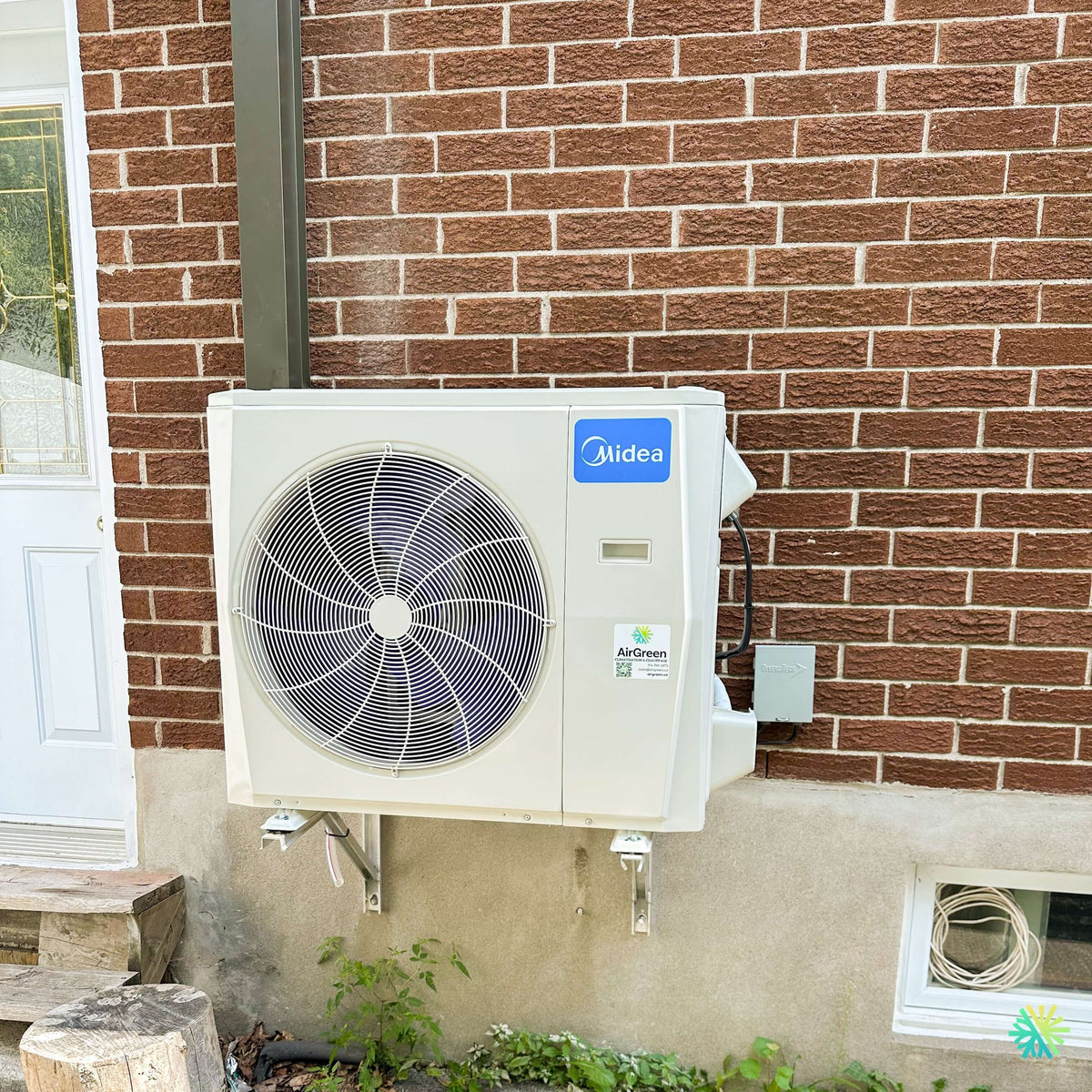
In Saint-Télesphore, AirGreen installs a MIDEA28 wall-mounted heat pump on metal brackets, between the basement door and window, with a layout designed for defrosting, snow, and maintenance.
- City
- Region
- Equipment
- Brand
- Challenges
- Published
The job on one screen
The unit’s data sheet
The range as published on airgreen.ca: pick a size to see its capacity in deep cold.
| Size | Heating at −8 °C | Heating at −15 °C | Coldest certified point | COP at −15 °C | SEER | HSPF | Indicative LogisVert aid |
|---|---|---|---|---|---|---|---|
| Midea Série 28 9 000 | 12,000 | 11,500 | −30 °C: 5,100 | 1.8 | 27.4 | 12.5 | – |
| Midea Série 28 12 000 | 12,000 | 11,500 | −30 °C: 5,900 | 1.8 | 25.4 | 10.5 | $1,440 |
| Midea Série 28 18 000 | 18,000 | 18,000 | −30 °C: 8,000 | 1.92 | 21.4 | 11.0 | $2,160 |
| Midea Série 28 24 000 | 22,200 | 24,200 | −30 °C: 11,900 | 2.34 | 21.0 | 13.5 | $2,664 |
| Midea Série 28 33 000 | 32,000 | 35,000 | −30 °C: 20,700 | 1.98 | 19.5 | 10.5 | $3,840 |
According to NEEP, it delivers 12,000 BTU/h at −8 °C (17 °F), as much as at 8 °C. It heats as hard in moderate cold as in mild weather.
At 8 °C, its certified maximum capacity reaches 16,000 BTU/h, 78% more than its nominal 9,000 BTU size.
According to NEEP, its certified heating capacity at −15 °C (5 °F) is 11,500 BTU/h, 128% of its nominal 9,000 BTU size. Its COP there is 1.80.
According to NEEP, it delivers 12,000 BTU/h at −8 °C (17 °F), as much as at 8 °C. It heats as hard in moderate cold as in mild weather.
At 8 °C, its certified maximum capacity reaches 16,000 BTU/h, 33% more than its nominal 12,000 BTU size.
At −30 °C, its certified minimum capacity is 2,000 BTU/h (3,800 at 8 °C). It slows down instead of cycling on and off.
According to NEEP, it delivers 18,000 BTU/h at −8 °C (17 °F), as much as at 8 °C. It heats as hard in moderate cold as in mild weather.
According to NEEP, its certified heating capacity at −15 °C (5 °F) is 18,000 BTU/h, 100% of its nominal 18,000 BTU size. Its COP there is 1.92.
According to NEEP, its COP at −15 °C is 2.34: the highest of the Série 28 line, which ranges from 1.80 to 1.98 at that temperature.
At −30 °C, its certified minimum capacity is 2,400 BTU/h (11,800 at 8 °C). It slows down instead of cycling on and off.
According to NEEP, its certified heating capacity at −15 °C (5 °F) is 24,200 BTU/h, 101% of its nominal 24,000 BTU size. Its COP there is 2.34.
According to NEEP, its certified maximum capacity at −30 °C (−22 °F) is 20,700 BTU/h, 63% of its nominal 33,000 BTU size.
At −30 °C, its certified minimum capacity is 4,200 BTU/h (19,700 at 8 °C). It slows down instead of cycling on and off.
According to NEEP, its certified heating capacity at −15 °C (5 °F) is 35,000 BTU/h, 106% of its nominal 33,000 BTU size. Its COP there is 1.98.
Data read live from the airgreen.ca page of each size (NEEP / AHRI certified performance). When the title names the installed size, it is highlighted; otherwise the whole range is shown. The aid shown is today’s, using Hydro-Québec’s rule ($120 per 1,000 BTU/h at −8 °C); amounts quoted in the article date from its publication. Only Hydro-Québec confirms the assistance granted.A dash in the aid column: amount to be confirmed for this model.
The article, chapter by chapter
A precisely integrated MIDEA28 installation on a residential brick façade in Saint-Télesphore
In Saint-Télesphore, we installed this MIDEA MIDEA28 wall-mounted heat pump on a property where the outdoor location required particularly careful planning. The outdoor unit had to fit between several existing elements: an exterior door on the left, a basement window on the right, a brick façade above the foundation, and a relatively restricted area of land immediately in front of the building.
We chose a installation on two metal wall brackets, with the outdoor unit installed above ground level. The photo clearly shows the result: the heat pump is positioned against the lower part of the façade, its fan remains completely unobstructed toward the front, and the electrical disconnect is installed nearby on the brick wall.
This installation clearly illustrates our approach at AirGreen: we do not simply look for a place where the unit can fit. We determine a location that takes into account winter operation, air clearance, mechanical stability, service access, and normal use of the home's entrances.
The MIDEA28 is particularly well suited to this type of project. Midea offers its ductless systems with a compact side-discharge outdoor unit that can be installed on a base or support, providing useful flexibility when the façade has limited available space.
Why did we choose a wall-mounted support rather than an installation directly on the ground?
On this property in Saint-Télesphore, the heat pump is located immediately next to a landscaped area and the foundation. An installation directly on the ground would have brought the unit closer to accumulations of snow, leaves, moisture, and water produced during defrost cycles.
The metal bracket installation leaves open space beneath the unit.
This additional height is particularly useful during Quebec winters. A heat pump in heating mode must periodically defrost its outdoor heat exchanger. The water resulting from this process must be able to drain away without gradually forming a block of ice against the underside of the unit.
On this project, the raised installation allows us, among other things, to:
- keep the outdoor heat exchanger farther away from ground-level accumulations;
- leave space beneath the heat pump for water drainage;
- reduce the risk of snow obstruction;
- keep the area in front completely clear;
- facilitate visual inspection of the installation;
- use the façade efficiently without unnecessarily encroaching on the property.
The goal is to prepare the installation for several heating seasons, not just for the conditions on the day we complete the work.
The door’s proximity required a balanced layout
To the left of the unit is an exterior door with its threshold and steps.
It would have been easy to move the heat pump toward this access point to shorten certain routes. However, we must ensure that an outdoor unit does not become an obstacle for occupants.
We specifically check that its location does not compromise:
- passageway;
- opening the door;
- access to the steps;
- building maintenance;
- the required clearance around the outdoor unit.
The MIDEA28 was therefore positioned far enough to the right of the entrance while avoiding placing it directly in front of the basement window visible on the other side.
This is a concrete example of what it means to custom HVAC installation : the heat pump must be fitted into a space with constraints that existed long before it arrived.
An outdoor fan that is completely unobstructed
The large circular grille visible at the front of the MIDEA28 is the outdoor fan.
We pay close attention to this area. A side-discharge unit must be able to move air freely through its heat exchanger and discharge it in front of the unit.
A solid fence, a wall that is too close, objects stored in front of the heat pump, or overly dense vegetation can interfere with this airflow.
At the installation completed in Saint-Télesphore, the front side is completely open. This prevents the outdoor unit from being placed in a small recess where the discharged air could return toward the machine.
The outdoor disconnect switch is located nearby and remains easily accessible
The photo also shows a electrical disconnect switch installed on the brick wall to the right of the unit.
This element is an integral part of the installation.
When a technician needs to perform maintenance or repairs, the equipment’s power supply must be able to be properly isolated. The disconnect switch must therefore be accessible and not hidden behind the heat pump or buried in a difficult-to-reach location.
For this project, the electrical installation is located next to the outdoor unit while remaining separate from the main airflow area.
This type of detail does not always attract attention in a photo, but it becomes very important when service is needed several years after the initial installation.
MIDEA28: a complete series from 9,000 to 33,000 BTU
Contrary to what its name might suggest, MIDEA28 does not indicate a 28,000 BTU heat pump.
This is the series name.
The technical table on page 11 of the Midea brochure lists five nominal cooling capacities for the MIDEA28:
- 9,000 BTU/h;
- 12,000 BTU/h;
- 18,000 BTU/h;
- 24,000 BTU/h;
- 33,000 BTU/h.
The corresponding nominal heating capacities are, respectively, 12,000, 12,000, 18,000, 29,000, and 36,000 BTU/h.
The exterior photo of this project does not show the nameplate clearly enough to confirm the exact capacity of the photographed unit. We therefore do not artificially assign it a BTU rating based solely on its appearance.
To determine the installed capacity precisely, the complete combination of indoor and outdoor units must be checked.
The five AHRI references for the MIDEA28 lineup
The documentation also provides a different AHRI reference for each capacity:
| Nominal capacity | Indoor unit | Outdoor unit | AHRI |
|---|---|---|---|
| 9,000 BTU | MSEHU-H09B-2A | MO1HS-H09B-2A | 215471380 |
| 12,000 BTU | MSEHU-H12B-2A | MO1HS-H12B-2A | 215471381 |
| 18,000 BTU | MSEHU-H18B-2A | MO1HS-H18B-2A | 215471382 |
| 24,000 BTU | MSEHU-H24B-2A | MO1HS-H24B-2A | 215471383 |
| 33,000 BTU | MSEHU-H33B-2A | MO1HS-H33B-2A | 215471384 |
These combinations are the ones indicated by Midea for the MIDEA28 series in the documentation provided.
This clarification is essential when a homeowner wants to compare performance or verify eligibility for a heat pump rebate in Quebec. The name “MIDEA28” alone is not enough: the exact combination and its AHRI number are what matter.
Up to 27.4 SEER2 depending on the selected capacity
The MIDEA28 is presented as a superior wall-mounted series offering performance of up to 27.4 SEER2.
However, performance varies from one model to another:
- 9,000 BTU: 27.4 SEER2;
- 12,000 BTU: 25.4 SEER2;
- 18,000 BTU: 21.4 SEER2;
- 24,000 BTU: 21.0 SEER2;
- 33,000 BTU: 19.5 SEER2.
This is something we frequently explain to homeowners in Saint-Télesphore, Montreal, Laval, Longueuil, the North Shore, and the South Shore.
The maximum performance advertised for a series is not necessarily that of every available capacity.
We therefore prefer to compare equipment based on its exact technical specification, rather than a single figure highlighted in a brochure.
A heat pump designed to heat down to -30°C
MIDEA28 is classified by Midea as a extreme heat pump and its published heating operating range extends down to -30°C. It uses R-454B and all five configurations shown are identified as Cold Climate V6.1.
The technical table confirms a heating operating range of -30°C to 24°C for all the MIDEA28 capacities shown.
This feature is particularly relevant for an installation in Saint-Télesphore, where a heat pump selected as a significant heating source must be able to continue operating when temperatures drop well below zero.
However, this does not mean that the available capacity remains exactly the same at all temperatures.
At -15°C, for example, Midea publishes rated heating capacities ranging from 11,500 BTU/h to 35,000 BTU/h depending on the configuration.
That is precisely why we size the unit according to the building rather than simply choosing the largest available capacity.
A high-performing MIDEA28 always begins with an installation suited to the building
Line-set dimensions vary considerably between 9,000 and 33,000 BTU
The MIDEA28 series is a good example of why we need to know the exact model number before planning or reusing existing piping.
According to Midea:
- 9,000 BTU: lines 1/4 in. and 3/8 in.;
- 12,000 BTU: 1/4 in. and 3/8 in.;
- 18,000 BTU: 1/4 in. and 1/2 in.;
- 24,000 BTU: 3/8 in. and 5/8 in.;
- 33,000 BTU: 3/8 in. and 3/4 in..
The difference between the extremes is considerable.
We regularly encounter properties where an older heat pump is already installed and the owner wants to keep the existing lines to reduce the amount of work.
This possibility must be verified technically. An older, well-maintained copper line set may still have the wrong diameters for the new unit.
The maximum line-set length also depends on capacity
The MIDEA28 offers different length limits:
- 82 feet for the 9,000 and 12,000 BTU versions;
- 98.4 feet for the 18,000 BTU;
- 164 feet for the 24,000 and 33,000 BTU versions.
This flexibility accommodates several building configurations, but a long distance should not become an excuse for creating an unnecessarily complicated route.
At AirGreen, we aim to create a logical, accessible, and protected route between the units.
Electrical requirements also vary with capacity
The five MIDEA28 models do not all require the same electrical supply.
The technical table indicates a minimum allowable amperage that increases from 15 A for the 9,000 and 12,000 BTU versions. to 34 A for the 33,000 BTU model.
The indicated maximum protection ranges from 15 A to 35 A depending on the capacity.
This demonstrates why the electrical assessment must be completed before installation, particularly when a heat pump is replacing an existing appliance.
We never choose a circuit breaker at random or simply based on the nominal capacity shown on the quote. The manufacturer’s electrical data determines the equipment requirements.
A wall-mounted installation also requires vibration control.
The heat pump shown in the photograph is attached to the structure with two brackets.
The compressor and fan produce vibrations during operation. We must therefore ensure that:
- the brackets are securely anchored;
- the machine is properly level;
- the feet rest properly on the support;
- no metal component remains loose;
- the lines are not under excessive tension.
A unit that vibrates on its support can produce noise unrelated to the heat pump’s normal sound level.
This is particularly important when the outdoor unit is mounted directly to a residential façade.
R-454B and an A2L detection device
Like the other recent models in this range, the MIDEA28 uses R-454B refrigerant.
Midea’s documentation also presents an A2L refrigerant leak detection sensor, as well as an A2L dispersion system among the features of the MIDEA35, MIDEA28, and MIDEA25 series.
This equipment requires work methods suited to this generation of refrigerant.
For us, this means paying close attention to connections, leak testing, vacuum evacuation, and commissioning.
Variable-speed technology makes it possible to better match actual needs.
Midea uses variable-speed technology that allows the compressor to adjust its operation as the temperature changes.
Rather than being limited to complete on-off cycles, the system can modulate its capacity. Midea indicates that this technology helps reduce temperature fluctuations and maintain a more stable environment.
For a homeowner in Saint-Télesphore, this becomes particularly useful on days when it is neither extremely cold nor extremely hot.
The machine can operate more gradually when demand is low instead of constantly using its full capacity.
Up to 100 indoor fan speed settings
The MIDEA28 also offers several options for the indoor unit.
Midea mentions 100 continuously adjustable airflow levels and control through the SmartHome app as well as via Wi-Fi, depending on the configuration.
The features presented for this series also include:
- ECO mode;
- Turbo;
- night mode;
- timer;
- “Follow Me” feature;
- automatic cleaning;
- silent mode;
- 8°C heating;
- horizontal and vertical oscillation;
- smart sensor;
- humidity control.
These settings allow occupants to fine-tune airflow and system behavior.
An interesting “Follow Me” feature when the temperature is not uniform
The feature “Follow Me” allows the sensor located in the remote control to measure the ambient temperature where the remote is located.
The heat pump can then use this measurement to adjust its operation.
In a large open room or in a home where the wall-mounted unit is installed far from the occupied area, this feature can help achieve a temperature better suited to where the occupants actually are.
Future maintenance influenced the outdoor positioning
The Saint-Télesphore outdoor unit is not positioned directly against the steps, window, or ground.
This matters when a technician eventually needs to access the service side, check the connections, take electrical measurements, or clean the heat exchanger.
A HVAC installation must remain practical once the project is completed.
We apply the same logic to the indoor unit. Midea documentation indicates that the blower wheel on the MIDEA35, 28, and 25 series can be removed to facilitate a thorough cleaning of the interior.
This is a particularly useful feature when a HVAC maintenance A complete one becomes necessary after several seasons of operation.
Mistakes that this Saint-Télesphore project helps prevent
An installation like this illustrates several common mistakes that we systematically seek to prevent:
-
Install the heat pump too close to the ground.
Snow and winter defrosting must be planned from the outset. -
Place the unit in front of a basement door or window.
The building’s normal use must be preserved. -
Block the fan with vegetation or a structure.
The outdoor air discharge must remain unobstructed. -
Choose the wrong copper diameter.
A 9,000 BTU MIDEA28 does not have the same connections as a 33,000 BTU MIDEA28. -
Assume that MIDEA28 means 28,000 BTU.
The series is available from 9,000 to 33,000 BTU in cooling. -
Do not overlook the electrical disconnect switch.
It must be accessible for servicing. -
Do not size solely according to the number of square feet.
Insulation, windows, heat losses, and the building configuration must be considered.
Subsidies: always verify the exact AHRI combination
The MIDEA28 has several AHRI references and different performance levels depending on its capacity. Eligibility for financial assistance must therefore be verified using the AHRI number of the combination actually installed, and not simply with the name MIDEA28.
The published references range from 215471380 to 215471384 for the five configurations presented.
The brochure provided does not specify the amount of any subsidy applicable to this particular installation in Saint-Télesphore. Any amount must therefore be confirmed according to the program in effect and the exact equipment combination.
Midea residential warranty
Midea documentation presents, for the residential sector, a 12-year limited warranty on the compressor, 12 years on parts, and 10 years on labor. The registration terms and conditions must be verified for the installation concerned.
We recommend keeping the invoice, serial numbers, exact references for both units, and registration confirmations.
Why this MIDEA28 installation in Saint-Télesphore reflects the way we work
This project is not simply about mounting a Midea heat pump on a brick wall.
We had to work between a door, a basement window, the foundation, the ground, and the existing electrical connections. The final solution uses the available portion of the facade while keeping the unit elevated and accessible.
The heat pump has clear space in front, the disconnect switch is easy to identify, the brackets free up floor space, and the selected height prepares the installation for the realities of winter.
At AirGreen, this is what we seek in every wall-mounted heat pump in Saint-Télesphore : a properly selected unit, but above all, an installation that respects the building it is intended for.
We carry out this same type of project in Montreal, Laval, and Longueuil, on the North Shore, the South Shore and in the surrounding municipalities. The configuration changes from one property to another, but our objective remains the same: to build an HVAC installation that will remain logical, accessible, and suited to real-world conditions long after we leave the job site.
The job tools
Two quick checks with real numbers: what heat costs, and what your current heaters add up to in BTU/h.
Baseboards and electric furnaces turn 1 kWh of electricity into 1 kWh of heat. A heat pump delivers more: that is its COP. At Hydro-Québec’s rate D (11.142¢/kWh above 40 kWh a day, since 1 April 2026):
Hydro-Québec: a heat pump can be up to three times more efficient than baseboards for heating in the colder months.
Estimate per kWh of heat, at the chosen temperature, using the certified COP from the product page. Taxes, access charge and backup heat not included.
Conversion: 1 W = 3.412 BTU/h. An indication, not a load calculation: baseboards and furnaces are often stronger than the real need, and they can stay as backup. AirGreen confirms the capacity on site.
How the job unfolds
The main steps of this kind of job at AirGreen. Every house has its quirks: the estimate brings them out.
We look at the room, the outside wall, the line route and where the outdoor unit will go. That is where the capacity gets chosen.
Model, capacity and price, in writing. We also check whether the model qualifies for assistance programs.
Floors and furniture protected, wall plate position marked level, wall opening located.
A single opening, with the slope the drain needs to flow outside.
Set on a stand raised above the snow, with the clearances the manufacturer requires.
Connected, insulated and protected. The opening is then sealed against water, cold air and insects.
A dedicated circuit and an accessible disconnect near the outdoor unit.
Leak test, vacuum, then start-up and a check of heating and cooling.
Remote, modes, filters: we show you the essentials before we leave.
- The on-site estimateWe look at the room, the outside wall, the line route and where the outdoor unit will go. That is where the capacity gets chosen.
- The quoteModel, capacity and price, in writing. We also check whether the model qualifies for assistance programs.
- Getting readyFloors and furniture protected, wall plate position marked level, wall opening located.
- The wall openingA single opening, with the slope the drain needs to flow outside.
- The outdoor unitSet on a stand raised above the snow, with the clearances the manufacturer requires.
- Lines, cable and drainConnected, insulated and protected. The opening is then sealed against water, cold air and insects.
- The electrical workA dedicated circuit and an accessible disconnect near the outdoor unit.
- Tests and start-upLeak test, vacuum, then start-up and a check of heating and cooling.
- The walkthroughRemote, modes, filters: we show you the essentials before we leave.
What we check on a job like this one
Each number is a point we check on site. Switch between summer and winter to watch air and heat move.
In summer, the outdoor unit rejects the house's heat outside.
Generic illustration of this type of installation, not a survey of this job site. Tap a number.
Mounted level on a wall plate, high enough for the air to reach the whole room, with enough space around it to slide the filters out easily.
The refrigerant lines, the communication cable and the drain go through the wall in a single opening, sealed against water, cold air and insects.
Two insulated copper pipes connect the two units. Outside, a line cover can protect them from sun, knocks and weather.
A shut-off switch near the outdoor unit isolates it safely for service. It must stay accessible at all times.
The compressor and the fan. In heating mode it captures heat from the outdoor air, even in winter, and moves it inside.
On the ground or on the wall, it keeps the unit above accumulated snow. The unit stays clear and defrost water can drain away.
The fan needs to blow freely. Storage, a fence or a wall too close, and efficiency drops while noise goes up.
Is your home ready?
Check what applies at your place. A "no" is not a refusal: it is what we sort out during the estimate.
Good habits, once the unit is in place
Six simple habits that keep the unit going. Your list stays on this device.
What to do, season by season
Three habits per season for this unit. They take a few minutes and prevent many calls.
- Clean the indoor unit's filters.
- Clear leaves and debris left on the outdoor unit by winter.
- Test cooling before the first hot days.
- Clean the filters more often when the unit runs a lot.
- Keep plants away from the outdoor unit.
- Check that no water drips from the indoor unit.
- Rake the leaves around the outdoor unit.
- Test heating before the first cold days.
- Book periodic maintenance before winter.
- Keep snow away from the stand and the front of the unit.
- Let the unit defrost: it is normal.
- Never hit the ice on the fins; call us if the unit stays iced up.
The right pages, at the right time
Four statements: true or false?
It all comes down to details you have just seen.
1. In heating mode, the outdoor unit can produce water.
During defrost cycles. That water must drain away without forming ice.
2. You pick the capacity with a simple square-footage rule.
Windows, insulation, orientation and how the room is used all count. Capacity is chosen on site.
3. A multi-zone connects several indoor heads to a single condenser.
One head per room, all on the same condenser. Each room keeps its own temperature.
4. The disconnect can sit behind the patio furniture.
It must stay accessible: it is what shuts the unit off for service.
0 / 4 right answers
What people ask us about this kind of work
Does a wall-mounted heat pump heat in winter?
Wall-mounted or multi-zone: how do I choose?
Where does the outdoor unit go?
Are there grants?
Do I need a permit?
How cold can it heat?
How much can I save?
How is the LogisVert assistance calculated?
Is it noisy?
The outdoor unit is covered in ice: is that normal?
Does AirGreen hold the required licences?
Is the estimate free?
No question matches. Write to us: we answer.
More jobs to see, near you
By town, by equipment or by region: browse more than 4,700 published projects.
Each dot: a town where AirGreen has published projects. The glowing dot: this job.
An on-site estimate, the right capacity, the right equipment.
The on-site estimate is free and the quote follows within 24 hours.
Text and photo: a real AirGreen Climatisation & Chauffage job. The diagrams are generic illustrations of the type of installation, not a survey of this job site. Sources of the added figures: airgreen.ca product pages (NEEP / AHRI performance), Hydro-Québec (Heat pumps page, LogisVert, read on 13 October 2026), Régie de l’énergie (rate D as of 1 April 2026).