
Installation of a FRIEDRICH ZoneAire® Premier PTAC in Saint-Nazaire-d’Acton, Montérégie
Installation of a FRIEDRICH ZoneAire Premier PTAC in Saint-Nazaire-d’Acton: integration beneath a window, inspection of the sleeve, front panel, drainage, and electrical supply.
- City
- Region
- Equipment
- Brand
- Challenges
- Published
The job on one screen
The article, chapter by chapter
Replacing a built-in unit without compromising the window, woodwork, or existing heating system
This FRIEDRICH PTAC ZoneAire® Premier installation in Saint-Nazaire-d’Acton illustrates a type of project where every detail matters. The unit had to fit into a wall opening located directly beneath a large window, near an existing baseboard heater and amid decorative trim that had already been finished.
In this configuration, it is not enough to insert a new unit into the wall and plug it in. The outcome depends on compatibility with the sleeve, sealing around the opening, clearance around the grilles, drainage, the electrical supply, and how air will be distributed throughout the room.
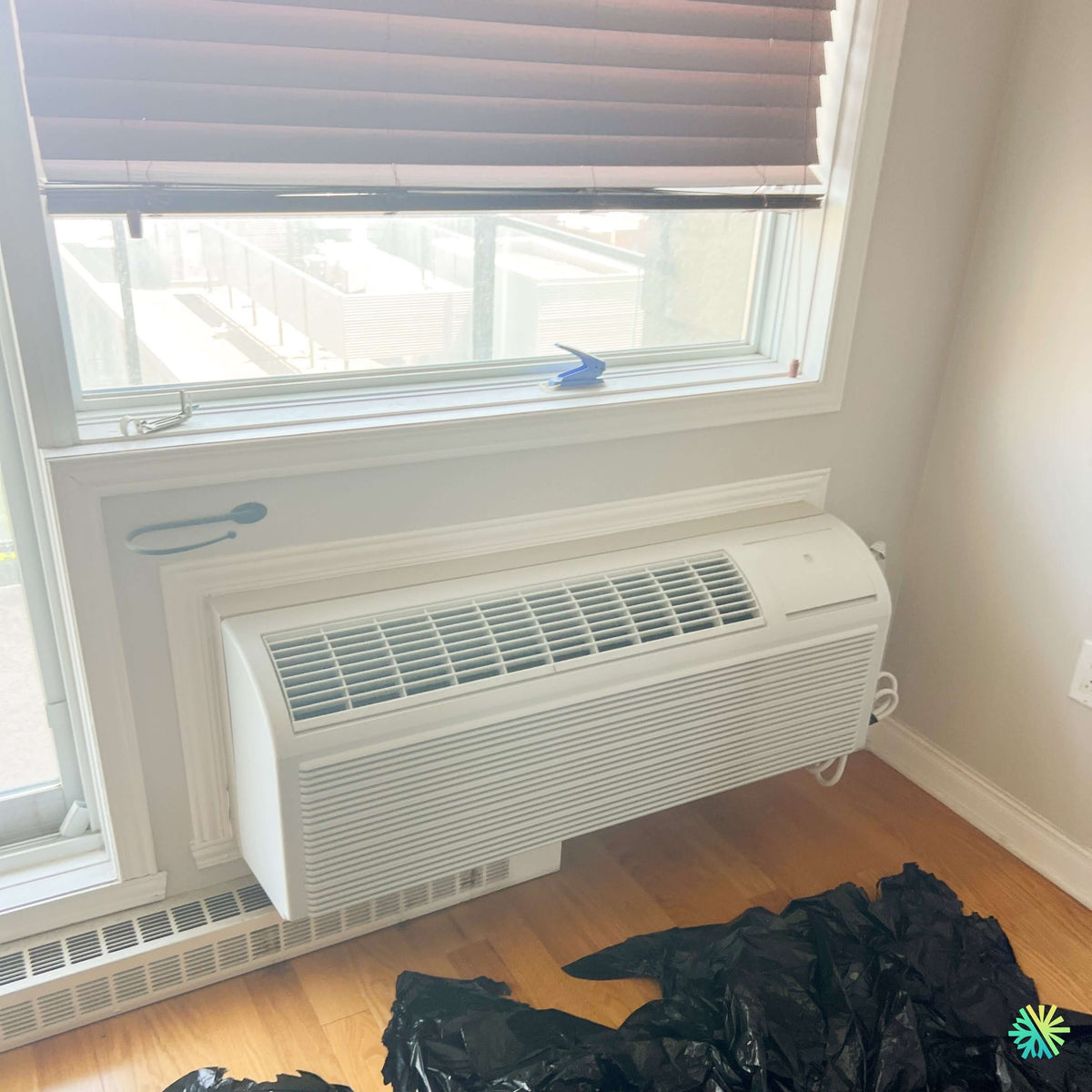
In the photograph of our work, the FRIEDRICH PTAC is perfectly centered beneath the window. Its white front blends with the trim and interior finish, while the upper supply grille remains unobstructed. The electrical supply remains accessible on the right side of the unit, which is important for maintenance and future service work.
Why a PTAC was particularly well suited to this room
A PTAC, or packaged terminal air conditioner, combines the main components needed to condition a room’s air in a single chassis. Unlike a wall-mounted heat pump, it does not require the installation of an indoor unit suspended from the wall and an outdoor unit connected by refrigerant lines.
The unit passes through the wall using a sleeve. Part of the chassis is inside the room, while the exterior section exhausts heat outside the building.
This solution is often suitable for:
- apartment buildings;
- hotels and lodging establishments;
- residences for seniors;
- offices;
- individual bedrooms;
- additions without ductwork;
- buildings where several zones need to be controlled separately.
In this project in Saint-Nazaire-d’Acton, the opening beneath the window was already adapted for a PTAC unit. Replacing or modernizing the equipment in this configuration made it possible to preserve the room’s layout without undertaking major work on the walls or ceiling.
The exterior view through the window also reveals several similar grilles installed along the building. This arrangement is typical of properties where each room or unit has its own self-contained system. It allows occupants to adjust their temperature independently, without relying on a shared central system.
An integration that had to respect the existing woodwork
The visible trim around the opening had already been painted and finished. Our work therefore had to protect the interior appearance while ensuring that the PTAC’s front panel could be removed if necessary.
A common mistake is to install trim too tightly against the unit’s front panel. This finish may look neat on the day of installation, but it later complicates:
- removing the filters;
- opening the control compartment;
- access to the chassis;
- cleaning the evaporator;
- the replacement of certain components;
- the complete removal of the unit from the sleeve.
We maintained a visually uniform trim without blocking the removable components. The front panel remains accessible, and the unit can be serviced without having to tear out the woodwork.
The existing baseboard heater: a detail that should not be overlooked
A baseboard heater is located at floor level, partially beneath the installation. The coexistence of two heating systems in a confined space requires careful inspection.
In particular, it must be confirmed that the PTAC does not block the baseboard heater’s natural airflow and that the heat it produces does not interfere with the unit’s temperature reading. If a sensor continuously receives air that is warmer than the rest of the room, the PTAC may end its cycle too early and leave some areas uncomfortable.
We also check that:
- the baseboard heater’s grilles are not crushed or obstructed;
- the PTAC’s power cord does not rest on an excessively hot surface;
- access to the baseboard heater remains possible;
- the two systems do not operate unnecessarily against each other;
- the temperature settings are consistent.
In some buildings, the baseboard heater serves as the primary or supplemental heating source when outdoor temperatures become very low. In others, it is simply retained as a backup solution. The operating mode must be clearly explained to the occupant to avoid unnecessary electricity consumption.
FRIEDRICH ZoneAire® Premier: a range designed for independent room conditioning
The FRIEDRICH ZoneAire® Premier range includes units with electric heat as well as heat pump versions. Current models are available in several capacity categories, generally designated as 7,000, 9,000, 12,000, and 15,000 BTU.
Depending on the model, the rated cooling capacity of the current range is approximately between 7,200 and 14,800 BTU/h. EER varies according to capacity and voltage, with values reaching approximately 13.3 on certain configurations. Depending on the model, heat pump versions have a coefficient of performance of up to approximately 3.6 under the nominal conditions published by the manufacturer.
Since the complete model number is not visible in the photograph, we do not claim to identify this unit's exact capacity based solely on its appearance. This distinction is important: several ZoneAire Premier units use a very similar front panel and chassis despite having different capacities, voltages, and heating systems.
Before replacing a unit, we always record:
- the complete model number;
- the serial number;
- the rated voltage;
- the cooling capacity;
- the electric heating capacity;
- the refrigerant type;
- the operating type, namely air conditioning with electric heat or a heat pump;
- the cord and electrical circuit requirements.
A design aimed at reducing noise in the room
In a PTAC, the compressor is located in the same chassis as the indoor section. The perceived noise may therefore be greater than that of a ductless heat pump, whose compressor is installed outdoors.
FRIEDRICH incorporates several features designed to limit vibrations and sound transmitted into the room. The manufacturer's documentation specifically mentions a rotary compressor mounted on isolators, permanently lubricated fan motors, high-density insulation, and an interior partition designed to reduce the transmission of outdoor noise.
However, the quality of the unit cannot compensate for poor installation. Even a PTAC designed to operate quietly can become noisy when:
- the sleeve is deformed;
- the chassis is not fully inserted;
- the front panel is touching a trim piece;
- a screw or metal part is vibrating;
- the wall directly transmits the compressor’s movements;
- the outdoor grille is damaged;
- the fan contains debris.
After installation, we therefore run a complete cycle to detect vibrations that may not be present when only the fan is operating.
A standard format that does not automatically guarantee compatibility
The current ZoneAire Premier range is designed around a sleeve approximately 42 inches wide by 16 inches high. The standard sleeve depth indicated by FRIEDRICH is approximately 13 3/4 inches, while the total depth with the interior front panel is greater.
These dimensions correspond to a common format in the PTAC industry, but the word “standard” should be used with caution. A unit may physically fit into an old sleeve without the following components being compatible:
- outdoor air intakes;
- joint position;
- architectural grille;
- drainage system;
- wall depth;
- fastening devices;
- connection accessories;
- the condenser exhaust geometry.
When replacing a unit, we therefore inspect the existing sleeve before confirming that the new chassis can be used without modification.
Checking the wall depth
Thicker walls may require an extended sleeve or a specific accessory. A chassis recessed too deeply may not properly draw in or exhaust outdoor air. Conversely, a unit that protrudes excessively into the room may interfere with circulation, curtain opening, or furniture layout.
In this installation in Saint-Nazaire-d’Acton, the front panel projects normally into the room and remains positioned below the windowsill, without blocking its opening mechanism.
Sleeve sealing in the Montérégie climate
A PTAC opening passes completely through the building envelope. Poor sealing around the sleeve can therefore become a significant source of air infiltration.
In winter, the consequences may include:
- a cold draft at floor level;
- condensation around the trim;
- increased heating needs;
- frost near the outdoor section;
- degraded wall finish;
- moisture or wind-driven snow entering.
We check the seal between the sleeve and the structure, as well as between the chassis and the sleeve. Sealant must not be applied arbitrarily to openings intended for drainage.
The goal is to block unwanted infiltration while respecting the condensate drainage path specified by the manufacturer.
Drainage: a slight slope that affects the entire installation
In cooling mode, the evaporator removes moisture from the air. This water must be managed by the condensate pan and the unit’s drainage system.
FRIEDRICH’s technical documentation specifies a drain pan, a system that uses condensate to improve heat rejection, and an emergency drain to the outside to limit the risk of damage inside the room.
An improperly positioned sleeve can cause:
- water accumulation;
- splashing sounds;
- odors;
- corrosion;
- water flowing indoors;
- moisture marks on the exterior wall;
- premature deterioration of the chassis.
We therefore check the sleeve orientation rather than improvising by tilting the unit. Excessive slope is not a better solution: it can alter how condensate is distributed within the unit and impair its intended operation.
A power supply that matches the exact model
ZoneAire Premier units are available in different electrical configurations. Common models may be designed for 208/230 volts or 265 volts, depending on their suffix and intended application. Electric heating capacity may also vary, notably from approximately 3.6 to 5 kW across the published range.
It is therefore dangerous to select a PTAC solely according to its BTU capacity or sleeve size.
Before commissioning, we check:
- the actual circuit voltage;
- the receptacle type;
- the installed cord;
- overcurrent protection;
- the grounding;
- the circuit capacity;
- the electric heating element’s power rating;
- the condition of the receptacle and wiring.
The cord visible on the right side of the unit remains accessible and does not pass through the baseboard grille. A residential extension cord must not be used to power a PTAC, as these units can require significant power, especially when the electric heat is operating.
An unobstructed front panel to preserve airflow
The ZoneAire Premier draws room air in through the large front grille and discharges it through the upper grille. The visible front panel in the photo has clear space in front of it, which promotes even airflow.
The units in this range have front-mounted filters designed to be removed without completely disassembling the front panel. The manufacturer describes them as washable and reusable. The supply grille can also be adjusted to direct the airflow according to the room.
To maintain this airflow, avoid placing the following directly in front of the unit:
- a bed;
- an armchair;
- a dresser;
- bags;
- boxes;
- long curtains;
- clothing;
- a blanket falling from the windowsill.
The visible blinds above this installation must also remain high enough not to cover the air outlet. When warm or cool air blows directly onto a blind, some of the airflow may return toward the internal thermostat and distort the temperature reading.
Our post-installation tests
Commissioning a PTAC involves more than a simple on-off test.
We check the following in sequence:
Indoor fan
We test the different speeds and observe whether the airflow remains stable. A rubbing noise may indicate that a blower wheel is touching its housing or that a component shifted during transport.
Air conditioning
We let the compressor run long enough to confirm that the supply-air temperature drops. We also monitor condenser noises and the first signs of condensate management.
Heating
When the unit is a heat pump model, we check heating through the refrigeration cycle as well as the electric auxiliary heat. On an air-conditioning model with an electric heater, we verify the temperature increase and the current drawn by the heating element.
Controls
The control panel must respond properly to changes in setpoint, mode, and speed. Depending on the owner’s or manager’s configuration, the current range may display either the actual room temperature or the setpoint temperature.
Vibrations
We pay close attention to the contact points between the front panel, trim, and wall. A slight vibration can become very bothersome in a quiet bedroom, even when the unit’s mechanical operation is normal.
What BTU capacity should you choose for a PTAC?
The width of the opening does not determine the required capacity. Several capacities use exactly the same sleeve.
The choice should instead take into account:
- the room's area and volume;
- building insulation;
- window size;
- sun exposure;
- the number of occupants;
- heat-producing equipment;
- the presence of an exterior wall;
- residential or commercial use;
- winter heat loss;
- the role of the existing electric baseboard.
An oversized PTAC can cool the room quickly and then shut off before removing enough moisture. The room feels cold but remains damp. An undersized unit runs almost continuously and may be unable to maintain the setpoint during the hottest periods.
At AirGreen, we therefore do not rely solely on the old unit. An old PTAC may itself have been improperly sized.
Subsidies: Why the Full Model Number Is Essential
A PTAC installation must never be automatically presented as eligible for a subsidy. Hydro-Québec programs require specific criteria related to the model, certification, heating capacity, and type of equipment.
For recent residential installations, Hydro-Québec requires, among other things, that the unit be checked against the list of eligible heat pumps and requires ENERGY STAR certification for certain installation dates. The LogisVert incentive for multi-unit residential buildings specifically targets ENERGY STAR-certified ductless heat pumps – Cold Climate, not all standalone units capable of providing heat.
For this FRIEDRICH ZoneAire Premier PTAC, eligibility therefore cannot be confirmed based on the photo or product line name. The exact model number, applicable AHRI number, certification, and requirements in effect on the date of the work would need to be verified.
This verification protects the owner against a subsidy estimate that could later be denied.
Errors We Avoid When Replacing a PTAC
Our HVAC installation work in Montréal, Laval, Longueuil, the North Shore, the South Shore, and Montérégie allows us to identify several recurring errors:
- Reusing a rusted sleeve without inspecting it.
- Ordering the wrong voltage.
- Blocking the drainage with sealant.
- Enclosing the front panel in permanent trim.
- Allowing the cord to touch a heating appliance.
- Installing the PTAC in front of a baseboard without checking the clearances.
- Obstructing the outdoor grille with a balcony, panel, or debris.
- Choosing the capacity solely based on the old unit.
- Ignoring the seal around the wall opening.
- Neglecting to clean the filters and condenser.
In this Saint-Nazaire-d’Acton project, the proximity of the window, baseboard, and trim made these checks particularly important.
Recommended maintenance for stable operation
The front filter should be inspected regularly, especially when the unit operates every day. A layer of dust reduces airflow and can cause lower performance, noise, evaporator freezing, or overheating in heating mode.
Professional HVAC maintenance may include:
- cleaning the filters;
- inspecting the evaporator;
- cleaning the outdoor condenser;
- checking the condensate pan;
- inspecting the motors;
- checking the power cord and outlet;
- checking the sleeve;
- a controls test;
- a heating and cooling test.
In a building with several PTACs, a shared maintenance schedule helps reduce breakdowns and quickly identify units whose filters, grilles, or drains require attention.
A project representative of our approach at AirGreen
This installation of a FRIEDRICH ZoneAire Premier in Saint-Nazaire-d’Acton shows why an apparently compact project can require genuine HVAC expertise.
We took the existing opening, interior finish, heating baseboard, electrical supply, filter access, and the clearance required for airflow into account. The unit fits beneath the window without changing the room’s overall layout and remains accessible for daily use.
At AirGreen, we approach every PTAC installation as a complete system. Performance depends not only on the compressor or the number of BTUs. It also depends on the wall, sleeve, drainage, electrical system, airflow, and quality of commissioning.
How the job unfolds
The main steps of this kind of job at AirGreen. Every house has its quirks: the estimate brings them out.
We look at the outside wall, the window, the space in the room and the power supply.
The unit, the sleeve and the price, in writing.
Installed following the manufacturer's instructions, so water drains to the outside.
A dedicated connection matched to the unit's voltage and amperage.
The unit slides into the sleeve; the outdoor grille stays clear.
Start-up and a check of heating and cooling.
Controls, filter, what to keep clear.
- The on-site estimateWe look at the outside wall, the window, the space in the room and the power supply.
- The quoteThe unit, the sleeve and the price, in writing.
- The wall sleeveInstalled following the manufacturer's instructions, so water drains to the outside.
- The electrical workA dedicated connection matched to the unit's voltage and amperage.
- Unit and grilleThe unit slides into the sleeve; the outdoor grille stays clear.
- TestsStart-up and a check of heating and cooling.
- The walkthroughControls, filter, what to keep clear.
What we check on a job like this one
Each number is a point we check on site. Switch between summer and winter to watch air and heat move.
Generic illustration of this type of installation, not a survey of this job site. Tap a number.
All-in-one: it heats and cools from inside the room, with no separate outdoor unit.
A box that goes through the wall and holds the unit. It is installed following the manufacturer's instructions so water drains to the outside.
This is where the unit exchanges heat with the outdoor air. It must stay clear.
A dedicated connection matched to the unit's voltage and amperage.
On the unit or through a wall thermostat, depending on the model.
Under a window, the unit must leave curtains, sill and opening free, and let air move through the room.
Is your home ready?
Check what applies at your place. A "no" is not a refusal: it is what we sort out during the estimate.
Good habits, once the unit is in place
Six simple habits that keep the unit going. Your list stays on this device.
What to do, season by season
Three habits per season for this unit. They take a few minutes and prevent many calls.
- Clean the filter.
- Clear the outdoor grille.
- Test cooling.
- Clean the filter more often.
- Check water drainage.
- Let air move in front of the unit.
- Test heating.
- Check the seal around the sleeve.
- Book maintenance.
- Keep the outdoor grille free of snow.
- Do not cover the unit with a curtain.
- Note any unusual noise.
The right pages, at the right time
Four statements: true or false?
It all comes down to details you have just seen.
1. A PTAC needs a separate outdoor unit.
It is an all-in-one unit that goes through the wall.
2. The outdoor grille must stay clear.
That is where the unit exchanges heat with the outdoor air.
3. Any electrical outlet will do.
It needs a connection matched to its voltage and amperage.
4. A PTAC can heat and cool a room.
That is its job: all-in-one, under the window, through the wall.
0 / 4 right answers
What people ask us about this kind of work
What is a PTAC?
Where does it go?
What does it need electrically?
Can the existing sleeve be reused?
Does a PTAC cool the whole house?
Does AirGreen hold the required licences?
Is the estimate free?
No question matches. Write to us: we answer.
More jobs to see, near you
By town, by equipment or by region: browse more than 4,700 published projects.
Each dot: a town where AirGreen has published projects. The glowing dot: this job.
An on-site estimate, the right capacity, the right equipment.
The on-site estimate is free and the quote follows within 24 hours.
Text and photo: a real AirGreen Climatisation & Chauffage job. The diagrams are generic illustrations of the type of installation, not a survey of this job site. Sources of the added figures: airgreen.ca product pages (NEEP / AHRI performance), Hydro-Québec (Heat pumps page, LogisVert, read on 13 October 2026), Régie de l’énergie (rate D as of 1 April 2026).