
Installation of a Friedrich ZoneAire® Premier PTAC beneath a large window in Saint-Philippe
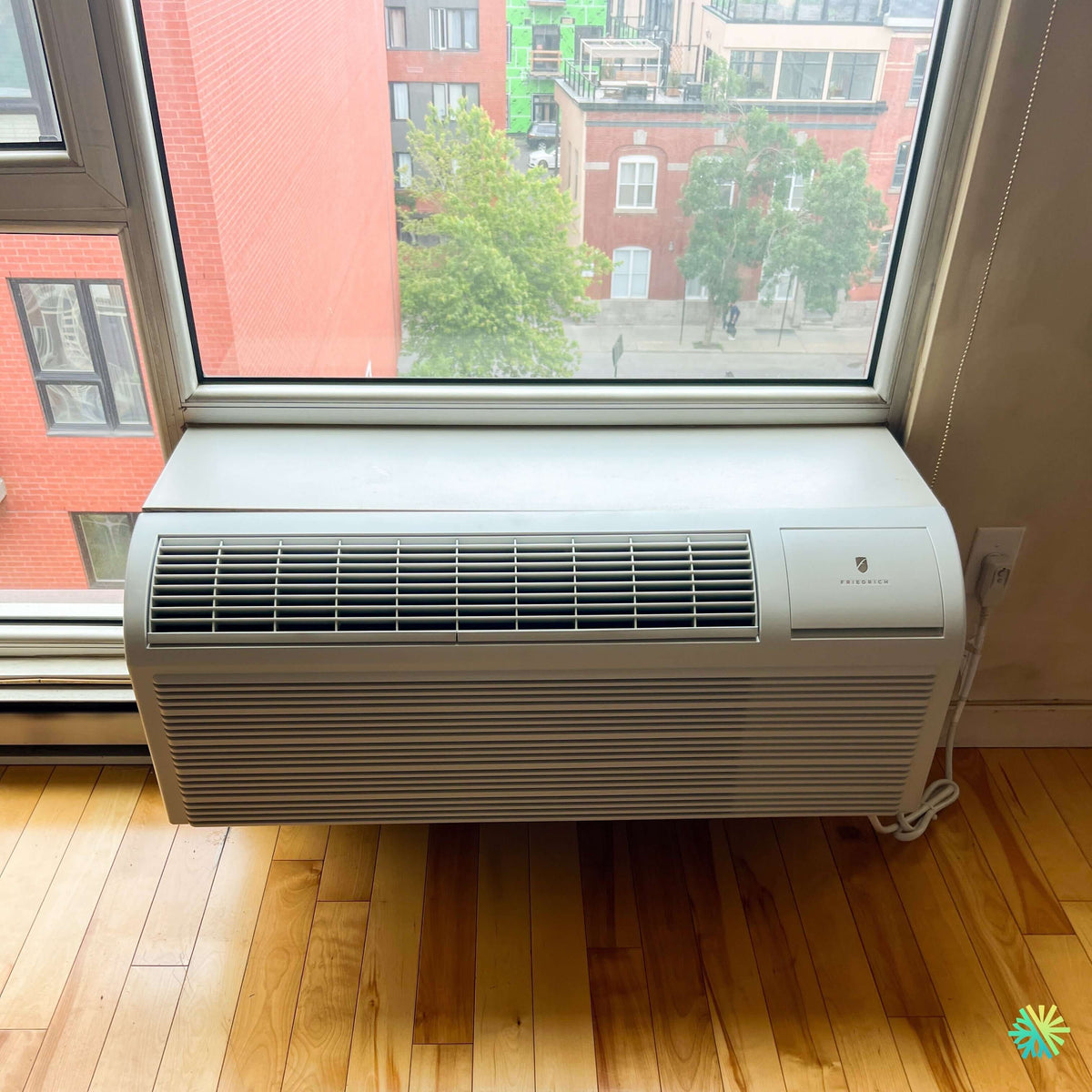
Professional installation of a Friedrich ZoneAire® Premier PTAC beneath a large window in Saint-Philippe, including inspection of the wall sleeve, sealing, drainage, and electrical connection.
- City
- Region
- Equipment
- Brand
- Challenges
- Published
The job on one screen
The article, chapter by chapter
A compact installation that had to accommodate the window, floor, and existing wall opening
This installation of a Friedrich ZoneAire® Premier PTAC in Saint-Philippe shows why replacing a self-contained terminal unit should not be treated as a simple appliance replacement. The new system must fit properly into the wall opening, drain its condensate water outdoors, receive an appropriate electrical supply, and maintain sufficient airflow despite the room’s architectural constraints.
In the photo of this AirGreen project, the Friedrich PTAC is positioned directly beneath a large window. The unit occupies almost the entire width of the available space without unnecessarily encroaching into the room. Its white front panel blends naturally with the window frame and walls, while the wood floor remains completely clear in front of the return-air grille.
The installation is located on an elevated level, as shown by the exterior view. This particularity makes preparation even more important. When a wall sleeve, exterior grille, or weather seal needs to be corrected, access to the façade may be more complex than at ground level. We must therefore inspect each component before permanently inserting the chassis into its opening.
Why the Friedrich ZoneAire® Premier was suitable for this configuration
The Friedrich ZoneAire® Premier belongs to the PTAC category, meaning self-contained terminal units installed through an exterior wall. This format makes it possible to cool a room without installing a separate condensing unit on a balcony, roof, or wall bracket.
Depending on the exact configuration selected, the ZoneAire® Premier series is available with electric heating or heat pump operation. The manufacturer offers capacities ranging from 7,000 to 15,000 BTU, making it possible to adapt the equipment to different types of rooms, apartments, offices, and commercial spaces. However, the exact capacity of the unit installed in Saint-Philippe must be confirmed using its complete model number, since it is not visible in the photo.
Friedrich also presents the ZoneAire® Premier as its quietest standard PTAC, particularly thanks to its QuietMaster® technology. This feature is especially relevant in a residential room where the unit is located near a bed, sofa, work table, or relaxation area.
A front designed for direct airflow
The photograph clearly distinguishes the two main air-circulation areas:
- the large lower grille, which primarily serves as the return for ambient air;
- the upper grille, which distributes conditioned air throughout the room.
This arrangement imposes a simple rule: no furniture, heavy curtains, decorative panels, or bulky objects should block the front. An obstruction in front of the lower grille reduces the volume of air passing through the coil. The system may then run longer, become noisier, and provide a less uniform temperature.
The upper discharge grille is located immediately beneath the windowsill. We therefore make sure that air can leave the unit without bouncing entirely off a surface that is too close. In this installation, the front remains clear, and the vertical clearance allows the air to spread throughout the room.
Protected controls on the right side
The control panel is integrated into the upper-right section of the PTAC. When closed, it protects the buttons and helps maintain a clean appearance. The manufacturer states that controls on the ZoneAire® Premier range can display the actual room temperature or the setpoint, depending on the selected setting. The system also includes a dehumidification function in cooling mode to improve comfort when the air is humid.
In a rental property or a building with multiple units, control management becomes especially important. Some property managers want to limit extreme temperatures, prevent constant mode changes, or use a wall thermostat. Compatibility with these options depends on the model number, installed accessories, and the unit's electronic configuration.
Sizing cannot be determined solely from the width of the PTAC
The exterior width of a PTAC does not determine its capacity. Several 7,000, 9,000, 12,000, or 15,000 BTU units may use a similar cabinet size while offering different performance.
To choose the right capacity, we analyze in particular:
- room area;
- ceiling height;
- window size and orientation;
- sun exposure;
- insulation quality;
- air infiltration;
- number of occupants;
- heat-generating equipment;
- the room’s residential or commercial use;
- actual heating needs.
In this PTAC installation in Saint-Philippe, the large glazed area above the unit is an important factor. During the summer, solar radiation can quickly increase the cooling load. In winter, a less efficient window can increase heat loss and create a colder area near the floor.
We therefore never recommend a capacity solely because it matches that of the old unit. The replaced equipment may have been improperly sized from the outset, or the building’s characteristics may have changed after window replacement, insulation was added, or the room’s use was modified.
Energy efficiency: compare the specific model, not just the brand
Friedrich states that current ZoneAire® Premier units can achieve an EER of up to 13.0 and, for certain heat-pump versions, a COP of up to 3.6. These maximum values do not automatically apply to all capacities or configurations. They must be verified in the technical specification sheet corresponding to the installed model number.
EER is used to compare cooling efficiency under specific test conditions. A higher rating generally means that the unit produces more cooling for a given electricity consumption.
COP applies to heat-pump heating. A value above 1 indicates that the system transfers more thermal energy than it directly consumes in the form of electricity. However, actual performance varies with outdoor temperature and operating conditions.
For a homeowner or property manager, the right approach is to compare:
- the exact model’s efficiency;
- acquisition cost;
- type of integrated heating;
- annual hours of use;
- parts availability;
- maintenance requirements;
- noise level;
- compatibility with the existing sleeve.
A thorough inspection of the wall sleeve
The sleeve is the metal structure installed in the wall. The PTAC chassis slides inside this enclosure. It supports part of the unit’s weight and helps manage water, outdoor air, and vibrations.
Before installing the Friedrich ZoneAire® Premier, we must examine several elements.
The interior dimensions
A difference of a few millimeters can prevent the chassis from fitting correctly or leave an unwanted gap around the unit. We check the width, height, depth, and mounting points.
The condition of the metal
A rusted or deformed sleeve can compromise the stability of the PTAC. Corrosion often appears near areas where water accumulates or where the exterior opening has been improperly sealed.
The slope toward the outside
The sleeve must have the slope specified by the manufacturer. A reverse slope can direct condensation water back into the room and damage the wood floor visible in the photo.
The outdoor grille
The grille must allow air intake and discharge without excessive recirculation. An incompatible or obstructed grille, or one installed too close to an exterior obstruction, can reduce system efficiency.
The perimeter seals
The space between the sleeve and the wall structure must be properly insulated and sealed. The interior finish alone is not enough to prevent infiltration if the technical seal behind it is incomplete.
Protecting the floor from condensation
The wood floor is one of the most visually prominent features of this room. It also underscores the importance of properly managing condensation.
In cooling mode, moisture removed from the air turns into water on the indoor coil. This water must flow into the designated drain pan and then be directed according to the manufacturer's drainage method.
Even a minor leak can cause:
- swelling of the wooden planks;
- discoloration of the varnish;
- marks near the wall;
- damage to the baseboard;
- a musty odor;
- damage to the structure beneath the unit.
During commissioning, we do more than verify that the compressor starts. We also observe the water behavior, the chassis slope, and the absence of moisture traces beneath the front panel.
A power supply that matches the model
The photo shows a wall outlet on the right side, along with the PTAC power cord. However, the exact shape of the plug and the circuit specifications are not visible enough to confirm the voltage or amperage.
Depending on the model, a PTAC may require specific electrical power and protection. Before connecting it, we verify:
- the voltage indicated on the nameplate;
- the minimum circuit amperage;
- the maximum permitted protection;
- the type of outlet;
- the grounding;
- the condition of the cord;
- the circuit breaker compatibility;
- the absence of signs of overheating.
We also ensure that the cord is neither pinched behind the unit nor placed under permanent mechanical tension. The excess length must be arranged neatly without interfering with removal of the front panel or filter maintenance.
Using an improvised adapter or modifying a plug is never an acceptable solution. The connection must comply with the manufacturer's requirements and the electrical standards applicable to the building.
What this installation in Saint-Philippe teaches homeowners and property managers
A PTAC effectively replaces an existing unit when the entire opening is compatible
The main advantage of replacing a PTAC is the possibility of reusing an opening that already passes through the wall. This can limit work on the façade and avoid adding a separate outdoor unit.
However, this apparent simplicity should not obscure the essential checks. A new PTAC may have the correct width without being compatible with the old sleeve. The depth, seals, exterior grille, drainage, and connections must also match.
At AirGreen, we ideally request the following information before preparing the replacement:
- a full photo of the unit;
- a clear photo of the rating plate;
- the model number;
- a photo of the plug and outlet;
- the opening dimensions;
- a photo of the exterior grille;
- a description of the problem encountered;
- the approximate room area.
This information reduces the risk of ordering an unsuitable unit and helps better anticipate the adaptations required.
Common mistakes to avoid with a PTAC
Block the return air with furniture
A sofa or bed placed in front of the large lower grille restricts airflow. Clearance must be maintained in front of the unit.
Enclose the unit in an enclosure that is too tight
A decorative cover can improve the appearance, but it must never block the grilles, prevent the panel from opening, or complicate chassis removal.
Ignore the condition of the sleeve
An old sleeve may have rust, an inadequate slope, or deteriorated seals. Installing a new unit without correcting these defects simply shifts the problem elsewhere.
Assume that the existing outlet is suitable
The presence of a nearby outlet does not confirm that it has the correct voltage, configuration, or electrical protection.
Choose the largest available capacity
An oversized unit may cool the room quickly, then shut off before sufficiently dehumidifying it. The result may be a low temperature accompanied by uncomfortable humidity.
Neglecting the filter
A clogged filter reduces airflow and increases the load on the fan. In a dusty environment or one occupied daily, it should be checked regularly.
Commissioning completed after installation
A professional installation must end with a complete sequence of checks.
We check, in particular:
- the stability of the PTAC in its sleeve;
- front panel attachment;
- operation of the controls;
- fan startup;
- cool air production;
- heating, when the model is equipped with it;
- supply air temperature;
- vibrations;
- contact noises;
- condensate drainage;
- the condition of the electrical connection;
- unrestricted airflow;
- removing and reinstalling the filter.
We then explain to the owner or occupant how to use the available modes and access the filter without damaging the front panel.
Recommended maintenance for the Friedrich ZoneAire® Premier
A PTAC operates in a compact space where dust can quickly accumulate on the filter, fan, and coils. Regular maintenance helps maintain airflow and limit odors.
The occupant can perform a few simple checks:
- inspect the filter monthly during periods of intensive use;
- clean or replace it according to the manufacturer’s instructions;
- keep the grilles clear;
- watch for any water near the floor;
- report any unusual noise or odor promptly;
- avoid placing objects on top of the unit.
Professional HVAC maintenance may include thorough cleaning of the indoor coil, fan, condensate pan, water passages, and outdoor section. We also inspect the connections, sleeve, and seals around the opening.
In a building equipped with several PTAC units, a uniform maintenance schedule simplifies management. It allows the units to be cleaned before the cooling season and helps identify those whose performance is beginning to decline.
Subsidies: eligibility must not be announced without the exact number
The name Friedrich ZoneAire® Premier is not enough to confirm financial assistance. For the LogisVert residential program, Hydro-Québec requires searching for the equipment using its model number or AHRI number. Heat pumps installed since November 26, 2025, must also be ENERGY STAR® certified to meet the criterion announced by Hydro-Québec.
LogisVert’s Multifamily Building Bonus specifically targets ENERGY STAR® – Cold Climate-certified ductless mini-split heat pumps in buildings meeting several criteria. A Friedrich PTAC should therefore not automatically be presented as eligible for this bonus intended for ductless systems.
For this installation in Saint-Philippe, potential eligibility must be verified based on:
- the complete model number;
- the AHRI number, if one exists for the combination;
- the exact type of unit;
- the applicable certification;
- the purchase and installation date;
- whether the building is residential or commercial;
- the rules of the program in effect.
We prefer to confirm these details before including a subsidy in the final price calculation.
PTAC or ductless mini-split heat pump in Saint-Philippe
A PTAC is particularly practical when the building already has a compatible wall opening and each room must be controlled independently. It avoids adding a separate condenser and maintains a compact installation.
A ductless mini-split heat pump may be preferable when the owner wants a more discreet indoor unit, specific winter performance, or the ability to serve multiple zones.
The choice depends on several factors:
- condominium rules;
- the building facade;
- outdoor access;
- the presence of a balcony;
- heating needs;
- the available indoor space;
- the condition of the existing opening;
- the desired noise level;
- the budget;
- the available financial assistance programs.
Our role is to compare solutions based on the actual building rather than automatically recommending the same type of unit for every project.
A clean, accessible installation suited to the room
The visible result in Saint-Philippe is simple and functional. The Friedrich ZoneAire® Premier is centered beneath the window, its front remains accessible, and the main grilles are not obstructed. The unit makes efficient use of the available space without requiring a high-mounted indoor unit or occupying a significant portion of the wall.
For AirGreen, the success of this type of HVAC installation depends on details that often remain invisible in a photo: sleeve compatibility, slope, sealing, electrical supply, drainage, and commissioning.
We carry out installations, replacements, and PTAC maintenance in Saint-Philippe, Montreal, Laval, Longueuil, on the North Shore, and on the South Shore. Every project begins with the precise identification of the unit and an analysis of the existing opening to achieve a durable, safe, and easy-to-maintain result.
How the job unfolds
The main steps of this kind of job at AirGreen. Every house has its quirks: the estimate brings them out.
We look at the outside wall, the window, the space in the room and the power supply.
The unit, the sleeve and the price, in writing.
Installed following the manufacturer's instructions, so water drains to the outside.
A dedicated connection matched to the unit's voltage and amperage.
The unit slides into the sleeve; the outdoor grille stays clear.
Start-up and a check of heating and cooling.
Controls, filter, what to keep clear.
- The on-site estimateWe look at the outside wall, the window, the space in the room and the power supply.
- The quoteThe unit, the sleeve and the price, in writing.
- The wall sleeveInstalled following the manufacturer's instructions, so water drains to the outside.
- The electrical workA dedicated connection matched to the unit's voltage and amperage.
- Unit and grilleThe unit slides into the sleeve; the outdoor grille stays clear.
- TestsStart-up and a check of heating and cooling.
- The walkthroughControls, filter, what to keep clear.
What we check on a job like this one
Each number is a point we check on site. Switch between summer and winter to watch air and heat move.
Generic illustration of this type of installation, not a survey of this job site. Tap a number.
All-in-one: it heats and cools from inside the room, with no separate outdoor unit.
A box that goes through the wall and holds the unit. It is installed following the manufacturer's instructions so water drains to the outside.
This is where the unit exchanges heat with the outdoor air. It must stay clear.
A dedicated connection matched to the unit's voltage and amperage.
On the unit or through a wall thermostat, depending on the model.
Under a window, the unit must leave curtains, sill and opening free, and let air move through the room.
Is your home ready?
Check what applies at your place. A "no" is not a refusal: it is what we sort out during the estimate.
Good habits, once the unit is in place
Six simple habits that keep the unit going. Your list stays on this device.
What to do, season by season
Three habits per season for this unit. They take a few minutes and prevent many calls.
- Clean the filter.
- Clear the outdoor grille.
- Test cooling.
- Clean the filter more often.
- Check water drainage.
- Let air move in front of the unit.
- Test heating.
- Check the seal around the sleeve.
- Book maintenance.
- Keep the outdoor grille free of snow.
- Do not cover the unit with a curtain.
- Note any unusual noise.
The right pages, at the right time
Four statements: true or false?
It all comes down to details you have just seen.
1. A PTAC needs a separate outdoor unit.
It is an all-in-one unit that goes through the wall.
2. The outdoor grille must stay clear.
That is where the unit exchanges heat with the outdoor air.
3. Any electrical outlet will do.
It needs a connection matched to its voltage and amperage.
4. A PTAC can heat and cool a room.
That is its job: all-in-one, under the window, through the wall.
0 / 4 right answers
What people ask us about this kind of work
What is a PTAC?
Where does it go?
What does it need electrically?
Can the existing sleeve be reused?
Does a PTAC cool the whole house?
Does AirGreen hold the required licences?
Is the estimate free?
No question matches. Write to us: we answer.
More jobs to see, near you
By town, by equipment or by region: browse more than 4,700 published projects.
Each dot: a town where AirGreen has published projects. The glowing dot: this job.
An on-site estimate, the right capacity, the right equipment.
The on-site estimate is free and the quote follows within 24 hours.
Text and photo: a real AirGreen Climatisation & Chauffage job. The diagrams are generic illustrations of the type of installation, not a survey of this job site. Sources of the added figures: airgreen.ca product pages (NEEP / AHRI performance), Hydro-Québec (Heat pumps page, LogisVert, read on 13 October 2026), Régie de l’énergie (rate D as of 1 April 2026).