
Installation of a MIDEA EVOX G3 central heat pump in Dorval, on the Island of Montreal
In Dorval, AirGreen installs a MIDEA EVOX G3 central heat pump on wall brackets, near a hedge and a basement window. Heating down to -30 °C, R-454B, inverter technology, and HVAC installation explained in detail.
In summer, the outdoor unit rejects the house's heat outside.
Generic illustration of this type of installation, not a survey of this job site. Tap a number.
It captures or rejects heat outside. It sits on a level base, above the snow, with free space all around.
The insulated refrigerant lines enter the house through a sealed opening and run to the indoor coil.
A shut-off switch near the outdoor unit isolates it safely for service.
Sitting on the indoor module, it moves heat between the house air and the refrigerant.
Electric furnace or air handler: its fan pushes air through the ducts. The electric backup takes over in extreme cold.
Supply ducts bring air to the rooms; returns bring it back to the unit. Their condition matters as much as the unit's.
It protects the coil and the fan. A dirty filter cuts airflow, so it gets checked regularly.
It runs the heat pump and the backup heat. It must be compatible with the installed system.
A carefully integrated central installation in a brick house in Dorval
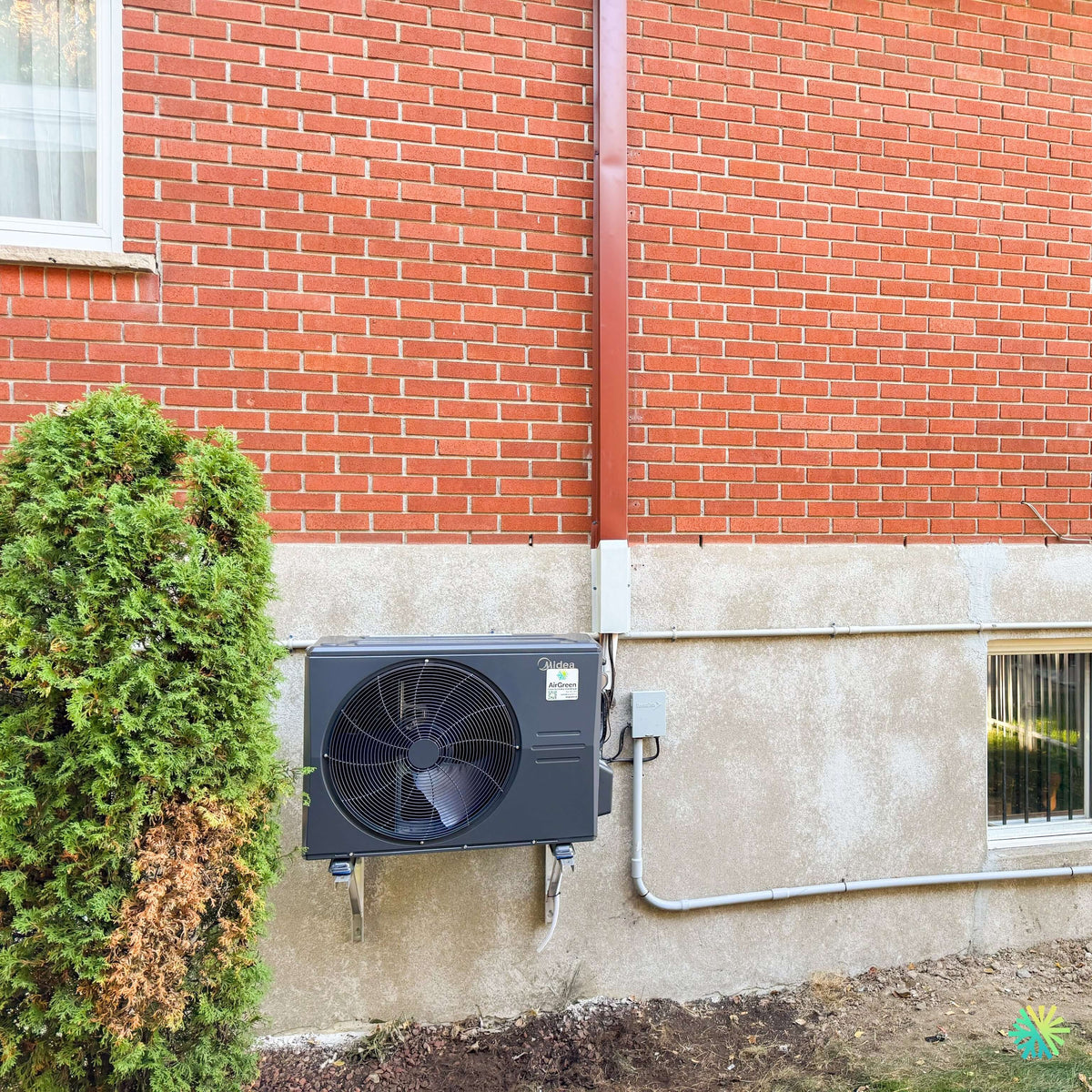
In Dorval, we completed this MIDEA EVOX G3 central heat pump installation on a property where the outdoor space had to be used intelligently. The project photo shows a situation that is highly representative of what we encounter in several residential areas of West Montreal: brick wall, exposed foundation, mature vegetation, basement window, downspout, existing electrical supply, and limited side space.
Rather than simply placing the outdoor unit on the ground, we installed the heat pump on wall-mounted metal brackets, at a sufficient height to maintain substantial clearance beneath the appliance. This decision is particularly relevant for a central heat pump used for heating during Quebec winters.
The MIDEA outdoor unit is installed compactly against the foundation, while its large front fan remains unobstructed. On the right, the electrical disconnect remains easily accessible. On the left, there is a mature hedge, which requires planning for its future maintenance to prevent it from gradually reducing airflow around the heat exchanger.
This is exactly the type of project where our work goes far beyond simply connecting a machine: we must consider winter operation, drainage, future servicing, the indoor ductwork, and the integration of the equipment into the building.
Why install a heat pump on wall brackets in Dorval
The visible height beneath the appliance is not an aesthetic choice.
In heating mode, a central heat pump extracts heat from the outdoor air. When temperatures drop, frost can form on the heat exchanger. The system must then run defrost cycles, which produce water.
If the outdoor unit is placed too close to the ground, this water can freeze beneath the appliance and gradually form an accumulation of ice. Heavy snowfall can also reduce the necessary clearances around the heat exchanger.
By placing the MIDEA EVOX G3 on wall brackets, we gain several practical benefits:
- more space beneath the unit for defrost water;
- better clearance in the event of snow accumulation;
- easier access for HVAC maintenance;
- greater distance from soil, leaves, and other debris;
- cleaner installation against the foundation.
In a climate like Dorval and Greater Montreal, this preparation is important from the outset.
A well-cleared front discharge
The photo clearly shows the large characteristic front fan of this family of units.
Midea's documentation describes the EVOX G3 as using a horizontal-discharge design, with a vertical heat exchanger intended to promote more uniform airflow across the heat exchanger's surface.
This relatively slim design is interesting for a property where side space is limited. The unit can remain close to the wall without extending excessively into the yard.
However, sufficient clearance must be maintained in front of the fan.
On this installation in Dorval, the front discharge remains unobstructed, with no decorative screen or wall immediately in front of the unit.
The surrounding vegetation must be maintained over time
A very important detail appears to the left of the heat pump: a mature hedge.
On the day of installation, the area is sufficiently clear. But a hedge continues to grow.
If the branches begin to reach the side of the unit, they can reduce airflow, deposit more debris on the heat exchanger, and make access more difficult for a technician.
We therefore recommend regularly trimming the vegetation around a heat pump.
This advice is simple, but it can make a real difference to performance and ease of maintenance several years after installation.
The electrical disconnect remains visible and accessible
To the right of the unit, we can also see the outdoor electrical disconnect.
Its location allows for an easily accessible local disconnect during maintenance or diagnostics.
The electrical conduit follows the foundation neatly and remains clearly identifiable. In a professional HVAC installation, we want to avoid exposed wires, difficult-to-access boxes, or components hidden behind vegetation.
A heat pump designed for very low-temperature heating
The MIDEA EVOX G3 Extreme Heat is designed to operate in severe winter conditions.
The manufacturer's documentation indicates continuous operation down to -30 °C. It also mentions up to 100% heating capacity at -25 °C, with a COP of up to 1.9 under the reference conditions presented.
For an installation in Dorval, these characteristics are much more important than a simple nominal capacity stated in BTUs.
A Quebec central heat pump must be able to contribute to heating when it is truly cold.
Midea also explains that, under extreme conditions, the compressor uses an intermediate-temperature vapor injection to increase the amount of compressed refrigerant and support heating performance.
Operation at -30 °C does not mean that no supplemental heating will ever be necessary
This distinction is important.
The minimum operating temperature of a heat pump is not the same as the heating capacity required to heat a given home.
A newer, well-insulated and tightly sealed residence may have relatively low heat losses.
An older, larger or highly glazed property may require more capacity when the outdoor temperature drops sharply.
We therefore size the system according to the actual building.
The EVOX G3 range includes several capacities
The name EVOX G3 refers to a complete range, not a single capacity.
Midea documentation presents configurations ranging from approximately 18,000 to 54,000 BTU/h in cooling, with different efficiencies depending on the combination used.
For the range, the manufacturer indicates performance of up to:
- 19 SEER2;
- 12.5 EER2;
- 10.8 HSPF2;
- a COP of up to 2.14 at 5 °F, or approximately -15 °C.
The technical table lists, among others, combinations of 18,000, 24,000, 30,000, 36,000, 48,000 and 54,000 BTU/h.
The photograph does not show the model number of the unit installed in Dorval clearly enough. We therefore cannot honestly assign an exact tonnage based on the image alone.
To confirm the precise performance, you must always check the outdoor model and the indoor unit model.
Why we do not automatically choose the same capacity as the old system
When replacing a central system, it can be tempting to simply copy the tonnage of the old unit.
We prefer to verify the actual requirements.
We consider, among other factors:
- floor area;
- insulation;
- the windows;
- air infiltration;
- the ceiling height;
- the duct configuration;
- the return-air capacity;
- the available auxiliary heating;
- the available electrical capacity.
A larger heat pump does not automatically mean greater comfort.
The system must match the building and the distribution network.
What happens inside is just as important as the MIDEA EVOX G3 visible on the outside
An air handler designed for renovations
The EVOX G3 has several features designed to facilitate the replacement of existing central systems.
Midea documentation indicates that the indoor unit can operate at 115 V or 208/230 V, depending on the configuration, with adaptation to the required voltage.
The manufacturer also indicates cabinet widths ranging from approximately 14.5 to 21.5 inches, to better match the common dimensions of several older furnaces.
In existing homes in Dorval, Pointe-Claire, Lachine, Montréal-Ouest, or Saint-Laurent, this type of compatibility can simplify a replacement.
The existing mechanical space is often already constrained by ducts, plumbing, the electrical panel, or finished walls.
A modular indoor design
Midea also presents a modular design allowing six installation configurations for the indoor unit.
The system can be installed in particular:
- vertically upward;
- vertically downward;
- horizontally to the left;
- horizontally to the right;
- in certain “low-boy” configurations when height is limited.
This modularity can be useful in basements where space is tight.
Airflow in the ducts remains fundamental
An excellent outdoor unit cannot fully compensate for an inadequate duct system.
Midea integrates its Computational Constant Airflow 2.0 technology into this range.
According to the documentation, the fan can adapt its operation to the conditions of the duct system, up to 1.2 in. of water column static pressure in the examples presented, with up to 60 airflow adjustment levels.
This technology is useful in renovations where the ducts are not always perfectly uniform.
But it does not replace good design.
An undersized return air system remains a problem
If the return is too small, a duct is crushed, or a filter is too restrictive, the fan will have to work harder.
During commissioning, we therefore look at the system as a whole.
Our goal is not simply to make the heat pump run, but to achieve consistent airflow in every room.
MERV 13 filtration available
Midea documentation also indicates compatibility with 1-, 2-, or 4-inch MERV 13 filters in the filtration module provided for this purpose.
This type of filter can capture more dust, pollen, and particles.
However, the filter surface area must be suited to the system's airflow.
A high-performance filter that is too small can cause a significant pressure drop.
Auxiliary heating up to 25 kW
The EVOX G3 can also be paired with a three-stage electric auxiliary heater, up to 25 kW depending on the application.
This supplemental heat may engage when the home's heat loss exceeds the heat pump's instantaneous capacity.
However, we want to prevent it from activating too early.
A properly tuned strategy allows the heat pump to provide most of the heating when conditions permit.
485 communication, 24 V thermostat, and wireless options
The EVOX G3 documentation mentions different control options, including:
- communication 485;
- certain 24 V thermostats;
- wireless communication options between certain Midea components.
The manufacturer also presents its communicating thermostat and the SmartHome app, with features such as schedule programming, some consumption data, and diagnostic tools.
This flexibility is useful when replacing an existing system in a finished home where running new wires is difficult.
R-454B refrigerant
The MIDEA EVOX G3 uses R-454B refrigerant.
Midea indicates a global warming potential of 466 for this A2L refrigerant.
This detail directly affects how we work on the refrigeration system.
Connections, leak testing, evacuation, and commissioning must be carried out using appropriate practices and equipment.
The visible drainage beneath the outdoor unit
In the Dorval photo, a small pipe is visible beneath the unit.
This detail is a reminder that water management is an integral part of the installation.
A heat pump used in winter can produce a significant amount of water during defrost cycles.
We want to prevent this water from creating an ice problem against the foundation, near a walkway, or directly beneath the supports.
A nearby basement window
The wider view of the installation also shows a basement window on the right.
When choosing the location, we need to take windows, ventilation outlets, and other openings into account.
A heat pump should not simply be placed in the spot closest to the mechanical room.
We need to consider the entire facade.
The mistakes we avoid on a project like this
Install the unit directly on the ground
This increases the risk of snow and ice accumulating around the unit.
Allowing the hedge to grow against the heat exchanger
Vegetation can reduce airflow and complicate maintenance.
Choosing capacity based on area alone
Two homes of the same size can have very different heat losses.
Neglecting the static pressure of the ductwork
A central heat pump depends on the air distribution network.
Automatically attributing the product line's best performance to all models
Values of up to 19 SEER2 and 10.8 HSPF2 are product-line maximums. Actual performance depends on the exact combination.
What about rebates?
Midea documentation indicates that the product line achieves high efficiency levels and includes models exceeding certain ENERGY STAR specifications in the North American context presented by the manufacturer.
However, the documentation provided does not, on its own, confirm the precise eligibility of this Dorval installation for a specific Quebec program.
To confirm financial assistance, the model number of the outdoor unit, that of the indoor unit, and the corresponding certified combination must be verified.
At AirGreen, we prefer to confirm this information rather than announce an amount based solely on the EVOX G3 commercial name.
An installation adapted to the reality of a Dorval home
This MIDEA EVOX G3 central heat pump installation in Dorval clearly demonstrates our approach.
We installed the outdoor unit at a height suited to winter conditions while preserving clearance in front of the fan. The electrical disconnect remains accessible. The nearby hedge can be maintained without blocking the equipment. The drainage and connections are grouped near the unit.
Inside, the air handler, ductwork, filtration, auxiliary heating, and thermostat must then function as a single system.
The EVOX G3 offers several interesting features for a central installation in Quebec: advertised operation down to -30 °C, inverter technology, R-454B refrigerant, modular indoor unit, advanced airflow management, and several control options.
At AirGreen, our work consists of adapting this platform to the actual property.
This is the same approach we apply to our central heat pump projects in Dorval, Montreal, Laval, Longueuil, on the South Shore and on the North Shore: proper sizing, thoughtful placement, clean installation, and attention to how the system operates under the real conditions of Quebec's climate.
How it goes, from the first call to the end
The main steps of this kind of job at AirGreen. Every house has its quirks: the estimate brings them out.
We look at the ducts, the current indoor module, the electrical panel and the planned spot for the outdoor unit.
The equipment combination, capacity and price, in writing. We check whether the combination qualifies for assistance programs.
Access protected, old unit disconnected and removed when it is being replaced.
Electric furnace or air handler, with its coil, connected to the supply and return ducts.
On a level base, raised above the snow, with free space all around.
Insulated, they enter through a sealed opening and run to the indoor coil.
Dedicated circuits, accessible disconnect, a thermostat that works with the heat pump and the backup heat.
Leak test, vacuum, start-up, airflow check and a test of both modes.
Filter, thermostat, backup heat in extreme cold: what to know before winter.
- The on-site estimateWe look at the ducts, the current indoor module, the electrical panel and the planned spot for the outdoor unit.
- The quoteThe equipment combination, capacity and price, in writing. We check whether the combination qualifies for assistance programs.
- Getting readyAccess protected, old unit disconnected and removed when it is being replaced.
- The indoor moduleElectric furnace or air handler, with its coil, connected to the supply and return ducts.
- The outdoor unitOn a level base, raised above the snow, with free space all around.
- The refrigerant linesInsulated, they enter through a sealed opening and run to the indoor coil.
- Electrical and thermostatDedicated circuits, accessible disconnect, a thermostat that works with the heat pump and the backup heat.
- Tests and start-upLeak test, vacuum, start-up, airflow check and a test of both modes.
- The walkthroughFilter, thermostat, backup heat in extreme cold: what to know before winter.
What the unit delivers when it is cold
The range as published on airgreen.ca: pick a size to see its capacity in deep cold.
| Size | Heating at −8 °C | Heating at −15 °C | Coldest certified point | COP at −15 °C | SEER | HSPF | Indicative LogisVert aid |
|---|---|---|---|---|---|---|---|
| Midea EVOX G3 · 1.5 tons | 14,700 | 18,600 | −30 °C: 11,800 | 2.12 | 19.0 | 10.1 | $1,764 |
| Midea EVOX G3 · 2 tons | 20,800 | 20,600 | −30 °C: 12,100 | 2.14 | 18.6 | 10.0 | $2,496 |
| Midea EVOX G3 · 2.5 tons | 24,000 | 33,200 | −30 °C: 17,900 | 1.97 | 17.2 | 10.8 | $2,880 |
| Midea EVOX G3 · 3 tons | 33,000 | 37,400 | −30 °C: 27,600 | 1.9 | 18.0 | 10.0 | $3,960 |
| Midea EVOX G3 · 4 tons | 39,500 | 48,000 | −30 °C: 27,200 | 2.0 | 17.5 | 9.5 | $4,740 |
| Midea EVOX G3 · 5 tons | 45,000 | 54,000 | −30 °C: 37,300 | 1.9 | 17.5 | 9.5 | $5,400 |
Data read live from the airgreen.ca page of each size (NEEP / AHRI certified performance). When the title names the installed size, it is highlighted; otherwise the whole range is shown. The aid shown is today’s, using Hydro-Québec’s rule ($120 per 1,000 BTU/h at −8 °C); amounts quoted in the article date from its publication. Only Hydro-Québec confirms the assistance granted.
And at your place?
Two quick checks with real numbers: what heat costs, and what your current heaters add up to in BTU/h.
Baseboards and electric furnaces turn 1 kWh of electricity into 1 kWh of heat. A heat pump delivers more: that is its COP. At Hydro-Québec’s rate D (11.142¢/kWh above 40 kWh a day, since 1 April 2026):
Hydro-Québec: a heat pump can be up to three times more efficient than baseboards for heating in the colder months.
Estimate per kWh of heat, at the chosen temperature, using the certified COP from the product page. Taxes, access charge and backup heat not included.
Conversion: 1 W = 3.412 BTU/h. An indication, not a load calculation: baseboards and furnaces are often stronger than the real need, and they can stay as backup. AirGreen confirms the capacity on site.
What to do, season by season
Three habits per season for this unit. They take a few minutes and prevent many calls.
- Check the indoor module's filter.
- Clear winter debris from the outdoor unit.
- Test cooling before the heat arrives.
- Check the filter more often in peak season.
- Keep registers and returns clear.
- Watch condensate drainage near the coil.
- Change or clean the filter.
- Test heating and backup heat before the cold.
- Book periodic maintenance.
- Clear snow around the outdoor unit.
- Store nothing in front of the indoor module.
- Note any unusual noise or smell and call us.
Which type of equipment for your project?
Pick what looks like your need.
Four mistakes we do not make
Flip each card to see what we do instead.
What people ask us about this kind of work
Can I keep my current ducts?
What happens in extreme cold?
Furnace, air handler, ducted: what is the difference?
Are there grants?
Do I need a permit?
How much can I save?
How is the LogisVert assistance calculated?
Will my current thermostat work?
Central or wall units: which one?
Does AirGreen hold the required licences?
Is the estimate free?
No question matches. Write to us: we answer.
Useful pages for what comes next
More jobs to see, near you
By town, by equipment or by region: browse more than 4,700 published projects.
Each dot: a town where AirGreen has published projects. The glowing dot: this job.
Tell us about your house. We come and see it for free.
The on-site estimate is free and the quote follows within 24 hours.
Text and photo: a real AirGreen Climatisation & Chauffage job. The diagrams are generic illustrations of the type of installation, not a survey of this job site. Sources of the added figures: airgreen.ca product pages (NEEP / AHRI performance), Hydro-Québec (Heat pumps page, LogisVert, read on 13 October 2026), Régie de l’énergie (rate D as of 1 April 2026).