
Installation of a GENERAL ELECTRIC Zoneline PTAC beneath a large window in Saint-Roch-de-Richelieu
AirGreen installs a GENERAL ELECTRIC Zoneline PTAC beneath a large window in Saint-Roch-de-Richelieu, checking the sleeve, airflow, airtightness, and the nearby electric baseboard heater.
Generic illustration of this type of installation, not a survey of this job site. Tap a number.
All-in-one: it heats and cools from inside the room, with no separate outdoor unit.
A box that goes through the wall and holds the unit. It is installed following the manufacturer's instructions so water drains to the outside.
This is where the unit exchanges heat with the outdoor air. It must stay clear.
A dedicated connection matched to the unit's voltage and amperage.
On the unit or through a wall thermostat, depending on the model.
Under a window, the unit must leave curtains, sill and opening free, and let air move through the room.
A carefully integrated installation in an existing wall opening, with an electric baseboard and limited space
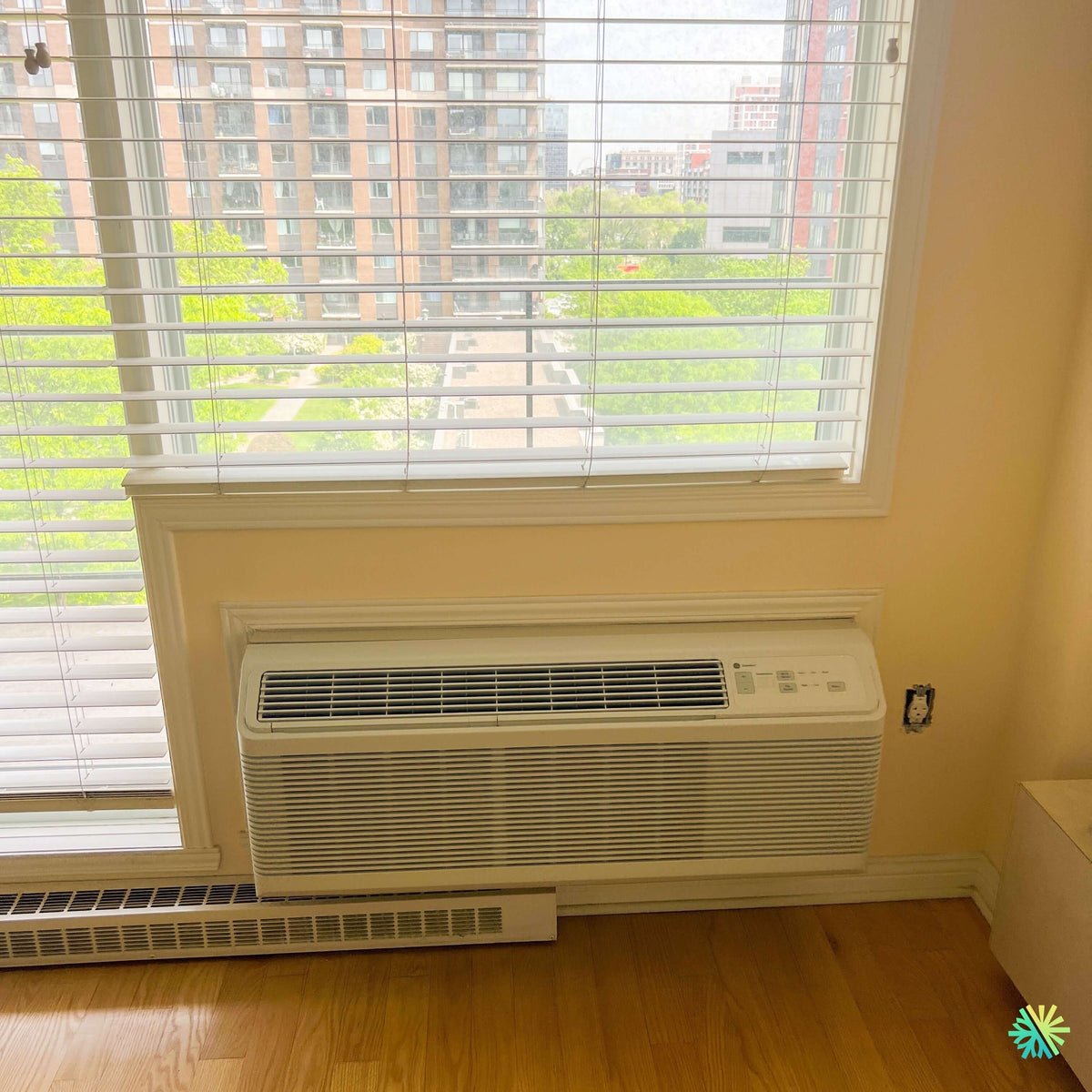
At Saint-Roch-de-Richelieu, we installed a GENERAL ELECTRIC Zoneline PTAC in a wall opening built beneath a large window. This configuration required more than a simple appliance replacement: the new system had to be integrated with the existing finish, the clearances required for airflow had to be maintained, and the electric baseboard installed immediately beneath the PTAC had to be taken into account.
The result visible in the photo shows a fully assembled appliance, equipped with its front panel and installed inside a painted wooden frame. The GENERAL ELECTRIC Zoneline fits precisely into the available space without encroaching on the window, horizontal blind, or room’s circulation area.
This type of installation is particularly suitable for apartments, condominiums, residences, hotel rooms, and multi-unit buildings that do not have a ductwork network. The PTAC combines the components required for cooling and, depending on the model’s exact configuration, heating in a single chassis.
Why the PTAC was suitable for this room
The existing wall opening was a logical location for a self-contained unit. Unlike a wall-mounted heat pump, a PTAC does not require the installation of a separate outdoor unit connected by refrigerant lines. The back of the appliance communicates directly with the outdoors through a sleeve passing through the wall.
This design retains several advantages:
- no ductwork network to build;
- no exposed refrigerant piping on the interior walls;
- independent temperature control in the room;
- front access to the filters and main components;
- efficient use of an existing wall opening;
- simplified replacement when the sleeve is compatible.
In this installation in Saint-Roch-de-Richelieu, positioning the unit beneath the window also avoided occupying an entire wall with a wall-mounted unit. The appliance remains compact and accessible while preserving the room’s overall layout.
A front panel that must remain completely unobstructed
The GENERAL ELECTRIC Zoneline PTAC draws room air in through the lower front section and redistributes it through the upper grille. This configuration requires the front panel to remain free of any obstruction.
The photo clearly illustrates the importance of this aspect: the piece of furniture on the right does not block the unit, and the blind stops above the air outlet grille. We also verified that the blind slats did not hang directly in front of the air outlet.
A curtain, blanket, sofa, or piece of furniture placed too close to the PTAC could:
- reduce airflow;
- cause uneven temperature distribution;
- increase operating time;
- promote filter clogging;
- create additional noise;
- reduce the unit’s performance.
We therefore recommend keeping the front panel and upper grille unobstructed at all times. Good airflow is essential for both cooling and heating.
The wooden frame: an aesthetic detail that must also remain functional
The unit is installed in a wooden frame that matches the window trim. This finish helps integrate the PTAC into the interior architecture, but it must never constrict the chassis or prevent its future removal.
When carrying out an HVAC installation, we must consider the maintenance that will be performed several years later. The technician must be able to:
- remove the front panel;
- access the filter;
- inspect the indoor coil;
- access the electrical compartment;
- remove the chassis from the sleeve if major repairs are required;
- check the drainage and watertightness.
Trim installed too close to the cover can make these operations difficult. It can also transmit chassis vibrations to the wall structure. We therefore verified that the finish maintained the necessary clearances without leaving an excessive gap around the unit.
The proximity of the electric baseboard heater
A baseboard heater is visible directly beneath the GENERAL ELECTRIC Zoneline. Its presence was an important feature of this project.
The heat produced by a baseboard heater naturally rises. If it operates at the same time as the PTAC, this warm air can quickly reach the unit’s temperature sensor. The system could then detect a higher temperature than the one felt elsewhere in the room.
This interaction must be taken into account, especially when the two units are controlled independently. We therefore considered:
- the clearance between the baseboard heater and the front panel;
- air circulation around the PTAC;
- the effect of rising heat on regulation;
- access to both units;
- the coordination of the heating modes;
- the operating instructions intended for the occupant.
In many homes in Montréal, Laval, Longueuil, the North Shore, and the South Shore, we encounter PTACs installed near electric baseboard heaters. The presence of two heating sources is not automatically problematic, but their use must be understood and adapted to the room’s configuration.
The essential role of the wall sleeve
The wall sleeve is the structure that passes through the wall and houses the PTAC chassis. It directly affects stability, drainage, sealing, and outdoor-air circulation.
Before commissioning the GENERAL ELECTRIC Zoneline, we paid particular attention to the following elements:
- The dimensional compatibility of the sleeve with the unit.
- The condition of the metal structure, particularly the absence of significant deformation.
- The level and slope specified by the manufacturer.
- The quality of the seals around the wall opening.
- The compatibility of the outdoor grille with the required airflow.
- The stability of the chassis once inserted.
- The ability to drain condensate properly.
A PTAC must not be installed in a sleeve selected solely because its dimensions appear to be close. An improperly fitted outdoor grille can cause hot air discharged by the condenser to recirculate. The unit then operates under unfavorable conditions, which can increase noise, electricity consumption, and refrigerant-circuit pressure.
Preventing air and water infiltration
Since the opening passes through the building envelope, sealing is a fundamental part of the work. A poorly sealed gap around the sleeve can allow cold air, moisture, wind-driven rain, or insects to enter.
Conversely, sealing carried out without taking drainage into account can trap water in a location where it should be drained.
Our approach is to clearly distinguish between:
- the seal between the sleeve and the building;
- the openings required for the PTAC to operate;
- the drainage openings provided by GENERAL ELECTRIC;
- the ventilation of the outdoor section;
- areas that must not be obstructed by insulation or sealant.
This distinction is particularly important in Quebec’s climate, where an installation must withstand fall rains, freeze-thaw cycles, and winter temperatures.
Commissioning, performance, and maintenance of the GENERAL ELECTRIC Zoneline
Simple controls for everyday use
The control panel is located in the upper-right section of the front panel. It allows the occupant to select the temperature, operating mode, and available ventilation settings.
Direct access to the controls is an advantage in dwellings where each room must be adjusted separately. However, the exact heating function depends on the complete model number. Depending on the Zoneline version, the unit may be equipped with a heat pump, an electric resistance heater, or a combination of both.
The nameplate is therefore essential for confirming:
- nominal capacity in BTU/h;
- electrical voltage;
- maximum amperage;
- heating capacity;
- the type and quantity of refrigerant;
- full model number;
- serial number;
- the electrical circuit requirements.
We avoid determining a PTAC’s capacity solely from its dimensions. Several versions may have a similar front panel while offering different capacities.
Sizing based on more than just floor area
The large glazed area above the unit affects heating and cooling requirements. A large window can increase solar gains in summer and heat loss in winter.
To select the right PTAC, we consider, among other factors:
- the room’s area and volume;
- window size;
- their orientation;
- glazing quality;
- wall insulation;
- the floor on which the dwelling is located;
- sun exposure;
- the number of occupants;
- the electrical appliances present;
- the desired temperature;
- the presence of a baseboard heater or other supplemental heating.
An undersized unit will run almost continuously without providing the desired comfort. An oversized unit may cool the room very quickly, but it will run short cycles that reduce dehumidification and accelerate wear on certain components.
Our verification procedure before handing the unit over to the customer
Commissioning a GENERAL ELECTRIC Zoneline PTAC involves more than pressing the start button. We perform a series of checks to confirm that the unit operates properly in its actual environment.
Our checks generally include:
- checking the electrical supply;
- confirming the appropriate circuit and protection;
- inspecting chassis stability;
- checking the façade and its attachment points;
- testing the fan speeds;
- testing the cooling mode;
- testing the available heating mode;
- observing noise and vibrations;
- checking the indoor airflow;
- checking the outdoor air discharge;
- inspection of the drainage;
- validation of the temperature controls.
We also let the unit run long enough to detect intermittent noise, façade vibration, or behavior that would not be visible during the first few seconds.
Signs of a successful installation
In this project in Saint-Roch-de-Richelieu, several elements demonstrate a well-planned integration:
- the PTAC is centered in the opening;
- the façade remains accessible;
- the supply-air grille is not blocked by the blind;
- the unit matches the window's white finish;
- the space in front of the air intake remains unobstructed;
- the chassis does not protrude unnecessarily into the room;
- the electric baseboard heater remains accessible;
- the PTAC's height allows for practical use of the controls.
The result is visually clean, but above all functional. An HVAC unit must integrate into the building without compromising its maintenance or performance.
Recommended maintenance to maintain good airflow
The front filter should be inspected regularly. In a home occupied daily, a monthly check is a good guideline, particularly during periods of intensive cooling.
The frequency may be increased when there is:
- pets;
- renovation work;
- a significant amount of dust;
- frequently opened windows;
- commercial use;
- several occupants;
- near-continuous use.
A clogged filter reduces airflow. The coil can then become too cold, accumulate frost, and reduce cooling capacity. In heating mode, insufficient airflow can also affect distribution and place additional strain on the components.
Periodic HVAC maintenance may include:
- cleaning or replacing the filter;
- inspecting the indoor coil;
- cleaning the supply-air grille;
- checking the drain;
- inspecting the exterior grille;
- removing debris;
- checking the seals;
- listening for bearing and fan noise;
- control checks.
Errors to avoid after installation
Place a piece of furniture in front of the façade
Even a low cabinet can disrupt air intake and create an artificial temperature zone around the unit.
Allowing the blind or curtains to cover the air outlet
The air may be redirected toward the window, reducing comfort in the rest of the room.
Operating two heating systems without coordination
The baseboard heater and the PTAC can conflict if their temperature settings differ.
Cleaning the coil with an unsuitable product
Some cleaners can damage the fins, plastics or protective coatings.
Blocking the outdoor grille
Leaves, snow, a decorative panel or an incompatible grille can prevent heat from being discharged.
Ignoring a new vibration
A change in noise may indicate a loose front panel, an unbalanced fan or a chassis transmitting its vibrations to the sleeve.
PTACs and rebate programs
A PTAC is not necessarily eligible for the same financial assistance as a cold-climate certified wall-mounted heat pump. Eligibility depends on the specific model, its certifications, its performance and the program rules in effect at the time of installation.
It is important to keep:
- itemized invoice;
- photographed rating plate;
- serial number;
- full model number;
- installation date;
- technical documentation;
- proof of payment;
- the contractor’s information.
We recommend confirming eligibility before choosing the unit rather than assuming that a heating mode or the term “heat pump” guarantees a rebate.
Expertise applicable to buildings throughout the Greater Montreal area
This installation of a GENERAL ELECTRIC Zoneline in Saint-Roch-de-Richelieu illustrates how we approach PTAC projects: we analyze the unit, as well as the window, sleeve, baseboard heater, interior finish, electrical supply, drainage and operating conditions.
The same methodology guides our work in Montreal, Laval, Longueuil, the North Shore and the South Shore. Whether in a home or a multi-residential building, a durable installation depends on compatibility between the machine and the building.
The end result here provides an accessible, discreet unit properly positioned beneath the window. The GENERAL ELECTRIC Zoneline can therefore condition the room’s air while maintaining harmonious integration with the existing trim and equipment already in place.
How it goes, from the first call to the end
The main steps of this kind of job at AirGreen. Every house has its quirks: the estimate brings them out.
We look at the outside wall, the window, the space in the room and the power supply.
The unit, the sleeve and the price, in writing.
Installed following the manufacturer's instructions, so water drains to the outside.
A dedicated connection matched to the unit's voltage and amperage.
The unit slides into the sleeve; the outdoor grille stays clear.
Start-up and a check of heating and cooling.
Controls, filter, what to keep clear.
- The on-site estimateWe look at the outside wall, the window, the space in the room and the power supply.
- The quoteThe unit, the sleeve and the price, in writing.
- The wall sleeveInstalled following the manufacturer's instructions, so water drains to the outside.
- The electrical workA dedicated connection matched to the unit's voltage and amperage.
- Unit and grilleThe unit slides into the sleeve; the outdoor grille stays clear.
- TestsStart-up and a check of heating and cooling.
- The walkthroughControls, filter, what to keep clear.
What to do, season by season
Three habits per season for this unit. They take a few minutes and prevent many calls.
- Clean the filter.
- Clear the outdoor grille.
- Test cooling.
- Clean the filter more often.
- Check water drainage.
- Let air move in front of the unit.
- Test heating.
- Check the seal around the sleeve.
- Book maintenance.
- Keep the outdoor grille free of snow.
- Do not cover the unit with a curtain.
- Note any unusual noise.
Which type of equipment for your project?
Pick what looks like your need.
Four mistakes we do not make
Flip each card to see what we do instead.
What people ask us about this kind of work
What is a PTAC?
Where does it go?
What does it need electrically?
Can the existing sleeve be reused?
Does a PTAC cool the whole house?
Does AirGreen hold the required licences?
Is the estimate free?
No question matches. Write to us: we answer.
Useful pages for what comes next
More jobs to see, near you
By town, by equipment or by region: browse more than 4,700 published projects.
Each dot: a town where AirGreen has published projects. The glowing dot: this job.
Tell us about your house. We come and see it for free.
The on-site estimate is free and the quote follows within 24 hours.
Text and photo: a real AirGreen Climatisation & Chauffage job. The diagrams are generic illustrations of the type of installation, not a survey of this job site. Sources of the added figures: airgreen.ca product pages (NEEP / AHRI performance), Hydro-Québec (Heat pumps page, LogisVert, read on 13 October 2026), Régie de l’énergie (rate D as of 1 April 2026).