
Installation of a MIDEA MIDEA35 wall-mounted heat pump in Godmanchester
In Godmanchester, AirGreen installs a MIDEA MIDEA35 wall-mounted heat pump on a narrow balcony with an elevated metal bracket, neat connections, heating down to -30 °C, and R-454B technology.
In summer, the outdoor unit rejects the house's heat outside.
Generic illustration of this type of installation, not a survey of this job site. Tap a number.
Mounted level on a wall plate, high enough for the air to reach the whole room, with enough space around it to slide the filters out easily.
The refrigerant lines, the communication cable and the drain go through the wall in a single opening, sealed against water, cold air and insects.
Two insulated copper pipes connect the two units. Outside, a line cover can protect them from sun, knocks and weather.
A shut-off switch near the outdoor unit isolates it safely for service. It must stay accessible at all times.
The compressor and the fan. In heating mode it captures heat from the outdoor air, even in winter, and moves it inside.
On the ground or on the wall, it keeps the unit above accumulated snow. The unit stays clear and defrost water can drain away.
The fan needs to blow freely. Storage, a fence or a wall too close, and efficiency drops while noise goes up.
A balcony heat pump installation in Godmanchester that required precise space management
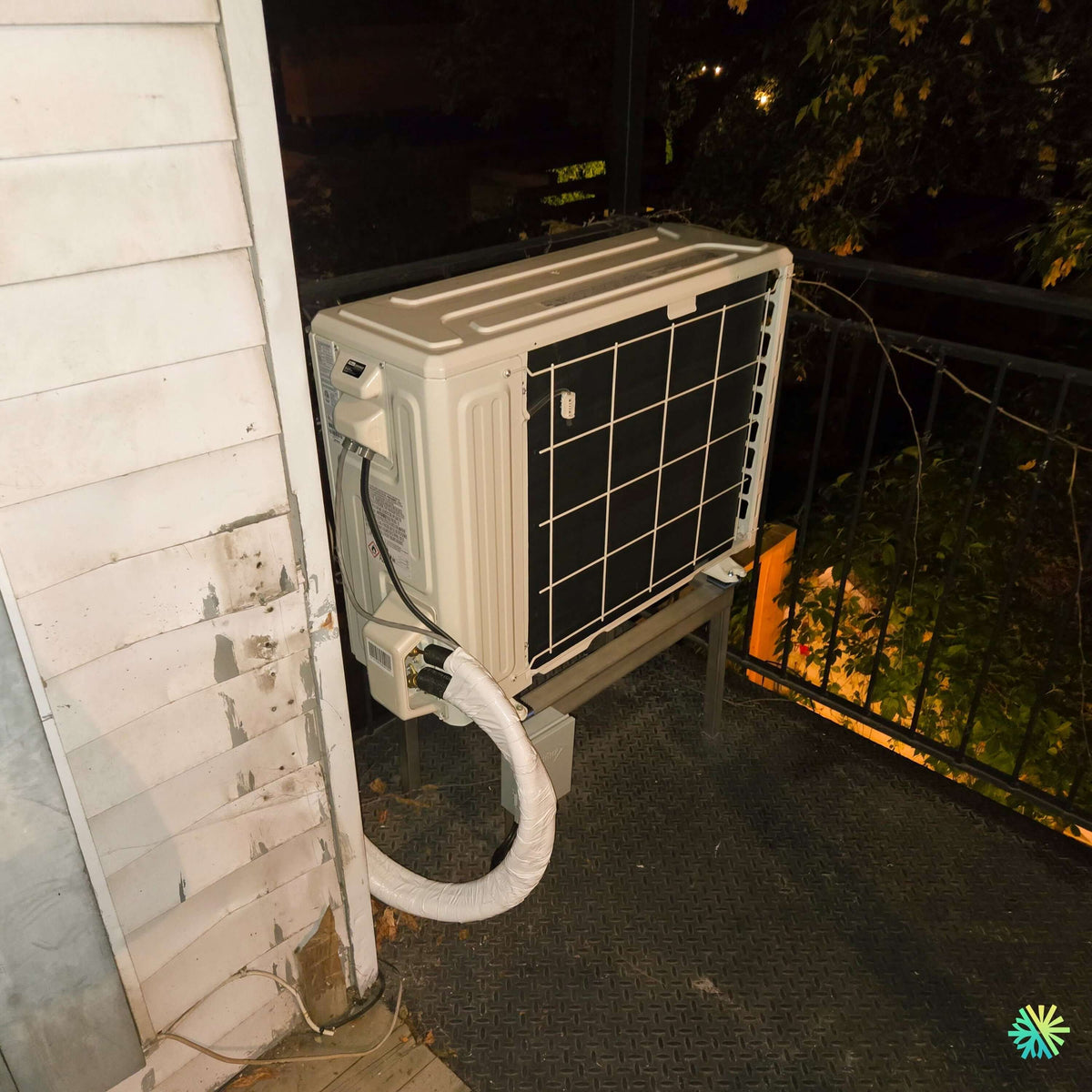
This MIDEA MIDEA35 wall-mounted heat pump installation in Godmanchester presents a particularly interesting configuration: the outdoor unit had to be positioned on a relatively narrow platform or balcony, with the building wall on one side and a metal railing on the other.
In the photo of our installation, the space available around the outdoor unit is immediately visible. It was not simply a matter of placing the heat pump on a ground-level slab. We had to integrate the equipment into an already structured area, maintain adequate airflow around the coil, organize the refrigerant lines, and preserve sufficient access for future maintenance.
Our solution was to install the MIDEA35 on a raised metal bracket. The outdoor unit therefore does not rest directly on the balcony floor. This decision improves the clearance beneath the machine and becomes particularly relevant when the heat pump operates in heating mode during the winter.
The photograph also shows the path of the insulated lines leaving the side of the outdoor unit, forming a controlled curve before reaching the building. In an installation where every inch counts, this type of detail must be planned before the equipment is permanently secured.
Why we raised the outdoor unit
A wall-mounted heat pump used as a heating appliance does not behave exactly like a simple outdoor air conditioner.
When temperatures drop, moisture can turn into frost on the outdoor coil. The unit then periodically initiates a defrost cycle. The ice melts and produces water beneath the heat pump.
On a balcony or platform like the one in this installation in Godmanchester, we must therefore account for this phenomenon from the project design stage.
By keeping the unit above the surface, we create additional space beneath it. This facilitates the drainage of defrost water and reduces the risk of the equipment's base becoming directly trapped in an accumulation of ice.
This precaution becomes particularly important for a MIDEA35, since this series is designed to continue operating in heating mode down to -30 °C.
The outdoor installation must therefore be designed for winter from day one.
A side-discharge heat pump well suited to this location
Midea’s outdoor configuration is particularly interesting when available space is limited.
The manufacturer’s documentation describes its wall-mounted outdoor units as side-discharge models side discharge, with a compact format suitable for installation on a support, patio, or balcony.
On the job site of Godmanchester, this design allows the unit to be installed relatively close to the building while keeping its large heat-exchange surface exposed to the outdoor air.
The challenge, however, is not to confuse a “compact unit” with a “unit that can be enclosed.”
A heat pump must be able to draw in and discharge a significant amount of air. A railing, vegetation, a wall, or any other obstacle that is too close can hinder this exchange.
We therefore position the equipment while considering the actual geometry of the balcony, rather than simply the space required to place the machine.
The line routing: a highly visible detail of this installation
In the photograph, the refrigerant connections are clearly visible on the left side of the outdoor unit.
The lines are insulated and bundled before entering the building. Their curve allows for the transition between the heat pump connections and the penetration point without imposing an abrupt change of direction on the copper tubing.
This is an important part of a professional HVAC installation.
Improperly handled refrigerant lines can become kinked, crushed, or subjected to unnecessary stress. A proper installation must therefore follow the diameters specified by the manufacturer and maintain an appropriate bend radius.
MIDEA35: several capacities under one name
A point we often explain to our clients about Godmanchester is that MIDEA35 is not a single capacity.
The series includes, among others, three configurations:
- 9,000 BTU/h in air conditioning: MSESU-H09B-2A with MO1SS-H09B-2A;
- 12,000 BTU/h : MSESU-H12B-2A with MO1SS-H12B-2A;
- 18,000 BTU/h : MSESU-H18B-2A with MO1SS-H18B-2A.
The corresponding AHRI reference numbers are, respectively, 215471386, 215471387, and 215471388.
The unit’s nameplate visible in the photo is not sufficiently legible to identify with certainty the capacity installed for this project. We therefore prefer not to assign a BTU rating that cannot be visually confirmed.
This distinction is important because the electrical and refrigeration specifications change according to capacity.
Pipe diameters vary by model
For the MIDEA35 units of 9,000 and 12,000 BTU, Midea specifies liquid and gas lines of 1/4 in and 3/8 in.
The 18,000 BTU uses instead 3/8 in and 5/8 in.
It is therefore essential to select the piping according to the exact system.
The maximum permitted length also varies:
- 82 ft for the 9,000 BTU model;
- 82 ft for the 12,000 BTU model;
- 164 ft for the 18,000 BTU model.
The ability to use relatively long lines can be advantageous when the outdoor unit’s location is dictated by the building’s layout.
However, we always aim to create the most practical route possible. A maximum length is a design limit, not a goal.
A power supply suited to the exact model
Another difference between the capacities concerns the electrical requirements.
All three models use a power supply of 208/230 V, single-phase, 60 Hz, but their requirements are not identical.
For the 9,000 and 12,000 BTU versions, Midea specifies a minimum allowable ampacity of 16 A, with a maximum protection of 20 A. For the 18,000 BTU version, the minimum ampacity is 24.9 A, with a maximum protection of 25 A.
Before installing a heat pump in Godmanchester, so we always check the available electrical capacity and the specifications of the selected model.
Installing equipment without checking its electrical circuit can lead to unexpected modifications on the day of the work.
Why the MIDEA35 is a particularly appealing option for a residence in Godmanchester
Heating down to -30 °C
MIDEA35 is presented by Midea as an extreme heat pump capable of operating in heating mode down to -30 °C. The product line also uses the refrigerant R-454B and is associated with Cold Climate V6.1 certification.
For a residence in Godmanchester, winter performance is naturally an important part of choosing a heat pump.
We do not select this type of equipment solely based on its ability to cool the home during the summer. A heat pump suited to Quebec’s climate must also be able to provide heating when temperatures drop well below freezing.
However, the expression “operates down to -30 °C” must be interpreted correctly.
This does not mean that the heating capacity will remain the same at all temperatures. As with any heat pump, performance varies depending on outdoor conditions.
That is why data published at low temperatures are particularly useful.
Documented heating capacity at -15 °C
At -15 °C, Midea indicates the following nominal capacities:
- 13,500 BTU/h for the 9,000 BTU system;
- 13,500 BTU/h for the 12,000 BTU system;
- 22,600 BTU/h for the 18,000 BTU system.
These figures provide a better way to evaluate the heat pump than the simple BTU figure in its name.
A 12,000 BTU heat pump in cooling mode is not necessarily limited to exactly 12,000 BTU when operating in heating mode.
That is precisely why, at AirGreen, we compare the actual low-temperature performance rather than focusing solely on the nominal capacity.
Up to 33.3 SEER2 depending on the configuration
The MIDEA35 also offers high cooling efficiency.
The manufacturer publishes:
- 33.3 SEER2 for the 9,000 BTU unit;
- 29.4 SEER2 for the 12,000 BTU unit;
- 25.6 SEER2 for the 18,000 BTU unit.
The HSPF2 IV values are respectively 22.0, 14.5, and 16.2.
This illustrates an important principle: the statement “up to 33.3 SEER2” describes the best performance available in the product line, not necessarily that of every capacity.
When we prepare a quote for a MIDEA35 heat pump in Godmanchester, so we therefore associate the performance with the exact model number offered.
A variable-speed compressor to maintain a more stable temperature
The MIDEA35 uses variable-speed compressor technology.
Unlike a conventional system that starts and stops constantly, the heat pump can adjust its operation according to the room’s needs.
Midea explains that this modulation helps reduce temperature fluctuations and maintain more consistent comfort.
This modulation capacity is particularly useful during periods when the heating or cooling demand is relatively low.
Rather than operating at maximum capacity continuously, the unit can gradually adjust its output.
The desired result is steadier operation and a more consistent indoor temperature.
Beware of oversizing
Even with a variable-speed heat pump, choosing the largest model is not necessarily the best strategy.
We assess the required capacity based on several factors:
- the area to be conditioned;
- insulation quality;
- windows;
- air infiltration;
- solar exposure;
- room layout;
- ceiling height;
- the actual heating and cooling needs.
An oversized unit may operate in less favorable cycles during periods when the heating load is low.
An undersized unit, on the other hand, may reach its limits when demand becomes high.
For a heat pump installation in Godmanchester, so sizing must be adapted to the building rather than based solely on a quick BTU-per-square-foot formula.
R-454B and the new generation of heat pumps
The MIDEA35 operates with R-454B, an A2L-classified refrigerant.
Midea’s documentation also mentions devices associated with the detection and dispersion of A2L refrigerant.
This new equipment requires adapted work methods.
For us, this means using the appropriate procedures and equipment during installation, commissioning, and future service calls.
For the owner, this primarily highlights the importance of choosing an HVAC contractor who is familiar with this new generation of systems.
Precise airflow control
The indoor section of the MIDEA35 also offers great flexibility.
Midea provides a fan speed adjustment ranging from 1% to 100%, as well as various functions that allow the direction of the airflow to be adjusted.
This adjustment capability is useful for avoiding a constant stream of air directed toward an occupied area.
Comfort does not depend solely on the number displayed on the remote control. Air speed and direction also play an important role in how the room feels.
Features designed for everyday use
The series also offers several practical settings:
- ECO mode;
- night mode;
- silent mode;
- timer;
- “Follow Me” function;
- horizontal swing;
- vertical swing;
- automatic cleaning;
- 8°C maintenance heating;
- humidity control;
- optional wired controller;
- smart control features.
The documentation also indicates that control through the SmartHome app and Wi-Fi may be available depending on the configuration.
These features allow the owner to adapt the heat pump’s operation to their schedule and varying comfort needs throughout the day.
An interesting design for indoor unit maintenance
One technical point that we consider particularly relevant is the ability to remove the indoor blower wheel for more thorough cleaning.
Midea indicates that this design facilitates access to the inside of the unit.
When heat pump maintenancecleaning the filters is important, but it represents only part of the long-term work.
Dust and various deposits can also accumulate on the heat exchanger and fan wheel.
A unit designed to facilitate this access therefore simplifies cleaning operations when the system has been operating for several years.
Subsidies must be verified using the exact AHRI number
For Godmanchester homeowners assessing the financial assistance available, we always emphasize one point: do not rely solely on the heat pump’s commercial name.
The three documented MIDEA35 units have different AHRI numbers.
Eligibility and the potential amount of financial assistance must therefore be verified based on:
- the exact system installed;
- its AHRI number;
- its capacity;
- the installation date;
- the criteria applicable at the time of application.
The documentation provided alone does not make it possible to determine the subsidy amount for this specific installation in Godmanchester. We therefore avoid presenting an amount that cannot be confirmed from the available information.
A balcony installation must be designed with future servicing in mind
One of the positive aspects of the photographed installation is the accessibility of the outdoor components.
Even in a limited space, the refrigerant connections and various service areas remain accessible.
This question is important because a technician may need, several years later, to access the valves, electrical connections, nameplate, or heat exchanger.
A unit installed in an inaccessible cavity may seem discreet at first, but can make future troubleshooting considerably more difficult.
At AirGreen, we therefore seek to reconcile integration, performance, and accessibility.
Defrosting, a reality to plan for from the time of installation
One of the most common mistakes with a heat pump installed on a patio or balcony is to think only about the summer season.
An installation may seem perfect when it is 25 °C and become problematic in the middle of winter.
During defrost cycles, water must be able to leave the area beneath the heat pump. If it accumulates and continually freezes in the same place, a mass of ice can gradually form.
The raised support used for this installation in Godmanchester contributes directly to creating more space beneath the unit.
This does not replace proper planning for drainage and winter conditions, but represents an important element of an installation suited to Quebec.
Stability and vibrations on a metal structure
The fact that the unit is installed on a metal platform also deserves particular attention.
A lightweight structure may transmit vibrations differently from a concrete slab directly on the ground.
The quality and rigidity of the bracket, as well as the way the unit rests on it, can therefore influence acoustic comfort.
Midea’s published outdoor sound levels are approximately 57 dB(A) for the 9,000 and 12,000 BTU versions and 61.5 dB(A) for the 18,000 BTU high-output version.
The level perceived inside the building also depends on vibrations transmitted through the structure and on the proximity of windows or living areas.
That is why we always consider the installation environment, not just the unit’s technical specifications.
An AirGreen installation adapted to Godmanchester’s real-world constraints
This installation of a MIDEA MIDEA35 wall-mounted heat pump in Godmanchester perfectly demonstrates why choosing a good unit is only the first step toward a successful HVAC project.
The MIDEA35 offers very interesting technical specifications: heating operation down to -30 °C, refrigerant R-454B, variable-speed technology, multiple capacities available, and efficiencies of up to 33.3 SEER2.
But on this project, the most interesting part is precisely what the brochure cannot anticipate: a narrow balcony, a metal structure, a railing, a curved refrigerant line route, and the need to keep the unit sufficiently clear and accessible.
This is where our work becomes especially important.
At AirGreen, we analyze the unit and the building as one complete system. In Godmanchester, this means properly selecting the capacity and meeting refrigeration and electrical requirements, while also designing an outdoor installation that can remain functional under real-world operating conditions.
The photograph of this project shows the result: a MIDEA35 installed on a raised bracket, integrated into a limited space, and connected in a way that preserves convenient access to the equipment.
For a homeowner in Godmanchester For anyone considering the installation or replacement of a wall-mounted heat pump, this project highlights a simple principle: the performance ratings listed on the technical specification sheet matter, but the quality of theHVAC installation determines how this performance will be used on a daily basis.
How it goes, from the first call to the end
The main steps of this kind of job at AirGreen. Every house has its quirks: the estimate brings them out.
We look at the room, the outside wall, the line route and where the outdoor unit will go. That is where the capacity gets chosen.
Model, capacity and price, in writing. We also check whether the model qualifies for assistance programs.
Floors and furniture protected, wall plate position marked level, wall opening located.
A single opening, with the slope the drain needs to flow outside.
Set on a stand raised above the snow, with the clearances the manufacturer requires.
Connected, insulated and protected. The opening is then sealed against water, cold air and insects.
A dedicated circuit and an accessible disconnect near the outdoor unit.
Leak test, vacuum, then start-up and a check of heating and cooling.
Remote, modes, filters: we show you the essentials before we leave.
- The on-site estimateWe look at the room, the outside wall, the line route and where the outdoor unit will go. That is where the capacity gets chosen.
- The quoteModel, capacity and price, in writing. We also check whether the model qualifies for assistance programs.
- Getting readyFloors and furniture protected, wall plate position marked level, wall opening located.
- The wall openingA single opening, with the slope the drain needs to flow outside.
- The outdoor unitSet on a stand raised above the snow, with the clearances the manufacturer requires.
- Lines, cable and drainConnected, insulated and protected. The opening is then sealed against water, cold air and insects.
- The electrical workA dedicated circuit and an accessible disconnect near the outdoor unit.
- Tests and start-upLeak test, vacuum, then start-up and a check of heating and cooling.
- The walkthroughRemote, modes, filters: we show you the essentials before we leave.
What the unit delivers when it is cold
The range as published on airgreen.ca: pick a size to see its capacity in deep cold.
| Size | Heating at −8 °C | Heating at −15 °C | Coldest certified point | COP at −15 °C | SEER | HSPF | Indicative LogisVert aid |
|---|---|---|---|---|---|---|---|
| Midea Série 35 9 000 | 11,000 | 13,500 | −30 °C: 7,500 | 2.0 | 33.3 | 14.6 | – |
| Midea Série 35 12 000 | 11,000 | 13,500 | −30 °C: 7,500 | 2.0 | 29.4 | 12.7 | $1,320 |
| Midea Série 35 18 000 | 19,300 | 22,600 | −30 °C: 11,900 | 2.34 | 25.6 | 16.2 | $2,316 |
According to NEEP, its certified maximum capacity at −30 °C (−22 °F) is 7,500 BTU/h, 83% of its nominal 9,000 BTU size.
At 8 °C, its certified maximum capacity reaches 17,200 BTU/h, 91% more than its nominal 9,000 BTU size.
According to NEEP, its certified heating capacity at −15 °C (5 °F) is 13,500 BTU/h, 150% of its nominal 9,000 BTU size. Its COP there is 2.00.
According to NEEP, its certified maximum capacity at −30 °C (−22 °F) is 7,500 BTU/h, 62% of its nominal 12,000 BTU size.
At 8 °C, its certified maximum capacity reaches 17,200 BTU/h, 43% more than its nominal 12,000 BTU size.
According to NEEP, its certified heating capacity at −15 °C (5 °F) is 13,500 BTU/h, 112% of its nominal 12,000 BTU size. Its COP there is 2.00.
According to NEEP, its COP at −15 °C is 2.34: the highest of the Série 35 line, which ranges from 2.00 to 2.00 at that temperature.
According to NEEP, its certified maximum capacity at −30 °C (−22 °F) is 11,900 BTU/h, 66% of its nominal 18,000 BTU size.
At 8 °C, its certified maximum capacity reaches 29,700 BTU/h, 65% more than its nominal 18,000 BTU size.
Data read live from the airgreen.ca page of each size (NEEP / AHRI certified performance). When the title names the installed size, it is highlighted; otherwise the whole range is shown. The aid shown is today’s, using Hydro-Québec’s rule ($120 per 1,000 BTU/h at −8 °C); amounts quoted in the article date from its publication. Only Hydro-Québec confirms the assistance granted.A dash in the aid column: amount to be confirmed for this model.
And at your place?
Two quick checks with real numbers: what heat costs, and what your current heaters add up to in BTU/h.
Baseboards and electric furnaces turn 1 kWh of electricity into 1 kWh of heat. A heat pump delivers more: that is its COP. At Hydro-Québec’s rate D (11.142¢/kWh above 40 kWh a day, since 1 April 2026):
Hydro-Québec: a heat pump can be up to three times more efficient than baseboards for heating in the colder months.
Estimate per kWh of heat, at the chosen temperature, using the certified COP from the product page. Taxes, access charge and backup heat not included.
Conversion: 1 W = 3.412 BTU/h. An indication, not a load calculation: baseboards and furnaces are often stronger than the real need, and they can stay as backup. AirGreen confirms the capacity on site.
What to do, season by season
Three habits per season for this unit. They take a few minutes and prevent many calls.
- Clean the indoor unit's filters.
- Clear leaves and debris left on the outdoor unit by winter.
- Test cooling before the first hot days.
- Clean the filters more often when the unit runs a lot.
- Keep plants away from the outdoor unit.
- Check that no water drips from the indoor unit.
- Rake the leaves around the outdoor unit.
- Test heating before the first cold days.
- Book periodic maintenance before winter.
- Keep snow away from the stand and the front of the unit.
- Let the unit defrost: it is normal.
- Never hit the ice on the fins; call us if the unit stays iced up.
Which type of equipment for your project?
Pick what looks like your need.
Four mistakes we do not make
Flip each card to see what we do instead.
What people ask us about this kind of work
Does a wall-mounted heat pump heat in winter?
Wall-mounted or multi-zone: how do I choose?
Where does the outdoor unit go?
Are there grants?
Do I need a permit?
How cold can it heat?
How much can I save?
How is the LogisVert assistance calculated?
Is it noisy?
The outdoor unit is covered in ice: is that normal?
Does AirGreen hold the required licences?
Is the estimate free?
No question matches. Write to us: we answer.
Useful pages for what comes next
More jobs to see, near you
By town, by equipment or by region: browse more than 4,700 published projects.
Each dot: a town where AirGreen has published projects. The glowing dot: this job.
Tell us about your house. We come and see it for free.
The on-site estimate is free and the quote follows within 24 hours.
Text and photo: a real AirGreen Climatisation & Chauffage job. The diagrams are generic illustrations of the type of installation, not a survey of this job site. Sources of the added figures: airgreen.ca product pages (NEEP / AHRI performance), Hydro-Québec (Heat pumps page, LogisVert, read on 13 October 2026), Régie de l’énergie (rate D as of 1 April 2026).