
Installation of a MIDEA EVOX G3 R454B central electric furnace in Montréal-Est
In Montréal-Est, AirGreen integrates a MIDEA EVOX G3 central electric furnace into the existing system: vertical installation, R454B, drainage, refrigerant lines, and precise airflow adjustment.
Take a tour of the installation
Each number is a point we check on site. Switch between summer and winter to watch air and heat move.
In summer, the outdoor unit rejects the house's heat outside.
Generic illustration of this type of installation, not a survey of this job site. Tap a number.
It captures or rejects heat outside. It sits on a level base, above the snow, with free space all around.
The insulated refrigerant lines enter the house through a sealed opening and run to the indoor coil.
A shut-off switch near the outdoor unit isolates it safely for service.
Sitting on the indoor module, it moves heat between the house air and the refrigerant.
Electric furnace or air handler: its fan pushes air through the ducts. The electric backup takes over in extreme cold.
Supply ducts bring air to the rooms; returns bring it back to the unit. Their condition matters as much as the unit's.
It protects the coil and the fan. A dirty filter cuts airflow, so it gets checked regularly.
It runs the heat pump and the backup heat. It must be compatible with the installed system.
In Montréal-Est, a vertical installation designed around the existing duct network
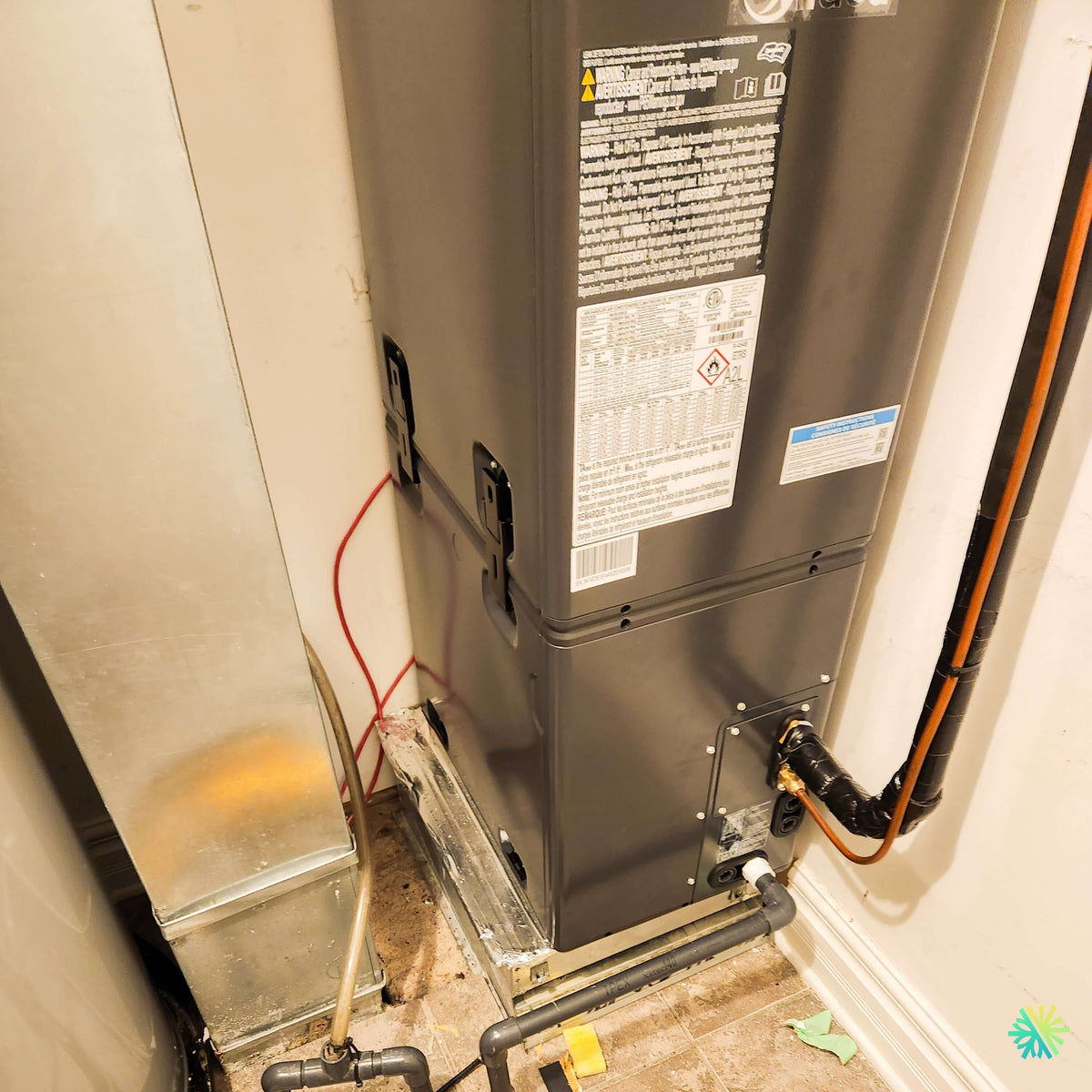
On this installation completed in Montreal East, the available space required an approach very different from a project where we have a large, unobstructed basement. The new MIDEA EVOX G3 central electric furnace was to be placed in a relatively narrow mechanical room, directly beside the existing galvanized sheet-metal ducts, with the refrigerant and drainage connections concentrated on one side of the unit.
The job-site photo shows several details that normally go unnoticed once the mechanical-room door is closed. The MIDEA indoor unit is installed vertically, its two sections are assembled one on top of the other, the existing duct network is retained and adapted, while the copper refrigerant lines enter from the right side. The large refrigerant line is carefully insulated, the small liquid line remains visible, and the coil’s drain connection is connected to a rigid pipe.
This type of installation aptly summarizes our work at AirGreen: we do not simply fit a new unit into the space left by the old one. We must make the equipment, ductwork, drainage, controls, electrical supply, and outdoor heat pump.
An electric furnace that is actually the indoor core of a central system
In Quebec, the term electric furnace is often used to refer to the central unit that heats the air and distributes it through the ducts. In a modern installation like this one, the technical reality is more interesting.
The MIDEA EVOX G3 used as an indoor unit is a central air handler that can operate with a variable-speed heat pump and accommodate auxiliary electric heating. The heat pump normally produces most of the heat, while the electric elements can operate when the building’s demand or outdoor conditions require it.
Midea specifically designed the EVOX G3 platform to facilitate the modernization of existing central systems. The manufacturer’s documentation notably describes a design with a width comparable to that of several traditional furnaces, as well as a multivoltage indoor power supply 115 V or 208/230 V, depending on the application.
For a replacement in Montréal-Est, this design may reduce the number of mechanical modifications required. However, it never eliminates our obligation to verify the existing electrical installation, the unit’s nameplate, the conductor gauge, the circuit breaker, and the output of the auxiliary heating actually selected.
What we can actually observe in the job-site photo
We can clearly identify a compact installation in which the unit occupies almost all the available width between the wall and the metal ductwork.
Several elements are particularly interesting.
The unit is installed in a vertical position
The EVOX G3 is assembled here as a vertical unit. This arrangement makes it possible to work with the existing central ductwork without unnecessarily taking up additional floor space.
The modular construction of this generation is particularly well suited to replacements. Midea states that the unit can be configured in six ways, including upflow, downflow, left-horizontal, or right-horizontal configurations, as well as certain low-profile low-boy.
This is not merely a commercial detail. On a real job site, this flexibility may determine whether we need to rebuild a large portion of the ductwork or can integrate the equipment much more cleanly.
The refrigerant connections remain accessible
On the lower right side of the unit, we can see the two refrigerant lines. The larger-diameter line is covered with black insulation to limit heat gains or losses and prevent condensation from forming on its surface.
The smallest copper line remains uninsulated in this portion of the installation.
The location of the connections is important for another reason: future maintenance. Wherever possible, we avoid building an installation in which a service panel or important connection becomes inaccessible behind a duct or against a wall.
The condensate drainage has been integrated into the bottom of the coil
We also see a drain line connected directly to the unit.
In air conditioning, the indoor coil becomes cold. Moisture in the air then condenses on its surface, and the water must be reliably directed to a drain.
A condensate problem may seem minor compared with a compressor failure, but in a building, a recurring leak can damage the floor, walls, or ceiling below the unit.
During an electric furnace and central heat pump installation, so we pay close attention to drainage, slope, connections and the ability to inspect or clean the line later.
The A2L symbol visible on the unit: an installation using R454B refrigerant
One detail is particularly visible on the plate of the photographed unit: the flame symbol associated with the classification A2L.
The EVOX G3 range presented in Midea documentation uses R454B, an A2L refrigerant. Midea indicates a global warming potential, or GWP, for this refrigerant of 466.
For the homeowner, this changes very little in the system's day-to-day use. For our HVAC technicians, however, it means that installation and service must follow practices suited to new A2L refrigerants and equipment specifically designed for them.
We specifically verify the refrigerant connections, the manufacturer's requirements, the system configuration and the commissioning procedures applicable to the installed model.
EVOX G3: capacities suited to several home sizes
The photograph does not allow us to read the full model number of this indoor unit. We therefore avoid artificially assigning a precise capacity in BTU/h to this unit based solely on its external width.
However, the Midea technical sheet provides a good representation of the EVOX G3 range. It includes combinations of 18,000, 24,000, 30,000, 36,000, 48,000 and 54,000 BTU/h, depending on the selected indoor and outdoor units.
Published performance varies depending on the equipment pairings. In the table on page 11 of the Midea document, the range reaches, among other values:
- up to 19 SEER2;
- up to 12.5 EER2;
- up to 10.8 HSPF2;
- a COP at -15 °C of up to 2.14, depending on the combination;
-
rated capacities covering several residential sizes.
These figures also show why we need to talk about a certified combination rather than assigning a universal rating to all EVOX G3 systems. An indoor unit alone does not, for example, have an independent SEER2 rating that automatically applies to all possible outdoor units.
A central heat pump designed to keep heating when Montreal gets very cold
A central installation in Montréal-Est must be assessed according to a simple reality: we need air conditioning in July, but it is often the heating capacity in January that reveals the system’s strengths and limitations.
Midea announces for the EVOX G3 a continuous operation down to -30 °C. The documentation also presents, for the system used in the tests cited by the manufacturer, a heating capacity reaching 100% around -25 °C, with a COP of up to approximately 1,9 under these conditions.
These values must always be put into context: they come from the platform’s tests and specifications and do not mean that every combination has exactly the same performance at every temperature.
For us, the practical question is instead to properly coordinate three elements:
the heat pump’s capacity, the building’s heat loss and electric backup heating.
A properly sized heat pump can continue producing heat at very low temperatures, while electric heating steps in when necessary. Conversely, an improper configuration can unnecessarily engage the electric heating elements and increase consumption.
Auxiliary heating: up to 25 kW does not mean that 25 kW must be installed
The EVOX G3 platform can accommodate various auxiliary heating modules. The documentation presents configurations of 10 kW, 15 kW, and up to 25 kW, with staged operation for certain applications.
Proper sizing is essential.
Installing more electric heating “just in case” is not systematically an improvement. Higher power may require:
- higher-capacity electrical conductors;
- one or more suitable circuits;
- sufficient capacity at the electrical panel;
- proper coordination with the heat pump controls.
At AirGreen, we instead aim for the central heat pump to do the job it is designed to do, while maintaining properly sized electrical backup heating for the building.
Why air distribution system quality matters as much as the new MIDEA EVOX G3
A high-performance unit cannot compensate for every ductwork problem
The photo of Montréal-Est immediately shows that we were working with an existing network. The metal duct adjacent to the new unit is part of the infrastructure we must consider when replacing it.
A central HVAC installation is never simply a matter of tonnage.
We must take airflow, duct cross-section, restrictions, return air, the filter, grilles, and total static pressure into account.
The Computational Constant Airflow 2.0 technology in the EVOX G3 is specifically designed to adapt fan operation to the system's conditions. Midea states that it can manage up to 1.2 inches of water column static pressure under certain conditions and offers up to 60 airflow-volume adjustment levels.
This gives our technicians greater flexibility during commissioning.
However, this does not mean that a poor duct automatically becomes adequate. An undersized section, significant restriction, or insufficient return air must be assessed as a mechanical problem in its own right.
Airflow adjustment directly affects comfort
When the airflow is too high, occupants may hear more air moving through the grilles and feel unpleasant drafts.
When it is too low, we may notably experience:
- less uniform distribution between rooms;
- inadequate coil temperatures;
- less efficient operation;
- lower comfort in areas farther from the system.
Having an adjustable-airflow motor therefore becomes particularly useful during a renovation in an existing building with Montreal East, where the ductwork was not necessarily originally designed for a modern variable-speed central heat pump.
MERV 13 filtration: useful, but it must be integrated correctly
The EVOX G3 can be paired with a module that accepts 1-, 2-, or 4-inch MERV 13, depending on the configuration. The manufacturer's documentation specifically mentions reducing dust, pollen, particles, and pet hair or dander in the air passing through the system.
However, we should point out that a more efficient filter generally creates more resistance than a highly unrestricted filter.
It is therefore necessary to select the filtration system while taking the ductwork and fan into account, then check the static pressure during commissioning. Installing a highly restrictive filter in an already borderline duct system can produce the opposite of the desired effect.
24 V controls or Midea communication: a platform designed for renovations
Replacing a central system can sometimes become complicated when the existing wiring is difficult to access.
The EVOX G3 documentation provides several options. The system can notably operate with dedicated communication 485 or, in certain configurations, with a conventional 24 V thermostat. Midea also describes wireless communication between certain EVOX components as a solution for avoiding some long communication-wiring runs.
This flexibility is useful in existing homes, but the final selection always depends on the exact combination of equipment and the controls installed.
What we verify before considering an installation complete
For an installation such as Montreal East, the cabinet’s aesthetic finish is only one part of the work.
Before final commissioning, we pay particular attention to:
- the refrigerant connections and their tightness;
- refrigerant-line insulation;
- condensate drainage;
- the airflow and fan settings;
- the system’s static pressure when necessary;
- the operation of the auxiliary heating;
- the controls and thermostat;
- the accessibility of the service panels;
- the electrical supply and required protections;
- the behavior of the complete system in heating and cooling mode.
This is the approach that turns an equipment replacement into a true central HVAC installation.
LogisVert grants: the complete system must be verified
Financial assistance is an important consideration for homeowners replacing their central heating in Montreal, Laval, Longueuil, the North Shore, or the South Shore.
For heat pumps installed since November 26, 2025, Hydro-Québec states that the units must be ENERGY STAR certified to be eligible for LogisVert financial assistance, and the amount depends on the list in effect on the installation date.
In the case of a central heat pump, you must verify the exact combination of the outdoor unit and the indoor unit, rather than simply searching for “MIDEA EVOX G3” as a product-line name.
This is particularly important here: the photographed nameplate confirms the equipment family and the use of R454B, but the image resolution does not allow us to confirm the complete model number with certainty. We therefore deliberately do not attribute no specific LogisVert amount to this installation without the exact model pair.
This approach avoids a common mistake: announcing a rebate simply because another capacity from the same series appears on a list.
The details visible today determine how easy maintenance will be several years from now.
A central installation must remain accessible long after the installation team has left.
In the photo of this project in Montreal East, the front of the unit remains unobstructed. The panels can be removed, and the connections are grouped visibly on the side.
This arrangement is important forHVAC maintenance and for any future diagnostics.
We are thinking in particular about access to:
- the coil;
- the blower motor;
- the electrical components;
- the heating module;
- the drain;
- the refrigerant connections;
- the filter.
When we work in a restricted mechanical space, a few centimeters used poorly during installation can become a considerable difficulty during a service call several years later.
A representative installation of the central renovations we carry out in Greater Montreal
The project involving Montreal East is a good example of a replacement where the value of the work is not measured by the amount of new ductwork that is visible.
Here, our goal was precisely the opposite: integrate a modern central system into the existing building as coherently as possible.
The MIDEA EVOX G3 offers several features that are relevant to this type of renovation: a modular cabinet, multiple installation orientations, compatibility with different control methods, a blower capable of adapting to variations in system pressure, configurable auxiliary electric heating, and a heat pump designed to operate at very low temperatures.
But none of these features replaces proper installation.
In Montreal East, as with our projects in Montreal, Laval, Longueuil, the North Shore, and the South Shore, we always consider the unit as part of a system. The ductwork, drainage, electrical, refrigerant, filtration, and settings must all work together.
This is especially true with a MIDEA EVOX G3 central electric furnace the configuration possibilities are extensive, but proper sizing and commissioning are what truly provide consistent comfort in both winter and summer.
The big day, step by step
The main steps of this kind of job at AirGreen. Every house has its quirks: the estimate brings them out.
We look at the ducts, the current indoor module, the electrical panel and the planned spot for the outdoor unit.
The equipment combination, capacity and price, in writing. We check whether the combination qualifies for assistance programs.
Access protected, old unit disconnected and removed when it is being replaced.
Electric furnace or air handler, with its coil, connected to the supply and return ducts.
On a level base, raised above the snow, with free space all around.
Insulated, they enter through a sealed opening and run to the indoor coil.
Dedicated circuits, accessible disconnect, a thermostat that works with the heat pump and the backup heat.
Leak test, vacuum, start-up, airflow check and a test of both modes.
Filter, thermostat, backup heat in extreme cold: what to know before winter.
- The on-site estimateWe look at the ducts, the current indoor module, the electrical panel and the planned spot for the outdoor unit.
- The quoteThe equipment combination, capacity and price, in writing. We check whether the combination qualifies for assistance programs.
- Getting readyAccess protected, old unit disconnected and removed when it is being replaced.
- The indoor moduleElectric furnace or air handler, with its coil, connected to the supply and return ducts.
- The outdoor unitOn a level base, raised above the snow, with free space all around.
- The refrigerant linesInsulated, they enter through a sealed opening and run to the indoor coil.
- Electrical and thermostatDedicated circuits, accessible disconnect, a thermostat that works with the heat pump and the backup heat.
- Tests and start-upLeak test, vacuum, start-up, airflow check and a test of both modes.
- The walkthroughFilter, thermostat, backup heat in extreme cold: what to know before winter.
What would it look like at your place?
Two quick checks with real numbers: what heat costs, and what your current heaters add up to in BTU/h.
Conversion: 1 W = 3.412 BTU/h. An indication, not a load calculation: baseboards and furnaces are often stronger than the real need, and they can stay as backup. AirGreen confirms the capacity on site.
Four mistakes we do not make
Flip each card to see what we do instead.
Your own project, step by step
What to do, season by season
Three habits per season for this unit. They take a few minutes and prevent many calls.
- Check the indoor module's filter.
- Clear winter debris from the outdoor unit.
- Test cooling before the heat arrives.
- Check the filter more often in peak season.
- Keep registers and returns clear.
- Watch condensate drainage near the coil.
- Change or clean the filter.
- Test heating and backup heat before the cold.
- Book periodic maintenance.
- Clear snow around the outdoor unit.
- Store nothing in front of the indoor module.
- Note any unusual noise or smell and call us.
Is your home ready?
Check what applies at your place. A "no" is not a refusal: it is what we sort out during the estimate.
Four statements: true or false?
It all comes down to details you have just seen.
1. A central heat pump uses the house's ducts.
It connects to the existing ducts to heat and cool everywhere.
2. In extreme cold, electric backup heat can take over.
The indoor module (furnace or air handler) works with the heat pump and takes over in extreme cold.
3. The filter only gets changed when the unit breaks down.
A dirty filter cuts airflow. It gets checked regularly.
4. You can reuse the old unit's size without checking.
The house may have changed: insulation, windows, added rooms. Capacity is confirmed on site.
0 / 4 right answers
What people ask us about this kind of work
Can I keep my current ducts?
What happens in extreme cold?
Furnace, air handler, ducted: what is the difference?
Are there grants?
Do I need a permit?
How much can I save?
How is the LogisVert assistance calculated?
Will my current thermostat work?
Central or wall units: which one?
Does AirGreen hold the required licences?
Is the estimate free?
No question matches. Write to us: we answer.
More jobs to see, near you
By town, by equipment or by region: browse more than 4,700 published projects.
Each dot: a town where AirGreen has published projects. The glowing dot: this job.
Every house has its constraints. We see them before we install.
The on-site estimate is free and the quote follows within 24 hours.
Text and photo: a real AirGreen Climatisation & Chauffage job. The diagrams are generic illustrations of the type of installation, not a survey of this job site. Sources of the added figures: airgreen.ca product pages (NEEP / AHRI performance), Hydro-Québec (Heat pumps page, LogisVert, read on 13 October 2026), Régie de l’énergie (rate D as of 1 April 2026).