
Installation of an ELIOS Central-Elios R454B electric furnace in Saint-Jean-Baptiste, Montérégie
In Saint-Jean-Baptiste, AirGreen installs an ELIOS Central-Elios R454B electric furnace with auxiliary heating, electronic controls, a central fan, and pre-installed connections for reliable performance in cold climates.
Take a tour of the installation
Each number is a point we check on site. Switch between summer and winter to watch air and heat move.
In summer, the outdoor unit rejects the house's heat outside.
Generic illustration of this type of installation, not a survey of this job site. Tap a number.
It captures or rejects heat outside. It sits on a level base, above the snow, with free space all around.
The insulated refrigerant lines enter the house through a sealed opening and run to the indoor coil.
A shut-off switch near the outdoor unit isolates it safely for service.
Sitting on the indoor module, it moves heat between the house air and the refrigerant.
Electric furnace or air handler: its fan pushes air through the ducts. The electric backup takes over in extreme cold.
Supply ducts bring air to the rooms; returns bring it back to the unit. Their condition matters as much as the unit's.
It protects the coil and the fan. A dirty filter cuts airflow, so it gets checked regularly.
It runs the heat pump and the backup heat. It must be compatible with the installed system.
A precisely prepared central installation before its integration into the ductwork
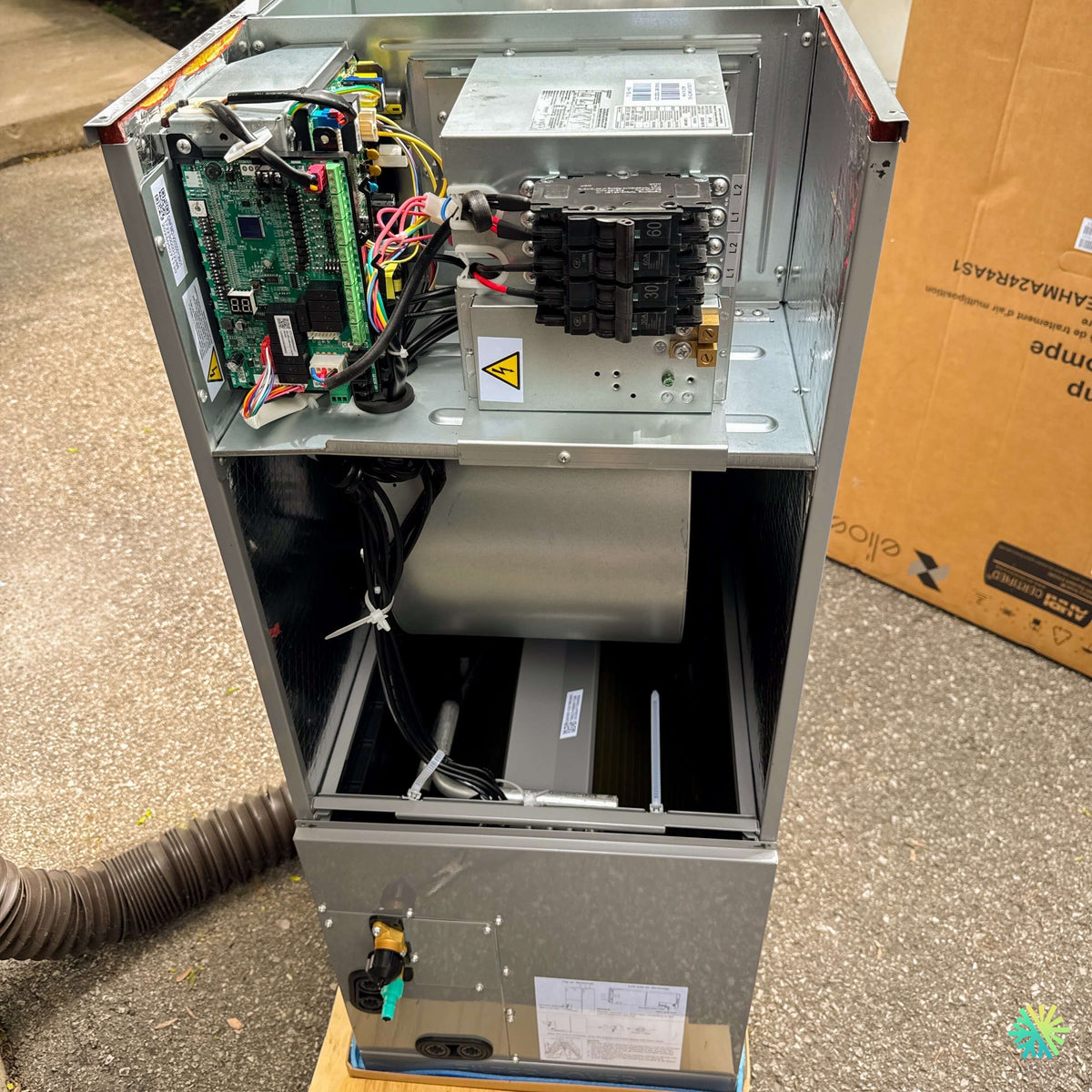
At Saint-Jean-Baptiste, in Montérégie, our AirGreen team installed an ELIOS Central-Elios electric furnace compatible with a central heat pump using R454B refrigerant. The photograph taken during the work provides a particularly informative view of the inside of the unit before its panels were fully closed and it was permanently connected to the ductwork.
The main components that allow a modern electric furnace to heat, cool, and circulate air throughout a property can be seen here: circuit board, control terminal blocks, electrical protection devices, central fan, indoor coil, refrigerant lines, and service access.
This stage of the installation is rarely visible to the homeowner. Yet it reveals much about the actual quality of the work. Before the unit is concealed in a mechanical room and connected to the ductwork, we must check the connections, fan configuration, auxiliary heating capacity, drainage, and compatibility among the system’s various components.
An electric furnace designed to work with a central heat pump
The unit shown in the photo is not a conventional electric furnace limited to resistance heating. It is a ELIOS central fan coil that can be paired with a Central-Elios outdoor unit.
In this configuration, the heat pump is normally the primary source of heating and cooling. The electric furnace then provides several supplementary functions:
- it circulates air through the ductwork;
- it contains the indoor evaporator coil;
- it distributes the heat produced by the heat pump;
- it provides air conditioning during the summer;
- it can receive auxiliary electric heating elements;
- it coordinates the controls with the thermostat and outdoor unit.
This distinction is important for homeowners comparing a central heat pump, an electric furnace, and a central air conditioner. In a modern system, these functions are not isolated. The indoor unit and outdoor unit must form a compatible, properly configured combination.
The Central-Elios range is available in nominal capacities of 24,000, 30,000, 36,000, 48,000, and 60,000 BTU, with specific indoor units for each capacity. The documentation also indicates a main supply of 208–230 V, single-phase, at 60 Hz for the various configurations.
What the inside of the ELIOS unit shows
The photograph shows the furnace’s internal construction before it is closed up.
In the upper-left section is the electronic control board. It manages signals from the thermostat, fan sequences, heating and cooling requests, and communication between the system’s components.
Nearby, several wires of different colors are grouped in identified terminal blocks. Each conductor has a specific function. A wiring error can produce symptoms such as:
- a fan that does not start;
- a heat pump remaining in the wrong mode;
- electric heating activating unnecessarily;
- a thermostat displaying an error;
- a loss of communication between the indoor and outdoor units.
We therefore check each connection rather than relying solely on the colors of the old wires already present in the building.
Visible integrated electrical protections in the photo
At the upper center of the unit, an array of integrated circuit breakers can be seen. The visible levers are marked with values including 60 A and 30 A.
These protections are generally associated with electric heating circuits and the unit’s internal components. Their presence indicates that the furnace is designed to receive or control a significant amount of electrical power.
However, it would not be rigorous to determine the exact power in kilowatts based solely on this photograph. The final value depends in particular on:
- the precise model of the heating kit;
- the actual voltage available;
- the wiring diagram;
- the specifications listed on the nameplate;
- the configuration selected for the project.
The Central-Elios range accepts backup electric heating coils available in different capacities, ranging from 3 to 25 kW, depending on the model and the building’s needs.
Why backup electric heating must be properly sized
A more powerful electric heating element is not automatically better. Its role is to supplement the heat pump when conditions become demanding, not to unnecessarily replace its efficient operation.
In Saint-Jean-Baptiste, sizing must account for winter temperatures as well as the outdoor unit’s low-temperature performance.
An undersized electric heat kit may not be sufficient during a period of intense cold or when a rapid temperature increase is required. An oversized kit, in turn, can:
- place an unnecessary load on the electrical panel;
- require larger conductors and circuit breakers;
- increase power demand;
- activate more often than necessary if the controls are programmed incorrectly;
- reduce the expected savings from a heat pump.
We therefore coordinate the supplemental heating capacity with the heat-loss calculation, the electrical panel capacity, and the heat pump's actual performance.
A system designed for Quebec's cold climate
The Central-Elios documentation presents the system as a cold-climate central heat pump, capable of operating in heating mode down to an outdoor temperature of -30 °C. The brochure indicates a heating capacity of approximately 69% to 76% of rated capacity at this temperature, depending on the equipment size.
This information is particularly relevant for an installation in Saint-Jean-Baptiste, where cold periods can be long and the owner generally seeks a system capable of heating efficiently without switching too quickly to electric resistance heating.
Inverter technology allows the compressor to modulate its speed. Rather than operating only at full capacity and then stopping, it adjusts its output according to demand.
This modulation helps to:
- stabilize the indoor temperature;
- extend low-power cycles;
- reduce abrupt fluctuations;
- improve comfort between floors;
- limit repeated starts;
- reduce operating noise.
According to the manufacturer's documentation, the system can provide up to 100% of its rated capacity at -20 °C, while continuing to operate down to -30 °C.
R454B refrigerant and A2L requirements
The R454B is a new-generation refrigerant used in this range of central heat pumps. It is not the furnace model number, but it defines the refrigerant used in the circuit between the indoor unit and the outdoor unit.
R454B belongs to the A2L category, meaning slightly flammable refrigerants. This classification entails specific requirements for installation, tools, leak detection, and commissioning.
The Central-Elios range includes a safety sensor designed to monitor for a potential refrigerant leak. According to the documentation, the system can stop the compressor, maintain air circulation, and generate a service alert when an anomaly is detected.
For our team, this means that the installation must follow several essential steps:
- use tools compatible with R454B;
- protect the lines from damage;
- conduct a leak test;
- perform a thorough evacuation of the circuit;
- confirm sensor operation;
- comply with the required volume and clearances;
- verify the safety sequence before handing the unit back to the owner.
The central fan visible at the heart of the unit
Beneath the electrical compartment, the fan's cylindrical housing can be seen. This component moves air through the filter, coil, and ductwork.
The fan must be adjusted according to the heat pump's capacity and the resistance of the ductwork. Insufficient airflow can cause:
- an inadequate coil temperature;
- reduced efficiency;
- ice buildup in cooling mode;
- overheating of the electric elements;
- insufficient distribution to certain rooms.
Excessive airflow can produce noise at the grilles, uncomfortable drafts, and less effective dehumidification during the summer.
Our work therefore goes beyond simply powering the furnace. We must confirm that the fan speed matches the system actually installed.
The indoor coil and refrigerant lines
The indoor coil is located in the lower section of the unit. The refrigerant lines are connected there to carry refrigerant between the furnace and the outdoor condenser.
The technical documentation for the Central-Elios line specifies 3/8 in. liquid-side piping and 3/4 in. gas-side piping for the configurations shown. Maximum lengths vary by capacity: up to 164 feet for some models and up to 246 feet for higher-capacity models.
This information must be confirmed for the exact model before installation. We never automatically reuse old piping simply because its diameter appears to be close.
We assess:
- the copper diameter;
- the total length;
- the height difference;
- the condition of the insulation;
- interior cleanliness;
- the number of elbows;
- compatibility with R454B;
- the amount of additional refrigerant required.
An easily accessible front-facing service valve
The lower front section features an easily accessible valve and service connection. This detail is important for commissioning and diagnostic work.
A well-planned installation must preserve access to the connections without requiring a technician to dismantle the ductwork or move the unit. When the furnace is installed too close to a wall, certain tasks become much longer and more expensive.
We therefore plan for the space needed to:
- remove the panels;
- access the electronic control board;
- inspect the fan;
- measure the electrical readings;
- check the coil;
- work on the drain;
- perform safe maintenance.
An exact capacity cannot be confirmed from the photo alone
The photograph clearly shows an ELIOS furnace from the Central-Elios range, but the model label is not legible enough to identify its rated capacity with certainty.
We therefore avoid arbitrarily assigning a capacity of 24,000, 30,000, 36,000, 48,000, or 60,000 BTU.
The range includes several sizes of indoor units. The 24,000 BTU model is approximately 17.52 in. wide, while the larger models use wider cabinets that can reach approximately 24.49 in. Net weights range from approximately 105.6 lb to 162.92 lb depending on capacity.
The model number remains the only reliable way to confirm the exact size.
From unpacking to commissioning: our method for a reliable HVAC installation
A complete inspection before entering the mechanical room
The photo appears to have been taken while the unit was still outside, possibly during the inspection before it was moved into the property.
This step is useful for checking:
- the condition of the cabinet;
- the presence of all components;
- the internal connections;
- the electrical protection devices;
- the tightness of the terminal blocks;
- the condition of the coil;
- the compliance of the delivered model;
- the absence of shipping damage.
A central furnace is easier to inspect before it is integrated into a confined space. Once connected to the ductwork, certain access points naturally become more limited.
The unit’s orientation must match the building
Depending on the existing system, an indoor unit can be installed in different orientations permitted by the manufacturer: vertical, horizontal, or according to a specific airflow configuration.
This decision affects:
- the coil position;
- the drain routing;
- access to the panels;
- the sheet-metal transition;
- the return air;
- the supply to the ducts;
- the routing of the refrigerant lines.
In Saint-Jean-Baptiste, we must adapt the configuration to the building rather than unnecessarily forcing the ductwork to go around the new furnace.
Duct transitions are custom-made
A new furnace does not always have the same dimensions as the old unit. Custom sheet-metal transitions must then be fabricated.
A proper transition should provide smooth airflow, without an abrupt reduction or leaks. The joints are sealed to prevent heated or conditioned air from being lost in the mechanical room.
We also verify that the return-air opening is adequately sized. A return that is too restrictive can strain the fan, increase noise, and reduce the efficiency of the entire system.
Filtration must protect the coil without choking the fan
The central filter is the first line of defense against dust. It helps keep the coil, fan, and ducts clean.
However, a filter that is too restrictive or completely clogged increases static pressure. The choice must therefore take into account:
- filtering surface area;
- MERV rating;
- fan capacity;
- the presence of pets;
- occupants' habits;
- replacement frequency;
- the overall condition of the system.
In several projects completed in Montreal, Laval, Longueuil, the North Shore, and the South Shore, we have found that problems attributed to the heat pump are actually caused by a saturated filter or insufficient return air.
Commissioning confirms the work as a whole
After the mechanical, refrigeration, and electrical connections are completed, we commission the system.
Our checks generally include:
- supply voltage;
- connection tightness;
- circuit amperage;
- fan operation;
- air speeds;
- electric heating stages;
- communication with the outdoor unit;
- heating operation;
- cooling operation;
- condensate drainage;
- the safety devices;
- the thermostat.
Central-Elios documentation mentions a Wi-Fi-compatible touchscreen thermostat, model ST1S42RW1, as well as a Wi-Fi-compatible wired controller, model KJRSAALW1. The choice depends on the configuration and the homeowner's needs.
Energy efficiency of the Central-Elios range
Depending on the capacity selected, the range offers seasonal cooling efficiency of up to 18.3 SEER2, as well as a HSPF2 of up to 8.6. The configurations are listed as compliant with ENERGY STAR V6.1 and ENERGY STAR certification for cold climates.
Values vary from one model to another. For example, the 24,000 BTU system has a 18.3 SEER2, while the 36,000 BTU system has a 17.3 SEER2. It is therefore important to compare the exact combination rather than a maximum value used to represent the entire range.
Mistakes to avoid when carrying out a similar installation
Size the furnace based solely on floor area
Floor area is a starting point, but it does not replace an analysis of heat loss, insulation, windows, airtightness, and the ductwork system.
Install the largest electrical kit available
Excessive supplemental capacity may require unnecessary electrical work and increase consumption.
Reuse old wiring without verification
The circuit breakers, conductors and protective devices must match the values indicated on the new unit's nameplate.
Neglecting Service Clearances
The panels must remain removable after installation. A duct transition or wall must not block access.
Setting the fan at random
The airflow must match the coil capacity and the system's static pressure.
Confirming a Rebate Based Solely on the Brand
Eligibility depends on the complete combination of models, recognized certification and the terms of the program in effect.
Warranty and Long-Term Protection
The Central-Elios brochure states a limited warranty of one year on parts and five years on the compressor and indoor coil. An optional ten-year extended warranty may cover the parts, compressor and indoor coil, while ten-year labour protection is also presented as an option offered by a third party.
The terms must always be confirmed at the time of sale, as they may depend on product registration, the model and the selected program.
Recommended Maintenance for This ELIOS Electric Furnace
To maintain stable operation, we recommend:
- check the filter regularly;
- keep the return grilles clear;
- watch for unusual noises;
- check for water around the unit;
- avoid storing objects against the panels;
- have the condensate drain inspected;
- schedule periodic professional maintenance;
- have any error code checked promptly.
Proper maintenance protects not only the furnace, but also the outdoor heat pump and the ductwork.
An installation designed for the actual needs of a Saint-Jean-Baptiste property
This ELIOS Central-Elios R454B electric furnace installation in Saint-Jean-Baptiste illustrates a central aspect of our work at AirGreen: every component must be checked before being concealed behind panels and ducts.
Final quality depends on sizing, connections, airflow, electrical capacity, refrigerant piping and commissioning. A modern furnace can only deliver its full performance when all these elements are coordinated.
We install heat pumps and electric furnaces in Saint-Jean-Baptiste, throughout Montérégie, as well as in Montreal, Laval, Longueuil, the North Shore and the South Shore. Our goal remains the same: to deliver an accessible, safe HVAC installation suited to the building rather than simply replacing equipment.
The big day, step by step
The main steps of this kind of job at AirGreen. Every house has its quirks: the estimate brings them out.
We look at the ducts, the current indoor module, the electrical panel and the planned spot for the outdoor unit.
The equipment combination, capacity and price, in writing. We check whether the combination qualifies for assistance programs.
Access protected, old unit disconnected and removed when it is being replaced.
Electric furnace or air handler, with its coil, connected to the supply and return ducts.
On a level base, raised above the snow, with free space all around.
Insulated, they enter through a sealed opening and run to the indoor coil.
Dedicated circuits, accessible disconnect, a thermostat that works with the heat pump and the backup heat.
Leak test, vacuum, start-up, airflow check and a test of both modes.
Filter, thermostat, backup heat in extreme cold: what to know before winter.
- The on-site estimateWe look at the ducts, the current indoor module, the electrical panel and the planned spot for the outdoor unit.
- The quoteThe equipment combination, capacity and price, in writing. We check whether the combination qualifies for assistance programs.
- Getting readyAccess protected, old unit disconnected and removed when it is being replaced.
- The indoor moduleElectric furnace or air handler, with its coil, connected to the supply and return ducts.
- The outdoor unitOn a level base, raised above the snow, with free space all around.
- The refrigerant linesInsulated, they enter through a sealed opening and run to the indoor coil.
- Electrical and thermostatDedicated circuits, accessible disconnect, a thermostat that works with the heat pump and the backup heat.
- Tests and start-upLeak test, vacuum, start-up, airflow check and a test of both modes.
- The walkthroughFilter, thermostat, backup heat in extreme cold: what to know before winter.
What would it look like at your place?
Two quick checks with real numbers: what heat costs, and what your current heaters add up to in BTU/h.
Conversion: 1 W = 3.412 BTU/h. An indication, not a load calculation: baseboards and furnaces are often stronger than the real need, and they can stay as backup. AirGreen confirms the capacity on site.
Four mistakes we do not make
Flip each card to see what we do instead.
Your own project, step by step
What to do, season by season
Three habits per season for this unit. They take a few minutes and prevent many calls.
- Check the indoor module's filter.
- Clear winter debris from the outdoor unit.
- Test cooling before the heat arrives.
- Check the filter more often in peak season.
- Keep registers and returns clear.
- Watch condensate drainage near the coil.
- Change or clean the filter.
- Test heating and backup heat before the cold.
- Book periodic maintenance.
- Clear snow around the outdoor unit.
- Store nothing in front of the indoor module.
- Note any unusual noise or smell and call us.
Is your home ready?
Check what applies at your place. A "no" is not a refusal: it is what we sort out during the estimate.
Four statements: true or false?
It all comes down to details you have just seen.
1. A central heat pump uses the house's ducts.
It connects to the existing ducts to heat and cool everywhere.
2. In extreme cold, electric backup heat can take over.
The indoor module (furnace or air handler) works with the heat pump and takes over in extreme cold.
3. The filter only gets changed when the unit breaks down.
A dirty filter cuts airflow. It gets checked regularly.
4. You can reuse the old unit's size without checking.
The house may have changed: insulation, windows, added rooms. Capacity is confirmed on site.
0 / 4 right answers
What people ask us about this kind of work
Can I keep my current ducts?
What happens in extreme cold?
Furnace, air handler, ducted: what is the difference?
Are there grants?
Do I need a permit?
How much can I save?
How is the LogisVert assistance calculated?
Will my current thermostat work?
Central or wall units: which one?
Does AirGreen hold the required licences?
Is the estimate free?
No question matches. Write to us: we answer.
More jobs to see, near you
By town, by equipment or by region: browse more than 4,700 published projects.
Each dot: a town where AirGreen has published projects. The glowing dot: this job.
Every house has its constraints. We see them before we install.
The on-site estimate is free and the quote follows within 24 hours.
Text and photo: a real AirGreen Climatisation & Chauffage job. The diagrams are generic illustrations of the type of installation, not a survey of this job site. Sources of the added figures: airgreen.ca product pages (NEEP / AHRI performance), Hydro-Québec (Heat pumps page, LogisVert, read on 13 October 2026), Régie de l’énergie (rate D as of 1 April 2026).