
Installation of a MIDEA EVOX G3 2-ton electric furnace with central air handler in Downtown Montreal
AirGreen installs a 2-ton MIDEA EVOX G3 electric furnace in Downtown Montreal: central air handler system, meticulous drainage, confined space, and lasting HVAC comfort.
- City
- Region
- Equipment
- Brand
- Challenges
- Published
The job on one screen
The article, chapter by chapter
A Compact, Clean, and Strategic Installation in a Restricted Mechanical Space in Downtown Montreal
In Downtown Montreal, HVAC installations rarely demand a standard approach. Between tight mechanical spaces, limited access, existing ductwork, co-ownership constraints, and year-round comfort needs, every detail matters. This installation of a MIDEA EVOX G3 2-ton electric furnace, configured as a central system with an Air Handler, perfectly illustrates the type of project where AirGreen's field experience makes all the difference.
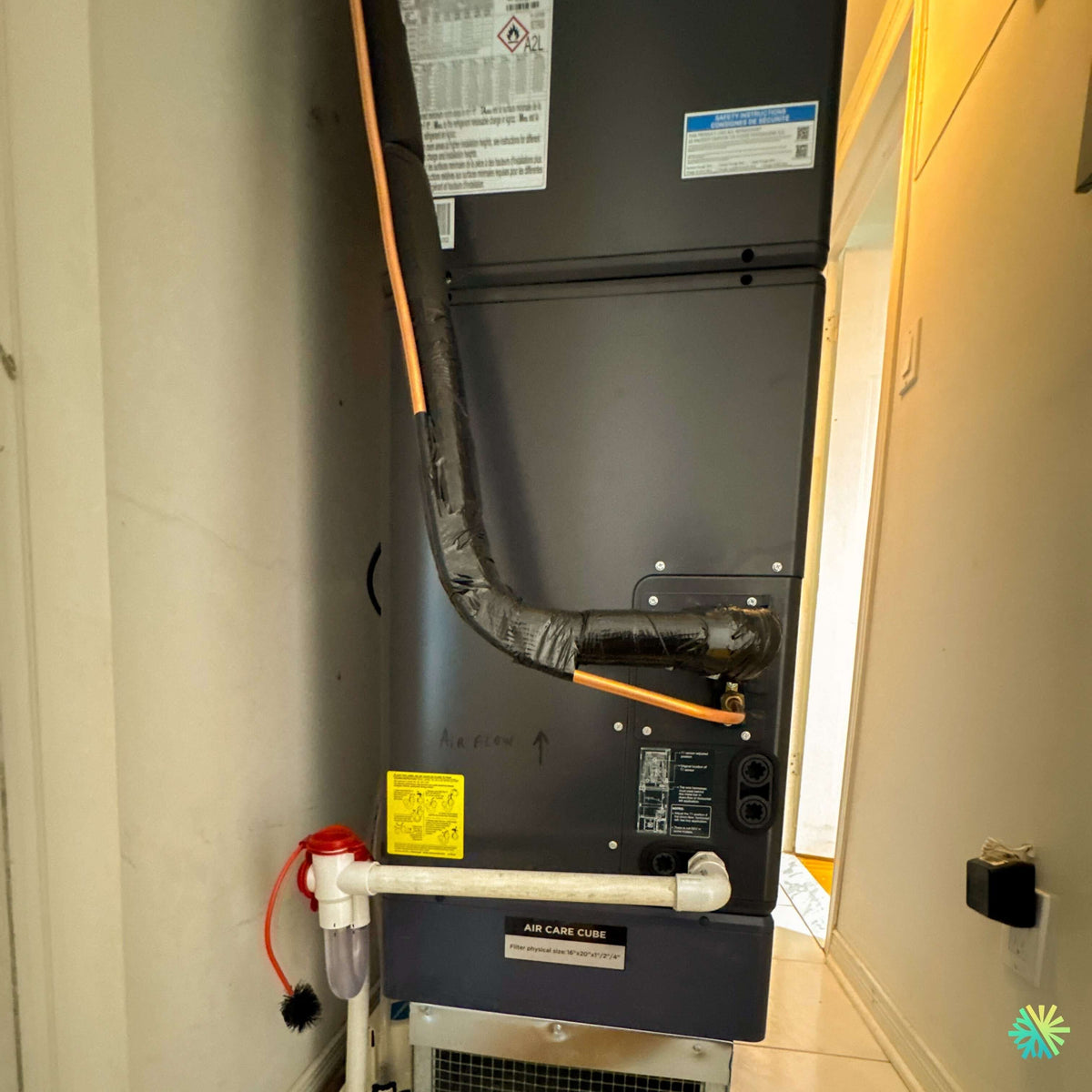
In this residence located right in the heart of Montreal, our team had to integrate a new central heating and air conditioning solution into a narrow mechanical room, with an existing configuration that required great precision. The project photo clearly shows the context: a vertical unit installed in a compact space, insulated refrigerant connections, PVC condensate drain with a cleaning trap, a front filter, and particular attention paid to the airflow direction.
This type of installation is not just about replacing equipment. It involves a complete intervention on indoor comfort, air circulation, system reliability, ease of maintenance, and energy performance. In a dense sector like Downtown Montreal, where housing can be exposed to significant temperature variations, substantial urban heat gains, and acoustic discretion requirements, a MIDEA EVOX G3 2-ton central system represents a very relevant solution when installed rigorously.
The choice of the MIDEA EVOX G3 2-ton: a central solution adapted to urban realities
The model installed here is a MIDEA EVOX G3 2-ton, used with an electric furnace / Air Handler in a central system configuration. This 2-ton capacity corresponds to a nominal power of approximately 24,000 BTU, which is suitable for several types of condos, apartments, and residential units located in urban buildings, provided the sizing is properly validated according to the area, insulation, sun exposure, duct distribution, and actual occupant needs.
At AirGreen, we place great importance on choosing the right capacity. An undersized unit will run too long and struggle to maintain comfort during peak periods. An oversized unit risks generating short cycles, poor dehumidification, irregular comfort, and premature wear. In this project in Downtown Montreal, the goal was to install a system that offers a strong balance between performance, comfort, and control.
The MIDEA EVOX G3 is appreciated for its integration into projects where a modern, efficient central solution compatible with current homeowner needs is sought. Depending on the complete system configuration, the installation can also help improve winter and summer comfort, while reducing reliance on more energy-intensive equipment or equipment less suited to the conditions of Montreal, Laval, Longueuil, the North Shore, and the South Shore.
A narrow mechanical space: the real challenge of this HVAC installation
The most significant feature of this installation was the available space. The unit is located in a narrow technical corridor or mechanical closet, with very little maneuvering room around the furnace. In these situations, the difficulty is not limited to placing the unit in the right spot. It also requires planning for:
- future filter access;
- access to service panels;
- proper airflow direction;
- reliable condensate drainage;
- safe passage for refrigerant lines;
- adequate pipe insulation;
- protection of existing walls, floors, and finishes;
- overall compliance of the installation.
In the photo, it's notable that the filter is installed on the front, with a clear indication of the required size. This attention is important because a hard-to-reach filter is often neglected by occupants. However, in a central system, the filter plays an essential role: it protects the coil, fan, coil, and ducts, while contributing to better indoor air quality.
We also paid particular attention to the direction of airflow. A handwritten note visible on the casing indicates the air direction, which prevents any confusion during future maintenance. This detail may seem simple, but it is very useful for technicians who will later work on the unit. A well-designed installation is one that remains understandable, accessible, and serviceable after the team has left.
Refrigerant connections: precision, insulation, and protection
The refrigerant lines visible in the image show careful insulation around the pipes. In a MIDEA electric furnace with Air Handler installation, these connections are essential for the proper functioning of the entire system when paired with an appropriate outdoor unit. Poor insulation can lead to efficiency losses, undesirable condensation, humidity risks, and reduced performance.
In a Downtown Montreal building, the stakes are even higher. Piping routes can be complex, access more difficult, and technical spaces often shared or limited. Our team must therefore work with precision to ensure clean, safe, and durable passage. Pipes must be protected against friction, well-positioned, and insulated in critical sections.
Aesthetics also matter. Even if the unit is installed in a technical space, a clean installation demonstrates a level of professionalism that is also found in less visible elements: brazing, pressure testing, vacuuming, drainage, leveling, electrical supply, and commissioning. At AirGreen, we believe that a successful HVAC installation is judged as much by what you see as by what you don't.
Condensate management: a detail that prevents big problems
The white PVC piping visible at the front of the unit corresponds to the condensate drainage system. It shows a configuration with a trap and cleaning access, a very important element for maintenance. In central systems, condensate produced in cooling mode must be reliably drained. Improper slope, a missing trap, a poorly sealed connection, or lack of cleaning access can lead to backups, water damage, or safety shutdowns.
In this project, the restricted space required organizing the drainage without blocking filter access or obstructing service panels. The result is a compact but functional installation, where each component retains its role. It is precisely in this kind of configuration that the experience of a local HVAC contractor becomes essential.
We regularly intervene in similar contexts in Montreal, Laval, Longueuil, on the North Shore, and on the South Shore, where clients want to replace an old system without overhauling all the building's mechanics. Our role is then to assess what can be kept, what needs to be adapted, and what absolutely must be corrected to ensure reliable operation.
A methodical commissioning for stable and lasting comfort
Once the unit is installed, commissioning is a crucial step. A well-selected MIDEA EVOX G3 2-ton can offer excellent comfort, but only if the installation is methodically validated. At AirGreen, we never consider a system finished simply because it is in place. We verify operation, airflow, connections, drainage, control parameters, and the overall system response.
Checks performed by our team
For this project in Downtown Montreal, our technicians performed a series of practical checks to ensure that the installation met customer expectations and the requirements of a high-performance central system. Among the elements checked were:
- the stability of the unit in its location;
- accessibility of the filter and panels;
- the tightness and quality of the connections;
- the insulation of the refrigerant lines;
- proper condensate flow;
- the direction of airflow;
- communication between system components, depending on the configuration;
- fan operation;
- the system's response to thermostat commands;
- absence of abnormal vibration or excessive noise.
These checks help prevent the most common problems after an installation: insufficient drainage, mispositioned filter, blocked service access, vibration, lack of airflow, or discomfort in certain rooms. In a downtown residence, where the client expects a discreet and reliable system, this rigor is essential.
Why filter access changes everything
The filter visible in the photo is a central element of maintenance. A dirty filter can reduce airflow, overwork the fan, decrease system performance, increase energy consumption, and impair comfort. In more advanced cases, it can even contribute to coil freeze-up in air conditioning or cause safety shutdowns.
We generally advise clients to check their filter regularly, especially in urban dwellings where dust, nearby renovations, pets, or occupancy density can accelerate particle accumulation. For a system like this MIDEA EVOX G3 electric furnace with Air Handler, simple but regular maintenance extends equipment life and improves comfort stability.
A good contractor doesn't just install the machine. They must also consider how the client will live with the system after installation. That's why we favor configurations where routine maintenance remains accessible, even when space is limited.
Mistakes to avoid during a central installation in a condo or restricted space
Central system projects in compact mechanical spaces present several pitfalls. Here are the mistakes we too often see during inspections or replacements:
Installing a unit without checking service access
A unit might seem well placed initially, but become very difficult to maintain if panels are blocked by a wall, door, pipe, or improperly positioned accessory. In this project, the front-facing organization allows for logical access to essential elements.
Neglecting condensate drainage
A poorly designed drain may work for a few weeks, then cause problems as dust accumulates. The presence of a trap and cleaning access is a simple measure that can prevent costly damage.
Poorly insulating refrigerant lines
Incomplete insulation can cause condensation on the pipes and reduce system efficiency. In a mechanical closet, humidity can quickly become a problem if ignored.
Replacing equipment without analyzing the ducts
The best unit will not perform well if the ducts are undersized, obstructed, or poorly balanced. On every project, we pay attention to existing air distribution, especially when the client reports rooms that are too hot or too cold.
Choosing a capacity solely based on the old unit
The fact that an old system had a certain capacity does not mean that this capacity is still ideal. Occupancy habits, renovations, insulation, and comfort expectations may have changed. For this installation in Downtown Montreal, the choice of the 2-ton unit had to be consistent with the actual needs of the dwelling.
A relevant solution for Montreal, Laval, Longueuil, the North Shore, and the South Shore
Although this project was carried out in Downtown Montreal, the same principles apply to many residential buildings in Greater Montreal. In Laval, we often encounter homes with aging central systems that require complete modernization. In Longueuil and on the South Shore, several properties combine electric heating, central heat pumps, and existing ductwork. On the North Shore, winter heating needs can be particularly significant, making equipment selection and installation quality even more critical.
AirGreen's strength lies in our ability to adapt each solution to the actual building. We do not offer a uniform approach. We analyze the space, ducts, access constraints, client expectations, budget, potential subsidies, and desired performance. This method allows for the installation of more reliable, better integrated, and easier-to-maintain systems.
Subsidies and eligibility: a point to validate before installation
Subsidy programs can represent a significant financial advantage for homeowners who install a central heat pump or modernize their HVAC system. Eligibility, however, depends on several factors: exact model, combination of indoor and outdoor units, certified energy efficiency, building type, installation date, program conditions, and documentation provided.
For an installation like this, our team can assist the client in understanding the available options, particularly for programs applicable in Quebec when the complete configuration is eligible. It is essential not to assume that equipment is automatically eligible simply because it is efficient. Model numbers, AHRI match-ups, and official criteria must be verified before presenting a final estimate of financial aid.
At AirGreen, this step is part of our professional approach. We know that customers in Montreal, Laval, Longueuil, the North Shore, and the South Shore often compare several quotes, and subsidies can strongly influence the decision. Our role is to provide clear, realistic information based on the exact system configuration.
The result: a clean, accessible central system ready for daily use
The result of this installation is a compact system, well-integrated and designed for the long term. The unit is installed in a confined space without sacrificing essential elements: filter access, drainage, insulated connections, airflow direction, and maintenance possibilities. For the customer, this translates into better comfort, simpler use, and increased peace of mind.
A MIDEA EVOX G3 2-ton electric furnace with Air Handler can become the heart of indoor comfort when properly installed. But the quality of the equipment never replaces the quality of execution. In this project in Downtown Montreal, our team had to contend with the concrete realities of the building: a narrow technical room, connections to be organized neatly, an evacuation to be secured, and maintenance access to be preserved.
This is exactly the kind of work that reflects the AirGreen approach: a careful HVAC installation, designed according to client needs, adapted to building constraints, and carried out with real attention to detail. Whether for a downtown condo, a house in Laval, a plex in Longueuil, a property on the North Shore, or a residence on the South Shore, we apply the same requirement: install a system that works well today and will remain practical to maintain tomorrow.
Practical tips after installation
To get the best performance from a central system like this, we recommend that owners follow a few simple practices:
- check the filter regularly and replace it as needed;
- keep the space in front of the unit clear;
- do not obstruct air returns and outlets;
- have the drainage inspected if water or humidity appears around the unit;
- plan periodic HVAC maintenance;
- promptly report any unusual noise, performance drop, or comfort variation.
These actions help preserve the system's efficiency and avoid preventable repairs. They are particularly important in urban buildings, where mechanical spaces are often small and a minor problem can quickly have consequences for daily comfort.
Why choose AirGreen for a MIDEA central installation
AirGreen installs, replaces, and maintains HVAC systems throughout Greater Montreal. Our experience with confined spaces, condos, townhouses, plexes, existing central systems, and new configurations allows us to offer solutions adapted to every situation. We know the realities of Montreal buildings, homeowner expectations, access constraints, performance requirements, and long-term maintenance challenges.
For this installation of a MIDEA EVOX G3 2-ton electric furnace in Downtown Montreal, our team delivered a precise, clean, and coherent project within the available space. The result demonstrates that a successful installation doesn't need to be spectacular to be remarkable. It must be well-thought-out, well-executed, and durable.
It is in these details that the true value of an experienced HVAC company lies.
The job tools
Two quick checks with real numbers: what heat costs, and what your current heaters add up to in BTU/h.
Conversion: 1 W = 3.412 BTU/h. An indication, not a load calculation: baseboards and furnaces are often stronger than the real need, and they can stay as backup. AirGreen confirms the capacity on site.
How the job unfolds
The main steps of this kind of job at AirGreen. Every house has its quirks: the estimate brings them out.
We look at the ducts, the current indoor module, the electrical panel and the planned spot for the outdoor unit.
The equipment combination, capacity and price, in writing. We check whether the combination qualifies for assistance programs.
Access protected, old unit disconnected and removed when it is being replaced.
Electric furnace or air handler, with its coil, connected to the supply and return ducts.
On a level base, raised above the snow, with free space all around.
Insulated, they enter through a sealed opening and run to the indoor coil.
Dedicated circuits, accessible disconnect, a thermostat that works with the heat pump and the backup heat.
Leak test, vacuum, start-up, airflow check and a test of both modes.
Filter, thermostat, backup heat in extreme cold: what to know before winter.
- The on-site estimateWe look at the ducts, the current indoor module, the electrical panel and the planned spot for the outdoor unit.
- The quoteThe equipment combination, capacity and price, in writing. We check whether the combination qualifies for assistance programs.
- Getting readyAccess protected, old unit disconnected and removed when it is being replaced.
- The indoor moduleElectric furnace or air handler, with its coil, connected to the supply and return ducts.
- The outdoor unitOn a level base, raised above the snow, with free space all around.
- The refrigerant linesInsulated, they enter through a sealed opening and run to the indoor coil.
- Electrical and thermostatDedicated circuits, accessible disconnect, a thermostat that works with the heat pump and the backup heat.
- Tests and start-upLeak test, vacuum, start-up, airflow check and a test of both modes.
- The walkthroughFilter, thermostat, backup heat in extreme cold: what to know before winter.
What we check on a job like this one
Each number is a point we check on site. Switch between summer and winter to watch air and heat move.
In summer, the outdoor unit rejects the house's heat outside.
Generic illustration of this type of installation, not a survey of this job site. Tap a number.
It captures or rejects heat outside. It sits on a level base, above the snow, with free space all around.
The insulated refrigerant lines enter the house through a sealed opening and run to the indoor coil.
A shut-off switch near the outdoor unit isolates it safely for service.
Sitting on the indoor module, it moves heat between the house air and the refrigerant.
Electric furnace or air handler: its fan pushes air through the ducts. The electric backup takes over in extreme cold.
Supply ducts bring air to the rooms; returns bring it back to the unit. Their condition matters as much as the unit's.
It protects the coil and the fan. A dirty filter cuts airflow, so it gets checked regularly.
It runs the heat pump and the backup heat. It must be compatible with the installed system.
Is your home ready?
Check what applies at your place. A "no" is not a refusal: it is what we sort out during the estimate.
Good habits, once the unit is in place
Six simple habits that keep the unit going. Your list stays on this device.
What to do, season by season
Three habits per season for this unit. They take a few minutes and prevent many calls.
- Check the indoor module's filter.
- Clear winter debris from the outdoor unit.
- Test cooling before the heat arrives.
- Check the filter more often in peak season.
- Keep registers and returns clear.
- Watch condensate drainage near the coil.
- Change or clean the filter.
- Test heating and backup heat before the cold.
- Book periodic maintenance.
- Clear snow around the outdoor unit.
- Store nothing in front of the indoor module.
- Note any unusual noise or smell and call us.
The right pages, at the right time
Four statements: true or false?
It all comes down to details you have just seen.
1. A central heat pump uses the house's ducts.
It connects to the existing ducts to heat and cool everywhere.
2. In extreme cold, electric backup heat can take over.
The indoor module (furnace or air handler) works with the heat pump and takes over in extreme cold.
3. The filter only gets changed when the unit breaks down.
A dirty filter cuts airflow. It gets checked regularly.
4. You can reuse the old unit's size without checking.
The house may have changed: insulation, windows, added rooms. Capacity is confirmed on site.
0 / 4 right answers
What people ask us about this kind of work
Can I keep my current ducts?
What happens in extreme cold?
Furnace, air handler, ducted: what is the difference?
Are there grants?
Do I need a permit?
How much can I save?
How is the LogisVert assistance calculated?
Will my current thermostat work?
Central or wall units: which one?
Does AirGreen hold the required licences?
Is the estimate free?
No question matches. Write to us: we answer.
More jobs to see, near you
By town, by equipment or by region: browse more than 4,700 published projects.
Each dot: a town where AirGreen has published projects. The glowing dot: this job.
An on-site estimate, the right capacity, the right equipment.
The on-site estimate is free and the quote follows within 24 hours.
Text and photo: a real AirGreen Climatisation & Chauffage job. The diagrams are generic illustrations of the type of installation, not a survey of this job site. Sources of the added figures: airgreen.ca product pages (NEEP / AHRI performance), Hydro-Québec (Heat pumps page, LogisVert, read on 13 October 2026), Régie de l’énergie (rate D as of 1 April 2026).