
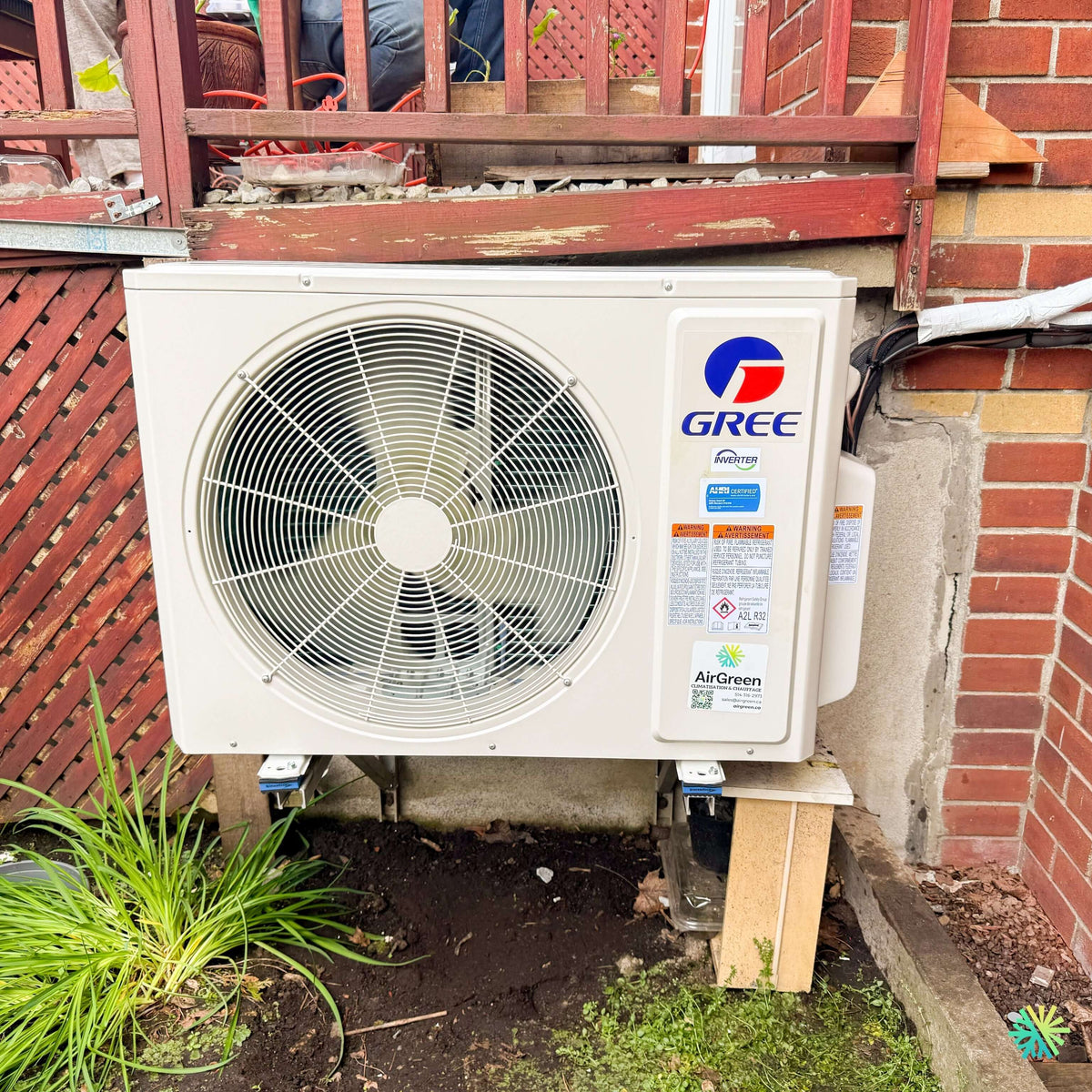
Installation of a GREE FreeMatch R32 2-head heat pump (GWHD(24)ND6MO) in Saint-Joseph-de-Sorel, Pierre-De Saurel RCM
A GREE FreeMatch R32 two-head wall-mounted heat pump installed in Saint-Joseph-de-Sorel, with one head dedicated to a basement workout room: why 6,000 BTU/h rather than 12,000, what the city actually requires, and why you should never “filter” the outdoor unit.
In summer, the outdoor unit rejects the house's heat outside.
Generic illustration of this type of installation, not a survey of this job site. Tap a number.
Mounted level on a wall plate, high enough for the air to reach the whole room, with enough space around it to slide the filters out easily.
The refrigerant lines, the communication cable and the drain go through the wall in a single opening, sealed against water, cold air and insects.
Two insulated copper pipes connect the two units. Outside, a line cover can protect them from sun, knocks and weather.
A shut-off switch near the outdoor unit isolates it safely for service. It must stay accessible at all times.
The compressor and the fan. In heating mode it captures heat from the outdoor air, even in winter, and moves it inside.
On the ground or on the wall, it keeps the unit above accumulated snow. The unit stays clear and defrost water can drain away.
The fan needs to blow freely. Storage, a fence or a wall too close, and efficiency drops while noise goes up.
A 1.4 km² city wedged between two rivers and heavy industry: what this changes for an air-conditioning project
Saint-Joseph-de-Sorel there is no equivalent in the Montérégie. Enclosed between the St. Lawrence River, the Richelieu River, and Sorel-Tracy—as the city itself puts it—it occupies approximately 1.4 km² at the confluence, with the QSL maritime terminal on Étienne Street at one end and the Sorel Forges (Finkl Steel) on McCarthy Street at the other. Established as a parish in 1875, as a village municipality in 1907, and then as a city in December 1942, it bears the name of M<sup>gr</sup> Joseph Larocque and that of Pierre de Saurel, captain of the Carignan-Salières Regiment. Long known for its shipyards, it still exists today within a port and metalworking landscape.
A HVAC installation this is therefore not the installation of a South Shore Montreal suburban home transposed 70 km east. At AirGreen, we installed, in this city, a GREE FreeMatch R32 two-head wall-mounted heat pump, model GWHD(24)ND6MO, in a house where half of the comfort plan takes place in the basement—and where the dominant constraint was neither the façade nor the neighbour, but a use that few homeowners spontaneously disclose to their contractor: a training room.
The selected configuration, in plain terms
| Item | Value |
|---|---|
| Outdoor unit | GREE FreeMatch R32 GWHD(24)ND6MO |
| AHRI certification (ductless) | 214931587 |
| Rated capacity | 24,000 BTU/h in cooling mode and in heating mode |
| Modulating range | 7,500 to 31,400 BTU/h |
| Efficiency | SEER2 21 · HSPF2 10 · EER2 12 · COP 3.9 |
| Power supply | 208/230 V · MCA 19.5 A · MOCP 25 A |
| Operating range | −30°C to 48°C in cooling mode · −30°C to 24°C in heating mode |
| Sound level (high speed) | 58 dB(A) · airflow 2,236 CFM |
| Refrigerant | R32 (A2L), 1,700 g precharged |
| Dimensions / weight | 964 × 660 × 402 mm · 51 kg |
| Piping | Precharge 30 m · max. total 60 m · max. elevation difference 15 m · 1/4 in. liquid, 3/8 in. gas |
| Heads | 15,000 BTU/h (open area, main floor) + 6,000 BTU/h (training room, basement) |
| Total head capacity | 21,000 BTU/h, namely 88% of nominal |
| Warranty | 10 + 2 years compressor and parts, upon registration with Wolseley |
The developed lengths were measured before ordering: 4 m for the main-floor head, 12 m for the basement one, including the foundation bypass, namely 16 m in total. Below the 30 m precharged, therefore no additional weighed charge. We point this out because the reverse interpretation is widespread: an unused precharge is neither a discount nor a reserve. It is a quantity calibrated for a given length; below that, the unit operates exactly as intended, and above that, we add 20 g per meter to the load scale. Nothing more, nothing less.
The basement used as a gym: a thermal load that has nothing to do with floor area
This is the heart of this project, and it is also the scenario that produces the most sizing errors we see when taking over work, in Montreal as in Laval, in North Shore as on the South Shore.
Why a 20 m² room may require less than you think
A finished basement is thermally buffered by the surrounding ground. Its envelope load is low, its solar gains are nearly zero, and its starting temperature in July is already the lowest in the house. It is not the room that heats up; it is the people inside.
A seated adult gives off just over one hundred watts. The same adult during sustained exercise gives off several times that, part of it latent considerable—perspiration. Two people exercising for 45 minutes in an enclosed room therefore create a latent load intense, brief, very humid, and perfectly intermittent : four hours a week, perhaps, divided into 45-minute peaks.
The commercial reflex when faced with this description is to sell a 12,000 BTU/h unit “because it gets hot in there.” We did the opposite and installed 6,000 BTU/h. Here is the complete reasoning, including what it costs.
- An oversized unit dehumidifies less effectively, not more. It reaches the setpoint quickly, modulates downward, and shortens its cycles. Yet it is the contact time between humid air and a cold coil that removes moisture. In a room where perspiration is the main problem, an oversized unit treats the thermometer and leaves the hygrometer unchanged.
- The useful lever is not capacity; it is air movement and anticipation. A workout room is managed by starting the unit 15 to 20 minutes before the session, at a high fan speed, with the airflow directed toward the exercise area—not toward a mirrored wall or at the back of someone resting between sets. The feeling of coolness during exercise depends more on air speed over the skin than on lowering the displayed temperature by two degrees.
- The cost borne, published here frankly: the modulation floor of the GWHD(24) is 7,500 BTU/htherefore above of a single 6,000 BTU/h head. When a basement head calls alone, in evening, the system runs at its minimum and shorter cycle in this room specific. We explained it to the the client before signing rather than after the first summer. It is the same mechanism than the one described in our Rosemont and Sainte-Christine : the floor is a property of the system, not a defect of the head.
What a wall-mounted head will never do in a gym
It this must be stated clearly, because the expectation exists. A a wall-mounted heat pump recirculates the room’s air; it does not ventilate it. It does not remove the CO₂ accumulated by two people exerting themselves in an enclosed space, neither the odors nor the compounds released with new rubber mats. Our articles on Longueuil and Beauharnois explain this refusal in detail; here, the practical consequence fits in one sentence: the gym door does not remain closed permanently, and mechanical ventilation remains a separate matter, to be handled by the right specialist.
TwoSecond maintenance point, specific to this use: a gym head’s filter gets clogged faster than a bedroom’s. Textile fibers, carpet dust, rubber particles. We agreed with this client a more frequent filter-cleaning schedule for this head than for the ground-floor one—two rooms, two schedules, in the same contract.
The ground-floor head: 15,000 BTU/h for the open area
The other half of the system serves the kitchen, dining room, and living room as one continuous space. 15,000 BTU/h in an open area, with a high-mounted head and clearance side observed, this is the configuration that best covers a through-space without creating a dead zone at the back of the room. The total 15,000 + 6,000 = 21,000 BTU/h place the system to 88% of its nominal capacity : below nominal, therefore with reserve for heating, and far from the modulated maximum of 31,400 BTU/h. The distribution 15 + 6 is a distinct choice from the 12 + 9 configurations that we have published in Beaconsfield and Repentigny on the same compressor — same total, logical room arrangement different.
What Saint-Joseph-de-Sorel regulates, and this that its air requires
A rare case: the the city states in black and white that no no permit is required
After dozens of articles in which we had to refer the reader to the service planning regulations without being able to cite anything this be, Saint-Joseph-de-Sorel offers a published response. Its page Permit application class explicitly the“installation of a heat pump” among the work that does not require a permit, alongside the carport temporary, from the household exterior and antenna.
Three nuances, because a misread exemption costs more than a permit.
- No permit does not mean no rules. The same list assigns a minimum distance of 2 m from a property line property line to a propane tank, and refers the fences and hedges to the “distances specific regulatory requirements.” It does not attach any distance to the heat pump—which does not mean that the Zoning By-law 192, which governs the permitted uses in front, side, and rear clearances, either silent. We do not claim it, and we we have not verified it article by article. article.
- The page names the heat pump, not the air conditioner. We do not extend the exemption by analogy to a wall-mounted air conditioner or to a system central.
- The procedure remains the same on our end: a call to the Service contact the planning department before setting the date, with the with the manufacturer's data in hand—mass of 51 kg, footprint of 964 × 660 mm, MCA 19.5 A / MOCP 25 A under 208/230 V, 58 dB(A) at high speed. The one that decides then works from figures, not an estimate.
The air of a port and steelmaking city, and the “filter” trap on the unit outdoor
Marine terminal, steel mill, heavy traffic: the local atmosphere deposits more on an outdoor coil than that of a residential neighborhood. The fouling and corrosion mechanisms corrosion, we documented them in detail in our article on Montréal-Est, and the question of aggressive degreasers for aluminum in that of BrossardWe we will not return to it.
What no one said, however, and that we we see appearing every year in the backyard: the owner who, thinking they are doing the right thing, wraps their outdoor unit in a filter sleeve bought online.
It is a bad idea, and for good reasons specific mechanical reasons:
- An outdoor coil has no filter by design, not by omission. It is designed to be washed, not protected.
- A sleeve adds pressure loss on the intake side. The airflow drops, the condensing pressure rises in cooling mode, and efficiency measured on the test bench AHRI no longer has anything to do with that of the field field.
- In the cold season, this fabric becomes a frost trap, precisely where the unit relies on a free exchange to defrost properly.
- The fan grille is not a filter either. It protects the fingers.
What to do with the place, in an environment loaded: maintain clearances that allow access the fin coil to wash it, wash from the inside toward the outside to remove the deposits in the opposite direction of their entry, and set the frequency based on what the site is actually removed—not on a generic schedule. In this city, that means annual cleaning rather than every three years.
The outdoor installation
The unit was installed along the wall of brick, on a dedicated base replicating the unit's complete footprint, slope taken by the base rather than by shims. Our articles on Sainte-Christine and La Prairie explain why a a board slipped under one foot ends up always give way on one side, and those ofAhuntsic-Cartierville and Villeray why nothing durable does not attach to stucco or brick veneer alone. Here, the electrical connection and the disconnect were entrusted to a master electrician, and the penetration through the wall was drilled with a slope toward outside.
Subsidies: what still exists in 2026
The GWHD(24)ND6MO is certified, AHRI-certified ENERGY STAR and recognized cold-climate, with a range of heating down to −30 °C. Two programs remain open and deserve to be verified when opening of the file: LogisVert from Hydro-Québec and RénoclimatWe . We publish no amount and no eligibility promise—the verification is handled through the file, with the program administrator, and the AHRI code must correspond exactly to the installed combination.
A correction is required by elsewhere, because many pages contractors still have it posted: the program Chauffez vert ended on March 31, 2026 and no longer accepts requests. Any page that presents it listed today as available is expired.
Our presence in the area
Our teams serve Montreal, Laval, Longueuil, the North Shore and the South Shore, and the corridor of Saint-Laurent to Sorel. Our worksites FreeMatch R32 of Verchères and Varennes already focused on exposure river-facing and exposed to wind and humidity of the river; that of Saint-Denis-sur-Richelieu, at a about thirty kilometers upstream, remains our reference for the diversity factor in a multi-zone system. Saint-Joseph-de-Sorel is our first page in the Pierre-De Saurel RCM — the entire worksite, basic equipment and refrigerant scale included, was loaded initially for a single mobilization and a single day.
For a project ofHVAC installation, of replacement orHVAC maintenance in the Sorel-Tracy area as in Greater Montreal, our advisors assess the parts schedule before propose a model. It is in this order in which errors in sizing is adjusted : at the office, not on the truck roof.
How it goes, from the first call to the end
The main steps of this kind of job at AirGreen. Every house has its quirks: the estimate brings them out.
We look at the room, the outside wall, the line route and where the outdoor unit will go. That is where the capacity gets chosen.
Model, capacity and price, in writing. We also check whether the model qualifies for assistance programs.
Floors and furniture protected, wall plate position marked level, wall opening located.
A single opening, with the slope the drain needs to flow outside.
Set on a stand raised above the snow, with the clearances the manufacturer requires.
Connected, insulated and protected. The opening is then sealed against water, cold air and insects.
A dedicated circuit and an accessible disconnect near the outdoor unit.
Leak test, vacuum, then start-up and a check of heating and cooling.
Remote, modes, filters: we show you the essentials before we leave.
- The on-site estimateWe look at the room, the outside wall, the line route and where the outdoor unit will go. That is where the capacity gets chosen.
- The quoteModel, capacity and price, in writing. We also check whether the model qualifies for assistance programs.
- Getting readyFloors and furniture protected, wall plate position marked level, wall opening located.
- The wall openingA single opening, with the slope the drain needs to flow outside.
- The outdoor unitSet on a stand raised above the snow, with the clearances the manufacturer requires.
- Lines, cable and drainConnected, insulated and protected. The opening is then sealed against water, cold air and insects.
- The electrical workA dedicated circuit and an accessible disconnect near the outdoor unit.
- Tests and start-upLeak test, vacuum, then start-up and a check of heating and cooling.
- The walkthroughRemote, modes, filters: we show you the essentials before we leave.
And at your place?
Two quick checks with real numbers: what heat costs, and what your current heaters add up to in BTU/h.
Conversion: 1 W = 3.412 BTU/h. An indication, not a load calculation: baseboards and furnaces are often stronger than the real need, and they can stay as backup. AirGreen confirms the capacity on site.
What to do, season by season
Three habits per season for this unit. They take a few minutes and prevent many calls.
- Clean the indoor unit's filters.
- Clear leaves and debris left on the outdoor unit by winter.
- Test cooling before the first hot days.
- Clean the filters more often when the unit runs a lot.
- Keep plants away from the outdoor unit.
- Check that no water drips from the indoor unit.
- Rake the leaves around the outdoor unit.
- Test heating before the first cold days.
- Book periodic maintenance before winter.
- Keep snow away from the stand and the front of the unit.
- Let the unit defrost: it is normal.
- Never hit the ice on the fins; call us if the unit stays iced up.
Which type of equipment for your project?
Pick what looks like your need.
Four mistakes we do not make
Flip each card to see what we do instead.
What people ask us about this kind of work
Does a wall-mounted heat pump heat in winter?
Wall-mounted or multi-zone: how do I choose?
Where does the outdoor unit go?
Are there grants?
Do I need a permit?
How cold can it heat?
How much can I save?
How is the LogisVert assistance calculated?
Is it noisy?
The outdoor unit is covered in ice: is that normal?
Does AirGreen hold the required licences?
Is the estimate free?
No question matches. Write to us: we answer.
Useful pages for what comes next
More jobs to see, near you
By town, by equipment or by region: browse more than 4,700 published projects.
Each dot: a town where AirGreen has published projects. The glowing dot: this job.
Tell us about your house. We come and see it for free.
The on-site estimate is free and the quote follows within 24 hours.
Text and photo: a real AirGreen Climatisation & Chauffage job. The diagrams are generic illustrations of the type of installation, not a survey of this job site. Sources of the added figures: airgreen.ca product pages (NEEP / AHRI performance), Hydro-Québec (Heat pumps page, LogisVert, read on 13 October 2026), Régie de l’énergie (rate D as of 1 April 2026).