
Installation of a Fujitsu Aquila XLTH dual-zone heat pump in Saint-Léonard, Montreal
In Saint-Léonard, AirGreen installs a Fujitsu Aquila XLTH dual-zone heat pump on a wall bracket, with protected lines and precise integration into a narrow outdoor passage.
- City
- Region
- Equipment
- Brand
- Challenges
- Published
The job on one screen
The article, chapter by chapter
A multi-zone installation completed in a narrow outdoor passage without compromising access or airflow
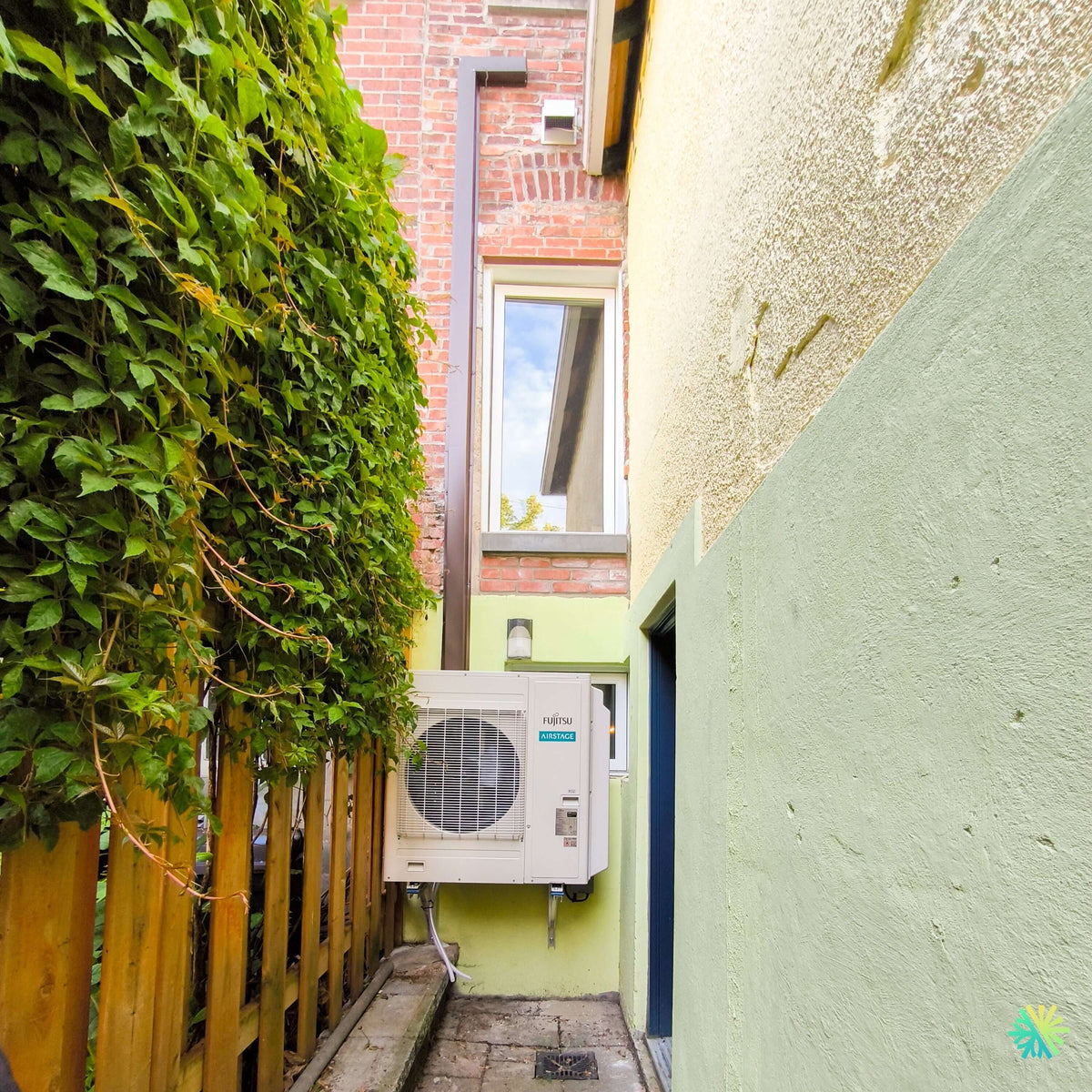
At Saint-Léonard, we installed a Fujitsu Aquila XLTH dual-zone heat pump in an outdoor configuration that required particularly precise planning. The outdoor unit had to be integrated into a narrow side passage bordered by a building wall, a wooden fence, and dense vegetation. In this type of environment, a few inches can make a significant difference to the unit’s ventilation, access to the service panel, the passage of the lines, and future maintenance.
The project photograph shows the Fujitsu AIRSTAGE outdoor unit mounted on a metal wall bracket, above ground level. The refrigerant lines are grouped inside a dark-colored vertical line cover that runs up along the brick wall before branching toward the inside of the building. This finish protects the mechanical and electrical connections while maintaining an orderly appearance despite the height of the run.
The owner’s goal was to heat and cool two separate spaces with a single outdoor unit. A single-zone configuration would have left part of the building less adequately served, while installing two separate compressors would have occupied more space in this already restricted passage.
The Fujitsu Aquila XLTH dual-zone system therefore makes it possible to connect two indoor units to a single outdoor unit, with independent control in each area.
Why did the side passage present a genuine installation challenge?
A narrow passage leaves virtually no room to correct poor positioning after installation. Before starting, we must check several constraints simultaneously:
- clearance in front of the fan;
- air intake at the rear and on the sides;
- the distance from the fence;
- the presence of climbing plants;
- the possible opening of nearby doors;
- access to the electrical and refrigeration panels;
- the technicians’ access route;
- the drainage of defrost water;
- the route of the lines to the two indoor units.
In this installation in Saint-Léonard, the unit is placed at the back of the passage, against an exterior wall. This position keeps the central area clear and preserves pedestrian access. It also allows the fan to be directed toward the open space in front of the unit rather than directly at a wall.
A multi-zone compressor must never be confined in a space where the expelled air can immediately return toward the heat exchanger. This recirculation can affect performance, particularly on very hot days or during periods of intensive heating.
A wall bracket suited to the environment
We chose a metal wall bracket rather than a ground pad. This decision served several objectives.
The walkway has paving, a drain, and surfaces where water may accumulate. By raising the unit, we reduce its exposure:
- to puddles;
- to leaves;
- to soil;
- to plant debris;
- to snow accumulation;
- to the ice produced during defrost cycles.
The wall bracket also frees up the ground, making it easier to clean the walkway and avoiding the creation of a permanent obstacle around the drain visible in the centre of the driveway.
A wall-mounted installation nevertheless requires secure fastening. The wall must be able to support the weight of the unit and the forces produced by vibrations. The anchors, the level of the brackets, and the position of the support points must be checked before placing the outdoor unit.
A vertical line route protected by a line-set cover
The photograph shows a long vertical line-set cover installed on the brick wall. This detail is particularly important for a dual-zone heat pump.
The lines connecting the outdoor unit to the indoor units generally include:
- the refrigerant lines;
- the power or communication wiring;
- the pipe insulation;
- sometimes part of the drainage system, depending on the configuration.
Leaving these components exposed for several metres would increase the risk of wear caused by the sun, rain, freezing, impacts, and movement. The line-set cover protects the installation while improving the visual finish on the rear façade.
The visible route runs between the building openings and around the existing architectural features. We must plan this type of route before drilling to avoid windows, vents, roof edges, and areas that are difficult to seal.
A dual-zone heat pump for two distinct needs
The principle of a dual-zone system is simple: one outdoor unit supplies two indoor units, each assigned to a section of the building.
This makes it possible, for example, to treat the following separately:
- a ground floor and an upper floor;
- a living room and a bedroom;
- a main living area and a basement;
- a room at the front and another at the back;
- an open-plan area and an office;
- two levels with different thermal loads.
Each indoor unit can be controlled separately. Occupants can therefore select different set temperatures and operate only one zone when the other does not need heating or cooling.
However, it is important to understand that a multi-zone system operates with one shared overall mode. Fujitsu specifies that AIRSTAGE systems can provide heating and cooling, but not simultaneously. Therefore, one zone cannot heat while the other cools.
This limitation is rarely an issue in a home, since both zones generally require heating during the winter and cooling during the summer. Nevertheless, we explain it during commissioning so that the operation of the remote controls is clearly understood.
Fujitsu Aquila XLTH: a solution designed for cold climates
The Fujitsu Aquila XLTH range is designed for applications where winter heating plays an important role. Fujitsu documentation on H-series multi-zone systems indicates that cold-climate units can operate in heating mode down to -26 °C.
This feature is relevant in Saint-Léonard and elsewhere in Montreal, where winter temperatures can drop well below freezing.
However, the minimum operating temperature must be distinguished from the capacity actually delivered at low temperatures. A heat pump may continue to operate as the temperature drops, but its capacity and efficiency vary depending on the conditions.
That is why we analyze:
- the building’s heat loss;
- the area of each zone;
- ceiling height;
- insulation;
- windows;
- air infiltration;
- solar exposure;
- the presence of supplemental heating;
- available capacity at low temperatures.
Selecting a system based solely on a rough BTU-per-square-foot rule can be misleading. Two rooms of the same size may require very different capacities.
Outdoor units from 18,000 to 45,000 BTU/h
The H Aquila series documentation lists outdoor units rated at 18,000, 24,000, 36,000, and 45,000 BTU/h. Depending on the model, they can accommodate two to five indoor units.
For a dual-zone installation, Fujitsu authorizes several combinations. The outdoor unit intended for two zones can be paired with different capacities of wall-mounted indoor units, depending on the needs of the rooms.
The manufacturer’s tables also show that certain combinations can exceed 100% of the outdoor unit’s rated capacity. This excess does not mean that the compressor automatically produces more power. Fujitsu specifies that exceeding the combined capacity does not increase the system’s output capacity.
For example, two indoor units whose combined rated capacity slightly exceeds the outdoor unit’s capacity may be permitted if their peak demands do not occur constantly at the same time. However, capacity remains shared when both zones place heavy demands on the system.
For this reason, the manufacturer recommends using the Design Simulator software to select H-series AIRSTAGE equipment. The tables help confirm whether a combination is permitted, but they do not replace a load analysis.
Dense vegetation to monitor around the unit
The photograph shows extensive climbing vegetation along the fence to the left of the unit. This setting adds character to the yard, but it requires regular monitoring.
Branches and leaves can gradually move closer to the heat pump. If they reach the heat exchanger or fan, they may:
- reduce airflow;
- retain moisture;
- accumulate dust;
- cause noise;
- partially obstruct the coil;
- make access more difficult for the technician.
We recommend trimming the vegetation to maintain consistent clearance around the unit. A properly installed heat pump can lose some of its efficiency if its surroundings change with the seasons.
You should also remove fallen leaves from the ground and check that the passage drain remains clear.
The technical details that ensure the reliability of a multi-zone installation
Prepare the two circuits without mixing them up
A dual-zone heat pump has two sets of refrigerant lines and wiring. Each set must correspond to the correct indoor unit.
A mix-up between the circuits can cause inconsistent behavior: a command made in one room may activate the wrong circuit or trigger a communication error.
To avoid this problem, we identify the zones during installation and test them individually during commissioning.
The procedure notably includes:
- starting the first indoor unit;
- confirmation of the corresponding refrigerant circuit;
- communication verification;
- testing of the second unit;
- simultaneous operation of both zones;
- supply-air temperature verification;
- drain inspection.
Test for leaks before commissioning
Refrigerant connections must remain completely leak-tight. Even a slow leak can reduce performance, increase operating time, and eventually damage the compressor.
After preparing the lines, we perform the necessary steps to confirm the circuit’s integrity. The vacuuming process then removes air and moisture before the refrigerant is released.
These steps are invisible once the line-set cover is closed, but they are crucial to the longevity of the HVAC system.
Take the refrigerant and A2L labeling into account
The unit shown in the photograph bears a marking associated with the category A2LThis classification indicates that the refrigerant has low flammability and must be handled using appropriate practices.
For the homeowner, daily use remains routine. However, work on the refrigeration circuit must be entrusted to trained technicians using the appropriate equipment.
Never drill into, move, or modify the lines without considering the refrigerant present in the system.
Plan for defrost water in winter
In heating mode, the outdoor heat exchanger may accumulate frost. The heat pump then initiates a defrost cycle, which produces water.
In this project, the unit is elevated, allowing water to drain beneath it rather than remain trapped in its base. The floor drain is also an element to consider in the overall management of water in the passageway.
However, the homeowner must monitor ice formation during the winter. If water freezes beneath the unit or on the walkway, it can create a slippery surface or form a block that approaches the bottom of the compressor.
Never strike the unit with a metal tool to remove ice. Any abnormal buildup must be assessed to determine its cause.
Maintain proper access for maintenance
The outdoor unit is located in a compact area, but its side panel remains accessible from the passageway. This accessibility is essential for future service work.
A technician must be able to:
- open the panels;
- check the connections;
- measure the electrical parameters;
- inspect the valves;
- clean the heat exchanger;
- inspect the condition of the support;
- check the lines.
An installation that works well on the day it is commissioned but becomes impossible to maintain is not a durable installation.
Mistakes to avoid in a narrow outdoor space
This Saint-Léonard project highlights several common mistakes we aim to prevent:
- installing the unit too close to a fence;
- directing the fan straight at a wall;
- allowing vegetation to reach the heat exchanger;
- blocking a door or passageway;
- placing the unit in an area where water accumulates;
- using a support that is too low;
- neglecting access to the service panel;
- leaving the lines exposed;
- failing to properly protect wall penetrations;
- choosing a capacity without analyzing both zones;
- assuming that the total number of wall-mounted heads corresponds to the actual output.
Every decision affects the system’s performance, noise level, maintenance, and lifespan.
Maintenance tips for homeowners
To keep this Fujitsu heat pump in good condition, we recommend a few simple checks.
Outside
The homeowner should:
- keep the area in front of the fan clear;
- trim climbing plants;
- remove leaves from the ground;
- monitor the condition of the line-set cover;
- check that the outdoor drain is not obstructed;
- clear snow from around the unit;
- look for any unusual ice buildup.
Indoors
The filters in both wall-mounted units should be cleaned regularly. A clogged filter reduces airflow and may affect comfort in the corresponding zone.
You should also monitor:
- unusual noises;
- odors;
- water droplets;
- reduced airflow;
- error codes;
- temperature differences between the zones.
Professional HVAC maintenance makes it possible to inspect the heat exchangers, drains, blower wheel, electrical connections, and the system’s overall operation.
Incentives and eligibility of the exact combination
A cold-climate heat pump may qualify for financial assistance, but eligibility depends on the complete installed combination.
The following must be confirmed:
- the outdoor model number;
- the models of both indoor units;
- the recognized combination;
- the applicable performance reference;
- the purchase date;
- the installation date;
- the program rules in effect when the application is submitted.
The photograph does not show the appliance’s complete model number or capacity clearly enough to read. It would therefore be inaccurate to announce a rebate amount or a precise energy rating based on the image alone.
At AirGreen, we rely on the exact numbers recorded in the project file to prepare the relevant documentation.
The result of this installation in Saint-Léonard
This Fujitsu Aquila XLTH dual-zone heat pump installation in Saint-Léonard now provides more precise heating and cooling control in two distinct areas of the building.
The result stands out for:
- a single outdoor unit for two zones;
- a wall-mounted installation that keeps the passage clear;
- clearance adapted to the available space;
- a vertical, protected piping route;
- a clean integration into the brick wall;
- accessibility maintained for servicing;
- a solution designed for cold-climate heating;
- more targeted use according to room occupancy.
We carry out this type of project in Saint-Léonard, throughout Montreal, as well as in Laval, Longueuil, on the North Shore, and on the South Shore. Every building has its own constraints: narrow passageways, balconies, rooftops, masonry walls, condominiums, or densely landscaped backyards.
Our work consists of adapting the equipment to the reality of the location. Choosing the right heat pump matters, but its placement, ventilation, support, connections, and accessibility are just as important for achieving a reliable and comfortable system.
The job tools
Two quick checks with real numbers: what heat costs, and what your current heaters add up to in BTU/h.
Conversion: 1 W = 3.412 BTU/h. An indication, not a load calculation: baseboards and furnaces are often stronger than the real need, and they can stay as backup. AirGreen confirms the capacity on site.
How the job unfolds
The main steps of this kind of job at AirGreen. Every house has its quirks: the estimate brings them out.
We look at the room, the outside wall, the line route and where the outdoor unit will go. That is where the capacity gets chosen.
Model, capacity and price, in writing. We also check whether the model qualifies for assistance programs.
Floors and furniture protected, wall plate position marked level, wall opening located.
A single opening, with the slope the drain needs to flow outside.
Set on a stand raised above the snow, with the clearances the manufacturer requires.
Connected, insulated and protected. The opening is then sealed against water, cold air and insects.
A dedicated circuit and an accessible disconnect near the outdoor unit.
Leak test, vacuum, then start-up and a check of heating and cooling.
Remote, modes, filters: we show you the essentials before we leave.
- The on-site estimateWe look at the room, the outside wall, the line route and where the outdoor unit will go. That is where the capacity gets chosen.
- The quoteModel, capacity and price, in writing. We also check whether the model qualifies for assistance programs.
- Getting readyFloors and furniture protected, wall plate position marked level, wall opening located.
- The wall openingA single opening, with the slope the drain needs to flow outside.
- The outdoor unitSet on a stand raised above the snow, with the clearances the manufacturer requires.
- Lines, cable and drainConnected, insulated and protected. The opening is then sealed against water, cold air and insects.
- The electrical workA dedicated circuit and an accessible disconnect near the outdoor unit.
- Tests and start-upLeak test, vacuum, then start-up and a check of heating and cooling.
- The walkthroughRemote, modes, filters: we show you the essentials before we leave.
What we check on a job like this one
Each number is a point we check on site. Switch between summer and winter to watch air and heat move.
In summer, the outdoor unit rejects the house's heat outside.
Generic illustration of this type of installation, not a survey of this job site. Tap a number.
Mounted level on a wall plate, high enough for the air to reach the whole room, with enough space around it to slide the filters out easily.
The refrigerant lines, the communication cable and the drain go through the wall in a single opening, sealed against water, cold air and insects.
Two insulated copper pipes connect the two units. Outside, a line cover can protect them from sun, knocks and weather.
A shut-off switch near the outdoor unit isolates it safely for service. It must stay accessible at all times.
The compressor and the fan. In heating mode it captures heat from the outdoor air, even in winter, and moves it inside.
On the ground or on the wall, it keeps the unit above accumulated snow. The unit stays clear and defrost water can drain away.
The fan needs to blow freely. Storage, a fence or a wall too close, and efficiency drops while noise goes up.
Is your home ready?
Check what applies at your place. A "no" is not a refusal: it is what we sort out during the estimate.
Good habits, once the unit is in place
Six simple habits that keep the unit going. Your list stays on this device.
What to do, season by season
Three habits per season for this unit. They take a few minutes and prevent many calls.
- Clean the indoor unit's filters.
- Clear leaves and debris left on the outdoor unit by winter.
- Test cooling before the first hot days.
- Clean the filters more often when the unit runs a lot.
- Keep plants away from the outdoor unit.
- Check that no water drips from the indoor unit.
- Rake the leaves around the outdoor unit.
- Test heating before the first cold days.
- Book periodic maintenance before winter.
- Keep snow away from the stand and the front of the unit.
- Let the unit defrost: it is normal.
- Never hit the ice on the fins; call us if the unit stays iced up.
The right pages, at the right time
Four statements: true or false?
It all comes down to details you have just seen.
1. In heating mode, the outdoor unit can produce water.
During defrost cycles. That water must drain away without forming ice.
2. You pick the capacity with a simple square-footage rule.
Windows, insulation, orientation and how the room is used all count. Capacity is chosen on site.
3. A multi-zone connects several indoor heads to a single condenser.
One head per room, all on the same condenser. Each room keeps its own temperature.
4. The disconnect can sit behind the patio furniture.
It must stay accessible: it is what shuts the unit off for service.
0 / 4 right answers
What people ask us about this kind of work
Does a wall-mounted heat pump heat in winter?
Wall-mounted or multi-zone: how do I choose?
Where does the outdoor unit go?
Are there grants?
Do I need a permit?
How cold can it heat?
How much can I save?
How is the LogisVert assistance calculated?
Is it noisy?
The outdoor unit is covered in ice: is that normal?
Does AirGreen hold the required licences?
Is the estimate free?
No question matches. Write to us: we answer.
More jobs to see, near you
By town, by equipment or by region: browse more than 4,700 published projects.
Each dot: a town where AirGreen has published projects. The glowing dot: this job.
An on-site estimate, the right capacity, the right equipment.
The on-site estimate is free and the quote follows within 24 hours.
Text and photo: a real AirGreen Climatisation & Chauffage job. The diagrams are generic illustrations of the type of installation, not a survey of this job site. Sources of the added figures: airgreen.ca product pages (NEEP / AHRI performance), Hydro-Québec (Heat pumps page, LogisVert, read on 13 October 2026), Régie de l’énergie (rate D as of 1 April 2026).