
Installation of a MIDEA EVOX G3 3-ton electric furnace with central Air Handler system in Deux-Montagnes
AirGreen installs a 3-ton MIDEA EVOX G3 electric furnace with central Air Handler system in Deux-Montagnes: clean integration, adapted ducts, and lasting HVAC comfort.
- City
- Region
- Equipment
- Brand
- Challenges
- Published
The job on one screen
The article, chapter by chapter
Central Installation Designed for a Technical Basement Under Renovation in Deux-Montagnes
In this Deux-Montagnes residence, our AirGreen team installed a MIDEA EVOX G3 3-ton electric furnace, integrated into a central system with an air handler. The project took place in an environment very typical of many homes on the North Shore: a basement undergoing renovation, an open wall structure, existing ducts to adapt, limited technical space, and a clear client expectation—to obtain a reliable, well-installed central system, ready to support home comfort during Quebec winters as well as during hot and humid summer periods.
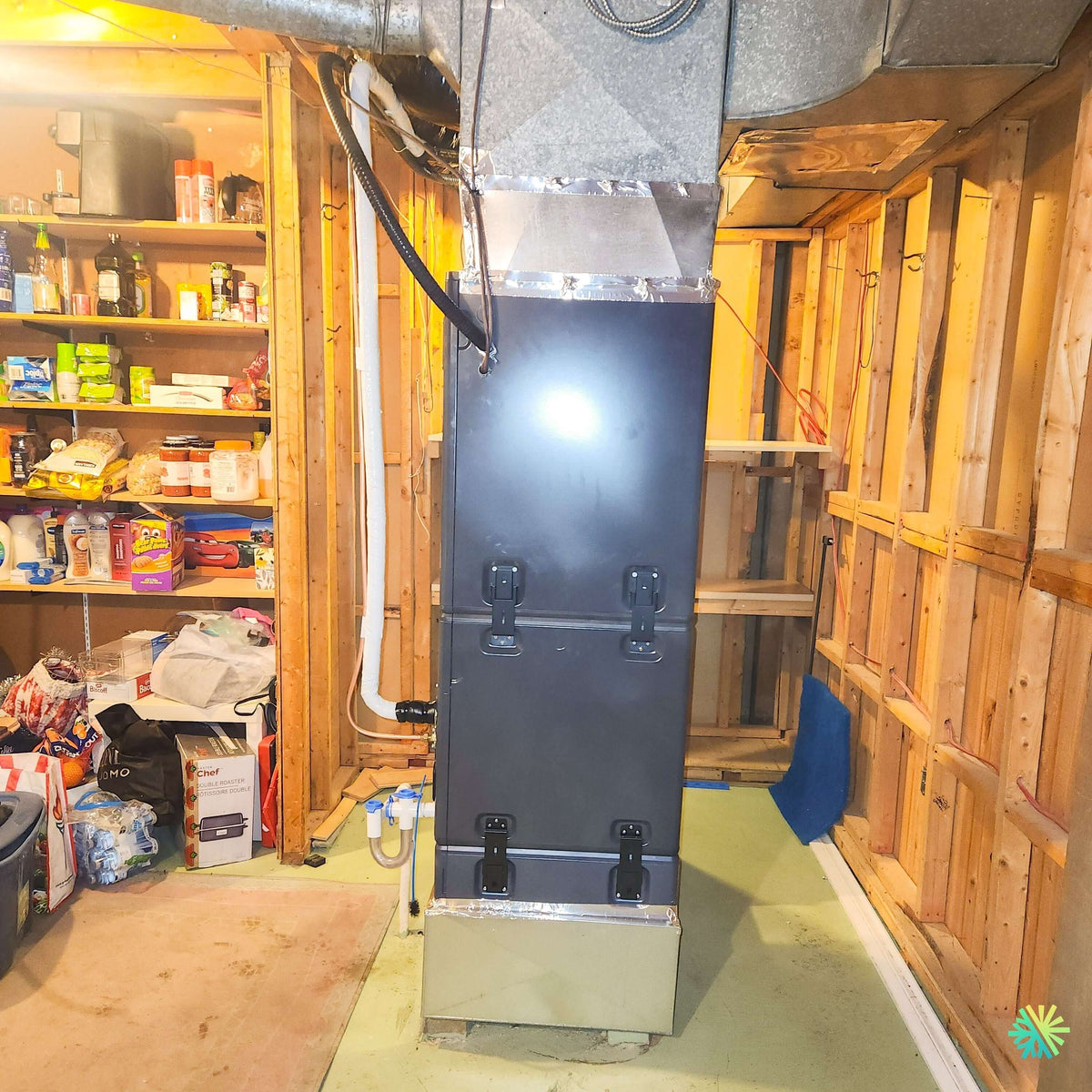
This type of HVAC installation requires much more than just equipment replacement. A central electric furnace must be perfectly aligned with the ducts, securely mounted on a stable base, carefully connected to drains, refrigerant lines, wiring, return air, and the existing distribution. In this specific case, the construction site photo clearly shows the reality of the work: the MIDEA unit is installed in the center of an open technical space, surrounded by wooden studs, metal ducts, white PVC piping, insulated fittings, and access still in preparation around the machine.
The goal was clear: to install a clean, durable, and high-performance central solution, while respecting the physical constraints of the basement and leaving the client with an accessible configuration for future HVAC maintenance.
Why Choose a MIDEA EVOX G3 3-ton for a Residential Central System
The MIDEA EVOX G3 3-ton is a particularly interesting solution for homeowners looking to modernize their central comfort without completely transforming their home. In a residence already equipped with ducts, a central air handler allows for uniform air distribution throughout the different rooms, which remains a significant advantage over multiple independent wall-mounted units.
For a home in Deux-Montagnes, where temperature differences between seasons are significant, a 3-ton capacity represents a solid option to meet typical residential demand, provided that the sizing has been validated according to the home's configuration, insulation, heat losses, serviced areas, and air distribution quality.
The MIDEA EVOX G3 range is often chosen for projects where the client seeks a good balance between performance, energy efficiency, comfort, and overall cost. In the context of a central system, the quality of installation becomes crucial: even an excellent machine can lose much of its potential if ducts are poorly connected, if airflow is insufficient, if drainage is poorly designed, or if access to the unit is neglected.
At AirGreen, we therefore pay particular attention to every visible and invisible detail: unit positioning, plenum transition, joint sealing, service clearances, connection cleanliness, integration into the job site, and preparation for the next finishing stages.
An Installation in an Open, Yet Technically Demanding Space
At first glance, open walls might seem to simplify the work. In reality, a basement under renovation often imposes several constraints. Exposed wooden studs facilitate access to ducts, wiring, and certain lines, but they also require precise coordination with future work. A poor decision at this stage can create complications after walls are closed: difficult filter access, blocked service panel, misplaced drain, overly tight duct, or insufficient clearance space.
In this project in Deux-Montagnes, the MIDEA unit was installed on a floor-mounted base, with a vertical connection to the existing metal duct network. A metal transition is visible above the appliance, sealed with aluminum tape to limit air loss and ensure a clean connection between the unit and the central distribution. This step is essential: an air leak in the plenum or a transition can reduce comfort, increase energy consumption, and impair the overall system performance.
The space around the appliance was also treated with a service logic in mind. The unit's front panels remain accessible, allowing technicians to intervene more easily during future maintenance, diagnostics, or adjustments. This is a detail that many homeowners only notice after a few years, when a filter needs replacing or an inspection becomes necessary.
The Crucial Role of Ducts in a Central Installation
An electric furnace with an air handler never works alone. Its performance heavily depends on the duct network. In a home in Deux-Montagnes, as in many properties in Laval, Montreal, Longueuil, on the North Shore, or the South Shore, existing ducts may have been designed for an older system, sometimes less efficient, sometimes less sensitive to airflow.
Before installing new central equipment, several elements must therefore be checked:
- the general condition of the metal ducts;
- the compatibility of the existing plenum;
- the quality of the return air;
- the presence of significant restrictions;
- the tightness of the joints;
- filter access;
- the distribution capacity to the main areas of the house.
In this project, integration with the upper duct required a careful transition. The connection visible above the appliance highlights the importance of a precise adjustment between the unit's outlet and the existing network. A poorly fabricated or sealed transition can generate turbulence, noise, pressure losses, and less uniform distribution. Our approach is to treat this portion as a key component of the system, and not as a mere temporary connection.
Drainage, Condensation, and Mechanical Cleanliness
The photo also highlights the presence of PVC drainage pipes near the unit. In a modern central system, condensation management is an essential aspect. During air conditioning, the evaporator extracts humidity from the indoor air, producing condensate water. This water must be properly evacuated, without backflow, without inverted slope, and without risk of leakage near the equipment or basement finishes.
In a renovated residence, this point is particularly important, as floors, walls, and storage areas can be vulnerable to a small, unnoticed leak. A clean installation must provide reliable, accessible, and logical drainage. A poorly positioned line can become difficult to inspect after finishing work.
At AirGreen, we always consider drainage as a complete technical component. A good central system is not only high-performing on the day of installation; it must also be stable and easy to maintain several years later.
A Well-Positioned Central Unit for Easy Maintenance
Another important element in this project is the machine's positioning. The unit is installed in such a way as to maintain front access to the panels. On a MIDEA EVOX G3 3-ton electric furnace, this access is essential for inspection, cleaning, component replacement, electrical checks, and preventive maintenance.
One of the common mistakes in central installations is placing the equipment too close to a wall, storage unit, partition, or another appliance. Initially, everything seems to work. But as soon as maintenance is required, the technician has to deal with difficult access, which increases intervention time and can complicate repairs.
In this case, the technical space was still open, which allowed us to work while considering future finishes. We always recommend homeowners not to close off a mechanical room without validating the clearances around the unit. A beautiful interior finish should never compromise access to central HVAC equipment.
What This Installation Reveals About Residential Renovations in Deux-Montagnes
Homes in Deux-Montagnes often present interesting configurations for central systems: semi-finished basements, versatile mechanical spaces, existing ducts, phased renovations, and multi-level comfort needs. In this type of context, equipment choice is important, but the installer's ability to adapt to the building is even more so.
Here, the environment around the unit clearly shows that the project was part of a construction phase. The open walls, exposed studs, nearby storage spaces, and visible technical passages forced us to conceive the installation as an integrated part of the construction site. It wasn't simply about placing a machine; it was about installing a system that would remain functional, accessible, and clean after the walls were closed and the basement was finally finished.
This reality is common in our projects in Montreal, Laval, Longueuil, on the North Shore and South Shore. An experienced team must know how to read the space, anticipate the next steps, and avoid decisions that seem easy in the short term but problematic in the long term.
Advantages of a MIDEA EVOX G3 3-ton Central System
For the owner, this installation offers several concrete benefits. A central system allows for better temperature uniformity in the home, especially when the duct network is well-designed and balanced. Unlike a wall-mounted solution that primarily acts in a given area, a central air handler distributes air through ducts, which can improve the overall comfort of bedrooms, living room, hallways, and common areas.
The MIDEA EVOX G3 3-ton can also be part of an energy efficiency strategy when the installation is properly carried out. The actual performance of an HVAC system depends on the equipment, but also on airflow, duct sealing, thermostat quality, house configuration, and usage habits.
For an owner who wants to modernize their comfort without multiplying visible indoor units, a central system remains a highly valued option. It maintains a discreet appearance, uses existing ducts when compatible, and can offer stable comfort throughout the residence.
Mistakes to Avoid During a Central Electric Furnace Installation
This project illustrates several important points for any homeowner considering a similar HVAC installation.
The first mistake would be to focus solely on the brand or nominal capacity. A 3-ton machine must be adapted to the house. If too small, it risks running continuously without achieving the desired comfort. If too large, it can create short cycles, poor dehumidification, and premature wear. Sizing should always be carefully considered.
The second mistake is neglecting the ducts. Even a good central unit will not deliver expected results if air circulation is poor. Restrictions, leaks, improvised transitions, and insufficient return air can impair performance.
The third mistake concerns service access. Installing a unit in a hard-to-reach corner or blocking it with walls, shelves, or storage is a costly long-term decision. Panels must remain accessible.
The fourth mistake is underestimating drainage. A poor slope, a fragile connection, or an uninspectable line can cause water damage and humidity problems.
The fifth mistake is closing walls too quickly after installation. Before finalizing a basement, it is recommended to validate that all HVAC, electrical, and mechanical connections are well-positioned and accessible.
The AirGreen Approach: Precision, Adaptation, and Long-Term Vision
At AirGreen, we approach every central installation as a complete project. Our work is not limited to installing a new appliance. We analyze the environment, airflow, building constraints, duct location, service logic, and the client's actual needs.
In this project in Deux-Montagnes, our team worked with particular attention to mechanical integration. The transition to ducts, unit stability, connection management, front access, and coordination with the surrounding construction site were all treated as essential elements. This rigor is particularly important in central system installations, where a small oversight can affect the comfort of the entire house.
We regularly carry out this type of project in Montreal, Laval, Longueuil, on the North Shore, and the South Shore, with very different configurations: replacement of old furnaces, conversion to more efficient systems, integration of central heat pumps, adaptation of existing ducts, basement renovation, modernization of single-family homes, and comfort improvement in multi-zone buildings.
Subsidies, Eligibility, and Project Value
Subsidy programs, such as those related to energy efficiency in Quebec, can be a significant factor in an owner's decision. Eligibility depends, however, on the exact model installed, the system configuration, the criteria in effect at the time of application, and the specific requirements of the program.
For an installation like this MIDEA EVOX G3 3-ton, we always recommend checking the latest information before confirming the potential amount of financial assistance. Criteria can change, and it is important that the invoice, model numbers, technical documentation, and installation information are consistent.
Beyond subsidies, the true value of the project lies in comfort, reliability, installation quality, and the reduction of daily inconveniences: more stable temperatures, better air distribution, a more modern central system, and more accessible maintenance.
A Successful Central Installation for Lasting Comfort in Deux-Montagnes
This installation of a MIDEA EVOX G3 3-ton electric furnace with a central Air Handler system in Deux-Montagnes truly represents the kind of project where on-site expertise makes all the difference. The open technical space, existing ducts, ongoing renovation, and performance needs required a structured, clean, and durable approach.
The result is a solid central installation, well-integrated into the home's mechanical environment, with particular attention paid to air distribution, service access, and system consistency. For homeowners in Deux-Montagnes and the North Shore, this type of project demonstrates that good equipment must always be accompanied by rigorous installation.
At AirGreen, we believe that a well-installed central HVAC system should offer more than just heating or cooling. It should integrate into the home, respect the building's reality, facilitate maintenance, and support the comfort of occupants for many years.
The job tools
Two quick checks with real numbers: what heat costs, and what your current heaters add up to in BTU/h.
Conversion: 1 W = 3.412 BTU/h. An indication, not a load calculation: baseboards and furnaces are often stronger than the real need, and they can stay as backup. AirGreen confirms the capacity on site.
How the job unfolds
The main steps of this kind of job at AirGreen. Every house has its quirks: the estimate brings them out.
We look at the ducts, the current indoor module, the electrical panel and the planned spot for the outdoor unit.
The equipment combination, capacity and price, in writing. We check whether the combination qualifies for assistance programs.
Access protected, old unit disconnected and removed when it is being replaced.
Electric furnace or air handler, with its coil, connected to the supply and return ducts.
On a level base, raised above the snow, with free space all around.
Insulated, they enter through a sealed opening and run to the indoor coil.
Dedicated circuits, accessible disconnect, a thermostat that works with the heat pump and the backup heat.
Leak test, vacuum, start-up, airflow check and a test of both modes.
Filter, thermostat, backup heat in extreme cold: what to know before winter.
- The on-site estimateWe look at the ducts, the current indoor module, the electrical panel and the planned spot for the outdoor unit.
- The quoteThe equipment combination, capacity and price, in writing. We check whether the combination qualifies for assistance programs.
- Getting readyAccess protected, old unit disconnected and removed when it is being replaced.
- The indoor moduleElectric furnace or air handler, with its coil, connected to the supply and return ducts.
- The outdoor unitOn a level base, raised above the snow, with free space all around.
- The refrigerant linesInsulated, they enter through a sealed opening and run to the indoor coil.
- Electrical and thermostatDedicated circuits, accessible disconnect, a thermostat that works with the heat pump and the backup heat.
- Tests and start-upLeak test, vacuum, start-up, airflow check and a test of both modes.
- The walkthroughFilter, thermostat, backup heat in extreme cold: what to know before winter.
What we check on a job like this one
Each number is a point we check on site. Switch between summer and winter to watch air and heat move.
In summer, the outdoor unit rejects the house's heat outside.
Generic illustration of this type of installation, not a survey of this job site. Tap a number.
It captures or rejects heat outside. It sits on a level base, above the snow, with free space all around.
The insulated refrigerant lines enter the house through a sealed opening and run to the indoor coil.
A shut-off switch near the outdoor unit isolates it safely for service.
Sitting on the indoor module, it moves heat between the house air and the refrigerant.
Electric furnace or air handler: its fan pushes air through the ducts. The electric backup takes over in extreme cold.
Supply ducts bring air to the rooms; returns bring it back to the unit. Their condition matters as much as the unit's.
It protects the coil and the fan. A dirty filter cuts airflow, so it gets checked regularly.
It runs the heat pump and the backup heat. It must be compatible with the installed system.
Is your home ready?
Check what applies at your place. A "no" is not a refusal: it is what we sort out during the estimate.
Good habits, once the unit is in place
Six simple habits that keep the unit going. Your list stays on this device.
What to do, season by season
Three habits per season for this unit. They take a few minutes and prevent many calls.
- Check the indoor module's filter.
- Clear winter debris from the outdoor unit.
- Test cooling before the heat arrives.
- Check the filter more often in peak season.
- Keep registers and returns clear.
- Watch condensate drainage near the coil.
- Change or clean the filter.
- Test heating and backup heat before the cold.
- Book periodic maintenance.
- Clear snow around the outdoor unit.
- Store nothing in front of the indoor module.
- Note any unusual noise or smell and call us.
The right pages, at the right time
Four statements: true or false?
It all comes down to details you have just seen.
1. A central heat pump uses the house's ducts.
It connects to the existing ducts to heat and cool everywhere.
2. In extreme cold, electric backup heat can take over.
The indoor module (furnace or air handler) works with the heat pump and takes over in extreme cold.
3. The filter only gets changed when the unit breaks down.
A dirty filter cuts airflow. It gets checked regularly.
4. You can reuse the old unit's size without checking.
The house may have changed: insulation, windows, added rooms. Capacity is confirmed on site.
0 / 4 right answers
What people ask us about this kind of work
Can I keep my current ducts?
What happens in extreme cold?
Furnace, air handler, ducted: what is the difference?
Are there grants?
Do I need a permit?
How much can I save?
How is the LogisVert assistance calculated?
Will my current thermostat work?
Central or wall units: which one?
Does AirGreen hold the required licences?
Is the estimate free?
No question matches. Write to us: we answer.
More jobs to see, near you
By town, by equipment or by region: browse more than 4,700 published projects.
Each dot: a town where AirGreen has published projects. The glowing dot: this job.
An on-site estimate, the right capacity, the right equipment.
The on-site estimate is free and the quote follows within 24 hours.
Text and photo: a real AirGreen Climatisation & Chauffage job. The diagrams are generic illustrations of the type of installation, not a survey of this job site. Sources of the added figures: airgreen.ca product pages (NEEP / AHRI performance), Hydro-Québec (Heat pumps page, LogisVert, read on 13 October 2026), Régie de l’énergie (rate D as of 1 April 2026).