
Installation of a GREE UNIX R32 electric furnace in Chambly, in Montérégie (Montreal’s South Shore)
Replacement of an electric furnace with a GREE UNIX R32 central system in Chambly: 34,000 BTU/h modulating capacity, 15 kW electric heating kit, R32 refrigerant, and existing ducts reused. The complete story of a project in a 26-inch mechanical closet.
In summer, the outdoor unit rejects the house's heat outside.
Generic illustration of this type of installation, not a survey of this job site. Tap a number.
It captures or rejects heat outside. It sits on a level base, above the snow, with free space all around.
The insulated refrigerant lines enter the house through a sealed opening and run to the indoor coil.
A shut-off switch near the outdoor unit isolates it safely for service.
Sitting on the indoor module, it moves heat between the house air and the refrigerant.
Electric furnace or air handler: its fan pushes air through the ducts. The electric backup takes over in extreme cold.
Supply ducts bring air to the rooms; returns bring it back to the unit. Their condition matters as much as the unit's.
It protects the coil and the fan. A dirty filter cuts airflow, so it gets checked regularly.
It runs the heat pump and the backup heat. It must be compatible with the installed system.
A 26-inch mechanical closet, a −30 °C winter, and the only configuration that held up
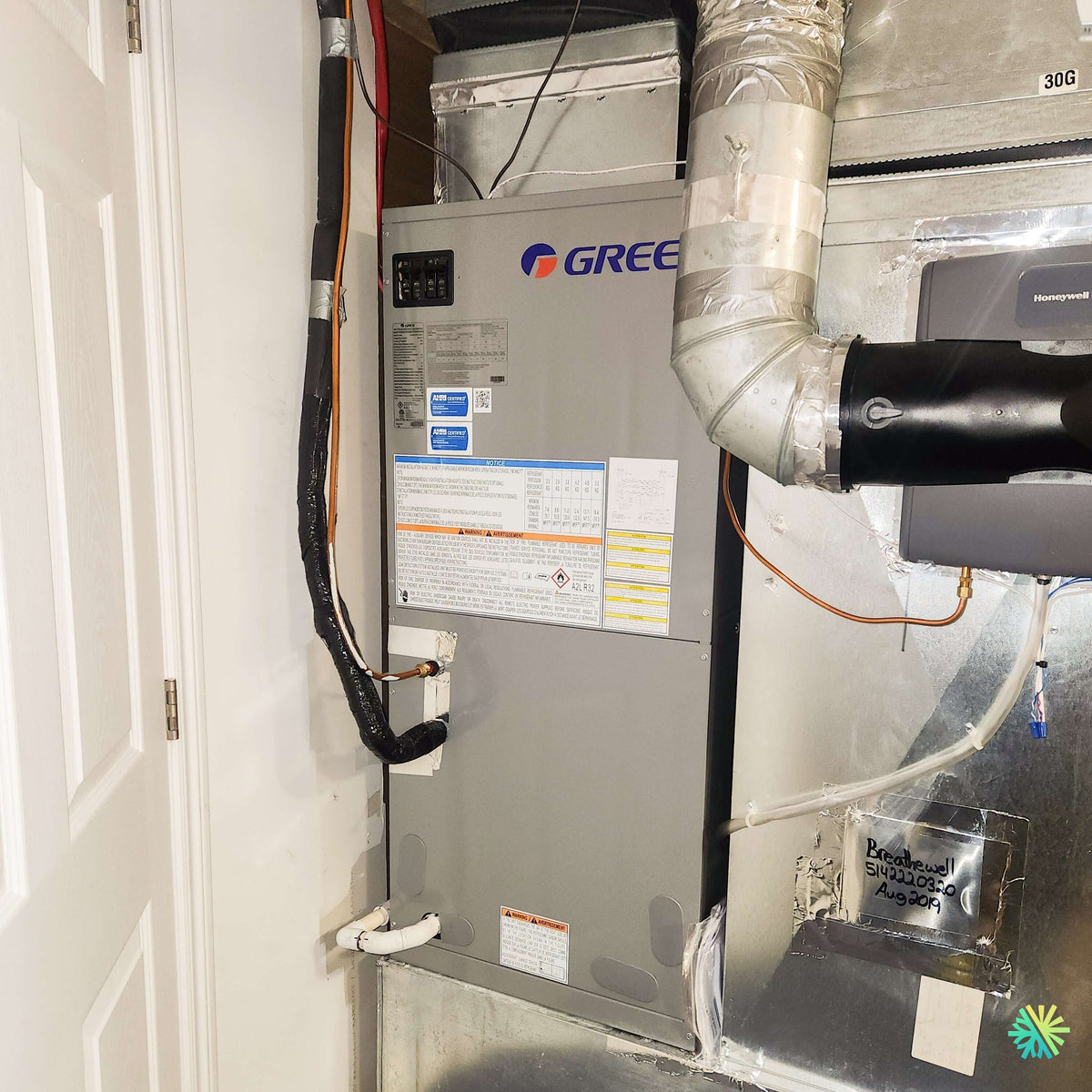
The project came to us at the beginning of spring, from a residential property in the Bassin area of Chambly: an end-of-life central electric furnace, a duct system in good condition, and a mechanical closet so narrow that a technician could not stand facing it. The owner wanted two things: to retain the safety of full electric heating during extreme weather and stop paying to heat at 100% with electric resistance from November to April. We installed a GREE UNIX R32 central system—an indoor air handler cabinet paired with an electric heat kit and an outdoor inverter condenser. Here is the full project breakdown, including what did not work the first time.
The starting point: what we found on site
The preliminary inspection revealed a situation common in homes built on the South Shore between the late 1990s and mid-2000s:
- A vertical upflow electric furnace, powered by two dedicated circuits, with no modulation. On-off heating.
- A rectangular galvanized sheet-metal supply plenum in very good condition, extended by a 30 cm round duct identified as “30G.”
- A duct system cleaned a few years earlier: the access panel still bore the cleaning contractor’s sticker, dated August 2019. A good sign, but one we still verified with a camera.
- A Honeywell bypass humidifier mounted on the plenum, with its copper water supply line, drain, and black bypass duct.
- No central air conditioning. Two window air conditioners in summer, and a winter electricity bill the owner described as “the most predictable and unpleasant budget line of the year.”
The physical constraint was the real issue. The mechanical closet, set against a partition wall and closed by a standard interior door, provided 26 inches of usable width. Any solution that required demolishing a partition would have sent the budget soaring for plastering, painting, and flooring.
Why the UNIX R32 air handler stood out
The GREE UNIX R32 is a central heat pump system designed for the Canadian climate. Its distinguishing feature, in a replacement project for an electric furnace, is that the indoor air-handler cabinet accepts an integrated electric heating kit. The result: a single appliance in the closet that performs both roles. The heat pump handles the vast majority of the season's heating hours, and the electric elements take over only when demand exceeds the available capacity.
We selected the 36,000 configuration:
- Indoor unit: GUD36AH2/G-D(U) — 540 mm wide (21-17/64 in.), 1,224 mm high, 540 mm deep, 74 kg net.
- Outdoor unit: GUD36W2/NhE-D(U) — 990 × 960 × 370 mm, 85 kg, 61 dB(A).
- Nominal cooling capacity: 34,000 BTU/h, modulating from 18,000 to 37,000 BTU/h.
- Nominal heating capacity: 34,000 BTU/h, modulating from 18,000 to 38,000 BTU/h.
- SEER 2 of 18.0, EER 2 of 12.0, HSPF 2 of 10.0, COP of 3.20 at 8 °C.
- Nominal airflow of 1,000 CFM at an external static pressure of 125 Pa (0.5 in. w.c.).
- Heating range down to −30 °C, while maintaining 100% heating capacity at −20 °C.
- Refrigerant R32, 2.9 kg charge, two-stage, two-cylinder compressor, and DC Inverter technology.
The cabinet's 540 mm width left us with less than two inches of actual clearance on each side in the closet. It's tight, but workable—and that's exactly why we measure three times before ordering.
The electric heating kit: the insurance policy, not the main engine
The cabinet was equipped with a 15 kW electric heating kit (approximately 51,200 BTU/h), distributed across three breakers integrated into the unit's panel, visible in the upper-left corner. This point deserves an explanation because it is often misunderstood.
Without the kit, the indoor unit's minimum circuit ampacity (MCA) is 5.3 A, with a maximum protection of 15 A. With the 15 kW kit, everything changes: it requires a properly sized dedicated power supply and an inspection of the main electrical panel. For this client, the 200 A panel had the necessary space, but we had to reroute the conductors from the basement. This is the step that low bids systematically fail to include in their pricing.
In practice, with a heat pump that delivers its full capacity down to −20 °C, the electric kit operates rarely: during morning recovery after a temperature setback, during defrost cycles, and on the few winter nights when Chambly drops below −22 °C. The rest of the time, it sits idle.
R32 and the A2L label: what changes in a closed closet
The R32 is a low-global-warming-potential refrigerant classified as A2L, meaning it is mildly flammable. This classification imposes rules that we apply systematically and that the general public often overlooks:
- A minimum room volume based on the refrigerant charge. The label affixed to the cabinet provides the table: for a 2.9 kg charge, a minimum floor area is required for the installation or storage room. We validate this calculation before even proposing a model.
- A factory-integrated refrigerant leak detector on all GREE Canada cabinets. It shuts down the system and activates ventilation if a leak is detected.
- No ignition sources in the air circuit. This rules out certain auxiliary devices in the duct.
- Dedicated tools: gauges, a vacuum pump and A2L-compatible detectors, along with compliant recovery of the old refrigerant.
In a closed 26-inch closet adjoining a living area, these checks are not an administrative formality. They determine whether the installation is legal.
The worksite process, step by step
Day 1 — dismantling, refrigerant line, and outdoor base
Removal of the existing electric furnace and recovery of the metal components. Cutting and adapting the plenum: the old unit had different dimensions, so we fabricated the sheet-metal transitions on site instead of using generic flexible fittings, to prevent air leaks and pressure losses.
Drilling through the exterior wall and routing the refrigerant line: 3/4-inch suction and 3/8-inch liquid lines, insulated along their entire length, including the indoor section visible in the closet. We see the suction line left bare indoors far too often—it is a guaranteed source of condensation and water damage to the basement ceiling.
Installation of the condenser pad and vibration-damping supports, with sufficient clearance for defrosting and meltwater drainage. In Chambly, raising the unit above the snow level is not a theoretical concern: we mount outdoor units on supports to prevent accumulated snow from blocking the heat exchanger.
Day 2 — evacuation, connections, and commissioning
Evacuation of the circuit to a stabilized deep vacuum, with a hold test before opening the service valves. The UNIX R32 series has external service valves and electrical terminals, which genuinely simplifies this step in the field.
Connecting the condensate drain in PVC with a trap and continuous slope, plus a secondary overflow line. Connecting the 24 V thermostat—the system is compatible with most wired 24 V thermostats on the market and also supports RS485 communication.
Reconnecting the existing Honeywell humidifier: bypass duct, copper water supply, drain, and control. We replaced the evaporative pad and checked the flow before closing everything up.
The issue that required correction: static pressure
At initial commissioning, the measured total external static pressure exceeded the nominal value of 0.5 in. w.c. specified in the catalog. The culprit was not the new system but the air return: a single central return, undersized for 1,000 CFM, inherited from an electric furnace that tolerated restriction better because it was not designed to modulate.
We returned to add a return section and replace the grille with a model offering a larger free area. Static pressure dropped back into the specified range, the noise level decreased noticeably, and the compressor’s low modulation range became genuinely usable. An inverter system installed on an overly restrictive duct network will never deliver its advertised efficiency—this is the number-one cause of disappointment with central heat pumps.
The mistakes we correct most often in Chambly, Carignan, and Saint-Basile-le-Grand
Oversizing “to be safe”
The temptation is strong to choose the 48,000 or 60,000 BTU/h model. An oversized system short-cycles, dehumidifies poorly in summer, and wears out its compressor. Load calculation according to the CSA F280 method remains the only sound basis. For this customer, the home’s cooling requirement came in well below 36,000 BTU/h: the 36,000 model, with its modulation range of 18,000 to 37,000 BTU/h, was an exact fit.
Setting the balance point at random
If the thermostat is configured to call for auxiliary heat as soon as the temperature reaches −5 °C, the homeowner pays the bill for a conventional electric furnace while having invested in a heat pump. We set the balance point based on the actual load calculation and the unit’s capacity curve, then revalidate it after the first cold snap.
Reusing ducts without evaluating them
Reusing an existing duct network is often the right economic decision—provided it is properly measured. Joint airtightness, insulation of sections in unheated spaces, return sizing, and outlet balancing. Without this step, the initial savings are paid for through fifteen years of discomfort.
Ignoring A2L requirements
The transition to R32 changes the installation, storage, and servicing requirements. A contractor who treats an A2L cabinet like an older R410A appliance exposes you to a potential insurance coverage denial and a compliance issue.
What you need to know about rebates
Hydro-Québec’s LogisVert heat pump component is intended for replacing an existing heating system in an already constructed residential building connected to the grid. Conditions to verify before purchase, not afterward, include the exact model being on the list of eligible equipment, ENERGY STAR certification for installations completed after November 26, 2025, and the contractor being enrolled in the program in addition to holding an RBQ licence. The Rénoclimat program may be added, with an energy assessment before and after the work. The Chauffez vert program, meanwhile, targets the replacement of an oil- or propane-fired system: it does not apply to an already fully electric home like this one.
The amounts and criteria for these programs change periodically. At AirGreen, we verify eligibility on file before finalizing a quote rather than promising a figure that never materializes.
The result, four months later
The system went into service in the spring and operated in cooling mode throughout the summer. The owner reported two specific observations: a much more stable temperature upstairs, a direct result of continuous modulation rather than on-off cycles, and an appliance quiet enough that he forgot it was there behind the closet door—the cabinet is rated at 51 dB(A). The real validation will come in January, and we have scheduled a follow-up visit to adjust the settings after the first sustained cold spell.
AirGreen on the South Shore
We carry out HVAC installation and HVAC maintenance projects in Chambly, Carignan, Saint-Basile-le-Grand, Beloeil, Saint-Bruno, Longueuil, as well as in Montréal, Laval, and on the North Shore. Electric furnace replacements, central heat pumps, wall-mounted air conditioners, multi-zone systems: every project begins with a load calculation and an assessment of the duct network, never with a preselected model.
For a central system replacement project in Chambly or elsewhere in Montérégie, contact us for an on-site assessment.
How it goes, from the first call to the end
The main steps of this kind of job at AirGreen. Every house has its quirks: the estimate brings them out.
We look at the ducts, the current indoor module, the electrical panel and the planned spot for the outdoor unit.
The equipment combination, capacity and price, in writing. We check whether the combination qualifies for assistance programs.
Access protected, old unit disconnected and removed when it is being replaced.
Electric furnace or air handler, with its coil, connected to the supply and return ducts.
On a level base, raised above the snow, with free space all around.
Insulated, they enter through a sealed opening and run to the indoor coil.
Dedicated circuits, accessible disconnect, a thermostat that works with the heat pump and the backup heat.
Leak test, vacuum, start-up, airflow check and a test of both modes.
Filter, thermostat, backup heat in extreme cold: what to know before winter.
- The on-site estimateWe look at the ducts, the current indoor module, the electrical panel and the planned spot for the outdoor unit.
- The quoteThe equipment combination, capacity and price, in writing. We check whether the combination qualifies for assistance programs.
- Getting readyAccess protected, old unit disconnected and removed when it is being replaced.
- The indoor moduleElectric furnace or air handler, with its coil, connected to the supply and return ducts.
- The outdoor unitOn a level base, raised above the snow, with free space all around.
- The refrigerant linesInsulated, they enter through a sealed opening and run to the indoor coil.
- Electrical and thermostatDedicated circuits, accessible disconnect, a thermostat that works with the heat pump and the backup heat.
- Tests and start-upLeak test, vacuum, start-up, airflow check and a test of both modes.
- The walkthroughFilter, thermostat, backup heat in extreme cold: what to know before winter.
And at your place?
Two quick checks with real numbers: what heat costs, and what your current heaters add up to in BTU/h.
Conversion: 1 W = 3.412 BTU/h. An indication, not a load calculation: baseboards and furnaces are often stronger than the real need, and they can stay as backup. AirGreen confirms the capacity on site.
What to do, season by season
Three habits per season for this unit. They take a few minutes and prevent many calls.
- Check the indoor module's filter.
- Clear winter debris from the outdoor unit.
- Test cooling before the heat arrives.
- Check the filter more often in peak season.
- Keep registers and returns clear.
- Watch condensate drainage near the coil.
- Change or clean the filter.
- Test heating and backup heat before the cold.
- Book periodic maintenance.
- Clear snow around the outdoor unit.
- Store nothing in front of the indoor module.
- Note any unusual noise or smell and call us.
Which type of equipment for your project?
Pick what looks like your need.
Four mistakes we do not make
Flip each card to see what we do instead.
What people ask us about this kind of work
Can I keep my current ducts?
What happens in extreme cold?
Furnace, air handler, ducted: what is the difference?
Are there grants?
Do I need a permit?
How much can I save?
How is the LogisVert assistance calculated?
Will my current thermostat work?
Central or wall units: which one?
Does AirGreen hold the required licences?
Is the estimate free?
No question matches. Write to us: we answer.
Useful pages for what comes next
More jobs to see, near you
By town, by equipment or by region: browse more than 4,700 published projects.
Each dot: a town where AirGreen has published projects. The glowing dot: this job.
Tell us about your house. We come and see it for free.
The on-site estimate is free and the quote follows within 24 hours.
Text and photo: a real AirGreen Climatisation & Chauffage job. The diagrams are generic illustrations of the type of installation, not a survey of this job site. Sources of the added figures: airgreen.ca product pages (NEEP / AHRI performance), Hydro-Québec (Heat pumps page, LogisVert, read on 13 October 2026), Régie de l’énergie (rate D as of 1 April 2026).