
Installation of a MIDEA EVOX G3 electric furnace in a mechanical room in Rosemont–La Petite-Patrie, Montréal
Installation of a MIDEA EVOX G3 electric furnace in Rosemont–La Petite-Patrie: integration with existing ductwork, R-454B A2L, accessible drainage, and a central configuration adapted to Montreal’s climate.
In summer, the outdoor unit rejects the house's heat outside.
Generic illustration of this type of installation, not a survey of this job site. Tap a number.
It captures or rejects heat outside. It sits on a level base, above the snow, with free space all around.
The insulated refrigerant lines enter the house through a sealed opening and run to the indoor coil.
A shut-off switch near the outdoor unit isolates it safely for service.
Sitting on the indoor module, it moves heat between the house air and the refrigerant.
Electric furnace or air handler: its fan pushes air through the ducts. The electric backup takes over in extreme cold.
Supply ducts bring air to the rooms; returns bring it back to the unit. Their condition matters as much as the unit's.
It protects the coil and the fan. A dirty filter cuts airflow, so it gets checked regularly.
It runs the heat pump and the backup heat. It must be compatible with the installed system.
A central modernization where the visible details tell the whole story of the installation
During this installation carried out in Rosemont–La Petite-Patrie, Montreal, the challenge was not simply to place a new MIDEA EVOX G3 electric furnace in the designated location. The challenge was to integrate a new generation of central equipment into the existing duct network, maintain a coherent mechanical configuration, and properly organize the refrigerant lines, condensate drainage, and various service access points.
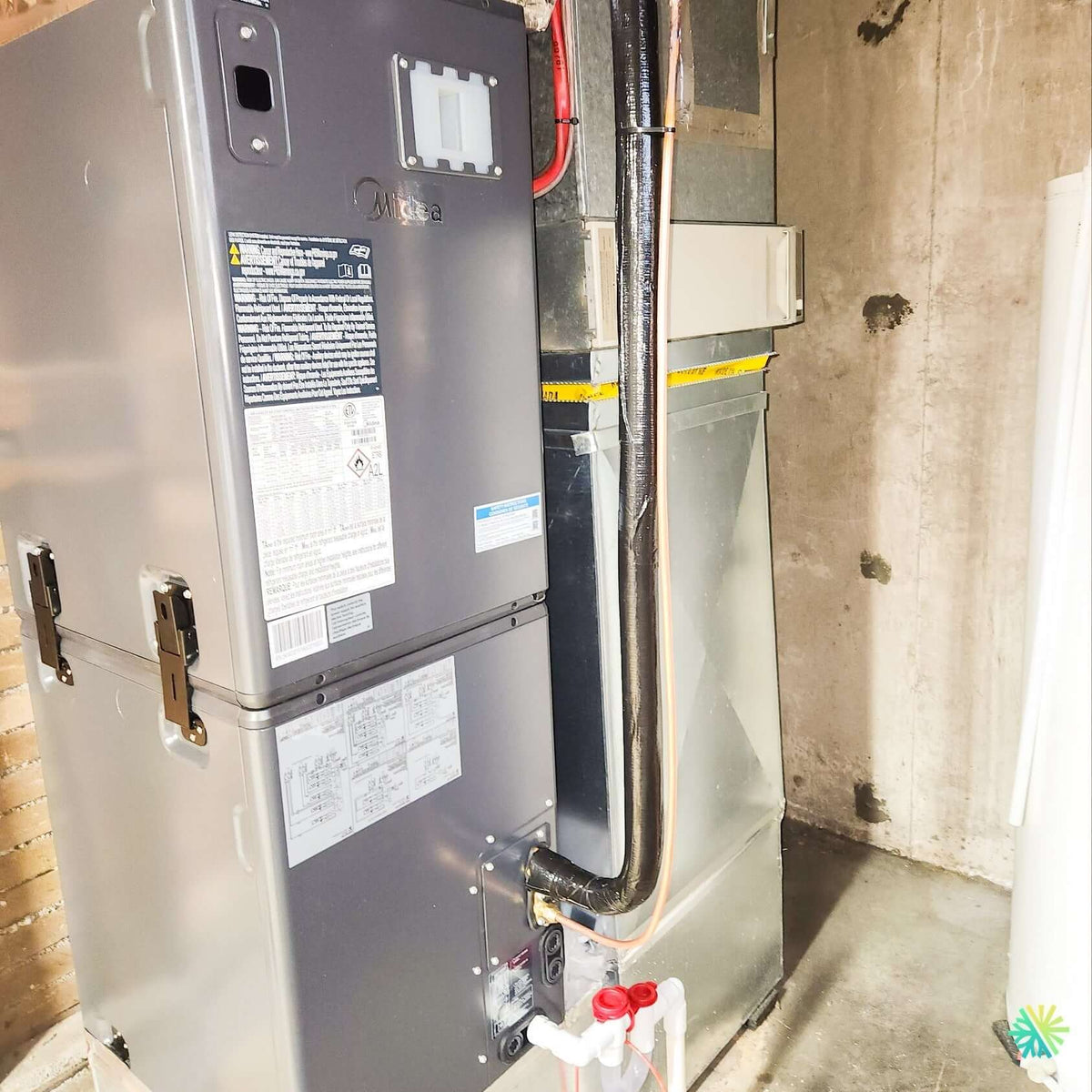
The job-site photo shows this integration work particularly well. The MIDEA unit is installed vertically against the existing duct network. To the right of the equipment, we can follow the path of the large insulated refrigerant line, along with the smaller copper line. At the base, the PVC drain connections are clearly accessible. Behind the furnace, the galvanized sheet-metal transitions connect the new equipment to the building's existing air distribution network.
For a homeowner, these are sometimes details that are barely noticeable once the work is complete. For us at AirGreen, these are precisely the details that determine the true quality of a central HVAC installation in Montreal.
A MIDEA EVOX G3 installed in a vertical configuration
The first feature that stands out in this installation is the cabinet's two-section design.
The MIDEA EVOX G3 is not a traditional electric furnace in the sense of older equipment consisting essentially of a fan and resistive elements. Technically, it is a modular central air handler, designed to operate with a heat pump and capable of receiving auxiliary electric heating.
In the vocabulary used daily in Quebec, however, people will very often refer to it as an electric furnace, as it ensures the circulation of heated air through the duct network and can incorporate the necessary electrical components, such as supplemental heating.
In our photo of Rosemont–La Petite-Patrie, the two stacked modules are clearly visible, connected by the characteristic side fasteners of this generation of equipment. This design is not solely aesthetic. It greatly facilitates handling and adaptation to existing mechanical rooms.
The diagram shown on page 6 of the MIDEA documentation clearly shows that the EVOX G3 was designed around a modular architecture Block N Lock and can be configured in six ways, including upflow, downflow, left horizontal, right horizontal, and compact configurations such as low-boy.
In a neighborhood like Rosemont–La Petite-Patrie, where we regularly work in duplexes, triplexes, older homes, and buildings that have already gone through several generations of heating systems, this flexibility is particularly useful.
What we can actually read on this installation, without inventing the tonnage
The rating plate is present on the front of the equipment, and the notation A2L is clearly visible in the photo. However, the image resolution does not make it possible to confirm the exact indoor model suffix with sufficient certainty.
We therefore prefer not to arbitrarily assign a specific capacity to this installation based solely on the cabinet width.
This is an important distinction.
The MIDEA EVOX G3 range described in the manufacturer's documentation includes several capacities, including 18,000, 24,000, 30,000, 36,000, 48,000, and 54,000 BTU/h. Depending on the indoor-outdoor combination, the published data indicate performance of up to 19 SEER2, 12.5 EER2, and 10.8 HSPF2.
To determine the exact performance of an installation, we instead use the complete indoor unit number, the outdoor heat pump number, and the corresponding certified combination.
This method avoids a common mistake: assuming that a given cabinet size automatically corresponds to a single tonnage.
Why the EVOX G3 modular design is interesting in a Montreal renovation
The photo shows a unit installed very close to the existing ducts, in a mechanical space that was clearly not built around this new MIDEA unit.
This is precisely the context in which the EVOX G3 concept becomes interesting.
MIDEA indicates cabinet widths ranging approximately from 14.5 to 21.5 inches depending on the capacities. The design is intended in particular to facilitate the replacement of existing equipment without requiring the mechanical environment to be completely rebuilt. The manufacturer also provides for adaptation to different voltages for the indoor unit, including 115 V and 208/230 V, depending on the configuration.
We often see the difference in the field.
With a conventional unit that is too wide or too deep, a few extra inches can require a much more complex new duct transition, reduce access to the filter, or create a clearance problem for servicing.
With a central installation, future ease of servicing must be considered from day one.
A connection to the existing ductwork that deserves as much attention as the furnace
To the right of the MIDEA unit in the photo, we can see a substantial section of existing metal ductwork. The new unit was integrated into this assembly rather than treated as a separate component.
This is essential.
A central electric furnace can be excellent on paper yet deliver disappointing results if the duct system imposes excessive airflow restriction.
The fan must deliver enough air to rooms sufficiently far into the building while also allowing adequate return airflow to the unit. We must also account for elbows, transitions, dampers, filters, and duct dimensions.
The EVOX G3 incorporates the technology MIDEA calls Computational Constant Airflow 2.0. According to the manufacturer, the system can adjust fan operation to adapt to different duct and filtration conditions. The documentation indicates a capacity of up to 1.2 in. of water column external static pressure and up to 60 airflow adjustment levels.
This provides valuable adjustment margin during a renovation.
However, this does not turn a poorly designed duct system into a good one. Excessive static pressure remains an issue that must be diagnosed and, when necessary, corrected.
Refrigerant lines: a particularly visible detail on this job site
The photo of this installation at Rosemont–La Petite-Patrie also makes it easy to clearly see the two lines connecting the indoor unit to the refrigeration circuit.
The larger-diameter line is covered with black insulation. This insulation is essential to the system’s operation and helps limit heat gain or loss as well as condensation on the piping.
Next to it, the smaller-diameter line descends toward the unit’s refrigerant connections.
The routing is organized along the right side of the furnace to preserve front access to the panels. This is an important practical consideration: when we install the lines, we are already thinking about the technician who may eventually need to open the cabinet to perform diagnostics, maintenance, or repairs.
A line placed in front of a service panel may seem acceptable on the day of installation and become a source of complications several years later.
Condensate drainage: a small component with significant consequences
At the base of the installed EVOX G3, the white PVC drainage system and its service access points.
When a central heat pump operates in cooling mode, the moisture in the air condenses on the cold coil. All this water must be drained properly.
The drainage must therefore be designed to allow:
reliable water drainage, access for cleaning, checking for a possible blockage, and simple servicing if maintenance becomes necessary.
In this installation, the connections are arranged outside the cabinet and remain accessible rather than being hidden behind the ducts.
This is exactly the kind of detail we look for during our installations in Montreal, Laval, Longueuil, the North Shore, and the South Shore.
A neglected condensate drain can eventually cause water around the furnace, floor damage, moisture problems, or system shutdown if a safety device is installed.
Auxiliary electric heating: bigger does not necessarily mean better
The electrical section plays a particularly important role in our climate.
The EVOX G3 documentation specifies auxiliary heating kits that can reach 10 kW, 15 kW, and up to 25 kW, depending on the equipment and application. MIDEA also describes a multi-stage system to adjust the electric heating output to the demand.
At AirGreen, we do not simply choose the largest electrical element available.
Sizing must take into account the building’s heating load, the heat pump’s capacity, the existing electrical supply, and the desired operating strategy.
A 20 or 25 kW electric furnace can represent a significant load for a residential electrical panel. The availability of a system with this capacity in the catalogue therefore does not mean that it is suitable for every property.
Before installation, the panel, circuit breaker, wiring, and other significant loads in the building must be checked, among other things.
Performance suited to cold weather when the EVOX G3 is paired with its heat pump
The interest of an EVOX G3 system lies not only in its electrical components.
When configured with the corresponding EVOX central heat pump, the goal is to produce most of the heating with the heat pump and reserve resistance heating for situations where supplemental heat is truly necessary.
MIDEA documentation indicates continuous heat pump operation down to -30 °C. For the tests cited on a three-ton MIDEA system, the manufacturer also reports significant performance at very low temperatures, particularly around -25 °C.
For a homeowner of Rosemont–La Petite-Patrie, this information is far more relevant than the performance of a heat pump measured only at mild outdoor temperatures.
In Montreal, a central system must be selected with actual cold-weather events in mind.
A fan design intended to provide more uniform airflow
The EVOX G3 documentation also emphasizes the unit’s internal design.
MIDEA uses an M-Coil and a symmetrical fan design. In its design data, the manufacturer compares this architecture with that of certain conventional units in order to reduce airflow differences through the coil and internal pressure loss.
In practice, airflow distributed more evenly across the coil surface promotes more uniform heat exchange.
But once again, the final quality depends on the installation as a whole. The fan, filter, return air, supply ducts, and settings must work together.
That is why our work does not end when the new MIDEA furnace is physically connected to the ductwork.
The technical choices that make a difference after several winters
R-454B and A2L: a new reality clearly visible on the nameplate
In the photo, the safety symbol A2L is clearly identified on the unit’s nameplate.
The EVOX G3 range uses R-454B refrigerant. MIDEA indicates a global warming potential, or GWP, of 466 for it.
R-454B belongs to the A2L category, meaning it is a mildly flammable refrigerant.
For homeowners, day-to-day operation remains simple. For HVAC professionals, however, this means that procedures, tools, refrigerant handling, and certain installation requirements must be adapted to this new generation of equipment.
This transition to R-454B is now an important market reality for central heat pumps in Montreal.
Filtration that must comply with the available airflow
MIDEA specifies compatibility for the EVOX G3 platform with different filtration thicknesses, including 1, 2 and 4 inches, as well as with certain filter configurations MERV 13. Page 9 of the documentation presents the three filter formats and their integration into the system.
A higher MERV rating can improve the capture of certain particles, but we should avoid choosing a filter based solely on its rating.
The more resistance a filter creates, the harder the fan must work to maintain the required airflow.
On a central system, we must therefore consider both filtration quality and duct static pressure.
Communicating thermostat or 24 V control
Another interesting feature of the EVOX G3 is its control flexibility.
The platform can be used with MIDEA communication strategies and also provides compatibility with 24 V controls. 24 V in some configurations. The manufacturer also describes a wireless communication solution between the main compatible components to simplify certain renovations where adding new cables would be complicated.
This is particularly relevant in existing buildings in Montréal.
Running a new cable between a thermostat and a mechanical room can be very simple in an open-concept building, but much more difficult in a finished duplex where several ceilings and walls separate the two.
The system’s flexibility then makes it possible to explore several ways to modernize the controls without unnecessarily undertaking finishing work.
LogisVert: verify the complete combination, not just the EVOX G3 name
For a homeowner considering a MIDEA EVOX G3 central heat pump in Montréal, the available financial assistance can obviously influence the final choice.
According to the conditions currently published by Hydro-Québec, a complete central air-source heat pump may qualify for the LogisVert when it meets, among other things, the applicable ENERGY STAR requirements and the indoor and outdoor units constitute an eligible system. For installations completed since November 26, 2025, Hydro-Québec requires ENERGY STAR certification.
Hydro-Québec currently indicates assistance of $50 per 1,000 BTU/h at -8°C for an eligible ENERGY STAR heat pump, or $120 per 1,000 BTU/h at -8°C when it is recognized as a heat pump for cold climates.
The distinction is important: the amount is not calculated simply from the nominal “tons” stated at the time of sale.
We need to verify the exact combination of models and the recognized capacity at -8°C.
For this reason, we never promise a LogisVert amount solely because a unit bears the name MIDEA EVOX G3.
Errors this installation can help illustrate
For a central furnace replacement like the one in Rosemont–La Petite-Patrie, several decisions can have a lasting effect on comfort and reliability:
- choose the capacity solely based on the old furnace, without checking the building's current needs;
- oversize the auxiliary electric heating without confirming the panel and wiring capacity;
- neglect static pressure and assume that all existing ductwork will automatically work with the new unit;
- install the refrigerant lines in front of the service panels;
- make the condensate drain difficult to clean;
- select a filter that is too restrictive without considering airflow;
- neglect the tightness of the transitions between the new unit and the existing ductwork;
- promise a rebate based on the brand or series rather than the officially eligible combination;
- treat a system R-454B A2L exactly like an older installation using another refrigerant;
- finish the job without checking the fan settings, controls, and overall system operation.
These points explain why two installations using exactly the same MIDEA EVOX G3 can deliver very different results.
What we take away from this installation in Rosemont–La Petite-Patrie
This project clearly illustrates how we approach a central electric furnace installation in Montreal.
Here we have modern equipment installed in an existing mechanical environment, with a duct network already in place and several technical elements to organize in a relatively compact space.
The photo shows the concrete result: MIDEA EVOX G3 in a vertical configuration, accessible refrigerant connection, carefully routed insulated line, accessible PVC drainage for maintenance, transition to the existing metal ductwork, and service panels that remain accessible.
This is the kind of attention that matters after five, ten, or fifteen years.
The quality of an HVAC installation is not measured solely by the moment when the thermostat first reaches the requested temperature. It is also measured by the stability of the airflow, ease of maintenance, drainage quality, system performance during cold periods, and how easily a technician can eventually access the components.
At AirGreen, this is the approach we apply to our electric furnaces, central heat pumps, and HVAC systems for Rosemont–La Petite-Patrie, throughout Montreal, as well as in Laval, Longueuil, on the North Shore and South Shore.
How it goes, from the first call to the end
The main steps of this kind of job at AirGreen. Every house has its quirks: the estimate brings them out.
We look at the ducts, the current indoor module, the electrical panel and the planned spot for the outdoor unit.
The equipment combination, capacity and price, in writing. We check whether the combination qualifies for assistance programs.
Access protected, old unit disconnected and removed when it is being replaced.
Electric furnace or air handler, with its coil, connected to the supply and return ducts.
On a level base, raised above the snow, with free space all around.
Insulated, they enter through a sealed opening and run to the indoor coil.
Dedicated circuits, accessible disconnect, a thermostat that works with the heat pump and the backup heat.
Leak test, vacuum, start-up, airflow check and a test of both modes.
Filter, thermostat, backup heat in extreme cold: what to know before winter.
- The on-site estimateWe look at the ducts, the current indoor module, the electrical panel and the planned spot for the outdoor unit.
- The quoteThe equipment combination, capacity and price, in writing. We check whether the combination qualifies for assistance programs.
- Getting readyAccess protected, old unit disconnected and removed when it is being replaced.
- The indoor moduleElectric furnace or air handler, with its coil, connected to the supply and return ducts.
- The outdoor unitOn a level base, raised above the snow, with free space all around.
- The refrigerant linesInsulated, they enter through a sealed opening and run to the indoor coil.
- Electrical and thermostatDedicated circuits, accessible disconnect, a thermostat that works with the heat pump and the backup heat.
- Tests and start-upLeak test, vacuum, start-up, airflow check and a test of both modes.
- The walkthroughFilter, thermostat, backup heat in extreme cold: what to know before winter.
And at your place?
Two quick checks with real numbers: what heat costs, and what your current heaters add up to in BTU/h.
Conversion: 1 W = 3.412 BTU/h. An indication, not a load calculation: baseboards and furnaces are often stronger than the real need, and they can stay as backup. AirGreen confirms the capacity on site.
What to do, season by season
Three habits per season for this unit. They take a few minutes and prevent many calls.
- Check the indoor module's filter.
- Clear winter debris from the outdoor unit.
- Test cooling before the heat arrives.
- Check the filter more often in peak season.
- Keep registers and returns clear.
- Watch condensate drainage near the coil.
- Change or clean the filter.
- Test heating and backup heat before the cold.
- Book periodic maintenance.
- Clear snow around the outdoor unit.
- Store nothing in front of the indoor module.
- Note any unusual noise or smell and call us.
Which type of equipment for your project?
Pick what looks like your need.
Four mistakes we do not make
Flip each card to see what we do instead.
What people ask us about this kind of work
Can I keep my current ducts?
What happens in extreme cold?
Furnace, air handler, ducted: what is the difference?
Are there grants?
Do I need a permit?
How much can I save?
How is the LogisVert assistance calculated?
Will my current thermostat work?
Central or wall units: which one?
Does AirGreen hold the required licences?
Is the estimate free?
No question matches. Write to us: we answer.
Useful pages for what comes next
More jobs to see, near you
By town, by equipment or by region: browse more than 4,700 published projects.
Each dot: a town where AirGreen has published projects. The glowing dot: this job.
Tell us about your house. We come and see it for free.
The on-site estimate is free and the quote follows within 24 hours.
Text and photo: a real AirGreen Climatisation & Chauffage job. The diagrams are generic illustrations of the type of installation, not a survey of this job site. Sources of the added figures: airgreen.ca product pages (NEEP / AHRI performance), Hydro-Québec (Heat pumps page, LogisVert, read on 13 October 2026), Régie de l’énergie (rate D as of 1 April 2026).