
Installation of a MIDEA EVOX G3 electric furnace in Ville-Marie, Montreal: Custom integration with the existing ductwork system
In Ville-Marie, AirGreen integrates a MIDEA EVOX G3 electric furnace into an existing ductwork system in a tight mechanical space, with custom sheet metal, Inverter technology, R-454B, and meticulous airflow preparation.
- City
- Region
- Equipment
- Brand
- Challenges
- Published
The job on one screen
The article, chapter by chapter
In Ville-Marie, modernizing central heating often means working with what the building already imposes on us
In several properties in Ville-Marie, in the heart of MontrealReplacing a central system does not mean removing the old unit and placing the new one in exactly the same location. Buildings have often been modified over the decades: ducts enlarged or relocated, masonry walls retained, return-air systems added, mechanical rooms converted into storage spaces, and technical passages reduced to the bare minimum.
This installation of a MIDEA EVOX G3 electric furnace perfectly illustrates this reality.
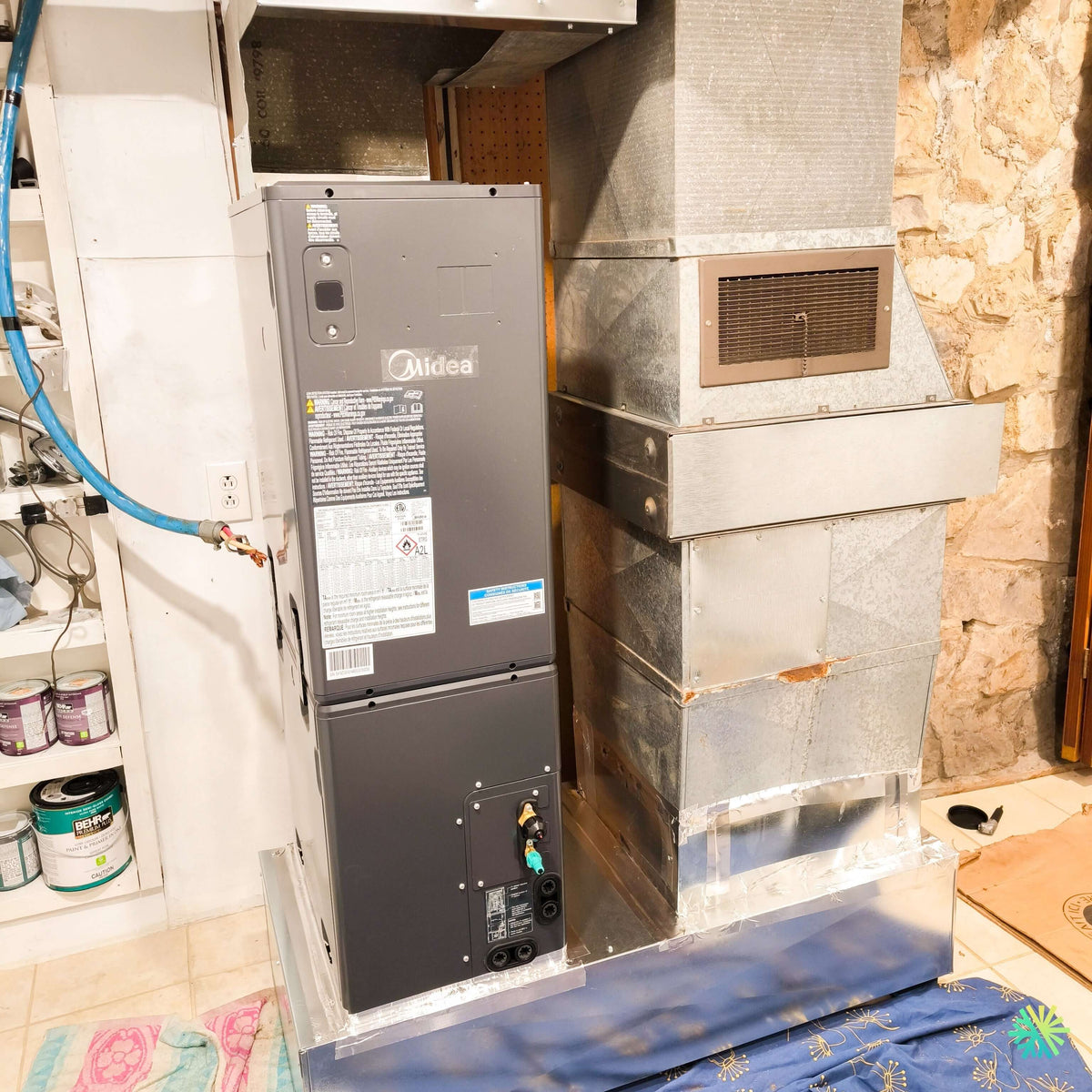
The photo taken during our work shows the new MIDEA unit installed vertically against an assembly of existing ducts. On the right, an imposing galvanized sheet-metal system occupies nearly all the available height and includes an integrated return-air grille. On the left, the space is bounded by a finished wall and shelves. Behind the duct system, the original masonry is still visible. There was therefore no point in designing this project as a theoretical new installation: the new HVAC installation had to fit into the actual building, centimetre by centimetre.
The MIDEA EVOX G3 is part of the Inverter ducted central systems from MIDEA, specifically designed to facilitate certain residential heating system modernizations.
What this construction-site photo immediately helps us understand
The first thing we notice is not the unit itself, but the relationship between the unit and the existing system.
The MIDEA EVOX G3 is positioned right beside a much larger vertical duct. At the bottom of the installation, we fabricated a new sheet-metal section that integrates the furnace into the system. The joints are carefully closed and sealed. This part of the installation is essential: it must direct air with as little loss and disruption as possible while respecting the available dimensions.
It is also noticeable that the photo was taken during the workSome service connections have not yet been finalized, and a temporary construction duct is visible on the side. For us, this image is particularly interesting because it shows what a homeowner rarely sees: the moment when the new unit is already in position, but the integration, connection, and commissioning work is still underway.
A properly completed central installation requires several steps before we can consider the system finished.
Custom sheet metal is not a decorative detail
When replacing an old furnace, the dimensions of the new unit rarely match the existing plenum or return-air system exactly.
We therefore need to fabricate Custom metal transitions.
In this Ville-Marie installation, the new sheet-metal section visible below and beside the unit serves several purposes:
- it allows the unit to be connected to the existing system;
- it creates a suitable transition between different dimensions;
- it limits air leakage;
- it supports the system’s mechanical configuration;
- it maintains a sufficiently clean geometry to avoid unnecessary restrictions;
- it keeps the service panels accessible.
A poor transition can cancel out some of the benefits of a new heat pump or electric furnace. An abrupt change in cross-section, an undersized plenum, or a poorly sealed connection can increase static pressure and reduce airflow.
That is why, at AirGreen, we consider sheet-metal work to be a technical component of the HVAC installationHVAC installation, rather than as a simple finish.
Why the MIDEA EVOX G3 format is well suited to renovations
MIDEA has provided several indoor-unit dimensions to facilitate the replacement of existing furnaces. Depending on capacity, the documentation indicates widths of approximately 14.5 to 21.5 inches, as well as a design that can operate with different electrical supplies for the indoor unit, including 115 V or 208/230 V depending on the application.
In a large new construction project, a difference of a few inches may seem unimportant.
In a mechanical room in Ville-Marie, they can determine whether the project is feasible.
Here, we had to preserve the large duct located to the right of the unit, respect the finished wall on the left, and work with a height already determined by the existing system. An overly wide unit could have required a much more extensive reconstruction of the duct system.
A modular design that gives installers more options
The EVOX G3 can be configured in several orientations. MIDEA’s documentation notably presents upflow, downflow, right-horizontal, and left-horizontal installations, as well as certain low-boy-type configurations. low-boy when available height is limited.
On this project, we selected a vertical installation adapted to the existing system.
The value of this versatility is most apparent when working in existing buildings. We do not want to choose equipment that systematically requires the entire mechanical room to be modified. Instead, we look for a combination that allows us to preserve what works well while replacing outdated components.
Electric furnace or air handler: a useful distinction
In Quebec, the term electric furnace is widely used to refer to the indoor unit of a central system.
In an EVOX G3 configuration with a heat pump, however, its role is broader.
The indoor unit provides, among other things:
- air circulation through the ducts;
- heat exchange with the indoor coil;
- the distribution of cooling in summer;
- the distribution of heat produced by the heat pump in winter;
- the integration of auxiliary electric heating when required.
In other words, when the heat pump can meet the demand, the system first uses the heat transfer provided by the heat pump. The electric elements can then provide supplemental heat depending on the configuration and requirements.
MIDEA offers multi-stage auxiliary heating kits capable of reaching 25 kW on certain configurations. The manufacturer also indicates that the controls can adjust the use of auxiliary heat as temperatures change.
This does not mean that 25 kW must be installed everywhere.
The electric heating capacity must be selected based on the capacity of the electrical panel, the wiring, the building’s heat losses, the heat pump’s low-temperature performance, and the planned heating strategy.
R-454B is clearly identified on this new generation
On the label visible on the front of the unit, we can distinguish the pictogram A2L, associated with the refrigerant used by this generation.
MIDEA states that the central EVOX range uses R-454B, an A2L refrigerant with an advertised global warming potential of 466.
For a professional installation, this refrigerant change is important.
The procedures, service equipment, connection methods, and commissioning must be adapted to the requirements associated with A2L refrigerants. Therefore, it is not only the machine that changes: installation practices must also evolve.
For a homeowner comparing several quotes for a central heat pump in Montreal, it is worth checking not only the brand and capacity, but also the refrigerant used by the proposed generation.
A system designed to continue heating when it is genuinely cold
In the Montreal area, a heat pump must be evaluated based on its performance in January, not only on its efficiency during an autumn day.
The EVOX G3 documentation states continuous operation down to approximately -30 °C. MIDEA also reports, for certain tested configurations, significant heating capacity at -25 °C, with a COP that can reach approximately 1.9 depending on the test conditions. The manufacturer specifies that some of these data come from a three-ton system used during testing.
These values are useful for a Ville-Marie property, but they must be interpreted correctly.
We cannot take the best figure from a brochure and automatically apply it to all capacities in the range. Actual performance depends on the exact pairing between the indoor and outdoor units, outdoor temperature, and operating conditions.
Performance varies depending on the pairing
The EVOX G3 range presented in the documentation covers several capacities, from approximately 18,000 to 54,000 BTU/h. The best advertised configurations reach up to 19 SEER2, 12.5 EER2, 10.8 HSPF2 and a COP of up to 2.14 to 5 °F, or approximately -15 °C.
The technical data sheet lists, among others, 18,000, 24,000, 30,000, 36,000, 48,000, and 54,000 BTU/h systems, each with its own performance characteristics.
The photo of this Ville-Marie installation does not allow us to read the exact model number with sufficient certainty to publish a precise tonnage without risking an error.
We therefore prefer to be rigorous: we do not present a capacity as being that of the project if it cannot be confirmed from the available information.
For a homeowner, this is also a good habit to adopt when comparing quotes. The name “MIDEA EVOX G3” is not enough. You need to request the exact references for the indoor and outdoor units.
Airflow is probably the most underestimated parameter of a central system
A high-quality central heat pump cannot provide good comfort if the duct network prevents it from breathing properly.
This is particularly relevant in this installation, where the new unit must work with an existing duct network.
The EVOX G3 incorporates a technology called Computational Constant Airflow 2.0. MIDEA states that this technology can adjust fan operation to maintain airflow when network resistance changes. The documentation presents conditions of up to 1.2 in. of external static pressure.
The system also allows the airflow volume to be adjusted over up to 60 levels, providing more leeway during commissioning.
This feature is useful for a renovation, but it should not be used as an excuse to keep a defective network. An undersized air return, severely crushed ducts, or undersized grilles must always be corrected when necessary.
The grille visible on the duct highlights the importance of the air return
In the Ville-Marie photo, a large brown grille is integrated directly into the existing vertical duct.
The presence of this component draws attention to an often-overlooked aspect: the air return.
Many homeowners focus their attention on the grilles that blow warm or cool air into the rooms. However, the system must first draw in enough air before it can redistribute it.
Therefore, when we modernize a central system, we must examine:
- return area;
- duct dimensions;
- the condition of the filters;
- restrictions;
- dampers;
- transitions;
- total static pressure;
- the airflow required for the installed capacity.
The blower and ductwork must be considered as a single system.
A successful central installation is also judged by what will be easy to maintain five or ten years from now
Keep the panels accessible
On the new MIDEA unit, the large front panels remain accessible.
This is essential.
An installation may seem very compact and tidy on the day of the job while becoming problematic later if a refrigerant line, drain, or sheet-metal part prevents a technician from opening the unit.
We therefore think about the future HVAC maintenance from the outset.
Technicians must be able to reach important components without dismantling half the mechanical room.
Filtration must match the ductwork, not just a MERV rating
The EVOX G3 range provides filtration solutions from 1, 2 and 4 inches, including configurations that can use MERV 13. MIDEA presents these options as a way to capture certain particles more effectively while providing greater protection for the indoor coil.
However, installing a more restrictive filter is not automatically an improvement.
The following must be checked:
- the filter's total surface area;
- its thickness;
- furnace airflow;
- static pressure;
- replacement frequency;
- the condition of the ductwork.
In some homes, a wider and deeper filter is an excellent improvement. In others, installing a highly restrictive filter without modifying the cabinet can unnecessarily reduce airflow.
The controls can also facilitate an upgrade
The EVOX G3 documentation provides several control options, including communication 485 and configurations using a conventional thermostat 24 V. The manufacturer also indicates various pairing options between EVOX equipment and certain third-party controls.
This flexibility is particularly useful in renovations in Montreal, where the existing thermostat wire may run through several finished walls and be difficult to replace.
Once again, we check each installation individually before confirming which functions will be available with a specific thermostat.
Mistakes to avoid when replacing an old furnace in Ville-Marie
This installation helps summarize several common mistakes we aim to avoid.
Buy the equipment before measuring the space
In such a tight location, width and height are just as important as BTU capacity.
Choose the tonnage based solely on the home's square footage
Square footage alone is not enough. Insulation, windows, exposure, air infiltration, the number of floors, and the ductwork network affect the actual load.
Keep all the old transitions without checking them
A transition that suited the old equipment may be inadequate for the new system’s airflow.
Neglecting static pressure
A modern blower must still comply with the duct system’s limitations.
Installing the equipment too close to obstacles
Access to service panels and components that may eventually need to be inspected or replaced must be maintained.
Treating auxiliary electric heating as the default primary heating source
With a cold-climate central heat pump, the goal is generally to maximize the heat pump’s efficient operation and reserve electric backup for situations where it truly adds value.
What about rebates for an MIDEA EVOX G3 system?
Financial assistance programs are often an important factor in a homeowner’s decision to replace their central system.
However, eligibility should never be determined solely from the series name.
For a MIDEA EVOX G3 central heat pump, the exact pairing of the indoor and outdoor units, the corresponding AHRI number, and the rules of the Quebec program in effect at the time of installation must be verified.
MIDEA’s technical table confirms that the same EVOX G3 family includes several capacities and several distinct combinations.
At AirGreen, we therefore recommend confirming eligibility for the applicable program, including Hydro-Québec’s LogisVert program when the project criteria are met, before considering the amount of financial assistance to be guaranteed.
Why this Ville-Marie installation is representative of our work on central systems
This project stands out not because it involved a perfectly empty mechanical room or an installation in a new building.
It is precisely the opposite.
We worked around an existing ductwork, limited side clearance, a masonry wall, an existing integrated grille, and a configuration that required precise planning for the new sheet metal.
This is the kind of situation we regularly encounter in Montreal’s central districts.
A successful installation is not about forcing the equipment into place at all costs. The entire system must operate properly: electric furnace, heat pump, return air, supply air, ductwork, filtration, drainage, refrigerant, controls, and blower settings projects.
This is the approach we apply to our heating and cooling in Ville-Marie, Montreal, Laval, Longueuil, the North Shore, and the South Shore.
When we replace an old furnace or modernize a central system, our goal is to create an installation that is not only functional on the day it is commissioned, but also logical, accessible, and suited to the building for the many heating and cooling seasons that follow.
The job tools
Two quick checks with real numbers: what heat costs, and what your current heaters add up to in BTU/h.
Conversion: 1 W = 3.412 BTU/h. An indication, not a load calculation: baseboards and furnaces are often stronger than the real need, and they can stay as backup. AirGreen confirms the capacity on site.
How the job unfolds
The main steps of this kind of job at AirGreen. Every house has its quirks: the estimate brings them out.
We look at the ducts, the current indoor module, the electrical panel and the planned spot for the outdoor unit.
The equipment combination, capacity and price, in writing. We check whether the combination qualifies for assistance programs.
Access protected, old unit disconnected and removed when it is being replaced.
Electric furnace or air handler, with its coil, connected to the supply and return ducts.
On a level base, raised above the snow, with free space all around.
Insulated, they enter through a sealed opening and run to the indoor coil.
Dedicated circuits, accessible disconnect, a thermostat that works with the heat pump and the backup heat.
Leak test, vacuum, start-up, airflow check and a test of both modes.
Filter, thermostat, backup heat in extreme cold: what to know before winter.
- The on-site estimateWe look at the ducts, the current indoor module, the electrical panel and the planned spot for the outdoor unit.
- The quoteThe equipment combination, capacity and price, in writing. We check whether the combination qualifies for assistance programs.
- Getting readyAccess protected, old unit disconnected and removed when it is being replaced.
- The indoor moduleElectric furnace or air handler, with its coil, connected to the supply and return ducts.
- The outdoor unitOn a level base, raised above the snow, with free space all around.
- The refrigerant linesInsulated, they enter through a sealed opening and run to the indoor coil.
- Electrical and thermostatDedicated circuits, accessible disconnect, a thermostat that works with the heat pump and the backup heat.
- Tests and start-upLeak test, vacuum, start-up, airflow check and a test of both modes.
- The walkthroughFilter, thermostat, backup heat in extreme cold: what to know before winter.
What we check on a job like this one
Each number is a point we check on site. Switch between summer and winter to watch air and heat move.
In summer, the outdoor unit rejects the house's heat outside.
Generic illustration of this type of installation, not a survey of this job site. Tap a number.
It captures or rejects heat outside. It sits on a level base, above the snow, with free space all around.
The insulated refrigerant lines enter the house through a sealed opening and run to the indoor coil.
A shut-off switch near the outdoor unit isolates it safely for service.
Sitting on the indoor module, it moves heat between the house air and the refrigerant.
Electric furnace or air handler: its fan pushes air through the ducts. The electric backup takes over in extreme cold.
Supply ducts bring air to the rooms; returns bring it back to the unit. Their condition matters as much as the unit's.
It protects the coil and the fan. A dirty filter cuts airflow, so it gets checked regularly.
It runs the heat pump and the backup heat. It must be compatible with the installed system.
Is your home ready?
Check what applies at your place. A "no" is not a refusal: it is what we sort out during the estimate.
Good habits, once the unit is in place
Six simple habits that keep the unit going. Your list stays on this device.
What to do, season by season
Three habits per season for this unit. They take a few minutes and prevent many calls.
- Check the indoor module's filter.
- Clear winter debris from the outdoor unit.
- Test cooling before the heat arrives.
- Check the filter more often in peak season.
- Keep registers and returns clear.
- Watch condensate drainage near the coil.
- Change or clean the filter.
- Test heating and backup heat before the cold.
- Book periodic maintenance.
- Clear snow around the outdoor unit.
- Store nothing in front of the indoor module.
- Note any unusual noise or smell and call us.
The right pages, at the right time
Four statements: true or false?
It all comes down to details you have just seen.
1. A central heat pump uses the house's ducts.
It connects to the existing ducts to heat and cool everywhere.
2. In extreme cold, electric backup heat can take over.
The indoor module (furnace or air handler) works with the heat pump and takes over in extreme cold.
3. The filter only gets changed when the unit breaks down.
A dirty filter cuts airflow. It gets checked regularly.
4. You can reuse the old unit's size without checking.
The house may have changed: insulation, windows, added rooms. Capacity is confirmed on site.
0 / 4 right answers
What people ask us about this kind of work
Can I keep my current ducts?
What happens in extreme cold?
Furnace, air handler, ducted: what is the difference?
Are there grants?
Do I need a permit?
How much can I save?
How is the LogisVert assistance calculated?
Will my current thermostat work?
Central or wall units: which one?
Does AirGreen hold the required licences?
Is the estimate free?
No question matches. Write to us: we answer.
More jobs to see, near you
By town, by equipment or by region: browse more than 4,700 published projects.
Each dot: a town where AirGreen has published projects. The glowing dot: this job.
An on-site estimate, the right capacity, the right equipment.
The on-site estimate is free and the quote follows within 24 hours.
Text and photo: a real AirGreen Climatisation & Chauffage job. The diagrams are generic illustrations of the type of installation, not a survey of this job site. Sources of the added figures: airgreen.ca product pages (NEEP / AHRI performance), Hydro-Québec (Heat pumps page, LogisVert, read on 13 October 2026), Régie de l’énergie (rate D as of 1 April 2026).