
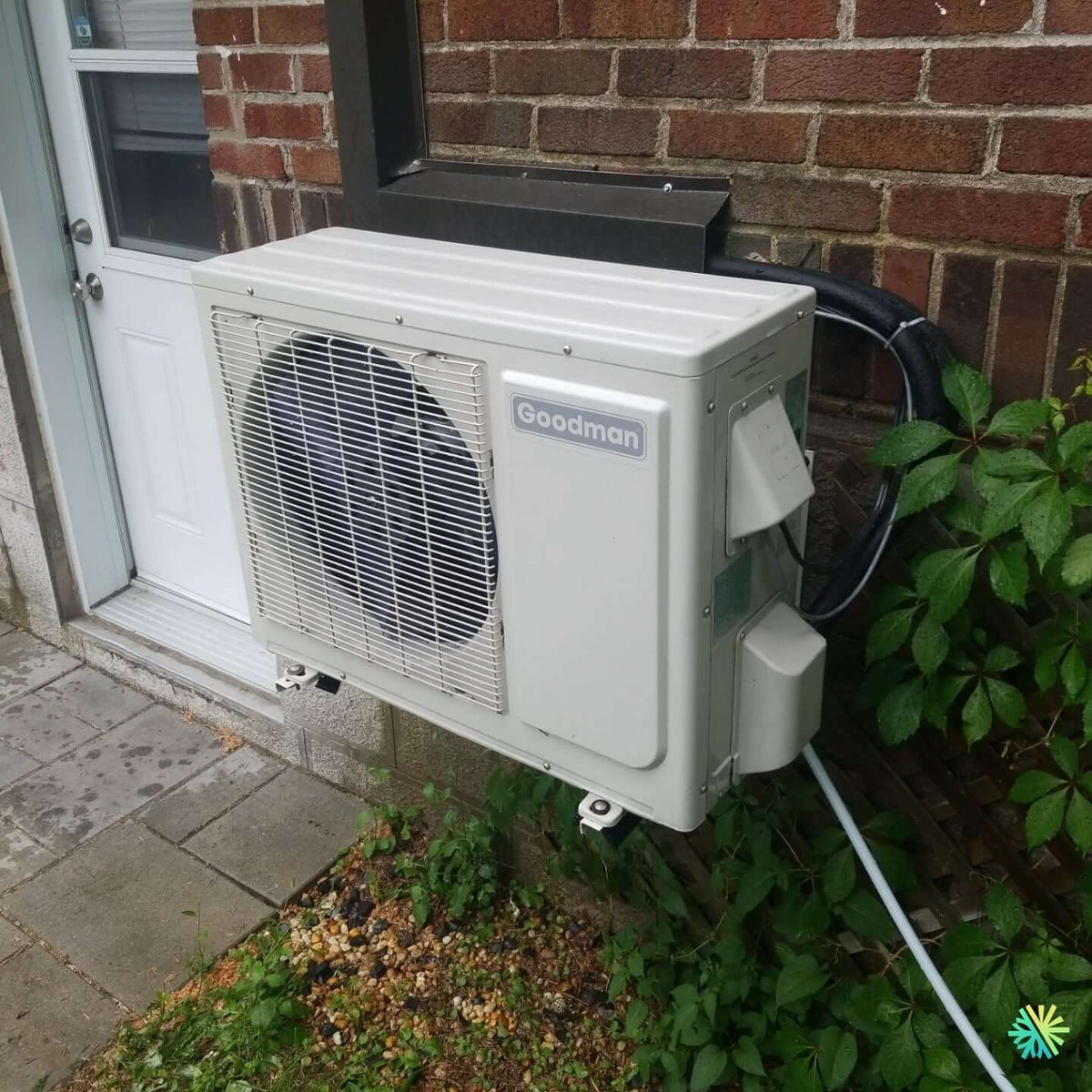
Installation of a Goodman wall-mounted heat pump in Saint-Léonard
AirGreen installs a Goodman wall-mounted heat pump in Saint-Léonard: raised condenser on brackets, short refrigeration path, defrost management, and careful finishing for four-season comfort. HVAC expertise in Greater Montreal.
In summer, the outdoor unit rejects the house's heat outside.
Generic illustration of this type of installation, not a survey of this job site. Tap a number.
Mounted level on a wall plate, high enough for the air to reach the whole room, with enough space around it to slide the filters out easily.
The refrigerant lines, the communication cable and the drain go through the wall in a single opening, sealed against water, cold air and insects.
Two insulated copper pipes connect the two units. Outside, a line cover can protect them from sun, knocks and weather.
A shut-off switch near the outdoor unit isolates it safely for service. It must stay accessible at all times.
The compressor and the fan. In heating mode it captures heat from the outdoor air, even in winter, and moves it inside.
On the ground or on the wall, it keeps the unit above accumulated snow. The unit stays clear and defrost water can drain away.
The fan needs to blow freely. Storage, a fence or a wall too close, and efficiency drops while noise goes up.
A wall-mounted condenser installed with millimeter precision near a rear door for reliable four-season performance
Client context and objectives
At AirGreen , we work in a typical brick plex in Saint-Léonard where the rear access is used for daily use. The owners want to modernize their heating and cooling system while maintaining a clear path to the garden. We offer a Goodman wall-mounted heat pump , chosen for its ease of maintenance, its stability in winter heating, and its compatibility with the small size of Montreal backyards.
The objectives set together:
-
maintain stable comfort in the living room and kitchen with controlled consumption;
-
take care of the HVAC system so that it does not obstruct traffic near the door;
-
ensure clean defrost water/condensate drainage, without splashes or ice cubes in winter;
-
provide rapid maintenance without heavy disassembly.
Exterior installation: wall brackets and snow protection height
The Goodman condenser is mounted on sturdy wall brackets above a bed of stones that provides drainage. This configuration offers several advantages:
-
elevation of approximately 35–45 cm above the ground level to clear snow accumulation;
-
reduction of dust/vegetation deposits in the exchanger while maintaining ground clearance;
-
structural vibration controlled thanks to silent blocks inserted between the unit and each bracket.
We adhere to the recommended rear and side clearances for air sweeping. The unit's close proximity to a door requires precise shimming: the unit is positioned away from the door leaf and oriented so as not to blow toward the user during defrost cycles. The passage remains clear for movement and evacuation.
Management of the refrigeration route and facade aesthetics
The refrigerant connections and the power supply are grouped together in a rigid protective sheath along the brick wall. We favor:
-
a short route between the indoor head and the outdoor unit to limit pressure losses;
-
continuous insulation of the lines (without breakage in the sun) to maintain performance in summer;
-
a generous radius of curvature at the condenser inlet, avoiding mechanical stress on the brazing joints.
The wall seals are treated with exterior mastic and weatherstripping to prevent any infiltration of air or water behind the brick.
Condensate drainage and frost management
Drainage is by gravity to the mineral drainage area, away from the door step. In winter, defrost cycles can produce water: we direct the discharge so as not to create ice stalagmites in the passage. Depending on wind direction and shade, we can add a heating cable to the critical portion of the drain. This attention prevents water from returning to the unit and extends the life of the tray.
Electrical connections and safety
-
Dedicated power supply and external disconnect within range of intervention;
-
clean routing of conductors, grounding checked;
-
clear identification of circuits to facilitate subsequent maintenance.
Commissioning: AirGreen method
We apply a strict procedure:
-
Deep vacuum until stabilization, followed by a leak test;
-
Factory load release, pressure control, superheating and subcooling in heating and air conditioning;
-
Checking the intensities and sound level; adjusting the fan bearings;
-
Setting of anti-cold air draft and defrost functions optimized for Montreal winters.
Specifics of mounting near a door
Installing a condenser near an access point requires precautions that we systematically integrate:
-
Height and setback to avoid hitting feet or objects when passing;
-
airflow direction to avoid blowing on the user;
-
rigid fixing to prevent any resonance with the masonry when opening/closing the door;
-
control of runoff on the doorstep to prevent freezing.
Benefits for the customer
-
Four-season comfort : the heat pump covers most of the heating, with the additional heating only being used during peaks of intense cold;
-
Energy savings : inverter modulation and optimized refrigeration path;
-
Silence : silent blocks and wall clearance reduce vibration transmission;
-
Easy maintenance : clearances respected, accessible disconnect, clear front for cleaning the exchanger.
Inside: Head placement and air circulation
The wall-mounted fan (living room) blows parallel to the flow of air, in order to sweep the open area without drafts on the occupants. Our settings:
-
Winter : slight vertical angle downwards to break the stratification and reach the corridor;
-
Summer : elongated angle to bring fresh air to the back of the room;
-
Night Mode : Automatic lowering of flow rate and sound level.
What we check on every visit
-
Cleaning and condition of the blower wheel and filters (interior);
-
Cleanliness of the external exchanger, straightening of the fins if necessary;
-
Condition of the drain and stone bed; no backflow or stagnation;
-
Tightening of connections and visual inspection of solders /insulators;
-
Updated settings to match actual usage (times, thresholds).
Common pitfalls… and how to avoid them
-
Condensation poorly directed : dripping at the door step, ice formation. → Discharge directed towards the mineral bed and, if necessary, heating cable.
-
Structural vibration : fixing too flexible or poorly distributed anchoring. → Properly sized brackets, dowels adapted to the brick, calibrated silent blocks .
-
Short-circuited air in winter: obstacle too close at the rear. → Clearances respected, fan orientation checked during defrosting.
-
Cables exposed to UV : insufficient sheath. → Rigid sheath, UV protection on insulation, stainless steel clamps.
Grants and Eligibility
Depending on the model and its seasonal performance indices, wall-mounted heat pumps may be eligible for financial assistance programs in Quebec. We validate the eligibility of the installed configuration and prepare the files for our clients in Montreal , Laval , Longueuil , North Shore and South Shore . Our team ensures an HVAC installation that complies with good practices for sealing, insulation and electrical safety.
AirGreen Usage Tips
-
Maintain a stable setpoint : the inverter works better without sudden variations.
-
Maintain a clearance of 60–90 cm in front of the exchanger; trim vegetation as the seasons change.
-
Rinse the outdoor heat exchanger with a gentle jet in the spring; avoid high-pressure cleaners.
-
During periods of severe cold, visually check the defrost drain and the absence of snow accumulations under the unit.
Why AirGreen in Saint-Léonard
Our brick plex projects require a thorough understanding of constraints: doorways, narrow walkways, snow, vegetation, existing electrical supply. Our method—flow studies, short refrigeration paths , drain management, and clean finishes—transforms a standard installation into a durable, high-performance, and easy-to-maintain facility. That's our promise, throughout Greater Montreal.
Integrated natural keywords : heat pump , wall-mounted air conditioner , HVAC installation , HVAC maintenance , Montreal , Laval , Longueuil , North Shore , South Shore .
How it goes, from the first call to the end
The main steps of this kind of job at AirGreen. Every house has its quirks: the estimate brings them out.
We look at the room, the outside wall, the line route and where the outdoor unit will go. That is where the capacity gets chosen.
Model, capacity and price, in writing. We also check whether the model qualifies for assistance programs.
Floors and furniture protected, wall plate position marked level, wall opening located.
A single opening, with the slope the drain needs to flow outside.
Set on a stand raised above the snow, with the clearances the manufacturer requires.
Connected, insulated and protected. The opening is then sealed against water, cold air and insects.
A dedicated circuit and an accessible disconnect near the outdoor unit.
Leak test, vacuum, then start-up and a check of heating and cooling.
Remote, modes, filters: we show you the essentials before we leave.
- The on-site estimateWe look at the room, the outside wall, the line route and where the outdoor unit will go. That is where the capacity gets chosen.
- The quoteModel, capacity and price, in writing. We also check whether the model qualifies for assistance programs.
- Getting readyFloors and furniture protected, wall plate position marked level, wall opening located.
- The wall openingA single opening, with the slope the drain needs to flow outside.
- The outdoor unitSet on a stand raised above the snow, with the clearances the manufacturer requires.
- Lines, cable and drainConnected, insulated and protected. The opening is then sealed against water, cold air and insects.
- The electrical workA dedicated circuit and an accessible disconnect near the outdoor unit.
- Tests and start-upLeak test, vacuum, then start-up and a check of heating and cooling.
- The walkthroughRemote, modes, filters: we show you the essentials before we leave.
And at your place?
Two quick checks with real numbers: what heat costs, and what your current heaters add up to in BTU/h.
Conversion: 1 W = 3.412 BTU/h. An indication, not a load calculation: baseboards and furnaces are often stronger than the real need, and they can stay as backup. AirGreen confirms the capacity on site.
What to do, season by season
Three habits per season for this unit. They take a few minutes and prevent many calls.
- Clean the indoor unit's filters.
- Clear leaves and debris left on the outdoor unit by winter.
- Test cooling before the first hot days.
- Clean the filters more often when the unit runs a lot.
- Keep plants away from the outdoor unit.
- Check that no water drips from the indoor unit.
- Rake the leaves around the outdoor unit.
- Test heating before the first cold days.
- Book periodic maintenance before winter.
- Keep snow away from the stand and the front of the unit.
- Let the unit defrost: it is normal.
- Never hit the ice on the fins; call us if the unit stays iced up.
Which type of equipment for your project?
Pick what looks like your need.
Four mistakes we do not make
Flip each card to see what we do instead.
What people ask us about this kind of work
Does a wall-mounted heat pump heat in winter?
Wall-mounted or multi-zone: how do I choose?
Where does the outdoor unit go?
Are there grants?
Do I need a permit?
How cold can it heat?
How much can I save?
How is the LogisVert assistance calculated?
Is it noisy?
The outdoor unit is covered in ice: is that normal?
Does AirGreen hold the required licences?
Is the estimate free?
No question matches. Write to us: we answer.
Useful pages for what comes next
More jobs to see, near you
By town, by equipment or by region: browse more than 4,700 published projects.
Each dot: a town where AirGreen has published projects. The glowing dot: this job.
Tell us about your house. We come and see it for free.
The on-site estimate is free and the quote follows within 24 hours.
Text and photo: a real AirGreen Climatisation & Chauffage job. The diagrams are generic illustrations of the type of installation, not a survey of this job site. Sources of the added figures: airgreen.ca product pages (NEEP / AHRI performance), Hydro-Québec (Heat pumps page, LogisVert, read on 13 October 2026), Régie de l’énergie (rate D as of 1 April 2026).