
Installation of a Gree R-32 wall-mounted heat pump in Le Sud-Ouest (Montreal)
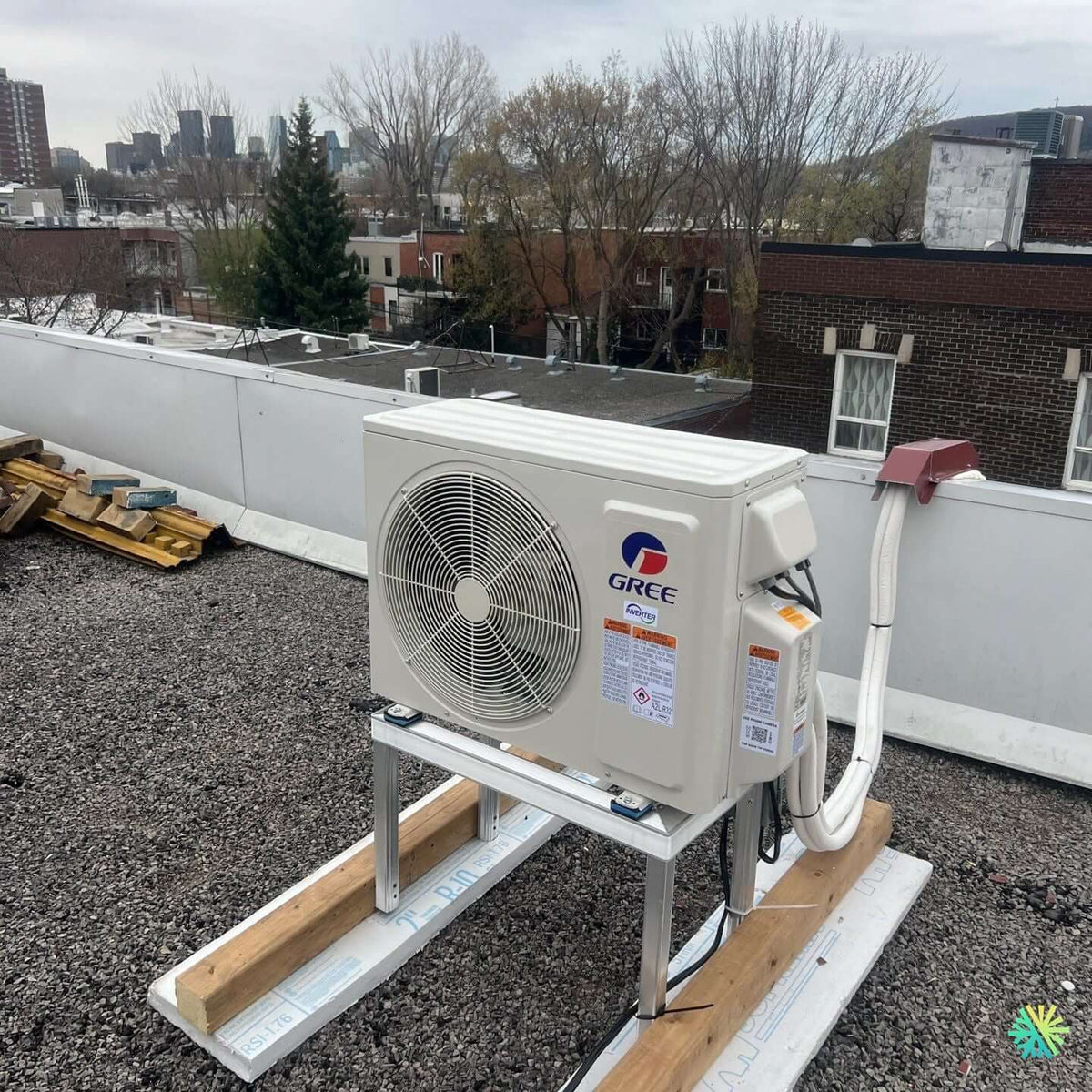
Rooftop installation of a Gree R-32 wall-mounted heat pump in the Southwest: anti-vibration frame, waterproof roof passage, protected connections and careful HVAC installation for four-season comfort. AirGreen — Greater Montreal.
In summer, the outdoor unit rejects the house's heat outside.
Generic illustration of this type of installation, not a survey of this job site. Tap a number.
Mounted level on a wall plate, high enough for the air to reach the whole room, with enough space around it to slide the filters out easily.
The refrigerant lines, the communication cable and the drain go through the wall in a single opening, sealed against water, cold air and insects.
Two insulated copper pipes connect the two units. Outside, a line cover can protect them from sun, knocks and weather.
A shut-off switch near the outdoor unit isolates it safely for service. It must stay accessible at all times.
The compressor and the fan. In heating mode it captures heat from the outdoor air, even in winter, and moves it inside.
On the ground or on the wall, it keeps the unit above accumulated snow. The unit stays clear and defrost water can drain away.
The fan needs to blow freely. Storage, a fence or a wall too close, and efficiency drops while noise goes up.
A flat roof installation designed for the Montreal climate: stability, silence and four-season performance
Background and objectives
In a typical plex in Southwest Montreal , the owner wanted to modernize the comfort of the main floor without encroaching on the interior space or the facade. We proposed a Gree wall-mounted heat pump ( R-32 refrigerant) with a condenser installed on a flat roof . The challenge: to combine performance , sound discretion and durability in the face of prevailing winds, freeze/thaw cycles and snow accumulations.
The selected equipment
-
Type : wall-mounted heat pump (mini-split) , one indoor head for the open living area.
-
Brand : Gree .
-
Range : R-32 generation with high seasonal efficiency.
-
Target capacity : 12,000–15,000 BTU depending on the main zone load calculation.
-
Key advantages : inverter compressor, low temperature capacity maintenance, reduced noise level, optimized defrost electronics, low GWP of R-32 refrigerant.
HVAC Installation Details – Rooftop Condenser
-
Support : raised aluminum frame anchored on anti-vibration pads . The loads are distributed via protective soles to protect the roof membrane.
-
Clearance : clearance under the device to limit the suction of gravel , facilitate the flow of winter condensates and prevent snow drifts.
-
Refrigerated connections : protected path in a chute up to the parapet , then crossing under a waterproof cover. Reinforced UV insulation and taping to counteract sunlight and wind.
-
Cabling : power and communication combined in the same route with anti-drip loop; service reserve for future maintenance.
-
Estimated total length **: 8 to 12 m between the indoor head and the condenser, ideal length for a good compromise between pressure losses and technical access.
-
Waterproofing : roof passage and vapor barrier sleeve at the parapet; membrane-compatible mastic to prevent any infiltration.
-
Upgrade : fine adjustment of the frame for the defrost flow , orientation in accordance with the prevailing wind direction to protect the exchanger.
-
Safety and maintenance : free space all around the device (≥ 30 cm on the sides, ≥ 60 cm on the front) for easy access to the electrical cabinet, valves and fan.
The inner head: diffusion and comfort
-
High ceiling installation to promote minimal stratification and the Coanda effect.
-
Wide-angle motorized sweep to cover living room, dining room and open kitchen.
-
Gravity drainage to the exterior: continuous slope, air trap and anti-vibration collars to prevent gurgling. No condensate pump required, reducing maintenance risks and noise.
Commissioning procedure
-
Nitrogen test and leak test at flared fittings.
-
Deep vacuum < 500 microns, stabilized with rebound monitoring.
-
Opening of the valves , superheating and subcooling readings in cooling mode then in heating mode.
-
Checking the intensities , calibrating the settings , pairing the remote control and explaining the modes to the occupant.
Construction site challenges and our solutions
-
Flat gravel roof exposed to the wind: high-rigidity frame and high-density pads to prevent any drift. Orientation studied to limit air recycling and whistling from the fan.
-
Parapet crossing : use of a rigid waterproof cover , complete UV protection of the cold insulation, sealed connections for a lasting result.
-
Access and handling : secure ascent by ladder with lifeline , handling of the unit using straps to avoid marking the sheet metal.
-
Noise perceived inside : anti-vibration spacers and service loops on the lines to mechanically decouple the unit from the walls.
Results obtained
-
Uniform cooling in summer and efficient supplementary heating in the off-season and in winter.
-
Silence on the roof and inside thanks to vibration decoupling.
-
Aesthetics preserved : no projection on the front facade; installation invisible from the street.
-
Efficiency : fine modulation of the inverter , reducing on/off cycles and consumption.
Good usage practices
-
Stable setpoint (21–23°C) to allow the inverter to optimize power.
-
Sweeping : in summer, flap slightly upwards to diffuse without drafts; in winter, horizontal sweep to mix the stratified air.
-
Doors open to extend comfort to hallway and adjacent rooms.
-
Dehumidification mode as needed to improve humidity comfort without overcooling.
Recommended HVAC maintenance
-
Filters : Rinse every 4–6 weeks during heavy use.
-
Internal exchanger and turbine : annual professional cleaning.
-
Roof condenser : dusting of the fins, checking of the anchors , inspection of the roof passage seals after freezing/thawing episodes.
-
Annual inspection : performance readings, terminal tightening, defrosting and flow control.
Grants and Eligibility
High-performance R-32 wall-mounted heat pumps may be eligible for assistance based on their nominal efficiency and low-temperature capacity maintenance. We validate each file for our clients in Montreal, Laval, Longueuil, North Shore, and South Shore , by providing the required technical evidence and installation certification.
Mistakes to avoid (feedback)
-
Installing a condenser on the roof too low : risk of sucking up gravel/snow and hindering the flow.
-
Forget about UV protection on insulation in direct sunlight.
-
Undersize capacity for an open living area.
-
Neglecting deep vacuum and leak testing : major causes of early failures.
Why this solution for the Southwest?
-
Urban density and flat roofs : roof installation frees up interior courtyards and respects the aesthetics of the alleyways.
-
Local climate : defrosting electronics and inverter modulation provide stable comfort, even during cold snaps and thaws.
-
Maintenance : generous clearances and clear paths facilitate maintenance, ensuring longevity.
Site sheet — summary
-
Address : Le Sud-Ouest sector (Montreal) , flat-roofed plex.
-
Appliance : Gree R-32 wall-mounted heat pump , 12–15k BTU depending on load.
-
Condenser : on raised frame with anti-vibration pads, protective soles, wind orientation .
-
Route : gully connections to the parapet , watertight crossing; length ~8–12 m.
-
Internal drain : gravity ; no condensate pump .
-
Commissioning : deep vacuum , nitrogen test, thermodynamic measurements, fine adjustments.
-
Goal : four-season comfort with durable and discreet HVAC installation .
Need a similar project?
We size, install and maintain wall-mounted heat pumps on flat roofs or facades, according to the best practices of Greater Montreal . We intervene quickly in Montreal, Laval, Longueuil, North Shore and South Shore with complete support (selection, installation, HVAC maintenance , grant application).
How it goes, from the first call to the end
The main steps of this kind of job at AirGreen. Every house has its quirks: the estimate brings them out.
We look at the room, the outside wall, the line route and where the outdoor unit will go. That is where the capacity gets chosen.
Model, capacity and price, in writing. We also check whether the model qualifies for assistance programs.
Floors and furniture protected, wall plate position marked level, wall opening located.
A single opening, with the slope the drain needs to flow outside.
Set on a stand raised above the snow, with the clearances the manufacturer requires.
Connected, insulated and protected. The opening is then sealed against water, cold air and insects.
A dedicated circuit and an accessible disconnect near the outdoor unit.
Leak test, vacuum, then start-up and a check of heating and cooling.
Remote, modes, filters: we show you the essentials before we leave.
- The on-site estimateWe look at the room, the outside wall, the line route and where the outdoor unit will go. That is where the capacity gets chosen.
- The quoteModel, capacity and price, in writing. We also check whether the model qualifies for assistance programs.
- Getting readyFloors and furniture protected, wall plate position marked level, wall opening located.
- The wall openingA single opening, with the slope the drain needs to flow outside.
- The outdoor unitSet on a stand raised above the snow, with the clearances the manufacturer requires.
- Lines, cable and drainConnected, insulated and protected. The opening is then sealed against water, cold air and insects.
- The electrical workA dedicated circuit and an accessible disconnect near the outdoor unit.
- Tests and start-upLeak test, vacuum, then start-up and a check of heating and cooling.
- The walkthroughRemote, modes, filters: we show you the essentials before we leave.
And at your place?
Two quick checks with real numbers: what heat costs, and what your current heaters add up to in BTU/h.
Conversion: 1 W = 3.412 BTU/h. An indication, not a load calculation: baseboards and furnaces are often stronger than the real need, and they can stay as backup. AirGreen confirms the capacity on site.
What to do, season by season
Three habits per season for this unit. They take a few minutes and prevent many calls.
- Clean the indoor unit's filters.
- Clear leaves and debris left on the outdoor unit by winter.
- Test cooling before the first hot days.
- Clean the filters more often when the unit runs a lot.
- Keep plants away from the outdoor unit.
- Check that no water drips from the indoor unit.
- Rake the leaves around the outdoor unit.
- Test heating before the first cold days.
- Book periodic maintenance before winter.
- Keep snow away from the stand and the front of the unit.
- Let the unit defrost: it is normal.
- Never hit the ice on the fins; call us if the unit stays iced up.
Which type of equipment for your project?
Pick what looks like your need.
Four mistakes we do not make
Flip each card to see what we do instead.
What people ask us about this kind of work
Does a wall-mounted heat pump heat in winter?
Wall-mounted or multi-zone: how do I choose?
Where does the outdoor unit go?
Are there grants?
Do I need a permit?
How cold can it heat?
How much can I save?
How is the LogisVert assistance calculated?
Is it noisy?
The outdoor unit is covered in ice: is that normal?
Does AirGreen hold the required licences?
Is the estimate free?
No question matches. Write to us: we answer.
Useful pages for what comes next
More jobs to see, near you
By town, by equipment or by region: browse more than 4,700 published projects.
Each dot: a town where AirGreen has published projects. The glowing dot: this job.
Tell us about your house. We come and see it for free.
The on-site estimate is free and the quote follows within 24 hours.
Text and photo: a real AirGreen Climatisation & Chauffage job. The diagrams are generic illustrations of the type of installation, not a survey of this job site. Sources of the added figures: airgreen.ca product pages (NEEP / AHRI performance), Hydro-Québec (Heat pumps page, LogisVert, read on 13 October 2026), Régie de l’énergie (rate D as of 1 April 2026).