
Installation of a Gree Vireo R32 wall-mounted heat pump in Villeray–Saint-Michel–Parc-Extension
In Villeray–Saint-Michel–Parc-Extension , AirGreen installs a Gree Vireo R32 wall-mounted heat pump : anti-vibration brackets, protected chute, adjusted R-32 charge and meticulous commissioning for lasting HVAC comfort .
Take a tour of the installation
Each number is a point we check on site. Switch between summer and winter to watch air and heat move.
In summer, the outdoor unit rejects the house's heat outside.
Generic illustration of this type of installation, not a survey of this job site. Tap a number.
Mounted level on a wall plate, high enough for the air to reach the whole room, with enough space around it to slide the filters out easily.
The refrigerant lines, the communication cable and the drain go through the wall in a single opening, sealed against water, cold air and insects.
Two insulated copper pipes connect the two units. Outside, a line cover can protect them from sun, knocks and weather.
A shut-off switch near the outdoor unit isolates it safely for service. It must stay accessible at all times.
The compressor and the fan. In heating mode it captures heat from the outdoor air, even in winter, and moves it inside.
On the ground or on the wall, it keeps the unit above accumulated snow. The unit stays clear and defrost water can drain away.
The fan needs to blow freely. Storage, a fence or a wall too close, and efficiency drops while noise goes up.
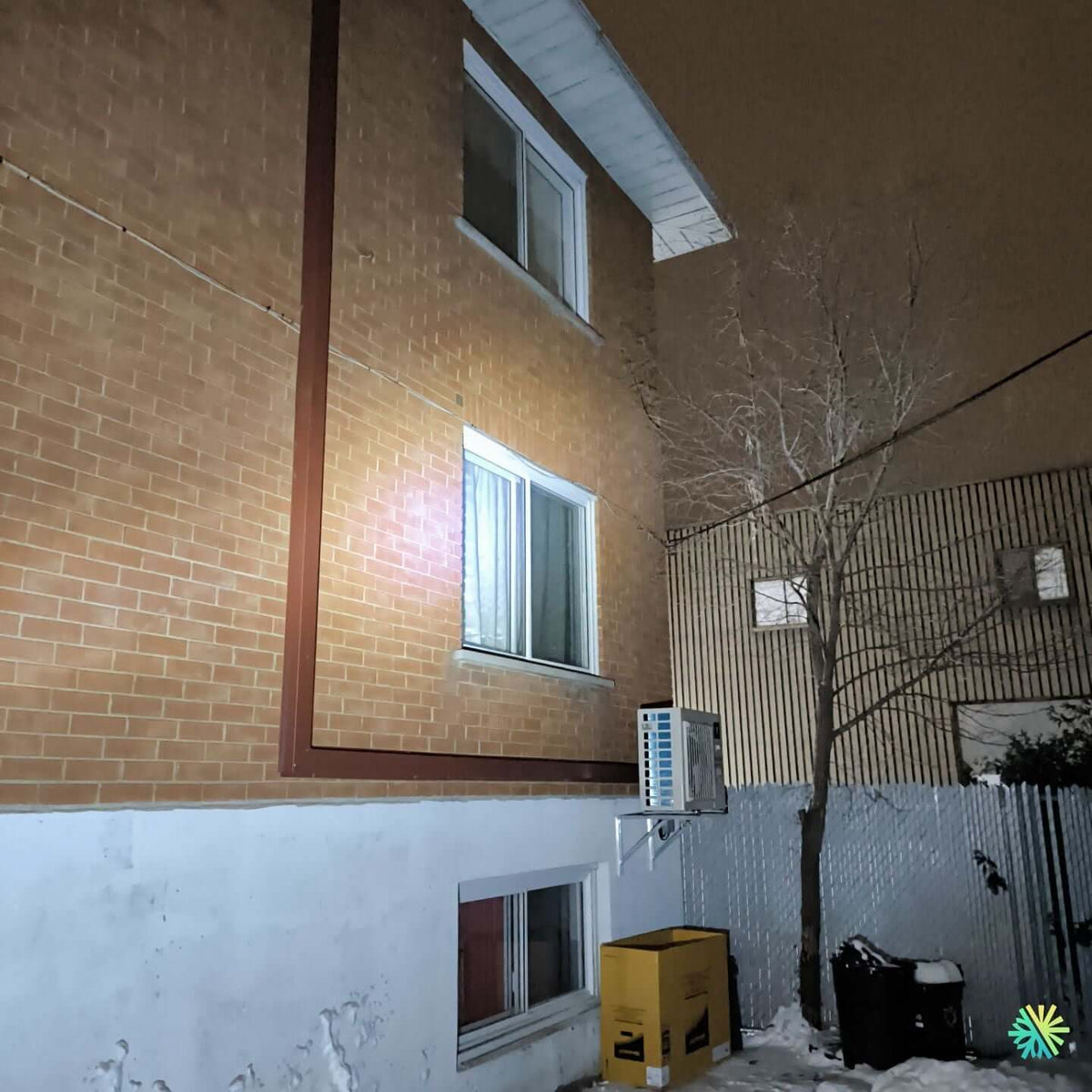
A mastered Montreal alley construction site: four-season comfort, clean and quiet installation
Context: a brick plex, demanding winters
At AirGreen , we are working on a brick plex in Villeray–Saint-Michel–Parc-Extension . The owner wants to stabilize the temperature of the main dwelling, reduce electricity costs and enjoy pleasant cooling in the summer without excessive noise. We offer a Gree wall-mounted heat pump – Vireo R32 range , calibrated for an open living room and adjacent bedrooms, with particular attention to exterior installation in an alley : snow, narrow passages, and proximity to neighbors.
Why a Gree Vireo R32 here?
-
R-32 : reduced charge, better volumetric efficiency and lower GWP than R-410A.
-
Responsive inverter : rapid temperature rise and fine modulation, useful during winter defrosting .
-
Quiet : Fan with optimized blades and suspended compressor; ideal for a shared backyard.
-
Anti-corrosion components (blue fin exchanger) for freeze/thaw cycles and urban salt spray.
-
Compatibility with efficient heat pump assistance programs when performance criteria are met in cold weather.
Our HVAC installation step by step
1) Exterior installation on wall brackets
We fix the condenser on galvanized steel brackets above the snow line . This height prevents obstruction by snow drifts, facilitates flow in defrost mode and limits dust absorption. Anti-vibration pads cut off sound transmission to the masonry.
2) Route of connections and finishes
The refrigeration bundle (liquid + gas), the communication cable, and the power supply are grouped together in a continuous external trunking . The vertical and then horizontal routing respects the bending radii of the copper and remains flush with the wall for a clean finish and protection against impacts. The junctions are capped and sealed to withstand the elements.
3) Drilling and interior passage
The drilling is done at a controlled angle to promote drainage and prevent water from returning. The whole structure is insulated and then sealed on the outside and inside to maintain the building's airtightness.
4) Condensate management
Inside, we prefer a gravity drain to an available return point. If the slope is insufficient, we integrate a soundproof mini-condensate pump with an alarm contact (cut-off in the event of overflow). The passage through a chute keeps the assembly discreet and accessible for maintenance.
5) Compliant power supply
Installation of an accessible external disconnect , circuit breaker dedicated to the electrical panel and wiring sized according to the nominal current. Everything follows the Quebec Construction Code and Gree guidelines: sections, tightening, grounding and marking.
6) Vacuuming, loading and testing
-
Nitrogen leak test .
-
Deep vacuum < 500 microns with stabilization.
-
R-32 charge adjustment to the nearest gram based on equivalent bond length .
-
Superheat and subcooling checks, temperature and current measurements.
-
Tests in cold/heat modes, validation of air flow and sweeping for uniform comfort.
Visible details and technical choices
Neat wall mount
The unit is perfectly plumb , with anchors in the solid brick via appropriate dowels. The rear and side clearances respect the clearances to avoid air recycling and preserve the nominal capacity.
Facade-colored chute
The capping follows the pattern of the brick facade; it protects the connections against UV rays, impacts and occasional vandalism in the alleys. This finish also reduces thermal bridges , a frequent source of losses in winter.
Height and runoff
The installation base prevents the formation of icicles near basement windows. Defrost water flows freely to the floor area without any passage.
Results at the customer
-
Stable heating even on cold nights, with smooth modulation without jolts.
-
Even cooling in summer, shutter oriented to cover the living room-kitchen area.
-
Outside noise contained : the neighbors only hear a discreet breath.
-
Controlled consumption thanks to the inverter compressor and continuous insulation of the connections.
HVAC usage and maintenance tips
Best practices
-
Maintain 30 to 40 cm of clearance around the condenser; clear snow after storms.
-
Clean the wall head filters every 4–6 weeks during use.
-
Avoid extreme setpoints (22–23°C in summer, 20–21°C in winter) to maximize seasonal efficiency .
Annual maintenance recommended
A complete HVAC maintenance before winter: inspection of the insulation , drain check, verification of the electrical connections , reading of the parameters and cleaning of the exchanger. This routine preserves the warranty and maintains performance.
Key technical points on a Montreal brick wall
Vibrations and structure-borne noise
The use of silent blocks and a tightening torque in accordance with the brackets prevents solid transmissions towards the interior (walls/floors). This is a major factor for the peace of mind of the occupants.
Lengths and loads
We calculate the additional R-32 charge per meter of connections, taking into account the elbows (equivalences). Overfilling or a lack of refrigerant deteriorates the COP , hence the systematic electronic weighing.
Wind and defrosting
The alley is a wind corridor : the orientation of the unit limits the return of cold air during defrosting. The cycles remain short and the power stabilizes quickly.
Common mistakes… that we avoid
-
Undersized fixings in a hollow facing: risk of misalignment and vibrations.
-
Tortuous path of the connections without respected radii: pressure losses, fluid noise.
-
Neglected drainage : traces of water in the basement or safety shutdown of the pump.
-
Insufficient clearances around the condenser: air recycling and reduced capacity.
-
Lack of accessible disconnect : non-compliance and delays in service.
AirGreen Grants and Coverage
High-efficiency R-32 wall-mounted heat pumps are generally eligible for assistance programs based on their cold performance data sheets. We validate the address's eligibility and manage the file . Our team serves Montreal , Laval , Longueuil , the North Shore , and the South Shore with the same installation and commissioning standards.
In short
This Gree Vireo R32 HVAC installation in Villeray–Saint-Michel–Parc-Extension demonstrates a clean installation, designed for Montreal's alleyways : brackets above the snow, protected chute, fine adjustments and complete testing. The result for the customer: four-season comfort , reduced energy bills and a system ready for many years of service.
The big day, step by step
The main steps of this kind of job at AirGreen. Every house has its quirks: the estimate brings them out.
We look at the room, the outside wall, the line route and where the outdoor unit will go. That is where the capacity gets chosen.
Model, capacity and price, in writing. We also check whether the model qualifies for assistance programs.
Floors and furniture protected, wall plate position marked level, wall opening located.
A single opening, with the slope the drain needs to flow outside.
Set on a stand raised above the snow, with the clearances the manufacturer requires.
Connected, insulated and protected. The opening is then sealed against water, cold air and insects.
A dedicated circuit and an accessible disconnect near the outdoor unit.
Leak test, vacuum, then start-up and a check of heating and cooling.
Remote, modes, filters: we show you the essentials before we leave.
- The on-site estimateWe look at the room, the outside wall, the line route and where the outdoor unit will go. That is where the capacity gets chosen.
- The quoteModel, capacity and price, in writing. We also check whether the model qualifies for assistance programs.
- Getting readyFloors and furniture protected, wall plate position marked level, wall opening located.
- The wall openingA single opening, with the slope the drain needs to flow outside.
- The outdoor unitSet on a stand raised above the snow, with the clearances the manufacturer requires.
- Lines, cable and drainConnected, insulated and protected. The opening is then sealed against water, cold air and insects.
- The electrical workA dedicated circuit and an accessible disconnect near the outdoor unit.
- Tests and start-upLeak test, vacuum, then start-up and a check of heating and cooling.
- The walkthroughRemote, modes, filters: we show you the essentials before we leave.
What would it look like at your place?
Two quick checks with real numbers: what heat costs, and what your current heaters add up to in BTU/h.
Conversion: 1 W = 3.412 BTU/h. An indication, not a load calculation: baseboards and furnaces are often stronger than the real need, and they can stay as backup. AirGreen confirms the capacity on site.
Four mistakes we do not make
Flip each card to see what we do instead.
Your own project, step by step
What to do, season by season
Three habits per season for this unit. They take a few minutes and prevent many calls.
- Clean the indoor unit's filters.
- Clear leaves and debris left on the outdoor unit by winter.
- Test cooling before the first hot days.
- Clean the filters more often when the unit runs a lot.
- Keep plants away from the outdoor unit.
- Check that no water drips from the indoor unit.
- Rake the leaves around the outdoor unit.
- Test heating before the first cold days.
- Book periodic maintenance before winter.
- Keep snow away from the stand and the front of the unit.
- Let the unit defrost: it is normal.
- Never hit the ice on the fins; call us if the unit stays iced up.
Is your home ready?
Check what applies at your place. A "no" is not a refusal: it is what we sort out during the estimate.
Four statements: true or false?
It all comes down to details you have just seen.
1. In heating mode, the outdoor unit can produce water.
During defrost cycles. That water must drain away without forming ice.
2. You pick the capacity with a simple square-footage rule.
Windows, insulation, orientation and how the room is used all count. Capacity is chosen on site.
3. A multi-zone connects several indoor heads to a single condenser.
One head per room, all on the same condenser. Each room keeps its own temperature.
4. The disconnect can sit behind the patio furniture.
It must stay accessible: it is what shuts the unit off for service.
0 / 4 right answers
What people ask us about this kind of work
Does a wall-mounted heat pump heat in winter?
Wall-mounted or multi-zone: how do I choose?
Where does the outdoor unit go?
Are there grants?
Do I need a permit?
How cold can it heat?
How much can I save?
How is the LogisVert assistance calculated?
Is it noisy?
The outdoor unit is covered in ice: is that normal?
Does AirGreen hold the required licences?
Is the estimate free?
No question matches. Write to us: we answer.
More jobs to see, near you
By town, by equipment or by region: browse more than 4,700 published projects.
Each dot: a town where AirGreen has published projects. The glowing dot: this job.
Every house has its constraints. We see them before we install.
The on-site estimate is free and the quote follows within 24 hours.
Text and photo: a real AirGreen Climatisation & Chauffage job. The diagrams are generic illustrations of the type of installation, not a survey of this job site. Sources of the added figures: airgreen.ca product pages (NEEP / AHRI performance), Hydro-Québec (Heat pumps page, LogisVert, read on 13 October 2026), Régie de l’énergie (rate D as of 1 April 2026).