
Installation of a GREE FreeMatch R32 3-head heat pump in Delson, on the South Shore, with the outdoor unit installed on a flat roof
In Delson, AirGreen installs a three-zone GREE FreeMatch R32 on a flat roof: elevated support, distributed load, grouped lines, and an installation designed for snow, defrosting, and maintenance.
- City
- Region
- Equipment
- Brand
- Challenges
- Published
The job on one screen
The article, chapter by chapter
A multi-zone rooftop heat pump installation where the support, lines, and service access matter just as much as the heat pump itself
This 3-head heat pump installation in Delson has a very different configuration from a residential project where the outdoor unit can simply be installed on the ground along a wall. Here, the outdoor unit GREE FreeMatch R32 was positioned on a flat roofwith several refrigerant lines leaving the unit to supply three distinct indoor zones.
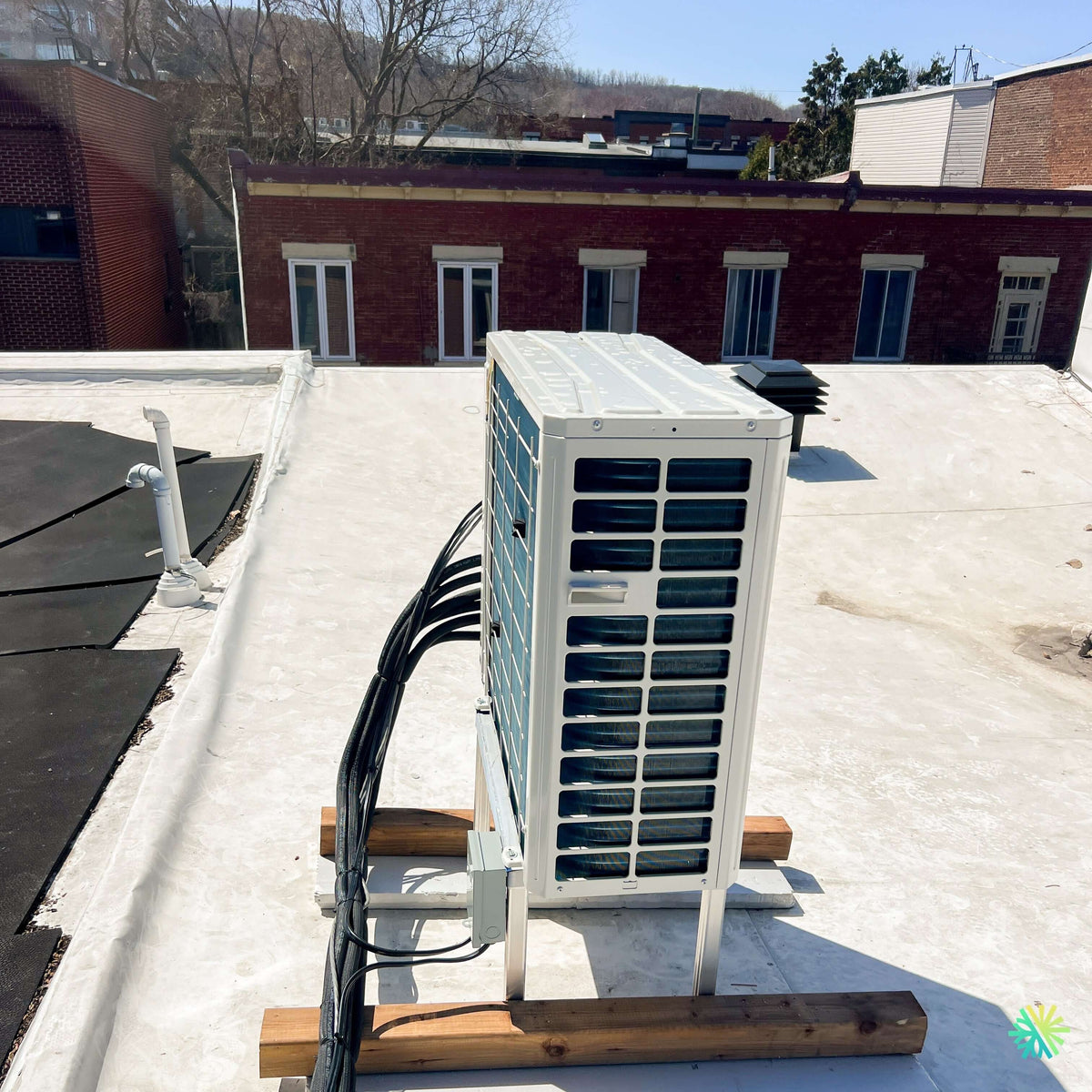
The job-site photograph immediately shows the project’s main features. The outdoor unit is installed on a raised metal structure that itself rests on long wooden members arranged on the roof. The lines connected to the three indoor units are grouped on one side of the machine, while an electrical box is mounted immediately beside the support. The unit remains completely unobstructed on its sides, facilitating airflow and future technical servicing.
For our team at AirGreen, a flat-roof installation requires special consideration. We must protect the membrane, distribute the equipment’s weight correctly, avoid creating unnecessary pressure points, maintain air clearances, and plan an installation that is stable enough to withstand rooftop conditions: wind, snow, ice, defrost water, and major temperature fluctuations.
Why install a GREE FreeMatch R32 on the roof in Delson
In some buildings, the roof is the most logical location for a multi-zone heat pump. The property may be constrained, exterior walls may have several windows or passageways, and a high-capacity unit may be difficult to integrate neatly at ground level.
In this project in Delsonthe flat roof made it possible to group the outdoor equipment away from traffic areas while providing sufficient clearance around the heat pump.
This solution offers several advantages:
- reduced ground-level footprint;
- no outdoor unit in a passageway or yard used daily;
- clear space in front of the heat exchanger and fan;
- the possibility of grouping the lines serving several areas of the building;
- relatively direct access to the unit during scheduled maintenance;
- reduced visual impact from street or yard level.
A rooftop installation is not, however, an automatic solution. It must be compatible with the building’s structure, the existing membrane, permitted refrigerant-line lengths, and safe accessibility for technicians.
A support designed to prevent the weight from being concentrated directly on the membrane
The most interesting detail in the photo is how the outdoor unit is supported. It does not rest directly on the white roof membrane.
We can see a vertical metal structure beneath the heat pump, along with long horizontal pieces of wood that distribute the support points over a larger area.
This approach addresses several needs.
Distributing the load
The FreeMatch R32 outdoor units do not all weigh the same. Depending on the capacity, the technical specifications list net weights ranging from 78.3 lb to 174.2 lb. Models compatible with three indoor units start at 112.5 lb for the GWHD(24)ND6MO and exceed 170 lb for the largest capacities.
This weight is compounded by the support, piping, and stresses caused by wind or snow accumulation.
The goal is therefore to avoid concentrating all this load on four small feet placed directly on the roof membrane. A larger support surface helps distribute the loads more evenly.
Protecting the roof
A roof membrane is not a structural base. It must continue to perform its waterproofing function after the HVAC system is installed.
We therefore pay particular attention:
- to edges that could damage the membrane;
- to movements caused by vibrations;
- to pressure points;
- to the roof’s natural drainage;
- to the access required for future roof replacement.
An installation carried out without this consideration can turn a perfectly functional heat pump into a source of problems for the building envelope.
Raising the unit for winter conditions on the South Shore
The clearance beneath the unit plays a particularly important role in Quebec.
During winter, a heat pump naturally accumulates frost on its outdoor heat exchanger. The unit then periodically initiates a defrost cycle. The FreeMatch R32 range specifically includes a smart defrosting, in addition to G10 inverter technology, self-diagnostics, and automatic voltage adaptation.
When the frost melts, a sometimes significant amount of water is released beneath the unit. In below-freezing temperatures, this water can then freeze on the roof.
The raised support therefore facilitates:
- water runoff beneath the unit;
- ice accumulation without immediately blocking the bottom of the machine;
- clearing snow around the heat exchanger;
- inspection of the underside of the unit;
- cleaning the area during maintenance.
On a roof, we must also consider snow drifting. Wind can create a much greater local accumulation than the amount that fell on the ground. The installation height must therefore be considered according to the roof’s actual environment.
Three clearly visible refrigerant connections on a single side
In the photograph, several insulated lines leave the outdoor unit from the same side and follow a common route before entering the building.
This is an important feature of a 3-head multi-zone heat pump : even if there is only one outdoor unit, each indoor unit has its own connection circuit to the outdoor unit.
These lines notably include:
- the insulated refrigerant lines;
- the communication and power cables;
- the components required to connect each head;
- depending on the indoor routing, the condensate drains specific to the indoor units.
The grouping must be orderly enough to facilitate identification and maintenance. On a roof exposed to sun, wind, and extreme temperatures, mechanical protection and the quality of the line insulation also become essential.
Refrigerant distances that must be calculated before installation
Multi-zone heat pumps are particularly sensitive to line-length planning because the total length is the sum of several runs.
Depending on the outdoor capacity, the documentation for the GREE FreeMatch R32 indicates a maximum total length ranging from 40 m to 100 m, with a maximum height difference ranging from 15 to 25 m.
The manufacturer also specifies:
- a 1/4-inch liquid line;
- a 3/8-inch gas line in the outdoor-unit table;
- a different precharged length depending on the model;
- an additional charge specified at 20 g/m beyond the length covered by the factory charge.
On a roof, this data is particularly important. The lines may need to descend one or more floors before reaching the indoor units. We therefore calculate the routes before finalizing the outdoor capacity and the exact position of the unit.
A FreeMatch R32 designed for multiple zones
The GREE FreeMatch R32 series is a multi-zone platform. The manufacturer states that it can be paired with up to seven different types of indoor units, providing considerable flexibility when designing a project.
In a three-head installation, we can therefore adapt the air distribution to three spaces that do not necessarily have the same configuration.
The range also offers seasonal performance of up to 21 SEER2, 12.5 EER2 and 10 HSPF2The stated operating range starts at -30 °C to 48 °C in cooling mode and from -30 °C to 24 °C in heating mode.
These data are useful for an installation on the Montreal’s South Shore, where the unit must operate through significant temperature differences between summer and winter.
However, it is important to distinguish between the minimum operating temperature and actual capacity at low temperatures. A heat pump that can continue operating at -30 °C does not necessarily provide its full nominal capacity at that temperature. When sizing the system, we therefore consider the building’s needs and the available capacity under the most demanding heating conditions.
What capacity for a three-head GREE heat pump
The photograph confirms the product family, but the nameplate is not visible clearly enough to identify the exact model number of the installed unit with certainty. We therefore do not arbitrarily assign it a capacity.
The technical data sheet nevertheless lists several FreeMatch R32 units compatible with three heads :
- GWHD(24)ND6MO : 24,000 BTU/h nominal cooling capacity, up to three indoor units;
- GWHD(30)ND6MO : 28,400 BTU/h nominal cooling capacity, up to four indoor units;
- GWHD(36)ND6MO : 36,000 BTU/h nominal cooling capacity, up to four indoor units;
- GWHD(42)ND6MO : 42,000 BTU/h nominal cooling capacity, up to five indoor units.
At nominal heating capacity, these same units deliver 24,000, 30,000, 36,000, and 44,300 BTU/h, respectively.
The outdoor capacity is therefore not selected solely based on the number of heads.
Why adding the BTUs of the three indoor units is not enough
A multi-zone system must be sized based on the building’s actual loads.
Three indoor units with similar capacities can serve rooms with completely different needs. A south-facing zone with large windows may require much more cooling than a north-facing bedroom.
We analyze, in particular:
- the area of each zone;
- air volume;
- the level of insulation;
- the amount of glazing;
- solar orientation;
- air infiltration;
- the floor and exposure of the room;
- the number of occupants;
- heat-producing appliances;
- the simultaneous demands of all three zones.
It is also important to understand that the three heads share the capacity of the outdoor unit. When multiple zones require substantial heating or cooling at the same time, the compressor distributes its available capacity among them.
One overall mode for all three heads
A three-head heat pump allows independent settings, but it does not constitute three completely independent systems.
Each indoor unit can :
- be turned on or off separately;
- receive its own temperature setting;
- operate at a different fan speed;
- adjust its airflow according to the zone.
However, the three units must normally operate in the same general mode.
It is therefore not expected that one head heat a room while another simultaneously calls for cooling.
This feature is especially important in spring and fall, when some rooms may receive a great deal of sunlight while others remain cool.
A power supply that depends on the exact outdoor model
All FreeMatch R32 models shown in the data sheet operate in 208/230 V.
However, the current requirements change with the capacity.
The documentation indicates a MCA ranging from 14.5 to 30 A and a maximum protection MOCP ranging from 20 to 45 A depending on the model.
In the site photo, an electrical box is installed directly next to the unit and the support. This positioning facilitates electrical isolation of the unit during troubleshooting or HVAC maintenance.
We never determine the circuit breaker simply from the BTU rating. The values listed on the outdoor unit's nameplate remain the final reference.
Additional precautions specific to flat-roof installations
Do not block roof drainage
The supports and piping must not prevent rainwater from reaching the drains. A long piece of wood installed across the natural path of the water can create a dam if its positioning is not carefully considered.
Leave enough space for a roofer
The roof may eventually need to be inspected or replaced. Installing the heat pump in a completely inaccessible location can turn a future intervention into a much more complex project.
Protect the piping
Rooftop piping is highly exposed to the sun. The insulation must remain in good condition to limit heat loss and properly protect the refrigerant lines.
Stabilize the equipment against the wind
The roof is generally more exposed than ground level. The support must therefore hold the unit securely without compromising the membrane.
Plan for technical access
The service panel, fittings, and main components must be accessible without dismantling the entire installation.
Commissioning is particularly important on a three-head system
After the mechanical installation, the work is far from finished.
We must check each connection separately before considering the system ready to operate.
Commissioning includes, in particular:
- checking the refrigerant connections;
- leak testing;
- evacuation;
- checking the total piping length;
- adjusting the refrigerant charge when required;
- identifying each circuit;
- checking the electrical connections;
- starting the three indoor units;
- testing the system with multiple zones calling for heating or cooling;
- validation of condensate drainage.
An error in matching the piping and cables can cause a communication fault or an incorrect response between an indoor unit and its outdoor port.
In a three-zone installation, clearly identifying the circuits during the work greatly simplifies future diagnostics.
What this Delson project shows before choosing a multi-zone heat pump on a roof
The best location is not always at ground level
This installation demonstrates that a flat roof can be an excellent location for a GREE FreeMatch R32 heat pump, provided that the entire project is designed around the roof rather than simply moving the unit above the building.
Here, the heat pump is:
- clear of the walls;
- elevated;
- supported on a base that distributes the load;
- accessible for maintenance;
- connected to several carefully grouped piping runs;
- installed in a space where its air discharge is not directly obstructed.
These details determine the actual quality of an installation.
Mistakes to avoid with a heat pump installed on a roof
Placing the unit directly on the membrane
This method concentrates the load and may make movement or vibration more damaging to the roof.
Underestimating snow accumulation
A unit that is too low may become partially buried or surrounded by ice.
Blocking a roof drain
The support must never negatively alter the natural flow of water.
Leaving the lines without adequate protection
Insulation degraded by sunlight and weather can reduce the performance of the refrigerant piping system.
Neglecting the roof access route
A heat pump must remain accessible for cleaning, diagnostics, or part replacement.
Exceeding the permitted refrigerant-line lengths
Installing the unit on the roof can significantly increase the distances to the indoor units. These distances must be calculated before installation.
Choosing a capacity solely by adding the three indoor units
Sizing must be based on the thermal loads and the approved combination, not on simple addition.
Efficiency, AHRI, and applicable rebates
The technical data sheet lists different AHRI references for ductless systems, ducted systems, or systems combining several types of units.
For a rebate application, the appropriate number must correspond exactly to the installed combination. The GREE document indicates that the range is eligible for local rebates, but it does not provide a universal amount applicable to all installations.
We therefore recommend confirming the following before installation:
- the exact outdoor model;
- the models of the three indoor units;
- the combination's AHRI number;
- the current program criteria;
- the type of building;
- the documents required for the application.
A heat pump from the right product family does not automatically guarantee eligibility for every combination.
Warranty: keep the information for each component
According to the information sheet provided, GREE indicates a 10-year standard warranty, with an additional two-year extension through Wolseley when the product is registered and proof of installation is provided, subject to the applicable terms.
For a three-head system, we recommend carefully keeping:
- the model and serial number of the outdoor unit;
- the model and serial number of each of the three indoor units;
- the invoice;
- the proof of payment;
- the AHRI number;
- the registration documents;
- the nameplate photos.
This documentation becomes particularly useful several years after installation, when a part needs to be ordered or a warranty service call needs to be verified.
An installation that reduces outdoor clutter while creating three comfort zones
The benefit of the system installed in Delson is that it can supply three zones with a single outdoor unit. In a building where outdoor space must be preserved, this configuration avoids three separate compressors, three outdoor electrical installations, and three locations to find around the building.
The roof therefore accommodates a single multizone unit, while occupants benefit from separate settings in the different rooms.
However, achieving this result requires treating the project as a whole: load calculation, selection of the combination, line-set length, support structure, membrane protection, electrical supply, drainage, and accessibility.
At AirGreen, we apply this approach to our heat pump installations in Delson, but also for Montreal, Laval, Longueuil, on the North Shore and the South ShoreA proper HVAC installation is not just about getting the equipment to work on startup day. It must also remain stable, accessible, and serviceable after several Quebec winters.
The job tools
Two quick checks with real numbers: what heat costs, and what your current heaters add up to in BTU/h.
Conversion: 1 W = 3.412 BTU/h. An indication, not a load calculation: baseboards and furnaces are often stronger than the real need, and they can stay as backup. AirGreen confirms the capacity on site.
How the job unfolds
The main steps of this kind of job at AirGreen. Every house has its quirks: the estimate brings them out.
We look at the room, the outside wall, the line route and where the outdoor unit will go. That is where the capacity gets chosen.
Model, capacity and price, in writing. We also check whether the model qualifies for assistance programs.
Floors and furniture protected, wall plate position marked level, wall opening located.
A single opening, with the slope the drain needs to flow outside.
Set on a stand raised above the snow, with the clearances the manufacturer requires.
Connected, insulated and protected. The opening is then sealed against water, cold air and insects.
A dedicated circuit and an accessible disconnect near the outdoor unit.
Leak test, vacuum, then start-up and a check of heating and cooling.
Remote, modes, filters: we show you the essentials before we leave.
- The on-site estimateWe look at the room, the outside wall, the line route and where the outdoor unit will go. That is where the capacity gets chosen.
- The quoteModel, capacity and price, in writing. We also check whether the model qualifies for assistance programs.
- Getting readyFloors and furniture protected, wall plate position marked level, wall opening located.
- The wall openingA single opening, with the slope the drain needs to flow outside.
- The outdoor unitSet on a stand raised above the snow, with the clearances the manufacturer requires.
- Lines, cable and drainConnected, insulated and protected. The opening is then sealed against water, cold air and insects.
- The electrical workA dedicated circuit and an accessible disconnect near the outdoor unit.
- Tests and start-upLeak test, vacuum, then start-up and a check of heating and cooling.
- The walkthroughRemote, modes, filters: we show you the essentials before we leave.
What we check on a job like this one
Each number is a point we check on site. Switch between summer and winter to watch air and heat move.
In summer, the outdoor unit rejects the house's heat outside.
Generic illustration of this type of installation, not a survey of this job site. Tap a number.
Mounted level on a wall plate, high enough for the air to reach the whole room, with enough space around it to slide the filters out easily.
The refrigerant lines, the communication cable and the drain go through the wall in a single opening, sealed against water, cold air and insects.
Two insulated copper pipes connect the two units. Outside, a line cover can protect them from sun, knocks and weather.
A shut-off switch near the outdoor unit isolates it safely for service. It must stay accessible at all times.
The compressor and the fan. In heating mode it captures heat from the outdoor air, even in winter, and moves it inside.
On the ground or on the wall, it keeps the unit above accumulated snow. The unit stays clear and defrost water can drain away.
The fan needs to blow freely. Storage, a fence or a wall too close, and efficiency drops while noise goes up.
Is your home ready?
Check what applies at your place. A "no" is not a refusal: it is what we sort out during the estimate.
Good habits, once the unit is in place
Six simple habits that keep the unit going. Your list stays on this device.
What to do, season by season
Three habits per season for this unit. They take a few minutes and prevent many calls.
- Clean the indoor unit's filters.
- Clear leaves and debris left on the outdoor unit by winter.
- Test cooling before the first hot days.
- Clean the filters more often when the unit runs a lot.
- Keep plants away from the outdoor unit.
- Check that no water drips from the indoor unit.
- Rake the leaves around the outdoor unit.
- Test heating before the first cold days.
- Book periodic maintenance before winter.
- Keep snow away from the stand and the front of the unit.
- Let the unit defrost: it is normal.
- Never hit the ice on the fins; call us if the unit stays iced up.
The right pages, at the right time
Four statements: true or false?
It all comes down to details you have just seen.
1. In heating mode, the outdoor unit can produce water.
During defrost cycles. That water must drain away without forming ice.
2. You pick the capacity with a simple square-footage rule.
Windows, insulation, orientation and how the room is used all count. Capacity is chosen on site.
3. A multi-zone connects several indoor heads to a single condenser.
One head per room, all on the same condenser. Each room keeps its own temperature.
4. The disconnect can sit behind the patio furniture.
It must stay accessible: it is what shuts the unit off for service.
0 / 4 right answers
What people ask us about this kind of work
Does a wall-mounted heat pump heat in winter?
Wall-mounted or multi-zone: how do I choose?
Where does the outdoor unit go?
Are there grants?
Do I need a permit?
How cold can it heat?
How much can I save?
How is the LogisVert assistance calculated?
Is it noisy?
The outdoor unit is covered in ice: is that normal?
Does AirGreen hold the required licences?
Is the estimate free?
No question matches. Write to us: we answer.
More jobs to see, near you
By town, by equipment or by region: browse more than 4,700 published projects.
Each dot: a town where AirGreen has published projects. The glowing dot: this job.
An on-site estimate, the right capacity, the right equipment.
The on-site estimate is free and the quote follows within 24 hours.
Text and photo: a real AirGreen Climatisation & Chauffage job. The diagrams are generic illustrations of the type of installation, not a survey of this job site. Sources of the added figures: airgreen.ca product pages (NEEP / AHRI performance), Hydro-Québec (Heat pumps page, LogisVert, read on 13 October 2026), Régie de l’énergie (rate D as of 1 April 2026).