
Installation of a MIDEA MIDEA35 wall-mounted heat pump in Saint-Charles-sur-Richelieu
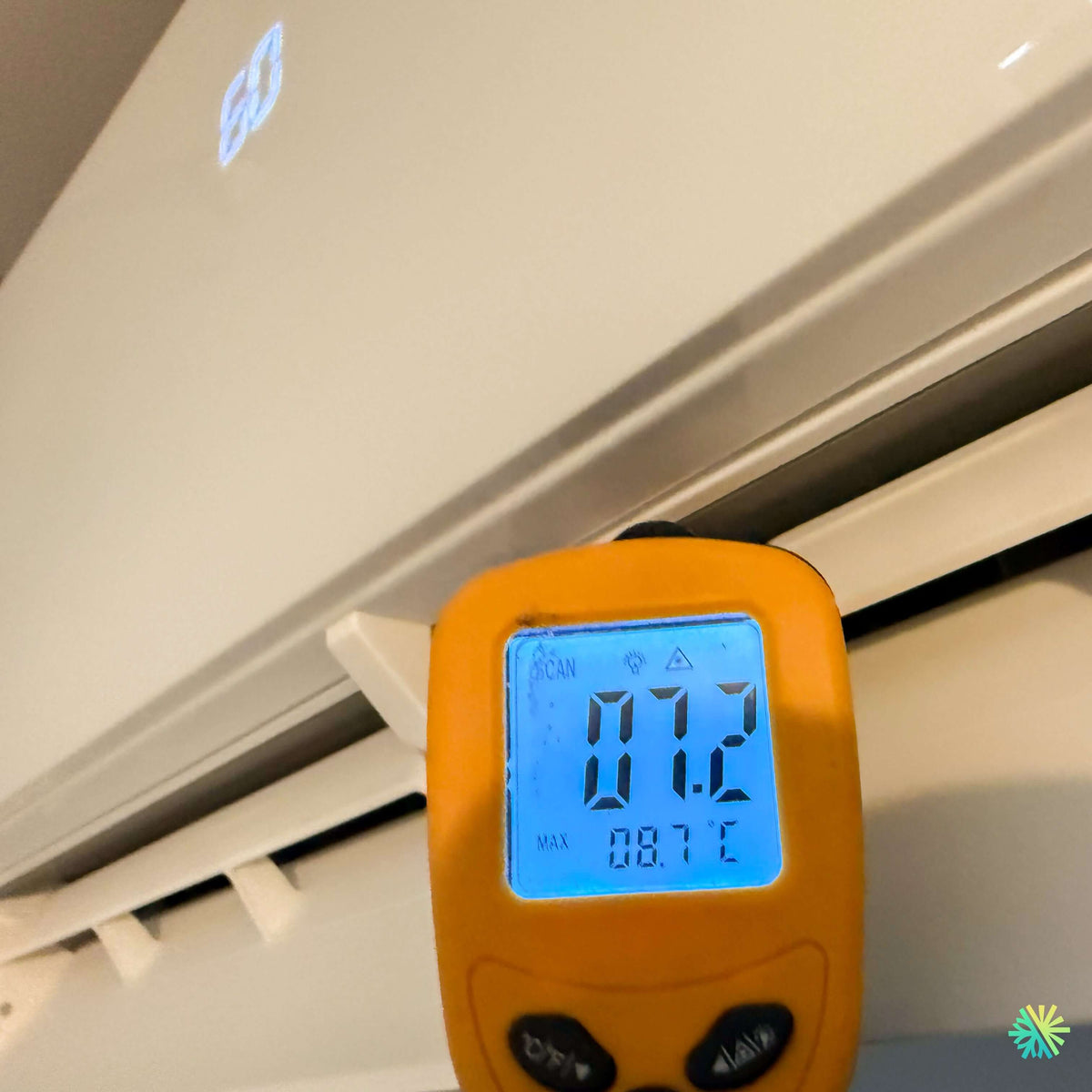
AirGreen installation of a MIDEA MIDEA35 wall-mounted heat pump in Saint-Charles-sur-Richelieu, including commissioning, temperature control at 7.2 °C, and a complete performance check in cooling mode.
Take a tour of the installation
Each number is a point we check on site. Switch between summer and winter to watch air and heat move.
In summer, the outdoor unit rejects the house's heat outside.
Generic illustration of this type of installation, not a survey of this job site. Tap a number.
Mounted level on a wall plate, high enough for the air to reach the whole room, with enough space around it to slide the filters out easily.
The refrigerant lines, the communication cable and the drain go through the wall in a single opening, sealed against water, cold air and insects.
Two insulated copper pipes connect the two units. Outside, a line cover can protect them from sun, knocks and weather.
A shut-off switch near the outdoor unit isolates it safely for service. It must stay accessible at all times.
The compressor and the fan. In heating mode it captures heat from the outdoor air, even in winter, and moves it inside.
On the ground or on the wall, it keeps the unit above accumulated snow. The unit stays clear and defrost water can drain away.
The fan needs to blow freely. Storage, a fence or a wall too close, and efficiency drops while noise goes up.
In Saint-Charles-sur-Richelieu, an MIDEA35 installation validated all the way to the supply-air temperature
A wall-mounted heat pump can be securely mounted, properly connected, and quiet at start-up, but at AirGreen, our work does not stop when the unit turns on. An HVAC installation must also be checked under real operating conditions. This is precisely what is shown by this service call carried out in Saint-Charles-sur-Richelieu, where we installed a MIDEA MIDEA35 wall-mounted heat pump and checked its operation after start-up.
The photo taken on site shows a detail we particularly like to document: our technician is taking a temperature reading directly near the indoor unit’s air outlet. The measuring device displays approximately 7.2°C, with a maximum recorded value of approximately 8.7 °C during the documented inspection. In the context of cooling operation, this type of verification helps us confirm that the unit is producing distinctly cooled air and that the system is operating as expected after installation.
This is not simply an aesthetic photo of the machine once it has been mounted on the wall. It illustrates an essential step in our method: install, commission, measure, and verify.
For this property Saint-Charles-sur-Richelieu, the choice was the MIDEA35, the premium wall-mounted series presented by Midea among its ductless heat pump systems. The manufacturer’s documentation clearly identifies the MIDEA35, MIDEA28, MIDEA25, and MIDEA22 series as ductless wall-mounted systems.
Why the MIDEA35 Is Particularly Well Suited to Quebec’s Climate
The main advantage of the MIDEA35 is not merely its ability to cool efficiently during the hot days in the Richelieu Valley. This range was designed as a true heat pump intended to operate throughout much of the Quebec winter.
The MIDEA35 series is advertised with:
- heating operation down to -30 °C;
- efficiency of up to 33.3 SEER2 in cooling;
- efficiency of up to 22.0 HSPF2 depending on capacity;
- the refrigerant R-454B;
- the classification Cold Climate V6.1;
- nominal versions of 9,000, 12,000, and 18,000 BTU/h in cooling;
- a power supply of 208/230 V, single-phase, 60 Hz.
These specifications are provided for the various combinations in the series and vary according to the exact capacity selected. The Midea brochure indicates, among other things, 33.3 SEER2 for the 9,000 BTU version, 29.4 for the 12,000 BTU version, and 25.6 for the 18,000 BTU version. All three configurations are rated for heating down to -30 °C.
Because the exact capacity of the unit installed in Saint-Charles-sur-Richelieu is not visible in the supplied photo, we prefer not to arbitrarily assign a BTU rating to this installation. This is an important detail: proper installation starts with accurate sizing, rather than automatically choosing the largest available unit.
A variable-speed heat pump: why it changes comfort
Midea’s variable-speed technology allows the compressor to adapt its operation to thermal needs instead of constantly repeating complete on-and-off cycles. The manufacturer explains that this modulation reduces indoor temperature fluctuations and helps maintain a more stable environment.
In the field, this feature is important for several reasons.
A properly sized unit can gradually reduce its output as the room approaches the desired temperature. It therefore does not always need to operate at full capacity. This promotes:
better temperature maintenance, particularly during long periods of hot weather;
smoother operation, since the fan and compressor can operate at different speeds;
better humidity management in cooling mode, when operating conditions and the unit’s sizing are appropriate;
fewer abrupt cycles, compared with a conventional unit that operates only in on-or-off mode.
For a house located in Saint-Charles-sur-Richelieu, where the differences between summer and winter temperatures are considerable, this adaptability is a tangible advantage.
The detail visible in our photo: measuring instead of simply assuming
After installation, we check that the heat pump is operating properly. During this service call, our technician places an infrared thermometer in the immediate vicinity of the indoor unit’s discharge louver.
The photographed reading of approximately 7.2°C is an informative indicator of the cooling produced at the time of testing. However, it should not be confused with a complete analysis of the heat pump’s performance.
A professional HVAC diagnosis never relies on a single number. Depending on the situation, we also consider the room temperature, return-air temperature, compressor speed, airflow, outdoor temperature, time elapsed since startup, and the condition of the refrigeration circuit.
Why the outlet temperature alone is not enough
Two identical heat pumps can display different discharge temperatures while still operating properly.
For example, a unit that starts up in a very hot room may operate at high capacity. Another, installed in a room already close to its setpoint, can significantly reduce its output thanks to its inverter compressor.
That is why we mainly seek to confirm consistent operation of the entire system, rather than maintaining an arbitrarily low discharge temperature.
Refrigeration circuit installation: a detail that can determine the system’s lifespan
The quality of the copper line installation is just as important as the equipment itself.
For the MIDEA35 series, the required diameters are not identical for all capacities. According to Midea documentation, the 9,000 and 12,000 BTU versions use liquid/gas lines measuring 1/4 in. and 3/8 in., while the 18,000 BTU version uses 3/8 in. and 5/8 in.. The indicated maximum length is 82 feet for the 9,000 and 12,000 BTU models and 164 feet for the 18,000 BTU version.
These are precisely the details that must be respected before commissioning.
An installer should never choose a copper diameter simply because they already have that size in their truck. The diameter, line length, elevation difference, additional refrigerant charge, and connection quality must meet the manufacturer’s requirements.
R-454B and the evolution of new heat pumps
The MIDEA35 operates with R-454B, an A2L refrigerant used in several new generations of HVAC equipment. The series notably incorporates a detection system designed for A2L applications; Midea documentation mentions a A2L refrigerant leak detection sensor among the features of these systems.
This also means that installation methods must follow practices suited to this new generation of refrigerants.
At AirGreen, we pay particular attention to line-set preparation, connections, testing, circuit evacuation, and commissioning. A high-efficiency heat pump cannot reach its full potential if moisture has contaminated its refrigeration circuit or if the connections are not properly made.
From choosing the equipment to the final inspection: what sets a properly executed HVAC installation apart
For a homeowner comparing several wall-mounted heat pumps in Montreal, Laval, Longueuil, on the North Shore or the South Shore, technical data sheets can quickly become difficult to interpret.
SEER2, HSPF2, COP, rated capacity, minimum capacity, maximum capacity, limit temperature, and AHRI number are useful data, but they must be placed in the real context of the building.
Sizing matters more than the number of BTUs displayed
A common mistake is to choose an oversized heat pump assuming it will automatically provide greater comfort.
That is not always the case.
A unit that is too large for its space can reach the requested temperature too quickly under certain conditions, which can reduce the time available for proper dehumidification. Conversely, an undersized unit may operate continuously near its maximum capacity during extreme conditions.
At AirGreen, we examine in particular:
- the size and layout of the spaces;
- the number of floors;
- insulation and windows;
- solar exposure;
- air circulation between rooms;
- the intended use of the heat pump for heating;
- the possible location of the indoor unit;
- the requirements for the outdoor unit;
- the drainage and refrigerant line routing;
- the available electrical supply.
The MIDEA35 is available in several capacities precisely because an installation of 9,000 BTU and an installation of 18,000 BTU do not meet the same needs.
An indoor unit designed for precise airflow control
The MIDEA35 series shares several features with the MIDEA28 and MIDEA25 series. The documentation specifically mentions an adjustable fan speed of 1% to 100%, horizontal and vertical swing, quiet mode, sleep mode, automatic cleaning, 8°C heating, ECO mode, the “Follow Me” function, and various control options.
Midea also specifies that the units can offer up to 100 airflow volume settings. App and Wi-Fi control through SmartHome is also available depending on the configuration and options selected.
In a residential installation, airflow adjustment is far from secondary. A heat pump placed in the right location but configured with a poorly directed air jet can cause discomfort, especially in a bedroom, living room, or open-plan area where occupants are directly in the path of the airflow.
The smart sensor and humidity control
The MIDEA35 also differs from the MIDEA22 series in certain control features. The documentation specifically indicates a smart sensor and a dual temperature and humidity control, except for the MIDEA22.
The smart sensor can also adapt the system’s behavior based on occupancy in the room. Midea indicates that the airflow can follow or avoid the occupant depending on the settings, and that the unit can reduce its operating frequency after a period of absence to lower consumption.
These features are particularly appealing when a wall-mounted heat pump becomes one of the main heating and cooling systems in the home.
Mistakes we seek to avoid when installing a wall-mounted heat pump
Our experience with installations in Montreal, Laval, Longueuil, on the South Shore and the North Shore has taught us that a quality appliance cannot compensate for poor installation.
Among the problems we systematically work to prevent are poor indoor-unit placement, an inadequate drain slope, improperly protected outdoor lines, an unstable outdoor support, unsuitable wiring, incorrect copper diameters, inadequate evacuation of the circuit before releasing the refrigerant, and capacity selection based solely on approximate floor area.
In Saint-Charles-sur-Richelieu, our photographed temperature check represents precisely the opposite step from this approximate approach: we check what the system actually does once installed.
A ductless installation that limits work in the home
One of the advantages of a ductless wall-mounted heat pump is that it does not require the construction of a complete air-duct network.
The Midea brochure emphasizes that the indoor unit communicates with the outdoor unit through a relatively small opening, which generally makes it possible to avoid the major demolition, repair, and painting work associated with adding a traditional ventilation system.
This feature is particularly appealing for existing homes in Saint-Charles-sur-Richelieu and the Montérégie region, but also for properties in Montreal, where the space available for new ductwork is often very limited.
Heating at -30 °C: important information that must be properly understood
The statement heating down to -30 °C means that the MIDEA35 is designed to operate in heating mode at this outdoor temperature under the conditions specified by the manufacturer. It does not mean that a heat pump delivers exactly the same capacity at -30 °C as it does at a milder outdoor temperature.
That is why we examine the performance tables, the building sizing, and the heating capacity at low temperatures.
For example, the brochure provides specific capacity values at -15 °Cwhich vary depending on the model. This information is much more useful for a serious analysis than a simple logo indicating “-30 °C.”
Grants: the AHRI number must correspond to the equipment actually installed
When a heat pump is purchased with the goal of receiving financial assistance, we recommend verifying eligibility based on the exact indoor unit + outdoor unit combination, rather than simply based on the commercial name “MIDEA35”.
Midea documentation lists, among others, the AHRI numbers 215471386, 215471387, and 215471388 for the 9,000, 12,000, and 18,000 BTU MIDEA35 configurations, respectively.
Since programs, amounts, and criteria may vary, final eligibility must always be verified according to the AHRI number of the combination actually installed and the program rules applicable at the time of the application.
Midea Warranty: Keep the Installation Information
The Midea brochure presents a limited warranty program for the residential sector of up to 12 years on the compressor, 12 years on parts, and 10 years on labor, subject to the manufacturer’s applicable terms and conditions.
This makes it particularly important to keep the invoice, model and serial numbers, and any required proof of registration.
At AirGreen, we consider this documentation an integral part of a professional installation.
The result in Saint-Charles-sur-Richelieu: a system installed, tested, and ready for Quebec’s seasons
This installation of a MIDEA MIDEA35 wall-mounted heat pump in Saint-Charles-sur-Richelieu summarizes our way of working well.
We do not simply mount an indoor unit and an outdoor unit. We must ensure that the equipment selection is appropriate, that the lines are suitable, that the drainage is properly installed, that the electrical and refrigerant connections meet the machine’s requirements, and that the system operates normally once started.
The thermometer visible in our photo, displaying approximately 7.2°C during the cooling inspectionmay seem like a small detail. To us, it represents something much more important: validating the work completed before considering the job finished.
This is the same approach we apply to our installations of heat pumps, wall-mounted air conditioners, and HVAC systems in Montreal, Laval, Longueuil, the North Shore, the South Shore, and the municipalities of Montérégie.
A good heat pump matters. Its sizing matters. Its location matters. But the quality of its installation and commissioning remains decisive in achieving the expected comfort and performance for years to come.
The unit on this job, in figures
The range as published on airgreen.ca: pick a size to see its capacity in deep cold.
| Size | Heating at −8 °C | Heating at −15 °C | Coldest certified point | COP at −15 °C | SEER | HSPF | Indicative LogisVert aid |
|---|---|---|---|---|---|---|---|
| Midea Série 35 9 000 | 11,000 | 13,500 | −30 °C: 7,500 | 2.0 | 33.3 | 14.6 | – |
| Midea Série 35 12 000 | 11,000 | 13,500 | −30 °C: 7,500 | 2.0 | 29.4 | 12.7 | $1,320 |
| Midea Série 35 18 000 | 19,300 | 22,600 | −30 °C: 11,900 | 2.34 | 25.6 | 16.2 | $2,316 |
According to NEEP, its certified maximum capacity at −30 °C (−22 °F) is 7,500 BTU/h, 83% of its nominal 9,000 BTU size.
At 8 °C, its certified maximum capacity reaches 17,200 BTU/h, 91% more than its nominal 9,000 BTU size.
According to NEEP, its certified heating capacity at −15 °C (5 °F) is 13,500 BTU/h, 150% of its nominal 9,000 BTU size. Its COP there is 2.00.
According to NEEP, its certified maximum capacity at −30 °C (−22 °F) is 7,500 BTU/h, 62% of its nominal 12,000 BTU size.
At 8 °C, its certified maximum capacity reaches 17,200 BTU/h, 43% more than its nominal 12,000 BTU size.
According to NEEP, its certified heating capacity at −15 °C (5 °F) is 13,500 BTU/h, 112% of its nominal 12,000 BTU size. Its COP there is 2.00.
According to NEEP, its COP at −15 °C is 2.34: the highest of the Série 35 line, which ranges from 2.00 to 2.00 at that temperature.
According to NEEP, its certified maximum capacity at −30 °C (−22 °F) is 11,900 BTU/h, 66% of its nominal 18,000 BTU size.
At 8 °C, its certified maximum capacity reaches 29,700 BTU/h, 65% more than its nominal 18,000 BTU size.
Data read live from the airgreen.ca page of each size (NEEP / AHRI certified performance). When the title names the installed size, it is highlighted; otherwise the whole range is shown. The aid shown is today’s, using Hydro-Québec’s rule ($120 per 1,000 BTU/h at −8 °C); amounts quoted in the article date from its publication. Only Hydro-Québec confirms the assistance granted.A dash in the aid column: amount to be confirmed for this model.
The big day, step by step
The main steps of this kind of job at AirGreen. Every house has its quirks: the estimate brings them out.
We look at the room, the outside wall, the line route and where the outdoor unit will go. That is where the capacity gets chosen.
Model, capacity and price, in writing. We also check whether the model qualifies for assistance programs.
Floors and furniture protected, wall plate position marked level, wall opening located.
A single opening, with the slope the drain needs to flow outside.
Set on a stand raised above the snow, with the clearances the manufacturer requires.
Connected, insulated and protected. The opening is then sealed against water, cold air and insects.
A dedicated circuit and an accessible disconnect near the outdoor unit.
Leak test, vacuum, then start-up and a check of heating and cooling.
Remote, modes, filters: we show you the essentials before we leave.
- The on-site estimateWe look at the room, the outside wall, the line route and where the outdoor unit will go. That is where the capacity gets chosen.
- The quoteModel, capacity and price, in writing. We also check whether the model qualifies for assistance programs.
- Getting readyFloors and furniture protected, wall plate position marked level, wall opening located.
- The wall openingA single opening, with the slope the drain needs to flow outside.
- The outdoor unitSet on a stand raised above the snow, with the clearances the manufacturer requires.
- Lines, cable and drainConnected, insulated and protected. The opening is then sealed against water, cold air and insects.
- The electrical workA dedicated circuit and an accessible disconnect near the outdoor unit.
- Tests and start-upLeak test, vacuum, then start-up and a check of heating and cooling.
- The walkthroughRemote, modes, filters: we show you the essentials before we leave.
What would it look like at your place?
Two quick checks with real numbers: what heat costs, and what your current heaters add up to in BTU/h.
Baseboards and electric furnaces turn 1 kWh of electricity into 1 kWh of heat. A heat pump delivers more: that is its COP. At Hydro-Québec’s rate D (11.142¢/kWh above 40 kWh a day, since 1 April 2026):
Hydro-Québec: a heat pump can be up to three times more efficient than baseboards for heating in the colder months.
Estimate per kWh of heat, at the chosen temperature, using the certified COP from the product page. Taxes, access charge and backup heat not included.
Conversion: 1 W = 3.412 BTU/h. An indication, not a load calculation: baseboards and furnaces are often stronger than the real need, and they can stay as backup. AirGreen confirms the capacity on site.
Four mistakes we do not make
Flip each card to see what we do instead.
Your own project, step by step
What to do, season by season
Three habits per season for this unit. They take a few minutes and prevent many calls.
- Clean the indoor unit's filters.
- Clear leaves and debris left on the outdoor unit by winter.
- Test cooling before the first hot days.
- Clean the filters more often when the unit runs a lot.
- Keep plants away from the outdoor unit.
- Check that no water drips from the indoor unit.
- Rake the leaves around the outdoor unit.
- Test heating before the first cold days.
- Book periodic maintenance before winter.
- Keep snow away from the stand and the front of the unit.
- Let the unit defrost: it is normal.
- Never hit the ice on the fins; call us if the unit stays iced up.
Is your home ready?
Check what applies at your place. A "no" is not a refusal: it is what we sort out during the estimate.
Four statements: true or false?
It all comes down to details you have just seen.
1. In heating mode, the outdoor unit can produce water.
During defrost cycles. That water must drain away without forming ice.
2. You pick the capacity with a simple square-footage rule.
Windows, insulation, orientation and how the room is used all count. Capacity is chosen on site.
3. A multi-zone connects several indoor heads to a single condenser.
One head per room, all on the same condenser. Each room keeps its own temperature.
4. The disconnect can sit behind the patio furniture.
It must stay accessible: it is what shuts the unit off for service.
0 / 4 right answers
What people ask us about this kind of work
Does a wall-mounted heat pump heat in winter?
Wall-mounted or multi-zone: how do I choose?
Where does the outdoor unit go?
Are there grants?
Do I need a permit?
How cold can it heat?
How much can I save?
How is the LogisVert assistance calculated?
Is it noisy?
The outdoor unit is covered in ice: is that normal?
Does AirGreen hold the required licences?
Is the estimate free?
No question matches. Write to us: we answer.
More jobs to see, near you
By town, by equipment or by region: browse more than 4,700 published projects.
Each dot: a town where AirGreen has published projects. The glowing dot: this job.
Every house has its constraints. We see them before we install.
The on-site estimate is free and the quote follows within 24 hours.
Text and photo: a real AirGreen Climatisation & Chauffage job. The diagrams are generic illustrations of the type of installation, not a survey of this job site. Sources of the added figures: airgreen.ca product pages (NEEP / AHRI performance), Hydro-Québec (Heat pumps page, LogisVert, read on 13 October 2026), Régie de l’énergie (rate D as of 1 April 2026).