
Installation of a 3-head GREE FREEMATCH R32 heat pump in Saint-Valérien-de-Milton, Montérégie
In Saint-Valérien-de-Milton, AirGreen installs a GREE FREEMATCH R32 three-zone heat pump with a wall-mounted unit positioned above a door to maximize clearance, comfort, and the interior finish.
In summer, the outdoor unit rejects the house's heat outside.
Generic illustration of this type of installation, not a survey of this job site. Tap a number.
Mounted level on a wall plate, high enough for the air to reach the whole room, with enough space around it to slide the filters out easily.
The refrigerant lines, the communication cable and the drain go through the wall in a single opening, sealed against water, cold air and insects.
Two insulated copper pipes connect the two units. Outside, a line cover can protect them from sun, knocks and weather.
A shut-off switch near the outdoor unit isolates it safely for service. It must stay accessible at all times.
The compressor and the fan. In heating mode it captures heat from the outdoor air, even in winter, and moves it inside.
On the ground or on the wall, it keeps the unit above accumulated snow. The unit stays clear and defrost water can drain away.
The fan needs to blow freely. Storage, a fence or a wall too close, and efficiency drops while noise goes up.
A wall-mounted head installed in a narrow space above a door: a detail that requires much more precision than it may seem
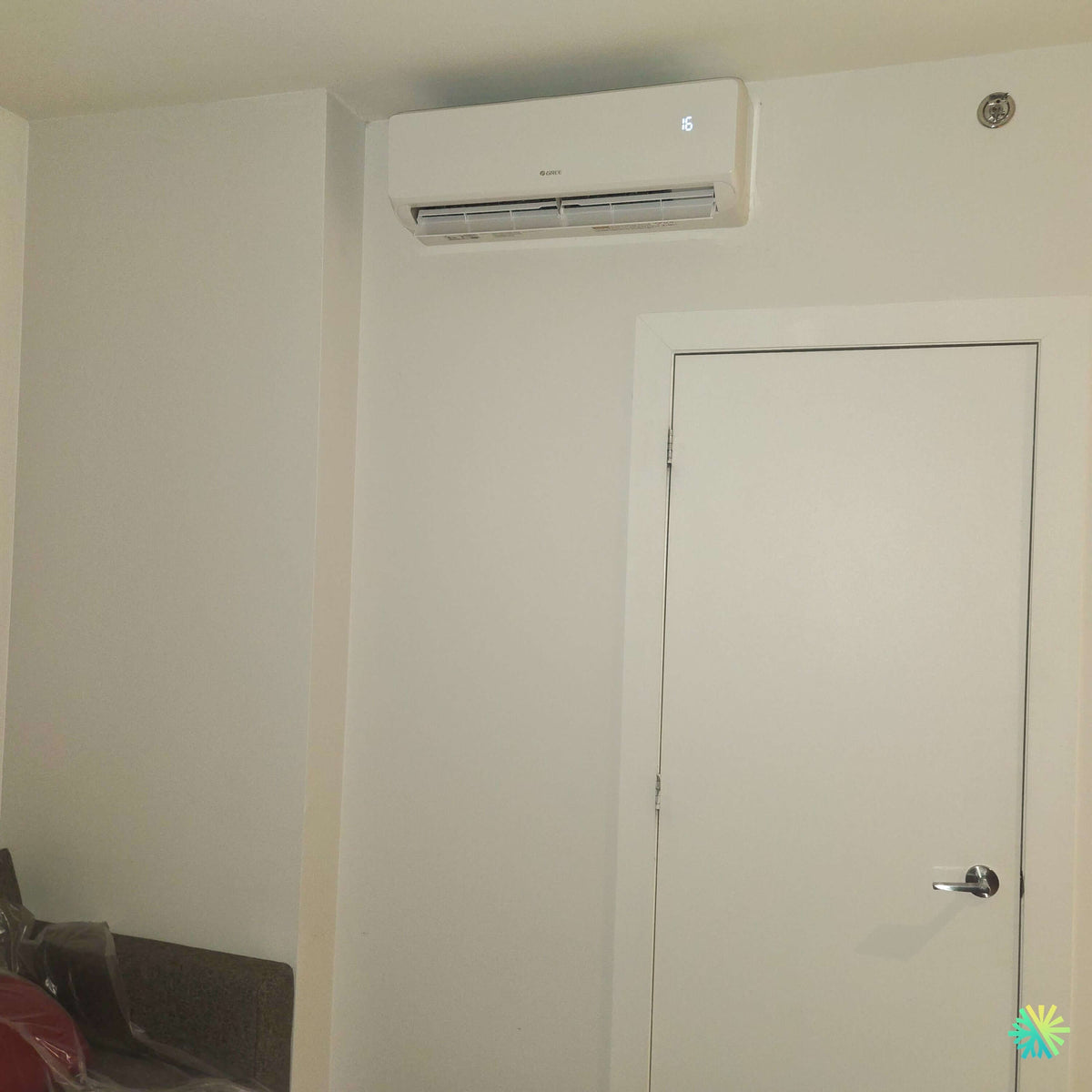
For this installation carried out at Saint-Valérien-de-Milton, we installed a GREE FREEMATCH R32 3-head heat pump to distribute heating and cooling among three distinct zones of the building. The job-site photograph shows one of the indoor units after installation: it is positioned very high on the wall, directly above a door, in a space where every centimeter mattered.
This type of location is particularly interesting from the standpoint ofHVAC installation. At first glance, the result seems simple: a white wall-mounted unit, aligned near the ceiling, with ample clearance beneath the air-supply louver. But before achieving this finished result, we must check several elements simultaneously: the available height, the door opening, the head's upper clearance, the airflow path, the wall structure, the condensate drain slope, and the route of the lines to the outdoor unit.
In the photo, the unit's digital display indicates 16 at the time the photo was taken. More importantly for the installation, the head remains completely unobstructed in front of it and does not reduce passage through the door below.
Why install a GREE head above a door?
In some rooms, large sections of wall are already occupied by windows, furniture, cabinets, or architectural features. An area above a door can then become a very interesting location, provided the available dimensions allow the manufacturer's requirements to be met.
This solution offers several advantages.
The head is positioned high, which is favorable for air distribution. It does not take up any usable wall space needed for furniture. It also remains away from accidental contact and areas where occupants move around.
But the space is more restrictive than a large empty wall.
We must check, among other things:
- the clearance between the top of the unit and the ceiling;
- the available width between the adjacent walls;
- the absence of interference with the door frame;
- the ability to open the front panel to clean the filters;
- the orientation of the air-supply louver;
- the ability to route the drain with an adequate slope;
- future accessibility for a HVAC maintenance.
A head that physically fits into the space is not automatically properly installed. It must still be able to breathe, be serviced, and distribute air correctly.
The clearance above is essential for air intake
A wall-mounted unit does not draw air in through its lower louver. This part is primarily used for blowing air out. Room air instead enters through the upper area of the cabinet before passing through the filters and heat exchanger.
That is why we must leave sufficient clearance between the heat pump and the ceiling.
In this installation in Saint-Valérien-de-Milton, the appliance was positioned near the ceiling to maximize the available space, without simply being placed directly against it.
An appliance installed too high can lead to:
- restricted air intake;
- more difficult filter cleaning;
- difficult access to the upper panel;
- less favorable airflow;
- a buildup of dust in a space that cannot be properly cleaned.
The final position must therefore be determined based on the actual head model being used, rather than according to a universal rule applied to all wall-mounted air conditioners.
A door beneath the head changes how we think about airflow
The location above a door creates a particular configuration: the head is naturally oriented toward the space in front of the opening.
This can be very advantageous when the goal is to distribute air over a good distance across the room rather than blow it directly onto a bed, sofa, or desk.
Nevertheless, we check the louver angle after commissioning.
In cooling mode, an air jet aimed too directly at occupants can create a feeling of discomfort even when the room's average temperature is correct. In heating mode, on the other hand, we aim to help warm air descend toward the occupied area rather than allowing it to accumulate at the ceiling.
This is why airflow direction is one of the settings we explain after installation.
An interior finish where the technical network remains out of sight
On the photographed wall, we do not see long exposed lines running around the head through the room. The finish therefore remains very clean.
Yet several elements must pass behind each indoor unit of a multi-zone system:
- liquid refrigerant line;
- gas refrigerant line;
- insulation;
- control and communication wiring;
- condensate drainage.
The challenge is to organize these elements without compromising the drain slope or imposing excessive bends on the refrigerant lines.
This step becomes even more important with a three-head heat pump, since the outdoor unit receives three separate circuits.
Three zones, three different heating and cooling needs
The principle of FREEMATCH is to connect several indoor units to a single outdoor unit. GREE documentation specifies that some outdoor units can accommodate up to five indoor units, while equipment designed for a three-head installation begins notably with the GWHD(24)ND6MO, designed for two or three units. The GWHD(30), GWHD(36), and GWHD(42) models can also accommodate three heads.
This does not mean that three identical units necessarily have to be installed.
For example, we may have a main zone with a higher load and two smaller rooms requiring less capacity. The choice of heads then depends on the heating load specific to each room.
We consider, in particular:
- area and volume;
- ceiling height;
- fenestration;
- solar exposure;
- insulation;
- building level;
- air infiltration;
- number of exterior walls;
- type of use;
- desired temperature;
- simultaneity of demand among the three zones.
This analysis is particularly important in a home where the bedrooms are separated from the main living area by doors.
What “3-head heat pump” really means
Three heads allow three local temperature settings, but the system does not thereby become three independent heat pumps.
The indoor units share the same outdoor unit. The compressor adjusts its output according to the zones requiring heating or cooling.
The three heads must also operate in compatible modes. We therefore avoid requesting heating from one unit while another is simultaneously trying to cool.
Explaining this during commissioning prevents a great deal of confusion, particularly in homes where several people use their own remote controls.
Performance, R32, connections, and financial assistance: the technical points to check on a three-head FREEMATCH system
Up to 21 SEER2 and heating operation down to -30 °C
According to the documentation provided by GREE, the FREEMATCH R32 range can reach 21 SEER2, 12.5 EER2, and 10 HSPF2. The published operating range is -30 °C to 48 °C in cooling mode and -30 °C to 24 °C in heating mode.
These features explain why this family of units is well suited to Quebec’s climate.
However, a minimum operating temperature should not be interpreted as a guarantee of constant rated capacity down to that temperature. The actual available capacity varies with the outdoor temperature and the demand from the different zones.
Proper sizing therefore remains essential, even with a heat pump designed for low temperatures.
The role of G10 Inverter technology with three indoor units
The FREEMATCH R32 uses a technology G10 InverterGREE also lists intelligent defrosting, self-diagnostics, automatic voltage adaptation, and quiet operation among the range’s features.
With three zones, requirements are constantly changing.
One head can reach its setpoint while the other two continue operating. One room may need only a small amount of heating while the main space requires more.
The variable-speed compressor modulates its operation according to this combined demand.
This modulation capacity is one of the reasons why a multi-zone system should not be evaluated solely by adding the figures shown on the indoor units.
Available capacities for a three-head configuration
Page 2 of the technical data sheet presents several possibilities.
The GWHD(24)ND6MO has a nominal cooling capacity of 24,000 BTU/h. The GWHD(30)ND6MO is rated at 28,400 BTU/h, the GWHD(36)ND6MO at 36,000 BTU/h, and the GWHD(42)ND6MO at 42,000 BTU/h.
In heating mode, the published nominal values for these four outdoor units are respectively 24,000, 30,000, 36,000, and 44,300 BTU/h.
The interior photo from Saint-Valérien-de-Milton does not allow us to identify the exact outdoor unit model with certainty. We therefore do not assign a specific capacity to this installation based solely on the appearance of the wall-mounted head.
This caution is important: several indoor unit capacities may use a very similar cabinet.
The refrigerant network must be calculated across all three branches
The FREEMATCH R32 documentation indicates outdoor connections of 1/4 in. for liquid and 3/8 in. for gas on the units shown.
For a configuration that can accommodate three heads, the permitted total length varies according to the outdoor unit:
- up to 60 m for the GWHD(24);
- up to 80 m for the GWHD(30) and GWHD(36);
- up to 100 m for the GWHD(42).
In a multi-zone system, we add the three runs together.
One head may be only a few metres from the outdoor unit, while another may be on the opposite floor. The length that matters for the system is not that of the farthest head: it is the total specified by the manufacturer's method.
Each drain must be tested separately
The unit visible in the photo is above a door. A water leak in this position could quickly reach the frame, wall, or floor.
The condensate drain therefore receives particular attention.
In air conditioning, moisture removed from the air condenses on the heat exchanger. This water must then leave the unit by gravity or, when the configuration does not allow this, through a suitable solution.
We check in particular:
- continuous slope;
- the absence of crushed sections;
- pipe attachment;
- actual drainage;
- the absence of leaks at the head connection.
In a three-head system, this check must be performed three times.
Why circuit identification becomes essential
Three indoor units also mean three sets of piping and communication lines.
We identify each circuit so that the refrigerant line for zone A corresponds to the wiring for zone A, and so on.
During commissioning, we do not simply start all three heads at the same time. We test them separately, then with different combinations.
This method confirms:
- proper communication;
- the response of each head;
- the discharge air temperatures;
- the operation of the louvers;
- the drains;
- the absence of error codes;
- the outdoor unit’s behavior when multiple zones are calling for heating or cooling.
R32 and the A2L sensor
The FREEMATCH uses R32 refrigerant. The GREE documentation also indicates the presence of an A2L leak detection sensor included.
R32 requires appropriate work methods and tools. The presence of a sensor obviously does not replace proper refrigeration installation.
We therefore perform a leak test and evacuate the system before commissioning. Line lengths are also recorded to determine whether a charge adjustment is required.
Electrical requirements that vary according to outdoor capacity
All FREEMATCH R32 systems presented in the datasheet operate on 208/230 V, but their minimum circuit ampacity and maximum overcurrent protection are different.
For example, for models capable of serving three heads, the published MCA ranges from 19.5 to 30 A, and the MOCP ranges from 25 to 45 A depending on the outdoor unit selected.
We therefore cannot say that a “three-head heat pump” automatically requires a specific circuit breaker.
Electrical sizing must be performed according to:
- the exact outdoor model;
- its nameplate;
- the MCA;
- the MOCP;
- the circuit length;
- the conductors;
- the requirements of the applicable Code.
ENERGY STAR, AHRI and LogisVert: verify the exact combination
The table on page 2 lists Different AHRI numbers for non-ducted, ducted, and mixed configurations, as well as the ENERGY STAR identification of the models shown.
For a three-head heat pump, eligibility must therefore not be determined solely from the name GREE FREEMATCH R32.
At the time of writing, Hydro-Québec offers, through LogisVert, assistance of $120 per 1,000 BTU/h of heating capacity at -8 °C for a certified heat pump ENERGY STAR – Cold Climate, when all requirements are met. An ENERGY STAR heat pump that is not classified as cold climate instead receives $50 per 1,000 BTU/h at -8 °C.
For certain eligible multi-unit residential buildings located in areas covered by Hydro-Québec, a $100 per 1,000 BTU/h at -8 °C bonus may bring the total amount to $220 per 1,000 BTU/h at -8 °C for an ENERGY STAR – Cold Climate ductless heat pump installed on or after June 15, 2026.
However, the precise cost of this installation in Saint-Valérien-de-Milton cannot be calculated from the photo. The exact model combination and its certified heating capacity at -8 °C must be known.
Why the AHRI number deserves a place in the homeowner’s file
The AHRI number identifies the certified combination rather than relying solely on the outdoor model.
The GREE datasheet notably provides the AHRI references for non-ducted configurations 214931587, 214931588, 214931589 and 214931590 for the 24,000 to 42,000 BTU outdoor units presented.
When submitting the documents, we recommend keeping the following together:
- the invoice;
- the outdoor model;
- the three head models;
- serial numbers;
- the AHRI number for the combination;
- ENERGY STAR documents;
- proof of registration;
- the documents associated with a LogisVert application.
This organization greatly simplifies any potential warranty or financial assistance claim.
FREEMATCH R32 Warranty
The documentation provided indicates a 10-year standard warranty, as well as an additional two-year extension from Wolseley when the registration or proof-of-installation conditions are met.
With a three-head heat pump, it is particularly important to document the four appliances that make up the system: three indoor units and one outdoor unit.
The most common errors in an installation like this
Choosing the location solely because the head fits above the door
The upper clearance, access to the filters, and effective air discharge must also be maintained.
Positioning the head too close to the ceiling
A few centimetres gained visually can become an air intake or maintenance problem.
Neglecting the discharge angle
A properly sized unit can still be uncomfortable if air continuously blows directly onto occupants.
Assuming that three heads necessarily correspond to three identical capacities
Each zone must be assessed according to its own load.
Confusing the rated capacity with the capacity used by LogisVert
The financial assistance is calculated based on the certified heating capacity at -8°C, not simply based on the number of BTUs appearing in the product name.
Testing only the nearest head
The three circuits must be checked individually and together.
A discreet installation that frees up wall space and preserves circulation
The photograph of this project at Saint-Valérien-de-Milton The photograph of this project illustrates well the result we seek indoors: the wall-mounted unit is visible, but the installation itself does not dominate the room.
The GREE head occupies space that would otherwise be little used, above the door. The wall remains available for furnishing. The air discharge louver has plenty of clearance, and no long technical run visibly crosses this side of the wall.
This result is made possible by decisions made before installation: selecting the location, verifying dimensions, organizing the drain, planning the refrigerant lines, and checking the multi-zone configuration.
At AirGreen, we apply this same rigor to our installations of multi-zone heat pumps, of wall-mounted air conditioners and systems HVAC to Montreal, Laval, Longueuil, on the North Shore and on the South Shore, as well as on projects tailored to the specific needs of properties located in areas such as Saint-Valérien-de-Milton.
How it goes, from the first call to the end
The main steps of this kind of job at AirGreen. Every house has its quirks: the estimate brings them out.
We look at the room, the outside wall, the line route and where the outdoor unit will go. That is where the capacity gets chosen.
Model, capacity and price, in writing. We also check whether the model qualifies for assistance programs.
Floors and furniture protected, wall plate position marked level, wall opening located.
A single opening, with the slope the drain needs to flow outside.
Set on a stand raised above the snow, with the clearances the manufacturer requires.
Connected, insulated and protected. The opening is then sealed against water, cold air and insects.
A dedicated circuit and an accessible disconnect near the outdoor unit.
Leak test, vacuum, then start-up and a check of heating and cooling.
Remote, modes, filters: we show you the essentials before we leave.
- The on-site estimateWe look at the room, the outside wall, the line route and where the outdoor unit will go. That is where the capacity gets chosen.
- The quoteModel, capacity and price, in writing. We also check whether the model qualifies for assistance programs.
- Getting readyFloors and furniture protected, wall plate position marked level, wall opening located.
- The wall openingA single opening, with the slope the drain needs to flow outside.
- The outdoor unitSet on a stand raised above the snow, with the clearances the manufacturer requires.
- Lines, cable and drainConnected, insulated and protected. The opening is then sealed against water, cold air and insects.
- The electrical workA dedicated circuit and an accessible disconnect near the outdoor unit.
- Tests and start-upLeak test, vacuum, then start-up and a check of heating and cooling.
- The walkthroughRemote, modes, filters: we show you the essentials before we leave.
And at your place?
Two quick checks with real numbers: what heat costs, and what your current heaters add up to in BTU/h.
Conversion: 1 W = 3.412 BTU/h. An indication, not a load calculation: baseboards and furnaces are often stronger than the real need, and they can stay as backup. AirGreen confirms the capacity on site.
What to do, season by season
Three habits per season for this unit. They take a few minutes and prevent many calls.
- Clean the indoor unit's filters.
- Clear leaves and debris left on the outdoor unit by winter.
- Test cooling before the first hot days.
- Clean the filters more often when the unit runs a lot.
- Keep plants away from the outdoor unit.
- Check that no water drips from the indoor unit.
- Rake the leaves around the outdoor unit.
- Test heating before the first cold days.
- Book periodic maintenance before winter.
- Keep snow away from the stand and the front of the unit.
- Let the unit defrost: it is normal.
- Never hit the ice on the fins; call us if the unit stays iced up.
Which type of equipment for your project?
Pick what looks like your need.
Four mistakes we do not make
Flip each card to see what we do instead.
What people ask us about this kind of work
Does a wall-mounted heat pump heat in winter?
Wall-mounted or multi-zone: how do I choose?
Where does the outdoor unit go?
Are there grants?
Do I need a permit?
How cold can it heat?
How much can I save?
How is the LogisVert assistance calculated?
Is it noisy?
The outdoor unit is covered in ice: is that normal?
Does AirGreen hold the required licences?
Is the estimate free?
No question matches. Write to us: we answer.
Useful pages for what comes next
More jobs to see, near you
By town, by equipment or by region: browse more than 4,700 published projects.
Each dot: a town where AirGreen has published projects. The glowing dot: this job.
Tell us about your house. We come and see it for free.
The on-site estimate is free and the quote follows within 24 hours.
Text and photo: a real AirGreen Climatisation & Chauffage job. The diagrams are generic illustrations of the type of installation, not a survey of this job site. Sources of the added figures: airgreen.ca product pages (NEEP / AHRI performance), Hydro-Québec (Heat pumps page, LogisVert, read on 13 October 2026), Régie de l’énergie (rate D as of 1 April 2026).