
Installation of a LIFEBREATH RNC 205 air exchanger in Sainte-Marthe-sur-le-Lac (Deux-Montagnes RCM, Laurentides)
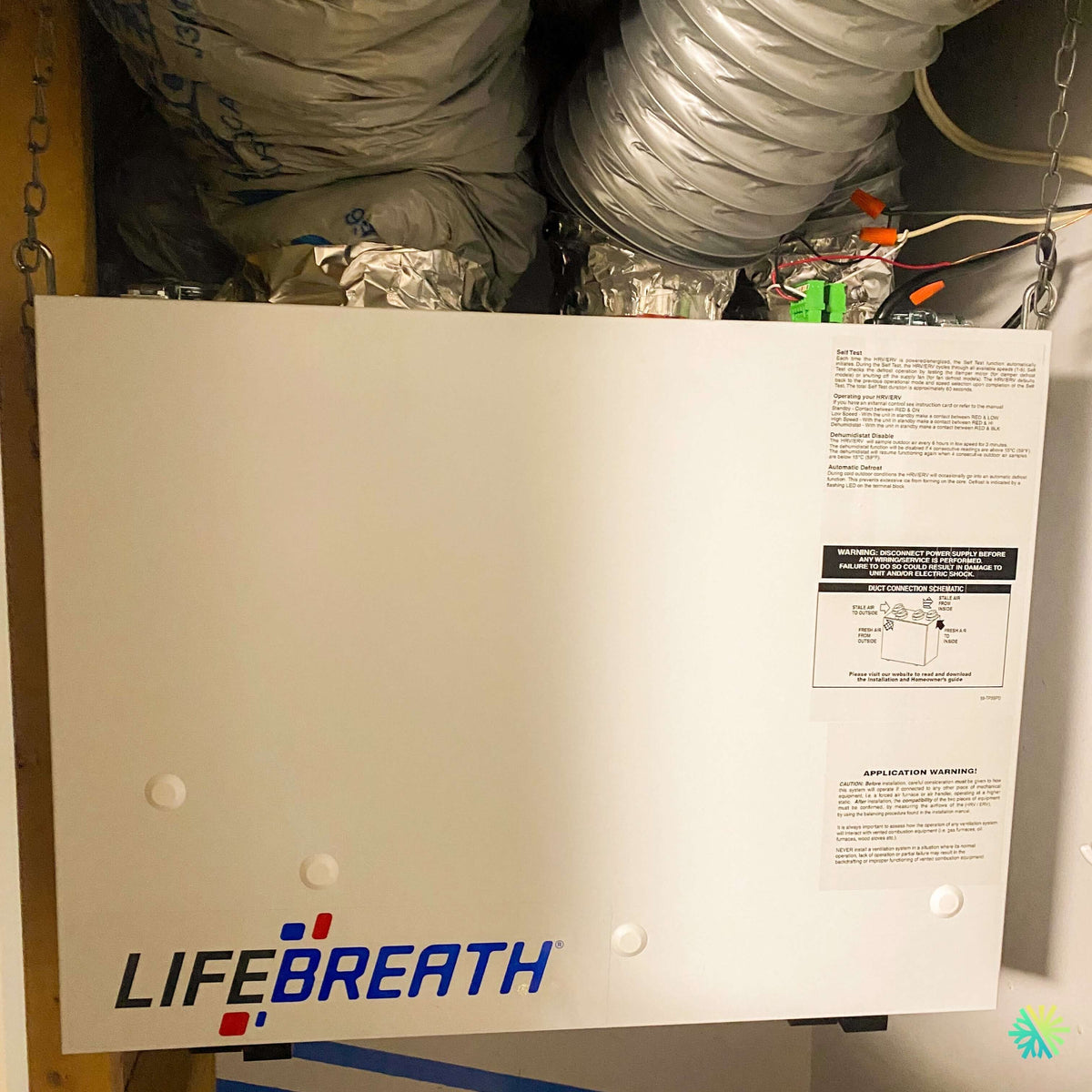
60-second self-test, RED and LOW contacts, a dehumidistat that switches off on its own, defrost LED: the label affixed to an HRV door contains half the diagnosis. Decoding on a LIFEBREATH RNC 205 installed in Sainte-Marthe-sur-le-Lac.
- City
- Region
- Equipment
- Brand
- Challenges
- Published
The job on one screen
The article, chapter by chapter
What the decal affixed to an air exchanger's door says, and what almost no one reads
On every Lifebreath HRV, a printed label occupies the upper-right corner of the access door. It consists of five short paragraphs. It explains the power-up self-test, the terminal block connections, the automatic deactivation logic of the dehumidistat, the defrost behavior, and an application warning that should be part of every serious quote. In the vast majority of homes where we work, this label has never been read — neither by the homeowner nor by the contractor who installed the unit.
The project we carried out in Sainte-Marthe-sur-le-Lac, in the Deux-Montagnes RCM, is an opportunity to examine it line by line, using a LIFEBREATH RNC 205 installed in a house whose basement had previously experienced water damage.
The context: a reconstructed house and homeowners who became attentive to humidity
Sainte-Marthe-sur-le-Lac occupies a special place in the landscape of the North Shore. The dike breach in April 2019 flooded a large portion of the area and forced the evacuation of thousands of residents. A higher dike has since been rebuilt, and much of the area's housing stock has been renovated: floors, partitions, basement insulation, and mechanical systems.
Our clients are among those who rebuilt everything. A raised bungalow of approximately 1,900 sq. ft. over two levels, four bedrooms, and a fully reconstructed basement with rigid perimeter insulation and a floating floor over a membrane. They came out of the experience with a lasting sensitivity to anything related to humidity, condensation, and air quality.
Their request was precise: an air exchanger capable of handling the home's entire volume, including the basement, with quantified proof that the unit does what it is supposed to do. Not a promise — a measurement.
Why we chose the RNC 205
The old unit, a compact model delivering approximately 100 CFM installed during construction, was undersized for the renovated area and did not serve any basement outlets. We proposed the RNC 205, the top-port model in the RNC series.
The technical specification sheet data
- Net supply airflow: 222 CFM (105 L/s) at 0.1 in. w.g., 207 CFM (98 L/s) at 0.2 in. w.g., 193 CFM at 0.3 and 179 CFM at 0.4 in. w.g.
- Apparent sensible effectiveness (ASE): 79% at 0 °C and 65 CFM
- Sensible recovery efficiency (SRE): 71% at 0 °C (64 CFM), 70% at 0 °C (100 CFM), and 68% at -25 °C (102 CFM)
- Power consumption: 120 V, 64 W on low speed, 96 W on high speed, 1.4 A
- Dimensions: 18 3/4 in. (H) x 33 5/8 in. (W) x 15 in. (D), 57 lb (25.8 kg)
- 6 in. (150 mm) oval collars, balancing dampers on all collars
- ENERGY STAR-qualified, HVI, CSA, and UL certified, manufactured to ISO 9001 standards
- Lifetime warranty on the core, 5 years on parts
The HEX core and performance in extreme cold
The RNC 205 uses Lifebreath’s patented HEX core, with counterflow operation. The difference between its performance at 0 °C (71%) and at -25 °C (68%) is only three points. This is the figure we look at first on every HVI sheet because it describes how the unit performs in January, not April.
Many units display appealing ratings at 0 °C and lose ten to fifteen points as soon as the outdoor temperature drops below -20 °C. On the North Shore, where nights at -25 °C are not rare, this difference translates directly into cold air blowing into the rooms and baseboard heaters working to compensate.
Top ports: the advantage—and the pitfall we see everywhere
The RNC 205 uses a top-connection design. Its four 6 in. oval collars exit through the top of the cabinet, completely freeing up the sides and allowing the unit to be installed against a wall or between two joists.
The advantage is real in a tight mechanical room. So is the pitfall: a top-port unit requires sufficient vertical clearance above the cabinet for the ducts to start their curve without being crushed. We regularly encounter installations where the insulated flexible duct is bent 90 degrees immediately after leaving the collar and compressed against the subfloor. The result is pressure loss that nothing can make up for later: the unit may show 207 CFM on paper but deliver 120 CFM throughout the house.
On this project, we lowered the unit’s suspension by 7 in. from the planned position specifically to give the four ducts enough room to start a wide curve.
The door decal explained
Here is what the label says, and why every paragraph matters.
The 60-second self-test
Each time it is powered on, the unit automatically runs a verification sequence: it cycles through all available speeds, tests the defrost damper motor on models with a damper, then returns to the mode and speed that were selected before the outage. The sequence lasts approximately 60 seconds.
Practical consequence: after a power outage, a unit that blows loudly for one minute is not malfunctioning. We receive several calls every winter for this exact reason.
The terminal block: RED and the others
The label lists the contacts to bridge from an external control:
- RED and ON: standby
- RED and LOW: low speed
- RED and HI: high speed
- RED and BLK: dehumidistat
This is the troubleshooting roadmap. A unit that refuses to switch to high speed despite the wall control can be diagnosed by bridging two terminals, without dismantling anything. You just have to know that the information is posted on the door.
The dehumidistat that disables itself
This is the least-known function, and the one that generates the most misunderstandings. The unit samples outdoor air every 6 hours, at low speed, for 3 minutes. If several consecutive readings indicate mild outdoor temperatures, the dehumidistat function is disabled automatically. It reactivates when the readings become cold again.
The logic is sound: a dehumidistat that triggers high speed in July, when outdoor air is more humid than indoor air, brings in moisture instead of removing it. The unit protects itself against this automatically.
The side effect can confuse homeowners: in spring, the dehumidistat stops responding and the unit seems to ignore the setting. Nothing is broken. We systematically explain this behavior when handing over the keys, because otherwise it generates an unnecessary service call every May.
Automatic defrost and the terminal block LED
In cold weather, the unit periodically enters defrost mode to prevent ice from accumulating in the core. On the RNC 205, a motorized recirculation damper closes the outdoor-air intake and circulates indoor air through the core.
The label specifies a detail we use in every diagnosis: defrosting is indicated by a flashing LED on the connection block. A unit that appears not to be drawing in outdoor air for a few minutes in January is not defective if the LED is flashing—it is doing exactly what it is supposed to do.
The application warning—the one that should have been read before the quote
The final callout is the most serious. It highlights three things:
- Compatibility between the HRV and any other mechanical equipment to which it is connected—a forced-air furnace or air-handling unit—must be confirmed after installation by measuring the airflow rates, according to the balancing procedure in the manual.
- The interaction between the ventilation system and any vented combustion appliance must be evaluated: a gas or oil furnace, or a wood stove.
- A ventilation system must never be installed in a situation where its normal operation, shutdown, or a partial failure could cause combustion-gas backdrafting.
This house is heated with electricity and has no combustion appliance. The point was still worth documenting because the owners are considering adding a wood-burning fireplace in the basement. We noted the constraint in the file: this addition will require reassessing the system balance and, depending on the selected configuration, a dedicated combustion-air intake.
What we take away from this Sainte-Marthe-sur-le-Lac project
Suspension: chains or straps
The unit was suspended from the joists with chains, using hooks screwed into the structure. Lifebreath supplies the RNC models with a set of four adjustable straps and four S-hooks, designed to absorb some of the vibrations and make leveling easier.
Both methods work, with one condition: a chain transmits vibrations to the structure much more faithfully than a strap. When we suspend the unit with chains—sometimes necessary when the available height requires a precise anchoring point—we always insert a flexible isolator at the contact point. Without this precaution, the motor’s hum travels through the floor of the living room above, and the owner eventually turns the unit off.
We also checked that the unit was level in both directions. An HRV installed crookedly does not drain its condensate properly.
The balancing, measured and documented
An unbalanced air exchanger puts the home under positive or negative pressure. Under negative pressure, outdoor air infiltrates through cracks and drains. Under positive pressure, moist air is pushed into the building assemblies, where it condenses—a scenario that homeowners who have already experienced water damage take very seriously.
We measured the supply and exhaust airflow with a digital manometer, using the integrated balancing ports, achieving a difference of less than 10% between the two streams. The RNC 205 offers three selectable high speeds: the factory H3 setting was lowered to H2, which was sufficient for the target airflow and noticeably quieter.
The report provided to clients includes the measured airflow in each stream, the system's static pressure, the selected speed, the location of each outlet, and the date of the next core inspection. This was the document that addressed their initial request.
The ductwork and outlets
- Four ducts connected to the 6 in oval collars, with wide bends and aluminum tape on every joint.
- 5 in reductions on the branches, with TechGrille 99-EAG5 grilles featuring an adjustable central cone, allowing the airflow to be adjusted room by room without touching the unit's dampers.
- Terminator 99-TM5 fittings at the walls and ceilings.
- Two new exhaust outlets added in the rebuilt basement, one of them in the mechanical room.
- Exterior hoods replaced, with mesh screens and the minimum required distance maintained between the intake and exhaust.
- Condensate drain rerouted with a loop trap and continuous slope.
The mistakes we correct most often
- Crushing the duct at the outlet of an upper port. The costliest error, and the least visible in an installation photo.
- Hanging it by a chain without an isolator. Noise transmitted to the structure is the leading cause of an HRV being deliberately shut down.
- Ignoring the door label. It contains half the diagnosis before the cabinet is even opened.
- Confusing defrosting with a malfunction. A flashing LED on the terminal block indicates normal operation.
- Billing for balancing without measuring it. Without a written record, there is no way to distinguish the two.
Grants: sequence matters as much as the amount
The Rénoclimat program provides $500 for the installation or replacement of an HRV or energy recovery ventilator. The RNC 205 is HVI-certified and listed in the required directory.
The point we repeat to every client concerns the order of operations. The assistance is paid only if an energy assessment was completed before the work and a second one afterward. A unit installed before the first assessment is not eligible, regardless of its performance. In addition, the program specifies that an HRV cannot be the only measure: it must accompany other energy-efficiency work, otherwise the assistance is refused.
In this case, the replacement was part of a set of post-rebuild work that had already been assessed, which simplified the process. Hydro-Québec's LogisVert program does not cover air exchangers—it targets heat pumps, water heaters, and the building envelope, among other measures.
Maintenance that protects the core
- Washable filters in both air streams: wash with warm soapy water every 3 months.
- HEX core: remove and rinse annually, preferably in the fall.
- Exterior hoods: inspect in spring and remove dryer lint and insect nests.
- Drain and trap: check twice a year.
- Professional inspection: every 2 to 3 years, with rebalancing after any modification to the network or building envelope.
Our other ventilation projects in the region
This project is part of a series of recent installations and replacements: several Lifebreath HRVs in Thérèse-De Blainville, a unit recessed into a condo tower's soffit in Laval, a side-discharge model in an upper-level apartment without a basement in Montréal-Nord, an integration into the central network of a West Island home, and a series of projects in Vaudreuil-Soulanges. The constraints change every time; the method does not.
Let's talk about your project
At AirGreen, we design, install, balance, and maintain residential and commercial ventilation systems in Sainte-Marthe-sur-le-Lac, Deux-Montagnes, throughout the North Shore, in Laval, Montreal, Longueuil, and on the South Shore. Our teams hold the required RBQ licences and work with LIFEBREATH, Fantech, Broan-NuTone, and Greentek product lines.
For an air exchanger replacement, the addition of outlets in a rebuilt basement, or documented balancing of your existing unit, write to us at sales@airgreen.ca or call (514) 316-2973.
How the job unfolds
The main steps of this kind of job at AirGreen. Every house has its quirks: the estimate brings them out.
We locate the wall for the two outdoor hoods, the unit's spot, service access and the drain.
The unit, its location and the price, in writing.
Hung or set level, with clear access to the filters and the core.
Fresh air intake and exhaust, kept apart and sealed.
The ones connected to the outside are insulated to prevent condensation inside the house.
Connected with its loop, when the unit needs one.
Installed where you will see it and use it.
Incoming and outgoing airflows are adjusted so the house is neither pressurized nor depressurized.
Speeds, filters, core: how to use it through the seasons.
- The on-site estimateWe locate the wall for the two outdoor hoods, the unit's spot, service access and the drain.
- The quoteThe unit, its location and the price, in writing.
- The unitHung or set level, with clear access to the filters and the core.
- The outdoor hoodsFresh air intake and exhaust, kept apart and sealed.
- The ductsThe ones connected to the outside are insulated to prevent condensation inside the house.
- The drainConnected with its loop, when the unit needs one.
- The wall controlInstalled where you will see it and use it.
- BalancingIncoming and outgoing airflows are adjusted so the house is neither pressurized nor depressurized.
- The walkthroughSpeeds, filters, core: how to use it through the seasons.
What we check on a job like this one
Each number is a point we check on site. Switch between summer and winter to watch air and heat move.
Generic illustration of this type of installation, not a survey of this job site. Tap a number.
It removes stale air and brings in fresh air. The two airflows cross in the core without mixing.
It recovers part of the heat from the outgoing air to temper the incoming air. Depending on the model, it also manages humidity.
An outdoor hood, kept away from the exhaust so the house does not pull back the air it just removed.
Humid, stale air leaves through its own hood, fitted with a damper.
The ducts that connect to the outside are insulated to prevent condensation inside the house.
Stale air is drawn from humid rooms and fresh air is sent to living areas. The airflows are balanced.
It sets the mode and speed. You use it more when the house is humid or full of people.
Depending on the model and the season, the core produces condensation, removed through a drain with its loop.
Is your home ready?
Check what applies at your place. A "no" is not a refusal: it is what we sort out during the estimate.
Good habits, once the unit is in place
Six simple habits that keep the unit going. Your list stays on this device.
What to do, season by season
Three habits per season for this unit. They take a few minutes and prevent many calls.
- Clean the filters and core as the manufacturer specifies.
- Check the outdoor hoods: nests, debris, dampers.
- Lower the speed if the outdoor air gets humid.
- Adjust the speed to the humidity in the house.
- Check that the drain flows.
- Keep the outdoor hoods clear.
- Clean the filters before the closed-house season.
- Check the exhaust damper.
- Book a full cleaning if the unit has not had one in a long time.
- Clear snow from both outdoor hoods.
- Raise the speed if condensation appears on windows.
- Let the unit run: with the house closed, humidity builds up.
The right pages, at the right time
Four statements: true or false?
It all comes down to details you have just seen.
1. In an air exchanger, fresh air and stale air mix.
The two airflows cross in the core without mixing.
2. The two outdoor hoods must be kept apart.
Otherwise the exchanger pulls back the air it just removed.
3. An air exchanger can help with condensation on windows.
It renews the air and helps keep humidity in the right range.
4. An exchanger never needs maintenance.
Filters and core get dirty and need regular cleaning.
0 / 4 right answers
What people ask us about this kind of work
What does an air exchanger do?
Does fresh air cool the house in winter?
What speed should it run at?
Does an exchanger need cleaning?
What are the signs of poor ventilation?
HRV or ERV: what is the difference?
Should it run in winter?
Does AirGreen hold the required licences?
Is the estimate free?
No question matches. Write to us: we answer.
More jobs to see, near you
By town, by equipment or by region: browse more than 4,700 published projects.
Each dot: a town where AirGreen has published projects. The glowing dot: this job.
An on-site estimate, the right capacity, the right equipment.
The on-site estimate is free and the quote follows within 24 hours.
Text and photo: a real AirGreen Climatisation & Chauffage job. The diagrams are generic illustrations of the type of installation, not a survey of this job site. Sources of the added figures: airgreen.ca product pages (NEEP / AHRI performance), Hydro-Québec (Heat pumps page, LogisVert, read on 13 October 2026), Régie de l’énergie (rate D as of 1 April 2026).