
Installation of a GREE VITA R32 Wall-Mounted Heat Pump - Air Conditioner - Mini Split in Saint-Bruno-de-Montarville, in a low-ceiling indoor space
AirGreen installs a GREE VITA R32 wall-mounted heat pump in Saint-Bruno, in a low-ceiling space, with precise positioning, controlled clearance, and clean finishing.
Take a tour of the installation
Each number is a point we check on site. Switch between summer and winter to watch air and heat move.
In summer, the outdoor unit rejects the house's heat outside.
Generic illustration of this type of installation, not a survey of this job site. Tap a number.
Mounted level on a wall plate, high enough for the air to reach the whole room, with enough space around it to slide the filters out easily.
The refrigerant lines, the communication cable and the drain go through the wall in a single opening, sealed against water, cold air and insects.
Two insulated copper pipes connect the two units. Outside, a line cover can protect them from sun, knocks and weather.
A shut-off switch near the outdoor unit isolates it safely for service. It must stay accessible at all times.
The compressor and the fan. In heating mode it captures heat from the outdoor air, even in winter, and moves it inside.
On the ground or on the wall, it keeps the unit above accumulated snow. The unit stays clear and defrost water can drain away.
The fan needs to blow freely. Storage, a fence or a wall too close, and efficiency drops while noise goes up.
A compact wall installation where every centimeter counted
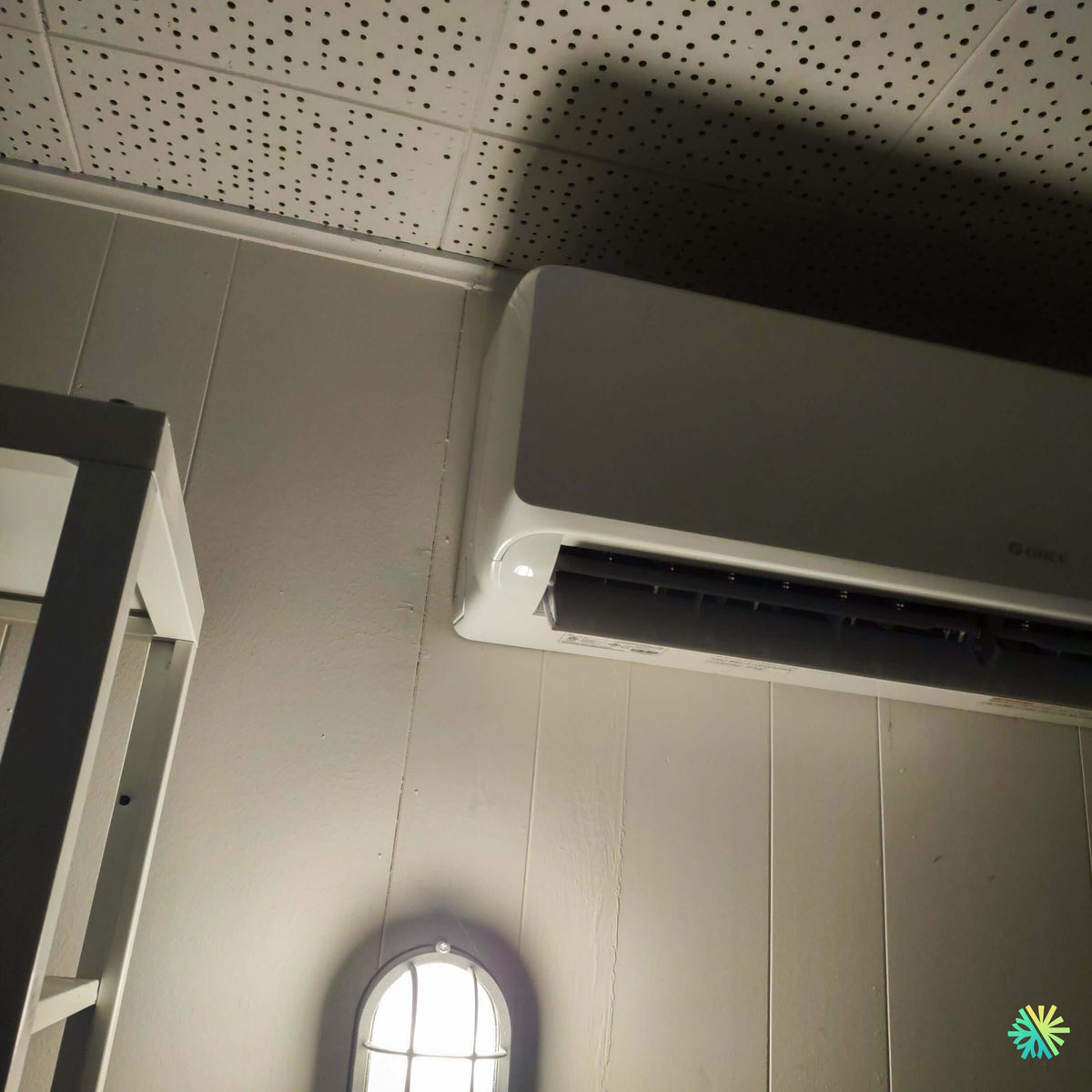
In Saint-Bruno-de-Montarville, this installation of a GREE VITA R32 wall-mounted heat pump presented us with a very concrete challenge: integrating a mini split system in a room with limited available height, an acoustic suspended ceiling, an already finished interior wall, and restricted space to position the wall unit in the right spot. The photo clearly shows the unit installed close to the ceiling, on a wall with vertical panels, with an air outlet directed downward to promote good comfort distribution in the area.
This type of installation requires much more than just wall mounting. A wall-mounted heat pump must be installed at a strategic height, with sufficient clearance for air intake, reasonable access to filters, an adequate slope for the condensation drain, and a well-planned refrigerant line route. In a space like this, where the ceiling is quite low and the available wall surface is limited by existing elements, precision becomes essential.
The choice of the GREE VITA R32 was relevant for this project because it is a compact, efficient unit well suited for residential or semi-commercial installations where air conditioning and heating are combined in a single solution. Thanks to its Inverter technology, the unit adjusts its operation according to actual demand, allowing for a more stable temperature without abrupt and repetitive cycles.
For owners in Saint-Bruno, Longueuil, Montreal, Laval, the North Shore or the South Shore, this project illustrates a common reality: the best HVAC system is not just the one with good technical features, but the one chosen, positioned, and installed according to the actual building. At AirGreen, we pay special attention to these details because they determine comfort, reliability, and ease of maintenance in the long term.
A GREE VITA R32 suited for spaces where discretion is important
The GREE VITA R32 is a wall heat pump designed to offer a good balance between performance, ease of use, and visual integration. In this installation in Saint-Bruno, its understated design suited the room well: the indoor unit remains discreet while being installed high enough not to interfere with the layout.
The refrigerant R32 is part of the important elements of this generation of devices. It is used in several recent HVAC systems for its thermal qualities and efficiency in residential applications. For the client, this mainly means a modern device designed to offer effective cooling in summer and useful heating during cooler periods.
The important elements of this installation were as follows:
- Brand: GREE
- Model: VITA R32
- Type: wall heat pump, air conditioner, mini split
- Technology: Inverter
- Refrigerant: R32
- Indoor installation: wall unit mounted high, near a suspended ceiling
- Location: Saint-Bruno-de-Montarville
- Application: zoned comfort for a room with a particular interior layout
- Subsidy: eligibility to be verified according to exact capacity, AHRI number, and current programs
We avoid recommending a BTU capacity without analyzing the site. The appropriate capacity depends on several factors: area, insulation, orientation, number of windows, room usage, ceiling height, sun exposure, and presence of heat-generating equipment. An undersized unit will run too long at high power. An oversized unit might cool quickly without properly controlling humidity. In both cases, comfort would be compromised.
The main challenge: install high, but not too high
In the photo, you immediately notice that the indoor unit is installed near a suspended ceiling with perforated acoustic tiles. This detail is important. A wall unit generally draws air from the top and expels it forward and downward. If the device is installed too close to the ceiling, the suction can be limited, efficiency may decrease, and access to the filters can become less convenient.
Our work therefore consisted of finding the best possible compromise between:
- maintain a functional clearance above the unit;
- keep the unit high enough not to interfere with the use of the room;
- ensure good air distribution to the occupied area;
- maintain access for HVAC maintenance;
- protect the aesthetics of the existing wall.
This precision is especially important in finished basements, offices, multipurpose rooms, commercial premises, service rooms, or rooms with low ceilings. In several installations in Longueuil, Montreal, and on the South Shore, we encounter similar configurations: suspended ceilings, finished walls, wall lighting, fixed furniture, stairs, or structures close to the planned location.
Air positioning: comfort without direct drafts
A well-installed wall heat pump should not blow directly on a person sitting for long periods. In this project, the orientation of the unit allows air to be projected into the room rather than concentrated on a single point. The outlet louvers can then be adjusted according to the seasons: higher in cooling to promote air mixing, lower in heating to help distribute the heat.
The presence of a wall light fixture under the unit also required special attention. We ensured that the airflow was not unnecessarily blocked or disturbed by the elements fixed to the wall. This kind of detail may seem secondary, but it influences the daily experience. A successful installation must take into account the actual air circulation, not just the available location.
A clean finish on an already finished wall
The wall visible in the photo is made of vertical panels, with an interior finish already in place. When installing a wall air conditioner or a heat pump in a finished space, we must work carefully to avoid unnecessary marks, rough cuts, or poorly integrated duct passages.
At AirGreen, we always strive to deliver an installation that looks natural in the room. This means:
- measure accurately before drilling;
- choose the location of the wall bracket based on the structure behind the finish;
- check the level of the unit;
- plan the passage of the drain and refrigerant lines;
- maintain a clean finish around the unit;
- Explain to the customer how to access the filters and use the operating modes.
In this installation in Saint-Bruno, the final result is sober and functional. The GREE unit fits into the top of the wall, without taking up floor space or visually weighing down the room.
What this installation in Saint-Bruno teaches owners shopping for a wall heat pump
Installing a mini split system like the GREE VITA R32 is often seen as a simple operation. In reality, several technical decisions directly influence comfort and the device’s lifespan. This project in Saint-Bruno-de-Montarville clearly shows why a professional assessment is essential before choosing the final location.
Common mistakes in low-ceiling rooms
Installing the unit without respecting air intake
A wall unit needs air to operate efficiently. When placed too close to the ceiling, it may draw in less air, work harder, and lose efficiency. In a project like this, every centimeter must be evaluated.
Choosing the location based only on appearance
Aesthetics matter, but they should not come before performance. A device placed in the wrong spot can create areas that are too cold, too hot, or uncomfortable drafts. We always look for a location that respects both the room’s design and HVAC logic.
Forgetting the condensate drain
In cooling mode, the indoor unit produces condensation. The drain must be installed with an adequate slope when possible, or with a suitable mechanical solution when gravity is not enough. Poor drainage can cause leaks, odors, or wall damage.
Neglecting filter access
HVAC maintenance starts with simple actions, like cleaning the filters. If the unit is installed too high or in a hard-to-reach place, the customer may postpone maintenance. We take this aspect into account from the installation stage.
Underestimating perceived noise
Even though modern wall units are generally discreet, the perceived noise depends on the room, surfaces, ceiling, proximity to occupants, and operating mode. In a low-ceiling room, positioning greatly influences the sound experience.
An AirGreen approach based on the building, not on a one-size-fits-all formula
We install wall heat pumps, wall air conditioners, and mini split systems in very different environments: condos in Montreal, single-family homes in Laval, plexes in Longueuil, buildings on the North Shore, residences on the South Shore, and commercial premises with technical constraints. This variety has taught us one simple thing: every installation must be adapted to the location.
In the case of this GREE VITA R32 in Saint-Bruno, we evaluated the available height, the position of the suspended ceiling, the wall finish, the presence of the light fixture, the desired direction of airflow, and future accessibility. This preparatory work helps avoid costly compromises after installation.
Concrete benefits for the customer
Once properly installed, the GREE VITA R32 wall heat pump offers several practical advantages:
- effective air conditioning during hot days;
- useful heating during cool periods;
- zoned temperature control;
- an installation without central ducts;
- a discreet visual presence;
- better controlled consumption thanks to Inverter technology;
- a more stable comfort than a device operating only in on-off mode.
For a low-ceiling space, these advantages are particularly interesting because the system frees up the floor, avoids adding bulky equipment, and allows treating a specific zone without modifying the entire building structure.
Grants and energy efficiency: what to check
Grant programs can represent a significant advantage for certain HVAC projects in Quebec. However, eligibility depends on specific criteria: exact model, capacity, AHRI number, energy performance, type of installation, and the program rules in effect at the time of the work.
At AirGreen, we help our customers verify relevant information before installation when the goal is to benefit from financial aid. For a GREE VITA R32, it is always necessary to confirm the data specific to the selected unit, as the same range can exist in several capacities.
Recommended maintenance to maintain good performance
After installation, the client must maintain the device regularly. For a wall unit like the one installed in Saint-Bruno, we recommend:
- clean the filters according to usage frequency;
- keep the air outlet clear;
- avoid placing furniture or objects that block airflow;
- watch for any abnormal water traces around the unit;
- have the system checked periodically by a professional;
- keep the outdoor unit clear and accessible.
A well-done HVAC maintenance helps preserve efficiency, air quality, noise level, and system lifespan.
A successful project in a demanding space
This installation of a GREE VITA R32 in Saint-Bruno-de-Montarville shows that a complex interior space can very well accommodate a wall-mounted heat pump, provided the installation is planned with rigor. The low ceiling, finished wall, proximity to existing elements, and access constraints are not obstacles when they are properly analyzed from the start.
For AirGreen, the success of a project is not limited to starting the device. It is measured in the client’s daily comfort, ease of use, the cleanliness of the finish, and the system’s performance throughout the seasons. This installation in Saint-Bruno fits exactly within this approach: a compact, well-integrated, efficient HVAC solution adapted to the actual building.
Whether it’s for a house in Saint-Bruno, a condo in Montreal, a residence in Laval, a building in Longueuil, a project on the North Shore or an installation on the South Shore, AirGreen supports its clients with a clear method: analyze, recommend, install, and provide professional follow-up. A GREE VITA R32 wall-mounted heat pump can offer excellent comfort, but it’s the quality of the installation that allows you to get the best performance.
The big day, step by step
The main steps of this kind of job at AirGreen. Every house has its quirks: the estimate brings them out.
We look at the room, the outside wall, the line route and where the outdoor unit will go. That is where the capacity gets chosen.
Model, capacity and price, in writing. We also check whether the model qualifies for assistance programs.
Floors and furniture protected, wall plate position marked level, wall opening located.
A single opening, with the slope the drain needs to flow outside.
Set on a stand raised above the snow, with the clearances the manufacturer requires.
Connected, insulated and protected. The opening is then sealed against water, cold air and insects.
A dedicated circuit and an accessible disconnect near the outdoor unit.
Leak test, vacuum, then start-up and a check of heating and cooling.
Remote, modes, filters: we show you the essentials before we leave.
- The on-site estimateWe look at the room, the outside wall, the line route and where the outdoor unit will go. That is where the capacity gets chosen.
- The quoteModel, capacity and price, in writing. We also check whether the model qualifies for assistance programs.
- Getting readyFloors and furniture protected, wall plate position marked level, wall opening located.
- The wall openingA single opening, with the slope the drain needs to flow outside.
- The outdoor unitSet on a stand raised above the snow, with the clearances the manufacturer requires.
- Lines, cable and drainConnected, insulated and protected. The opening is then sealed against water, cold air and insects.
- The electrical workA dedicated circuit and an accessible disconnect near the outdoor unit.
- Tests and start-upLeak test, vacuum, then start-up and a check of heating and cooling.
- The walkthroughRemote, modes, filters: we show you the essentials before we leave.
What would it look like at your place?
Two quick checks with real numbers: what heat costs, and what your current heaters add up to in BTU/h.
Conversion: 1 W = 3.412 BTU/h. An indication, not a load calculation: baseboards and furnaces are often stronger than the real need, and they can stay as backup. AirGreen confirms the capacity on site.
Four mistakes we do not make
Flip each card to see what we do instead.
Your own project, step by step
What to do, season by season
Three habits per season for this unit. They take a few minutes and prevent many calls.
- Clean the indoor unit's filters.
- Clear leaves and debris left on the outdoor unit by winter.
- Test cooling before the first hot days.
- Clean the filters more often when the unit runs a lot.
- Keep plants away from the outdoor unit.
- Check that no water drips from the indoor unit.
- Rake the leaves around the outdoor unit.
- Test heating before the first cold days.
- Book periodic maintenance before winter.
- Keep snow away from the stand and the front of the unit.
- Let the unit defrost: it is normal.
- Never hit the ice on the fins; call us if the unit stays iced up.
Is your home ready?
Check what applies at your place. A "no" is not a refusal: it is what we sort out during the estimate.
Four statements: true or false?
It all comes down to details you have just seen.
1. In heating mode, the outdoor unit can produce water.
During defrost cycles. That water must drain away without forming ice.
2. You pick the capacity with a simple square-footage rule.
Windows, insulation, orientation and how the room is used all count. Capacity is chosen on site.
3. A multi-zone connects several indoor heads to a single condenser.
One head per room, all on the same condenser. Each room keeps its own temperature.
4. The disconnect can sit behind the patio furniture.
It must stay accessible: it is what shuts the unit off for service.
0 / 4 right answers
What people ask us about this kind of work
Does a wall-mounted heat pump heat in winter?
Wall-mounted or multi-zone: how do I choose?
Where does the outdoor unit go?
Are there grants?
Do I need a permit?
How cold can it heat?
How much can I save?
How is the LogisVert assistance calculated?
Is it noisy?
The outdoor unit is covered in ice: is that normal?
Does AirGreen hold the required licences?
Is the estimate free?
No question matches. Write to us: we answer.
More jobs to see, near you
By town, by equipment or by region: browse more than 4,700 published projects.
Each dot: a town where AirGreen has published projects. The glowing dot: this job.
Every house has its constraints. We see them before we install.
The on-site estimate is free and the quote follows within 24 hours.
Text and photo: a real AirGreen Climatisation & Chauffage job. The diagrams are generic illustrations of the type of installation, not a survey of this job site. Sources of the added figures: airgreen.ca product pages (NEEP / AHRI performance), Hydro-Québec (Heat pumps page, LogisVert, read on 13 October 2026), Régie de l’énergie (rate D as of 1 April 2026).