
Installation of a GREE VITA R32 18,000 BTU wall-mounted heat pump in a condo with large windows in Île-des-Sœurs, Montreal
AirGreen installs a GREE VITA R32 18,000 BTU wall-mounted heat pump in a condo on Île-des-Sœurs: R-32 mini split, installed above a large window, WiFi included, and four-season comfort.
In summer, the outdoor unit rejects the house's heat outside.
Generic illustration of this type of installation, not a survey of this job site. Tap a number.
Mounted level on a wall plate, high enough for the air to reach the whole room, with enough space around it to slide the filters out easily.
The refrigerant lines, the communication cable and the drain go through the wall in a single opening, sealed against water, cold air and insects.
Two insulated copper pipes connect the two units. Outside, a line cover can protect them from sun, knocks and weather.
A shut-off switch near the outdoor unit isolates it safely for service. It must stay accessible at all times.
The compressor and the fan. In heating mode it captures heat from the outdoor air, even in winter, and moves it inside.
On the ground or on the wall, it keeps the unit above accumulated snow. The unit stays clear and defrost water can drain away.
The fan needs to blow freely. Storage, a fence or a wall too close, and efficiency drops while noise goes up.
A discreet wall installation to control the comfort of a bright condo at Île-des-Sœurs
At Île-des-Sœurs, modern condos often offer an unobstructed view, abundant windows, and beautiful natural light. These architectural qualities, however, create a well-known challenge in HVAC (heating, ventilation, and air conditioning): large glazed surfaces can increase heat gains in summer, let in cold near windows in winter, and make some areas of the home harder to stabilize. For this project, our AirGreen team installed a GREE VITA R32 18,000 BTU wall-mounted heat pump, used both as a wall air conditioner, an efficient supplemental heating system, and a residential mini split adapted to the constraints of a condominium building.
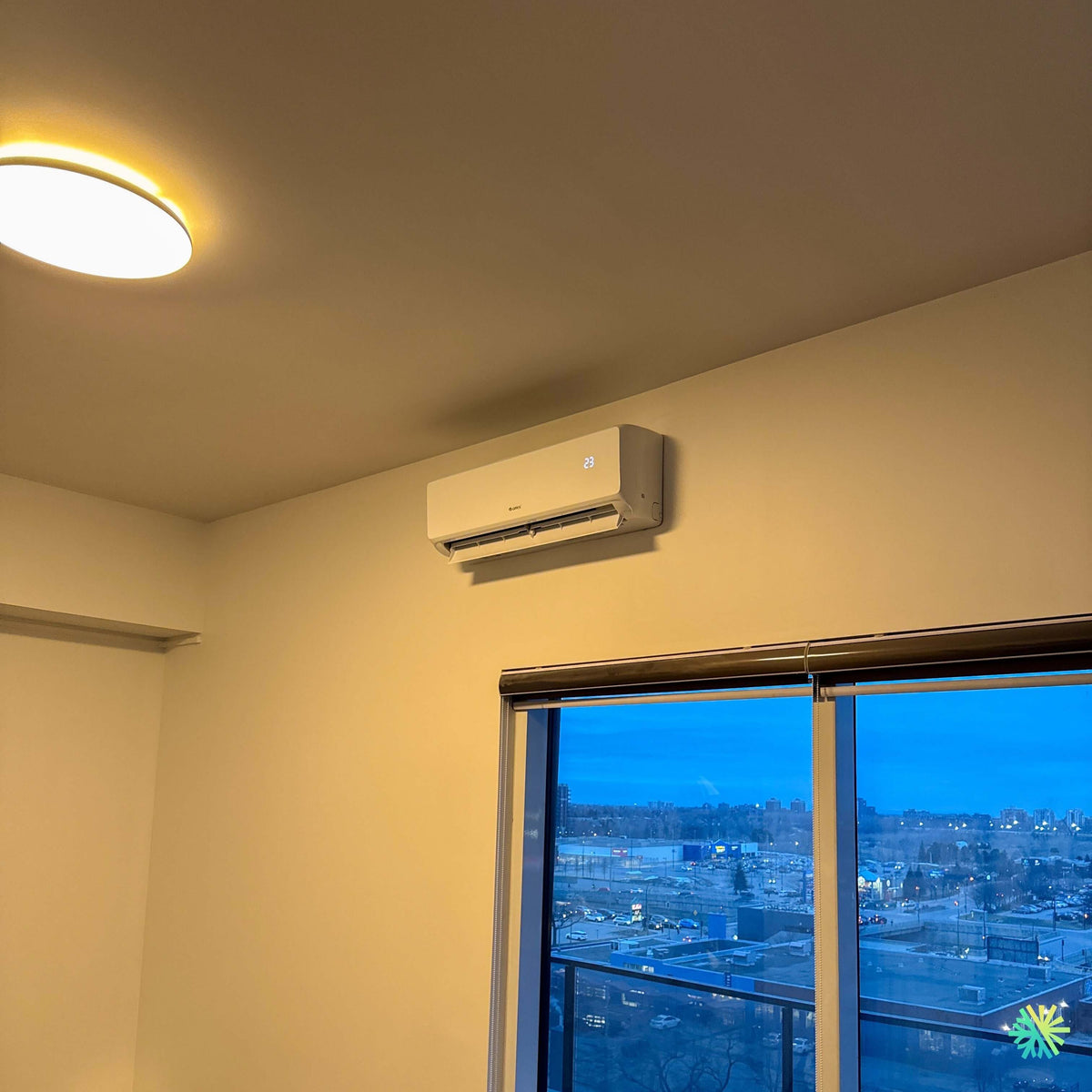
The photo shows an indoor unit installed high on a clear wall, just above a large window overlooking the surrounding urban area. The unit is positioned to distribute air towards the living space, without cluttering the wall, interfering with the blinds, or disrupting the condo's clean aesthetic. This type of integration is particularly important in Montréal condominiums, where every placement choice must respect comfort, interior finish, service access, and building regulations.
The client wanted an effective solution to maintain a comfortable temperature year-round, especially during hot days when sunlight comes directly through the window. The chosen location allows the unit to quickly treat the indoor air while maintaining a discreet visual presence. The unit's display, visible in the photo, shows a set temperature of 23 °C, a typical setting to achieve a good balance between comfort and energy consumption.
Why the location above the window was strategic
In a condo with large windows, installing a heat pump near the area exposed to heat or cold can improve the comfort feeling. Here, the unit was placed high enough to ensure good air flow reach, while preserving the available wall space for interior design.
This positioning offered several advantages:
- more uniform air distribution towards the main room;
- better compensation of heat gains from the window;
- visually discreet installation above the opening;
- sufficient clearance for blinds and window dressing;
- reasonable access for filter cleaning and HVAC maintenance;
- careful integration in a modern condo environment.
In this type of installation, a few centimeters can make a real difference. The unit should not be placed too close to the ceiling because the return air must circulate properly. It should also not be installed too low, especially above a window, to avoid creating obstacles with blinds or curtains. Our team therefore adjusted the height, alignment, and clearance to achieve a clean, functional, and durable installation.
A GREE VITA R32 suited for urban condos
The GREE VITA R32 18,000 BTU is an interesting solution for condos, spacious apartments, and open living areas. The model’s technical sheet indicates a cooling capacity of 18,000 BTU, operation with refrigerant R-32, included WiFi, heating capacity down to -25 °C, a SEER2 of 20.0, an HSPF2 of 8.5, an EER2 of 12.4, an indoor sound pressure of 34 / 53 dB(A), piping of 1/4 - 1/2 inch, a voltage of 220 V, as well as a warranty of 10 years on the compressor and 10 years on parts.
These technical data are important, but they only tell part of the story. In a condo on Île-des-Sœurs, the success of the project also depends on the choice of location, the routing of the pipes, the condensation drainage, coordination with condominium rules, and the quality of commissioning.
An 18,000 BTU machine can provide excellent comfort in an open area, but it must be installed precisely. A unit that is poorly oriented can blow directly on the occupants. A unit too far from the glazed area may take longer to correct temperature variations. A poorly drained unit can cause humidity or water backflow problems. That’s why we treat each wall-mounted heat pump installation as a complete project, not just a simple device setup.
Managing condensation: a crucial point in condominiums
In a condo, draining condensation water is often one of the most delicate aspects. In cooling mode, the wall air conditioner extracts moisture from the indoor air. This water must be directed to an appropriate drain, without risk of leakage, noise nuisance, or impact on interior finishes.
For this installation, our team paid special attention to the slope, routing, and discretion of the drainage. In high-rise buildings, the building's configuration sometimes imposes limits: concrete walls, finished ceilings, restricted access, absence of nearby gravity drains, or specific condominium association rules. Our role is to propose a realistic, reliable solution that complies with the site's constraints.
Good drainage is barely noticeable once the installation is complete. That is exactly what we aim for: a system that works properly without drawing attention, without visible marks, and without repeated intervention after startup.
The challenge of large windows on Île-des-Sœurs
Condos on Île-des-Sœurs are often sought after for their view, brightness, and proximity to Montreal. However, this same brightness can cause rapid overheating, especially when the sun shines directly on the windows for several hours. Even with blinds, the temperature can rise in certain areas, creating discomfort near the windows and a marked difference with the rest of the dwelling.
The GREE VITA R32 installed here addresses this issue in a targeted way. In cooling mode, the unit can lower the indoor temperature and help control humidity. In heating mode, it can improve comfort when the area near the window becomes cooler. The goal is not just to reach a temperature displayed on the remote control but to make the room pleasant to live in.
This is also why the orientation of the louvers is important. During commissioning, we adjust the settings to avoid a direct air jet on a sofa, table, or workspace. Real comfort depends as much on air distribution as on the machine's nominal capacity.
Key steps for a successful AirGreen installation in a Montreal condo
Wall analysis and preparation before drilling
Before installing the indoor unit, we need to understand the composition of the wall. In a condo, you can find load-bearing concrete walls, lightweight partitions, soffits, technical columns, or areas where pipe passage is limited. Drilling must be carefully planned to avoid structural elements, existing ducts, electrical wires, and sensitive finishes.
In this project, the unit was installed with careful alignment, respecting the available space between the ceiling, window, and side wall. The result is balanced: the device does not seem randomly added; it is part of the layout.
Coordination with condominium rules
Condominium buildings often require more comprehensive documentation than a single-family home. Depending on the building, it may be necessary to confirm the location of the outdoor unit, noise level, type of support, method of pipe routing, protection of common areas, and insurance requirements.
At AirGreen, we are used to working in this type of context. We can provide the necessary technical information, explain the installation method, and coordinate the steps to reduce surprises. Our $5,000,000 liability insurance is also reassuring for managers and associations who want to oversee the work in their building.
Commissioning and final checks
Once the installation is complete, we do not just turn on the device. The commissioning includes several checks: operation in cooling mode, operation in heating mode, ventilation control, drainage validation, inspection of connections, remote control confirmation, explanation of the main modes, and usage advice.
For the client, this step is essential. A system like the GREE VITA R32 offers several practical functions, but you still need to know how to use them correctly. We explain how to adjust the temperature, use the dehumidification mode, avoid extreme settings, clean the filters, and maintain good air circulation around the unit.
LogisVert Subsidy: an advantage to validate at the time of the project
The AirGreen sheet for the GREE VITA R32 18,000 BTU indicates a LogisVert provincial subsidy of $1,836, updated as of November 26, 2025. For condo owners in Montreal, Laval, Longueuil, on the North Shore or the South Shore, this type of aid can make a significant difference in the final budget.
It is, however, essential to validate eligibility at the time of the application. The criteria may vary depending on the model, installation date, type of dwelling, and program rules. Hydro-Québec specifically indicates that the application must be submitted within nine months of the equipment installation date. At AirGreen, we provide a detailed invoice and the information of the installed model to facilitate the client's procedures.
Mistakes to avoid in a condo with a mini split
Installing the unit based only on appearance
Aesthetics matter, especially in a modern condo, but they should not take precedence over performance. The unit must be attractive, discreet, and well positioned to treat the air effectively.
Underestimating the impact of windows
A large window can change the thermal behavior of a room. The choice of capacity, location, and air direction must take this reality into account.
Neglecting drainage
A poorly planned drain can cause costly damage. In condominiums, this risk must be taken very seriously.
Forgetting access to the filters
A simple HVAC maintenance starts with accessible filters. Even if the unit is installed high up, it must still be possible to open and clean it properly.
Comparing price only
Two quotes may mention the same brand and capacity but include very different installation quality. The finishing, protection of the pipes, commissioning, management of condominium constraints, and after-sales service must be taken into account.
A sober, efficient result adapted to Île-des-Sœurs
The final result is a well-integrated, discreet GREE VITA R32 wall heat pump ready to respond to the typical temperature variations of a bright condo. The unit is placed in the right spot to act on the glazed area while maintaining a neat and professional appearance.
This project clearly illustrates our approach at AirGreen: analyze the housing, understand the real constraints, propose a suitable solution, and carry out a careful HVAC installation from start to finish. Whether it is on Île-des-Sœurs, downtown Montreal, in Laval, in Longueuil, on the North Shore or the South Shore, we apply the same rigor for every heat pump, every wall air conditioner, and every mini split.
How it goes, from the first call to the end
The main steps of this kind of job at AirGreen. Every house has its quirks: the estimate brings them out.
We look at the room, the outside wall, the line route and where the outdoor unit will go. That is where the capacity gets chosen.
Model, capacity and price, in writing. We also check whether the model qualifies for assistance programs.
Floors and furniture protected, wall plate position marked level, wall opening located.
A single opening, with the slope the drain needs to flow outside.
Set on a stand raised above the snow, with the clearances the manufacturer requires.
Connected, insulated and protected. The opening is then sealed against water, cold air and insects.
A dedicated circuit and an accessible disconnect near the outdoor unit.
Leak test, vacuum, then start-up and a check of heating and cooling.
Remote, modes, filters: we show you the essentials before we leave.
- The on-site estimateWe look at the room, the outside wall, the line route and where the outdoor unit will go. That is where the capacity gets chosen.
- The quoteModel, capacity and price, in writing. We also check whether the model qualifies for assistance programs.
- Getting readyFloors and furniture protected, wall plate position marked level, wall opening located.
- The wall openingA single opening, with the slope the drain needs to flow outside.
- The outdoor unitSet on a stand raised above the snow, with the clearances the manufacturer requires.
- Lines, cable and drainConnected, insulated and protected. The opening is then sealed against water, cold air and insects.
- The electrical workA dedicated circuit and an accessible disconnect near the outdoor unit.
- Tests and start-upLeak test, vacuum, then start-up and a check of heating and cooling.
- The walkthroughRemote, modes, filters: we show you the essentials before we leave.
And at your place?
Two quick checks with real numbers: what heat costs, and what your current heaters add up to in BTU/h.
Conversion: 1 W = 3.412 BTU/h. An indication, not a load calculation: baseboards and furnaces are often stronger than the real need, and they can stay as backup. AirGreen confirms the capacity on site.
What to do, season by season
Three habits per season for this unit. They take a few minutes and prevent many calls.
- Clean the indoor unit's filters.
- Clear leaves and debris left on the outdoor unit by winter.
- Test cooling before the first hot days.
- Clean the filters more often when the unit runs a lot.
- Keep plants away from the outdoor unit.
- Check that no water drips from the indoor unit.
- Rake the leaves around the outdoor unit.
- Test heating before the first cold days.
- Book periodic maintenance before winter.
- Keep snow away from the stand and the front of the unit.
- Let the unit defrost: it is normal.
- Never hit the ice on the fins; call us if the unit stays iced up.
Which type of equipment for your project?
Pick what looks like your need.
Four mistakes we do not make
Flip each card to see what we do instead.
What people ask us about this kind of work
Does a wall-mounted heat pump heat in winter?
Wall-mounted or multi-zone: how do I choose?
Where does the outdoor unit go?
Are there grants?
Do I need a permit?
How cold can it heat?
How much can I save?
How is the LogisVert assistance calculated?
Is it noisy?
The outdoor unit is covered in ice: is that normal?
Does AirGreen hold the required licences?
Is the estimate free?
No question matches. Write to us: we answer.
Useful pages for what comes next
More jobs to see, near you
By town, by equipment or by region: browse more than 4,700 published projects.
Each dot: a town where AirGreen has published projects. The glowing dot: this job.
Tell us about your house. We come and see it for free.
The on-site estimate is free and the quote follows within 24 hours.
Text and photo: a real AirGreen Climatisation & Chauffage job. The diagrams are generic illustrations of the type of installation, not a survey of this job site. Sources of the added figures: airgreen.ca product pages (NEEP / AHRI performance), Hydro-Québec (Heat pumps page, LogisVert, read on 13 October 2026), Régie de l’énergie (rate D as of 1 April 2026).