
Installation of a GREE Freematch R32 2-head wall-mounted heat pump in La Présentation, Montérégie
Why choose 18,000 BTU instead of 24,000, where to place a wall-mounted indoor unit, and why pipe length changes the refrigerant charge: the complete details of a GREE Freematch R32 installation in La Présentation, by AirGreen.
- City
- Region
- Equipment
- Brand
- Challenges
- Published
The job on one screen
The article, chapter by chapter
What 68 on a Display Says About a Successful Installation
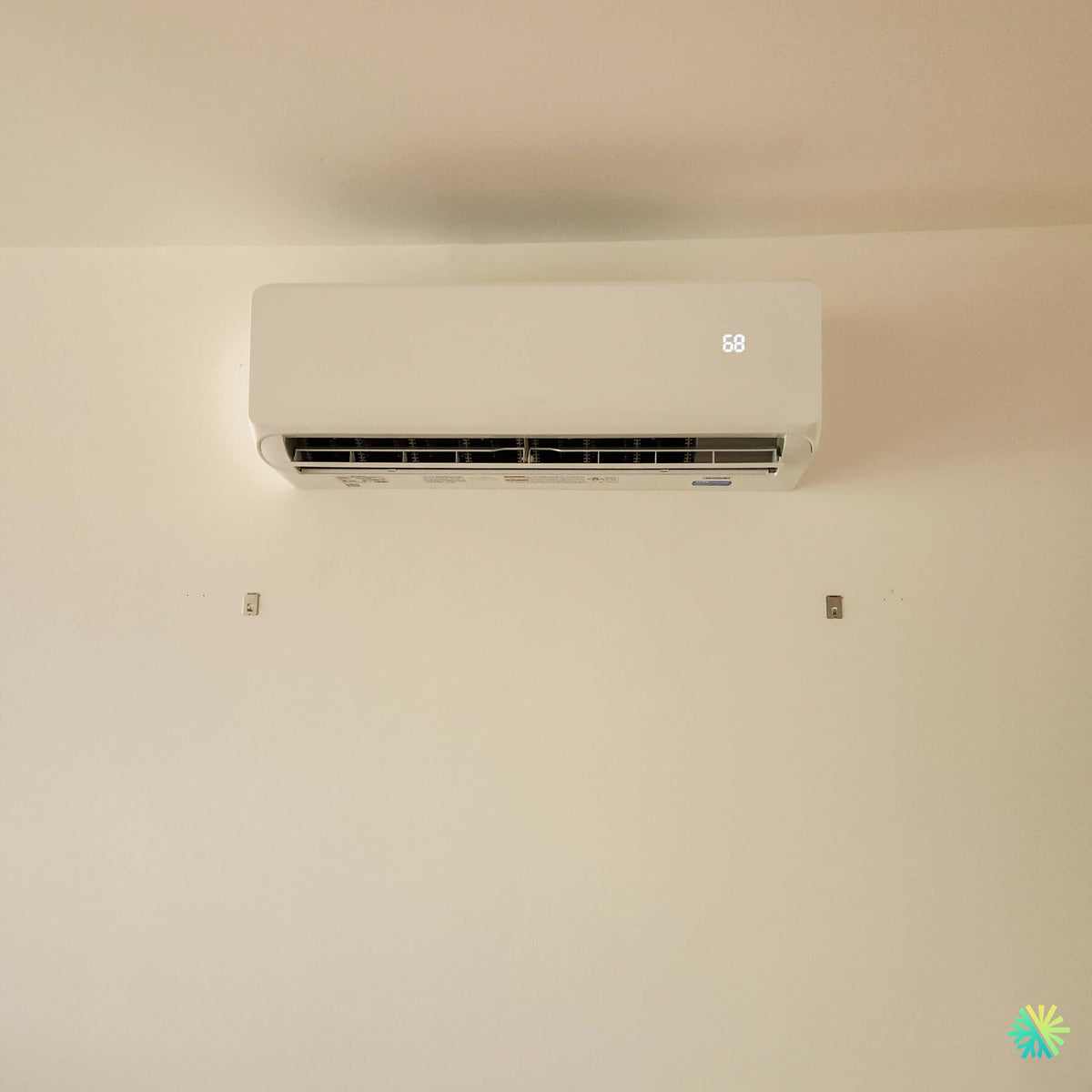
The photo our technicians took at the end of the project in La Présentation shows little: a beige wall, a white wall-mounted head, and three glowing digits — 68. For the homeowner, that number marked the end of six summers spent dragging a portable air conditioner from one room to another. For us, it confirmed that the load calculation, unit positioning, and balancing of the two zones had been done correctly.
What this photo does not show is precisely the subject of this article: the decisions made before drilling the first hole.
La Présentation: A Unique Heating Context in Montérégie
Located in the MRC des Maskoutains, a few minutes from Saint-Hyacinthe, La Présentation, like several rural municipalities on the South Shore, has a reality we rarely encounter in Montreal: its residential housing stock still combines oil- and propane-fired systems with first-generation electric baseboard heaters. Homes there are often larger and more exposed to the wind, and homeowners think in terms of full-season costs rather than occasional comfort.
The building in question: a single-story home with a finished basement, electric heating, and no forced-air ventilation. Two clear needs.
- The open-concept main floor — kitchen, dining room, and living room — had no air conditioning at all.
- The master bedroom, thermally isolated from the rest by a hallway and a door, was consistently uncomfortable at night.
The wall chosen for the first head had a history: two metal anchors from an old piece of furniture were still there, visible in the photo. The homeowner was hesitant to drill more holes. This kind of seemingly cosmetic detail actually guides the entire design of a wall-mounted HVAC installation.
Why Choose the GREE Freematch R32 GWHD(18)ND6MO
We selected the GWHD(18)ND6MO configuration, the outdoor unit of the Freematch R32 system designed to accommodate exactly two indoor units.
Outdoor Unit Technical Specifications
| Data | Value |
|---|---|
| Rated cooling capacity | 18,000 BTU/h (5,275 W), modulation from 7,300 to 19,800 BTU/h |
| Rated heating capacity | 18,000 BTU/h, modulation from 7,300 to 18,100 BTU/h |
| SEER2 | 21 |
| HSPF2 | 10 |
| EER2 | 12,5 — COP 3.9 |
| Minimum operating temperature in heating mode | -30 °C |
| Refrigerant | R32, factory charge 900 g |
| Airflow | 1,354 ft³/min |
| Sound pressure | 54 dB(A) |
| Electrical | 208/230 V — MCA 14.5 A — maximum protection 20 A |
| Dimensions | 822 × 550 × 352 mm — 35.5 kg |
| Included piping length | 10 m — maximum total 40 m |
| Certifications | ENERGY STAR, AHRI, cold-climate certification |
| Warranty | 10 years + 2 years on the compressor and parts, upon registration |
Why this model instead of the 24,000 BTU model
This is a question we are often asked, and the answer contradicts the intuition of many homeowners: bigger is not better.
The home's heating and cooling load calculation indicated a peak cooling demand of approximately 15,000 BTU/h for the two zones combined. Choosing a 24,000 BTU/h compressor would have meant operating the unit constantly below its optimal range, with three concrete consequences:
- Insufficient dehumidification. An oversized compressor reaches the temperature setpoint too quickly and stops before it has removed the humidity. The result is a room at 21 °C that still feels damp.
- Accelerated wear caused by an increase in short cycles.
- A higher purchase cost for lower actual efficiency.
The GWHD(18)ND6MO modulates from 7,300 to 19,800 BTU/h. This range covers both the cool nights of May and the July heat wave without ever operating in on-off mode.
The positioning of wall-mounted units: the most underestimated decision
The living room unit
We installed it on the interior wall, approximately 2.25 m above the floor, with 15 cm of clearance below the ceiling—the minimum required by GREE so that the air intake at the top is not restricted.
Two common mistakes were avoided here.
Never install a wall-mounted unit above a sofa or bed if the cold air jet falls directly onto the occupants. Perceived comfort has nothing to do with the measured temperature: a 15 °C draft on the back of the neck at 2 a.m. will reduce customer satisfaction much faster than a one-degree difference on the thermostat. We positioned the unit so that the airflow follows the ceiling and naturally descends at the far end of the room.
Never place a head facing a localized heat source—stove, fireplace, or large-screen television. The temperature sensor built into the unit would read an inaccurate value and cause the compressor to run unnecessarily.
The condensate drain, by gravity, without exception
A wall-mounted head produces several litres of condensate per day during peak season. We established a continuous slope of at least 2% toward the outside along the entire length of the drain, with no reverse slope or low spots.
We systematically refuse to use a condensate pump when gravity drainage is feasible. A pump is one more mechanical component, powered and liable to fail—and when it does, water runs down the living-room wall. On this project, the configuration allowed gravity drainage for both heads.
Routing the refrigerant lines
The refrigerant lines—1/4 in. liquid and 3/8 in. gas—were routed through a decorative enclosure along the exterior wall, then through the crawl space to reach the second head. No exposed lines inside the living spaces.
A technical point that few contractors explain to clients: the GWHD(18)ND6MO comes precharged for 10 metres of piping, no more. Beyond that, R32 must be added at a rate of 20 g per additional metre. Our total length reached 17 metres combined for the two branches, so we weighed and added the supplementary charge using an electronic scale; the amount was recorded on the commissioning sheet.
An installation whose charge has not been adjusted to the actual length will operate. Poorly. And the performance difference, around 10 to 15%, is not visible on any display—only on the electricity bill.
Commissioning and results
The protocol applied in La Présentation, identical to that used on all our projects in Montréal, Laval, Longueuil, the North Shore, and the South Shore:
- Dry nitrogen pressure test, with pressure-hold verification.
- Evacuation to below 500 microns, with a vacuum gauge isolation test.
- Measured refrigerant charge added according to the measured length.
- Air temperature readings at the return and supply, on both indoor heads.
- Verification of the compressor's actual amperage against the MCA.
- Training the client on the remote control, operating modes, and filter cleaning.
Project duration: one full day, two technicians.
The bedroom's night mode was programmed to 20 °C with minimum fan speed — the indoor head then emits noticeably less than the outdoor unit's nominal 54 dB(A), below which a sleeper no longer perceives the appliance.
Rebates and eligibility
The Freematch R32 is ENERGY STAR certified and covered by AHRI numbers for each configuration. For an electrically heated residence in Montérégie, the heat pump component of the Hydro-Québec LogisVert program generally applies.
The checks we perform before signing a contract:
- Exact match of the AHRI number for the installed outdoor/indoor combination with the current eligible list.
- Type of heating replaced or supplemented — the amounts differ depending on whether the home used oil, propane, or electricity.
- Compliance with the submission deadline after commissioning.
- Valid RBQ licence for the contractor, a standard eligibility requirement.
The parameters of these programs change from year to year. We verify eligibility when the quote is prepared, never based on a brochure from the previous year.
Our approach in Montérégie and Greater Montreal
At AirGreen, we install multi-zone wall-mounted heat pumps in very different settings: downtown condos where the outdoor unit must fit on a two-metre balcony, homes in Blainville and Terrebonne on the North Shore, bungalows in Brossard and Saint-Bruno, and rural residences such as the one in La Présentation, where the challenge is no longer space but piping distance and exposure to wind.
What remains constant: performing a load calculation before choosing the model, adjusting the refrigerant charge to the actual line length, and ensuring the drain flows in the right direction.
For an assessment of your heat pump, wall-mounted air conditioner, or HVAC maintenance project, our team serves the entire Greater Montreal, Montérégie, and Laurentians regions.
The job tools
Two quick checks with real numbers: what heat costs, and what your current heaters add up to in BTU/h.
Conversion: 1 W = 3.412 BTU/h. An indication, not a load calculation: baseboards and furnaces are often stronger than the real need, and they can stay as backup. AirGreen confirms the capacity on site.
How the job unfolds
The main steps of this kind of job at AirGreen. Every house has its quirks: the estimate brings them out.
We look at the room, the outside wall, the line route and where the outdoor unit will go. That is where the capacity gets chosen.
Model, capacity and price, in writing. We also check whether the model qualifies for assistance programs.
Floors and furniture protected, wall plate position marked level, wall opening located.
A single opening, with the slope the drain needs to flow outside.
Set on a stand raised above the snow, with the clearances the manufacturer requires.
Connected, insulated and protected. The opening is then sealed against water, cold air and insects.
A dedicated circuit and an accessible disconnect near the outdoor unit.
Leak test, vacuum, then start-up and a check of heating and cooling.
Remote, modes, filters: we show you the essentials before we leave.
- The on-site estimateWe look at the room, the outside wall, the line route and where the outdoor unit will go. That is where the capacity gets chosen.
- The quoteModel, capacity and price, in writing. We also check whether the model qualifies for assistance programs.
- Getting readyFloors and furniture protected, wall plate position marked level, wall opening located.
- The wall openingA single opening, with the slope the drain needs to flow outside.
- The outdoor unitSet on a stand raised above the snow, with the clearances the manufacturer requires.
- Lines, cable and drainConnected, insulated and protected. The opening is then sealed against water, cold air and insects.
- The electrical workA dedicated circuit and an accessible disconnect near the outdoor unit.
- Tests and start-upLeak test, vacuum, then start-up and a check of heating and cooling.
- The walkthroughRemote, modes, filters: we show you the essentials before we leave.
What we check on a job like this one
Each number is a point we check on site. Switch between summer and winter to watch air and heat move.
In summer, the outdoor unit rejects the house's heat outside.
Generic illustration of this type of installation, not a survey of this job site. Tap a number.
Mounted level on a wall plate, high enough for the air to reach the whole room, with enough space around it to slide the filters out easily.
The refrigerant lines, the communication cable and the drain go through the wall in a single opening, sealed against water, cold air and insects.
Two insulated copper pipes connect the two units. Outside, a line cover can protect them from sun, knocks and weather.
A shut-off switch near the outdoor unit isolates it safely for service. It must stay accessible at all times.
The compressor and the fan. In heating mode it captures heat from the outdoor air, even in winter, and moves it inside.
On the ground or on the wall, it keeps the unit above accumulated snow. The unit stays clear and defrost water can drain away.
The fan needs to blow freely. Storage, a fence or a wall too close, and efficiency drops while noise goes up.
Is your home ready?
Check what applies at your place. A "no" is not a refusal: it is what we sort out during the estimate.
Good habits, once the unit is in place
Six simple habits that keep the unit going. Your list stays on this device.
What to do, season by season
Three habits per season for this unit. They take a few minutes and prevent many calls.
- Clean the indoor unit's filters.
- Clear leaves and debris left on the outdoor unit by winter.
- Test cooling before the first hot days.
- Clean the filters more often when the unit runs a lot.
- Keep plants away from the outdoor unit.
- Check that no water drips from the indoor unit.
- Rake the leaves around the outdoor unit.
- Test heating before the first cold days.
- Book periodic maintenance before winter.
- Keep snow away from the stand and the front of the unit.
- Let the unit defrost: it is normal.
- Never hit the ice on the fins; call us if the unit stays iced up.
The right pages, at the right time
Four statements: true or false?
It all comes down to details you have just seen.
1. In heating mode, the outdoor unit can produce water.
During defrost cycles. That water must drain away without forming ice.
2. You pick the capacity with a simple square-footage rule.
Windows, insulation, orientation and how the room is used all count. Capacity is chosen on site.
3. A multi-zone connects several indoor heads to a single condenser.
One head per room, all on the same condenser. Each room keeps its own temperature.
4. The disconnect can sit behind the patio furniture.
It must stay accessible: it is what shuts the unit off for service.
0 / 4 right answers
What people ask us about this kind of work
Does a wall-mounted heat pump heat in winter?
Wall-mounted or multi-zone: how do I choose?
Where does the outdoor unit go?
Are there grants?
Do I need a permit?
How cold can it heat?
How much can I save?
How is the LogisVert assistance calculated?
Is it noisy?
The outdoor unit is covered in ice: is that normal?
Does AirGreen hold the required licences?
Is the estimate free?
No question matches. Write to us: we answer.
More jobs to see, near you
By town, by equipment or by region: browse more than 4,700 published projects.
Each dot: a town where AirGreen has published projects. The glowing dot: this job.
An on-site estimate, the right capacity, the right equipment.
The on-site estimate is free and the quote follows within 24 hours.
Text and photo: a real AirGreen Climatisation & Chauffage job. The diagrams are generic illustrations of the type of installation, not a survey of this job site. Sources of the added figures: airgreen.ca product pages (NEEP / AHRI performance), Hydro-Québec (Heat pumps page, LogisVert, read on 13 October 2026), Régie de l’énergie (rate D as of 1 April 2026).