
Installation of a Mitsubishi Electric Hyper Heat wall-mounted heat pump in Saint-Léonard
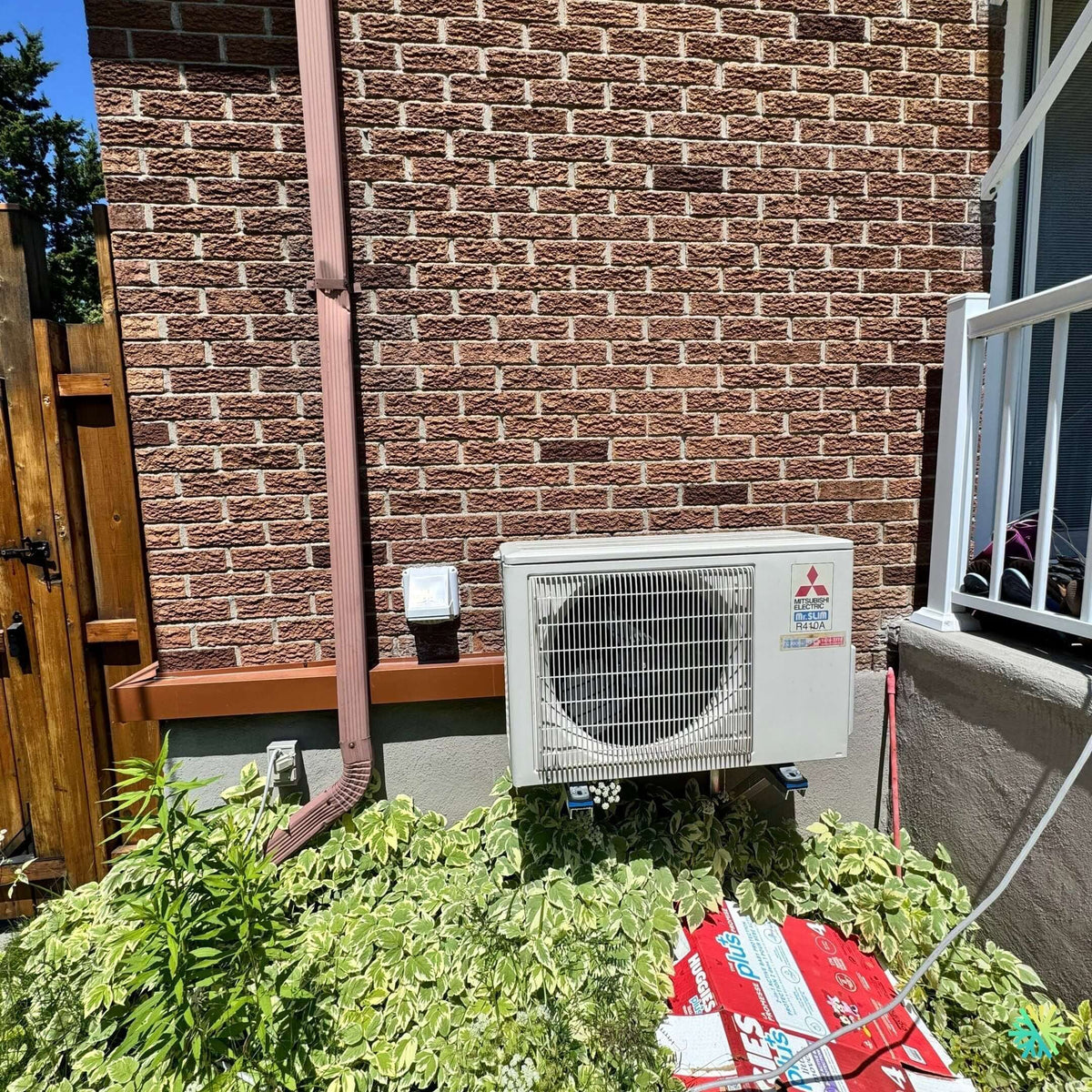
AirGreen installs a Mitsubishi Electric Hyper Heat wall-mounted heat pump in Saint-Léonard: raised supports, short connections, dedicated disconnect switch and reliable performance for Montreal, Laval, Longueuil, North Shore and South Shore.
In summer, the outdoor unit rejects the house's heat outside.
Generic illustration of this type of installation, not a survey of this job site. Tap a number.
Mounted level on a wall plate, high enough for the air to reach the whole room, with enough space around it to slide the filters out easily.
The refrigerant lines, the communication cable and the drain go through the wall in a single opening, sealed against water, cold air and insects.
Two insulated copper pipes connect the two units. Outside, a line cover can protect them from sun, knocks and weather.
A shut-off switch near the outdoor unit isolates it safely for service. It must stay accessible at all times.
The compressor and the fan. In heating mode it captures heat from the outdoor air, even in winter, and moves it inside.
On the ground or on the wall, it keeps the unit above accumulated snow. The unit stays clear and defrost water can drain away.
The fan needs to blow freely. Storage, a fence or a wall too close, and efficiency drops while noise goes up.
An exemplary outdoor installation for reliable heating down to -25°C
At AirGreen , we specialize in wall-mounted heat pump installations in residential areas of Montreal . This project, carried out in Saint-Léonard , highlights the careful integration of a Mitsubishi Electric – Hyper Heat range to provide four-season comfort while protecting the equipment from local climatic hazards.
The context: a brick house with clear needs
The residence is a brick bungalow with a side driveway and small garden. The owners wanted to replace an energy-intensive portable air conditioner with an HVAC solution that efficiently heats most of the ground floor in the heart of Montreal's winter, while quietly cooling it in the summer. They were looking for a unit known for its reliable low-temperature heating performance and eligible for subsidies .
Why Mitsubishi Electric (Hyper Heat)
-
Stable heating down to around −25°C , ideal for periods of prolonged cold in the east of the island.
-
Energy Star efficiency and inverter modulation to reduce power consumption.
-
Quiet operation and proven durability of the Mr. Slim/Hyper Heat family units.
-
Accessible components for maintenance, a key point to preserve the warranty and longevity.
Installation process: precision, safety and aesthetics
Choosing and preparing the outdoor location
We positioned the condenser on the brick side wall, protected from wind-blown snow accumulations. The unit is raised on wall brackets with anti-vibration pads, keeping the frame above the snow line and freeing up floor space for frost drainage in defrost mode. This elevation also improves air convection around the unit, which promotes heating efficiency.
Key points of the implementation:
-
Clearances respected around the exchanger for air intake/discharge.
-
Optimized height for maintenance and protection against debris.
-
Orientation avoiding direct wind towards the neighboring covered terrace.
Short and clean refrigeration lines
The drilling was carried out through the brick to the living area , for a reduced line length (approximately 2–3 m between heads and condenser), limiting pressure losses and maximizing efficiency. The insulated refrigerant pipes , the communication cable and the condensate drain are grouped in a discreet external capping , guaranteeing a clean and durable finish against UV. Internally, the wall unit is positioned to project the air along the main circulation area.
Dedicated power supply and security
A non-fusible outdoor disconnect switch was installed in close proximity to the unit, as required by code. The circuit has a dedicated breaker at the main panel. The conduits are sealed and neatly secured along the brick wall for mechanical strength and clear readings during inspections. This rigor facilitates future diagnostics and contributes to the overall reliability of the system.
Condensate management in heating and air conditioning mode
In summer, the condensate from the indoor head drains by gravity to the outside via the integrated drain. In winter, defrosting the condenser generates water that must flow freely under the unit : we have provided a drainage area clear of plants and construction materials, in order to prevent the formation of harmful ice under the base.
Site features and AirGreen solutions
Brick wall and existing elements
The side facade has a downspout and a terrace border. We have:
-
Move the unit away from the downspout to prevent water from being sprayed onto the condenser.
-
Laser-calibrated bracket/disconnector/capping assembly for a continuous visual line and simplified maintenance.
-
Offered the customer seasonal maintenance to check the fixings in the brick and the condition of the anchors.
Vegetation at the foot of the wall
The dense bed beneath the unit has been thinned out along the drain to prevent air obstruction and moisture retention. We recommend keeping 60–90 cm clear around the base during the winter.
Noise and vibration management
In addition to the anti-vibration pads , the elevation on brackets limits transmission to the ground. The Mitsubishi Electric turbine and inverter compressor are particularly quiet ; the positioning was also chosen to preserve auditory comfort on the adjacent terrace.
Commissioning and quality controls
Waterproofing and charging
-
Nitrogen test then deep vacuum with micronmeter to validate the tightness and dehumidification of the circuit.
-
Opening of valves and checking of parameters (temperatures, currents, superheating/subcooling) to ensure optimal performance according to the actual length of lines.
User settings
-
Configuration of diffusion flaps to push air along the aisles and limit blowing towards the seating areas.
-
Explanation of modes (Auto/Heating/Cooling/Dehumidification), basic HVAC maintenance (cleaning interior filters, visual inspection of capping, snow removal) and best practices for saving energy.
Results: tangible comfort and energy efficiency
From the first tests, the house benefits from rapid and uniform cooling . In heating, the Inverter modulation maintains a stable temperature while reducing on/off cycles. The owners note a decrease in noise compared to their previous equipment and appreciate the responsiveness of the unit during weather variations. On the bill, the combined effect of the high SEER2/HSPF2 and the right power is synonymous with energy savings .
AirGreen Tips for Brick Homes in East Montreal
Good practices to remember
-
Elevate the condenser and ensure free drainage for the defrost period.
-
Maintain sufficient plant clearance around the appliance.
-
Provide an accessible disconnect switch and dedicated power supply for safety and compliance.
-
Schedule annual maintenance : cleaning the external exchanger, checking connections, verifying pressures/parameters.
Grants and Eligibility
Mitsubishi Electric Hyper Heat's high-performance wall-mounted heat pumps are generally eligible for grant programs when they meet Energy Star efficiency and low-temperature performance criteria. We assist our customers in Montreal, Laval, Longueuil, the North Shore, and the South Shore to prepare applications, verify AHRI numbers, and maximize available grants.
What this installation demonstrates about AirGreen expertise
-
Reading of the site : harmonious integration on brick wall with constraints of downspout and terrace.
-
Durable finish : UV capping, anchors suitable for masonry, robust supports.
-
Targeted performance : short lines, rigorous commissioning, usage advice for 4-season comfort .
We operate weekly in the east end of the island, in Saint-Léonard, Anjou, Saint-Michel and Montréal-Nord , as well as throughout Greater Montreal . Our goal: to deliver a HVAC system that lasts, is easy to maintain and is ready for Quebec winters.
How it goes, from the first call to the end
The main steps of this kind of job at AirGreen. Every house has its quirks: the estimate brings them out.
We look at the room, the outside wall, the line route and where the outdoor unit will go. That is where the capacity gets chosen.
Model, capacity and price, in writing. We also check whether the model qualifies for assistance programs.
Floors and furniture protected, wall plate position marked level, wall opening located.
A single opening, with the slope the drain needs to flow outside.
Set on a stand raised above the snow, with the clearances the manufacturer requires.
Connected, insulated and protected. The opening is then sealed against water, cold air and insects.
A dedicated circuit and an accessible disconnect near the outdoor unit.
Leak test, vacuum, then start-up and a check of heating and cooling.
Remote, modes, filters: we show you the essentials before we leave.
- The on-site estimateWe look at the room, the outside wall, the line route and where the outdoor unit will go. That is where the capacity gets chosen.
- The quoteModel, capacity and price, in writing. We also check whether the model qualifies for assistance programs.
- Getting readyFloors and furniture protected, wall plate position marked level, wall opening located.
- The wall openingA single opening, with the slope the drain needs to flow outside.
- The outdoor unitSet on a stand raised above the snow, with the clearances the manufacturer requires.
- Lines, cable and drainConnected, insulated and protected. The opening is then sealed against water, cold air and insects.
- The electrical workA dedicated circuit and an accessible disconnect near the outdoor unit.
- Tests and start-upLeak test, vacuum, then start-up and a check of heating and cooling.
- The walkthroughRemote, modes, filters: we show you the essentials before we leave.
And at your place?
Two quick checks with real numbers: what heat costs, and what your current heaters add up to in BTU/h.
Conversion: 1 W = 3.412 BTU/h. An indication, not a load calculation: baseboards and furnaces are often stronger than the real need, and they can stay as backup. AirGreen confirms the capacity on site.
What to do, season by season
Three habits per season for this unit. They take a few minutes and prevent many calls.
- Clean the indoor unit's filters.
- Clear leaves and debris left on the outdoor unit by winter.
- Test cooling before the first hot days.
- Clean the filters more often when the unit runs a lot.
- Keep plants away from the outdoor unit.
- Check that no water drips from the indoor unit.
- Rake the leaves around the outdoor unit.
- Test heating before the first cold days.
- Book periodic maintenance before winter.
- Keep snow away from the stand and the front of the unit.
- Let the unit defrost: it is normal.
- Never hit the ice on the fins; call us if the unit stays iced up.
Which type of equipment for your project?
Pick what looks like your need.
Four mistakes we do not make
Flip each card to see what we do instead.
What people ask us about this kind of work
Does a wall-mounted heat pump heat in winter?
Wall-mounted or multi-zone: how do I choose?
Where does the outdoor unit go?
Are there grants?
Do I need a permit?
How cold can it heat?
How much can I save?
How is the LogisVert assistance calculated?
Is it noisy?
The outdoor unit is covered in ice: is that normal?
Does AirGreen hold the required licences?
Is the estimate free?
No question matches. Write to us: we answer.
Useful pages for what comes next
More jobs to see, near you
By town, by equipment or by region: browse more than 4,700 published projects.
Each dot: a town where AirGreen has published projects. The glowing dot: this job.
Tell us about your house. We come and see it for free.
The on-site estimate is free and the quote follows within 24 hours.
Text and photo: a real AirGreen Climatisation & Chauffage job. The diagrams are generic illustrations of the type of installation, not a survey of this job site. Sources of the added figures: airgreen.ca product pages (NEEP / AHRI performance), Hydro-Québec (Heat pumps page, LogisVert, read on 13 October 2026), Régie de l’énergie (rate D as of 1 April 2026).