
Installation of a Sharp ZU1 series wall-mounted heat pump in the Southwest (Montreal)
Sharp ZU1 series wall-mounted heat pump installed in the Southwest (Montreal) : 12,000 BTU sizing, sloped drilling, neat finishes, quiet comfort and energy savings. AirGreen, HVAC experts Greater Montreal.
Take a tour of the installation
Each number is a point we check on site. Switch between summer and winter to watch air and heat move.
In summer, the outdoor unit rejects the house's heat outside.
Generic illustration of this type of installation, not a survey of this job site. Tap a number.
Mounted level on a wall plate, high enough for the air to reach the whole room, with enough space around it to slide the filters out easily.
The refrigerant lines, the communication cable and the drain go through the wall in a single opening, sealed against water, cold air and insects.
Two insulated copper pipes connect the two units. Outside, a line cover can protect them from sun, knocks and weather.
A shut-off switch near the outdoor unit isolates it safely for service. It must stay accessible at all times.
The compressor and the fan. In heating mode it captures heat from the outdoor air, even in winter, and moves it inside.
On the ground or on the wall, it keeps the unit above accumulated snow. The unit stays clear and defrost water can drain away.
The fan needs to blow freely. Storage, a fence or a wall too close, and efficiency drops while noise goes up.
Discreet and efficient four-season comfort for a concrete slab condo
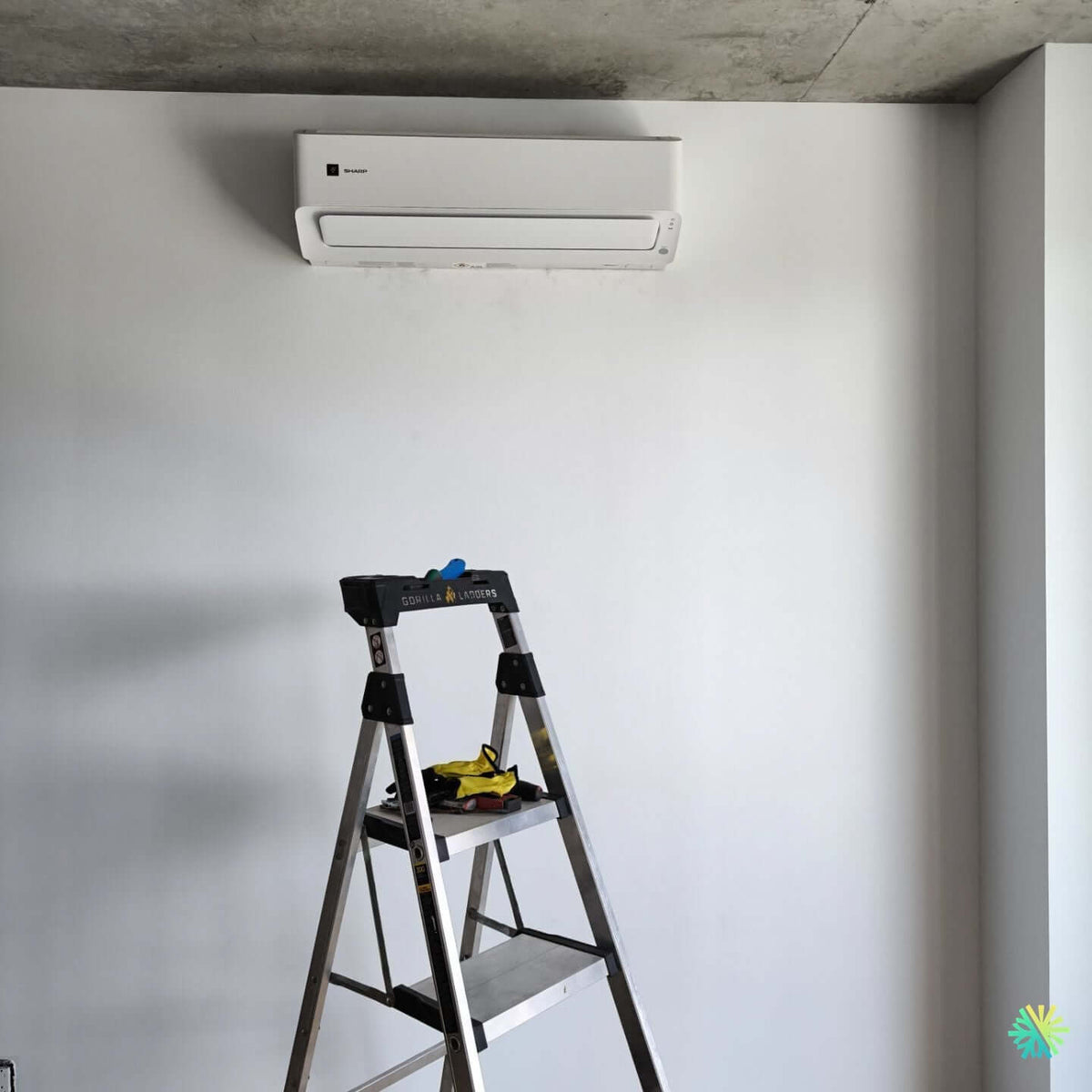
In a condo in Southwest Montreal , our team is installing a Sharp ZU1 series wall-mounted heat pump to provide stable, quiet, and economical heating and cooling . The indoor unit is integrated under the exposed concrete ceiling slab, perfectly centered on a smooth wall for even air distribution throughout the open living area. This project illustrates our approach: precise sizing , clean installation , compliance with HVAC standards, and discreet finishes—all designed for the unique characteristics of Montreal condos.
Client context and objectives
The owner wanted:
-
keep a constant temperature all year round without drying out the air;
-
reduce your energy bill in the face of heat waves and cold nights in the off-season;
-
maintain a minimalist aesthetic (no visible ducts, quick maintenance);
-
benefit from a device compatible with current grant programs when eligible.
After calculating the thermal load (surface area, orientation, glazing, airtightness), we selected a 12,000 BTU configuration from the ZU1 series —a consistent size for a well-insulated condo living area. This power ensures rapid temperature increases , fine modulation in mid-season, and sufficient reserve during harsher episodes.
Why the Sharp ZU1 series for a condo in Montreal?
Next-generation efficiency and refrigerant
The ZU1 series operates with a new generation refrigerant and wide modulation range inverter technology . The result: long and stable cycles, fewer jolts and therefore less noise and lower consumption . For urban housing, this is ideal: it avoids temperature variations and maintains exemplary acoustic comfort .
Air quality and comfort
Sharp is renowned for its careful air treatment (large-surface washable filters, advanced sanitation functions). In an open-plan room, this guarantees gentle blowing , even distribution and the reduction of stagnation zones. Intelligent defrosting and fine-tuned fan control prevent cold drafts in winter: a real plus for perceived comfort .
Potential Grant Eligibility
High-efficiency wall-mounted heat pumps are generally eligible for provincial/federal assistance— subject to performance, power, and installation conditions . We assist our clients in verifying the actual eligibility of the chosen configuration (programs applicable in Montreal, Laval, Longueuil, North Shore, South Shore ), preparing the documents (detailed invoices, product numbers), and submitting the application at the right time.
Our condo HVAC installation methodology
1) Positioning of the inner head
-
Optimized height under concrete slab: it promotes controlled stratification and efficient mixing without direct blowing onto the occupants.
-
Clearances respected for maintenance (opening the hood, cleaning the filters) and for air sweeping free of any obstacles.
2) Drilling and crossing
-
Creation of a single, slightly outwardly sloping hole for gravity management of condensates when the configuration allows.
-
Use of a waterproof sleeve and vapor barrier sealant to preserve the building envelope and eliminate parasitic air inlets.
3) Refrigerant lines and wiring
-
Copper connections insulated according to the rules of the art, bent without constraint.
-
Communication and power cables routed neatly, with markings for any future work.
-
Verification of equivalent length and elevation to remain within the tolerances of the ZU1 series (guarantee of compressor performance and durability).
4) Condensate management
-
Continuous slope validated; if the route requires an ascent, we install a silent condensate pump with a service hatch. Here, the configuration allows for gravity flow —synonymous with maximum reliability and silence .
5) Commissioning and balancing
-
Deep vacuum with micron meter until stabilization.
-
Leak testing , superheat/subcooling measurements , and control of blowing temperatures at different levels.
-
Automatic scanning setting and demonstration of modes (heating, cooling, dehumidification, auto).
Salient details of the construction site
-
Context : urban condo in Montreal – Southwest , exposed concrete ceiling, smooth painted walls.
-
Working height : secured via stepladder, surface protection.
-
Finishes : discreet routing, minimalist interior facade restored after installation, clear visuals without visible cables.
-
Acoustics : fixing on a support adapted to the substrate (gypsum/frame) with appropriate anchors, reducing the transmission of vibrations.
Result: comfort, energy efficiency and preserved aesthetics
Upon startup, the temperature stabilizes quickly. In air conditioning mode, laminar airflow prevents unpleasant drafts. In heating mode, modulation maintains constant comfort while limiting electrical consumption. The system visually blends into the contemporary aesthetic of the home.
AirGreen Recommended HVAC Maintenance
To maintain performance:
-
Filters : rinse every 4 to 8 weeks (more frequently if there are animals or construction dust).
-
Exchanger : annual inspection, professional dust removal if there is accumulation.
-
Condensates : check the slope and discharge point before summer; clean the tank.
-
Outdoor unit (when accessible): 30–60 cm clearance all around, snow removal in winter, anti-vibration supports in good condition.
-
Remote control : update schedules and “eco” temperatures according to your habits.
We offer modular HVAC maintenance plans , tailored to condos and homes on the North Shore , South Shore , Laval and Montreal .
Pitfalls to avoid (feedback from the field)
-
Undersizing or oversizing the device: both affect comfort and bills. Load calculation is not optional.
-
Drilling without slope : source of odors and overflows; always ensure drainage .
-
Unsuitable fixings on lightweight walls: vibrations and noise. Use appropriate anchors and load distribution .
-
Lack of controlled vacuum draw : a summary draw degrades the oil and shortens the life of the compressor.
-
Neglected maintenance : Clogged filters reduce efficiency and increase consumption.
Usage tips for optimal comfort
-
Single continuous setting (rather than on/off) to let the Inverter work.
-
Blades oriented slightly towards the ceiling in air conditioning to allow fresh air to fall naturally.
-
Dehumidification mode for hot days: improves the feeling without overcooling.
-
Program eco-slots on days when you are away, with no more than a 2–3°C difference to avoid energy-consuming restarts.
AirGreen: a local team, clean and guaranteed facilities
We operate weekly in Montreal, Laval, Longueuil, North Shore and South Shore . Our signature: detailed quotes, grant procedures when eligible, careful HVAC installation and responsive after-sales service . For a condo, a plex or a house, the Sharp wall-mounted heat pump – ZU1 series is a safe bet when it is properly sized and properly installed .
Project sheet (summary)
-
Type : mono-split wall-mounted heat pump
-
Brand : Sharp , ZU1 series
-
Indicative power : 12,000 BTU (after load calculation)
-
Context : condo – Southwest (Montreal) , concrete ceiling, high installation
-
Key points : sloping drilling, isolated lines, controlled vacuum, discreet finish, acoustic comfort
Need a free assessment? We will visit your site, perform a load calculation , validate the feasibility (routing, evacuations, electricity) and provide you with a clear proposal with maintenance options.
Keywords : heat pump , HVAC installation , wall-mounted air conditioner , Montreal , Laval , Longueuil , North Shore , South Shore , Sharp ZU1 series , condo , energy efficiency , HVAC maintenance .
The unit on this job, in figures
The range as published on airgreen.ca: pick a size to see its capacity in deep cold.
| Size | Heating at −8 °C | Heating at −15 °C | Coldest certified point | COP at −15 °C | SEER | HSPF | Indicative LogisVert aid |
|---|---|---|---|---|---|---|---|
| Sharp ZU1 12 000 | 14,500 | 12,000 | −27 °C: 7,200 | 2.11 | 22.0 | 11.0 | $1,740 |
| Sharp ZU1 15 000 | 18,100 | 15,300 | −27 °C: 10,100 | 2.1 | 24.0 | 11.0 | $2,172 |
| Sharp ZU1 18 000 | 22,000 | 18,000 | −27 °C: 11,500 | 2.2 | 24.0 | 11.0 | $2,640 |
| Sharp ZU1 24 000 | 22,400 | 19,000 | −27 °C: 12,300 | 2.2 | 22.0 | 11.0 | $2,688 |
According to NEEP, it delivers 14,500 BTU/h at −8 °C (17 °F), more than at 8 °C (14,000 BTU/h). It heats as hard in moderate cold as in mild weather.
According to NEEP, its certified maximum capacity at −27 °C (−17 °F) is 7,200 BTU/h, 60% of its nominal 12,000 BTU size.
At 8 °C, its certified maximum capacity reaches 17,100 BTU/h, 42% more than its nominal 12,000 BTU size.
According to NEEP, it delivers 18,100 BTU/h at −8 °C (17 °F), more than at 8 °C (18,000 BTU/h). It heats as hard in moderate cold as in mild weather.
According to NEEP, its certified maximum capacity at −27 °C (−17 °F) is 10,100 BTU/h, 67% of its nominal 15,000 BTU size.
At 8 °C, its certified maximum capacity reaches 21,800 BTU/h, 45% more than its nominal 15,000 BTU size.
According to NEEP, it delivers 22,000 BTU/h at −8 °C (17 °F), more than at 8 °C (21,600 BTU/h). It heats as hard in moderate cold as in mild weather.
According to NEEP, its COP at −27 °C is 1.88: the highest of the ZU1 line, which ranges from 1.79 to 1.82 at that temperature.
According to NEEP, its certified maximum capacity at −27 °C (−17 °F) is 11,500 BTU/h, 64% of its nominal 18,000 BTU size.
At −27 °C, its certified minimum capacity is 3,200 BTU/h (5,500 at 8 °C). It slows down instead of cycling on and off.
According to NEEP, its certified heating capacity at −15 °C (5 °F) is 19,000 BTU/h, 79% of its nominal 24,000 BTU size. Its COP there is 2.20.
Data read live from the airgreen.ca page of each size (NEEP / AHRI certified performance). When the title names the installed size, it is highlighted; otherwise the whole range is shown. The aid shown is today’s, using Hydro-Québec’s rule ($120 per 1,000 BTU/h at −8 °C); amounts quoted in the article date from its publication. Only Hydro-Québec confirms the assistance granted.
The big day, step by step
The main steps of this kind of job at AirGreen. Every house has its quirks: the estimate brings them out.
We look at the room, the outside wall, the line route and where the outdoor unit will go. That is where the capacity gets chosen.
Model, capacity and price, in writing. We also check whether the model qualifies for assistance programs.
Floors and furniture protected, wall plate position marked level, wall opening located.
A single opening, with the slope the drain needs to flow outside.
Set on a stand raised above the snow, with the clearances the manufacturer requires.
Connected, insulated and protected. The opening is then sealed against water, cold air and insects.
A dedicated circuit and an accessible disconnect near the outdoor unit.
Leak test, vacuum, then start-up and a check of heating and cooling.
Remote, modes, filters: we show you the essentials before we leave.
- The on-site estimateWe look at the room, the outside wall, the line route and where the outdoor unit will go. That is where the capacity gets chosen.
- The quoteModel, capacity and price, in writing. We also check whether the model qualifies for assistance programs.
- Getting readyFloors and furniture protected, wall plate position marked level, wall opening located.
- The wall openingA single opening, with the slope the drain needs to flow outside.
- The outdoor unitSet on a stand raised above the snow, with the clearances the manufacturer requires.
- Lines, cable and drainConnected, insulated and protected. The opening is then sealed against water, cold air and insects.
- The electrical workA dedicated circuit and an accessible disconnect near the outdoor unit.
- Tests and start-upLeak test, vacuum, then start-up and a check of heating and cooling.
- The walkthroughRemote, modes, filters: we show you the essentials before we leave.
What would it look like at your place?
Two quick checks with real numbers: what heat costs, and what your current heaters add up to in BTU/h.
Baseboards and electric furnaces turn 1 kWh of electricity into 1 kWh of heat. A heat pump delivers more: that is its COP. At Hydro-Québec’s rate D (11.142¢/kWh above 40 kWh a day, since 1 April 2026):
Hydro-Québec: a heat pump can be up to three times more efficient than baseboards for heating in the colder months.
Estimate per kWh of heat, at the chosen temperature, using the certified COP from the product page. Taxes, access charge and backup heat not included.
Conversion: 1 W = 3.412 BTU/h. An indication, not a load calculation: baseboards and furnaces are often stronger than the real need, and they can stay as backup. AirGreen confirms the capacity on site.
Four mistakes we do not make
Flip each card to see what we do instead.
Your own project, step by step
What to do, season by season
Three habits per season for this unit. They take a few minutes and prevent many calls.
- Clean the indoor unit's filters.
- Clear leaves and debris left on the outdoor unit by winter.
- Test cooling before the first hot days.
- Clean the filters more often when the unit runs a lot.
- Keep plants away from the outdoor unit.
- Check that no water drips from the indoor unit.
- Rake the leaves around the outdoor unit.
- Test heating before the first cold days.
- Book periodic maintenance before winter.
- Keep snow away from the stand and the front of the unit.
- Let the unit defrost: it is normal.
- Never hit the ice on the fins; call us if the unit stays iced up.
Is your home ready?
Check what applies at your place. A "no" is not a refusal: it is what we sort out during the estimate.
Four statements: true or false?
It all comes down to details you have just seen.
1. In heating mode, the outdoor unit can produce water.
During defrost cycles. That water must drain away without forming ice.
2. You pick the capacity with a simple square-footage rule.
Windows, insulation, orientation and how the room is used all count. Capacity is chosen on site.
3. A multi-zone connects several indoor heads to a single condenser.
One head per room, all on the same condenser. Each room keeps its own temperature.
4. The disconnect can sit behind the patio furniture.
It must stay accessible: it is what shuts the unit off for service.
0 / 4 right answers
What people ask us about this kind of work
Does a wall-mounted heat pump heat in winter?
Wall-mounted or multi-zone: how do I choose?
Where does the outdoor unit go?
Are there grants?
Do I need a permit?
How cold can it heat?
How much can I save?
How is the LogisVert assistance calculated?
Is it noisy?
The outdoor unit is covered in ice: is that normal?
Does AirGreen hold the required licences?
Is the estimate free?
No question matches. Write to us: we answer.
More jobs to see, near you
By town, by equipment or by region: browse more than 4,700 published projects.
Each dot: a town where AirGreen has published projects. The glowing dot: this job.
Every house has its constraints. We see them before we install.
The on-site estimate is free and the quote follows within 24 hours.
Text and photo: a real AirGreen Climatisation & Chauffage job. The diagrams are generic illustrations of the type of installation, not a survey of this job site. Sources of the added figures: airgreen.ca product pages (NEEP / AHRI performance), Hydro-Québec (Heat pumps page, LogisVert, read on 13 October 2026), Régie de l’énergie (rate D as of 1 April 2026).