
Installation of a Hitachi airHome 400 wall-mounted heat pump in Ahuntsic-Cartierville, Montreal
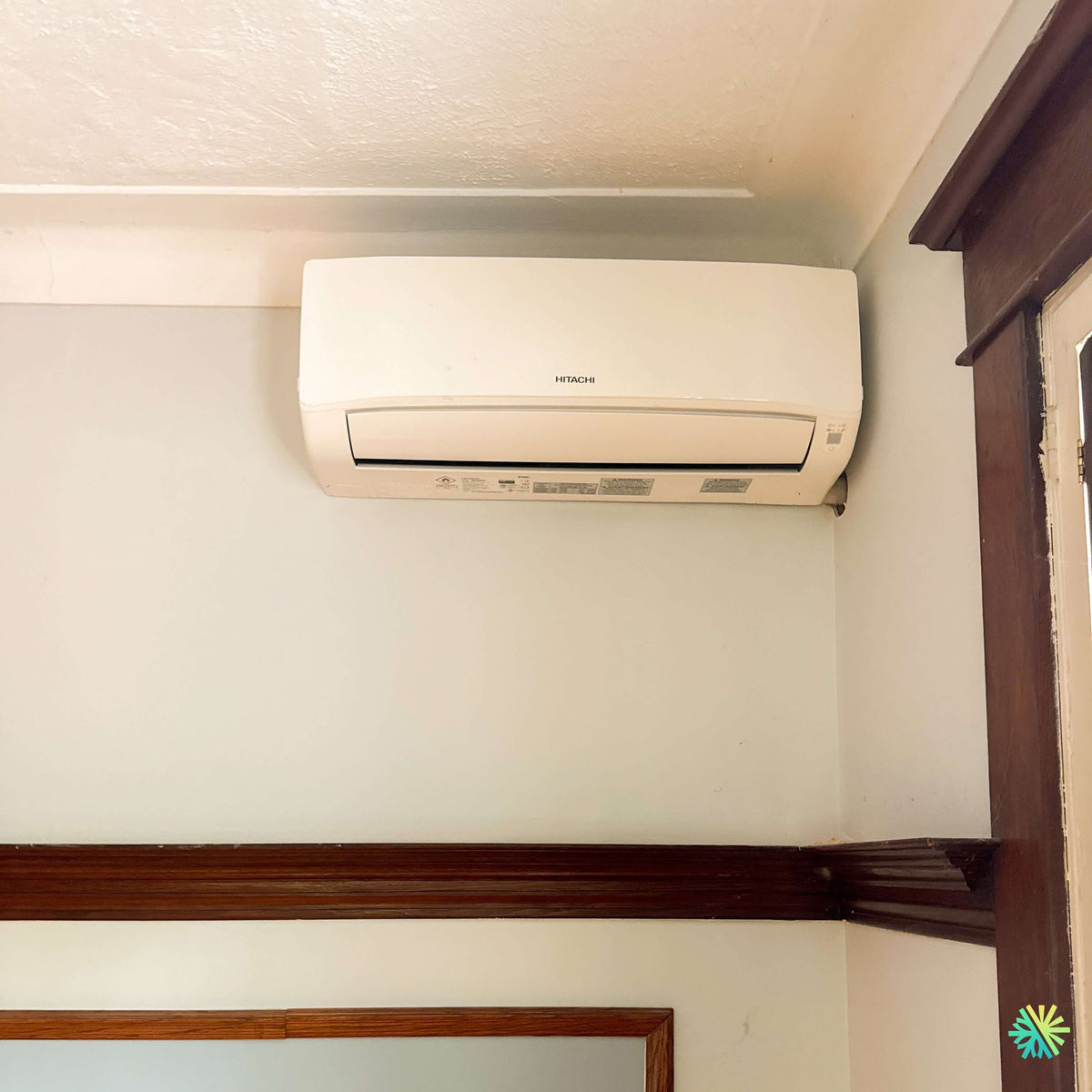
In Ahuntsic-Cartierville, AirGreen installs a Hitachi airHome 400 wall-mounted heat pump in a confined space, preserving the woodwork while optimizing airflow, drainage, and access for maintenance.
- City
- Region
- Equipment
- Brand
- Challenges
- Published
The job on one screen
The article, chapter by chapter
A Precise Installation in a Home with Distinctive Architectural Character
Installing a wall-mounted heat pump in Ahuntsic-Cartierville often requires more than simply choosing the right capacity and drilling through an exterior wall. Many properties in this part of Montreal have high ceilings, imposing door frames, solid wood moldings, and an interior layout that leaves few genuinely effective locations for distributing air.
For this project, our AirGreen team had to integrate a Hitachi airHome 400 into a room where available space was particularly limited. The indoor unit had to be positioned between the ceiling, the corner of the wall, and the dark wood door frame. The challenge was to achieve an installation that was functional, accessible for maintenance, and discreet enough not to detract from the character of the residence.
The result shows a unit installed high up, near the upper corner of the room, with the connections exiting on the right side. This arrangement frees up the walls occupied by the woodwork while promoting good air distribution throughout the living space.
Why the indoor unit’s location was critical
The actual performance of a wall-mounted air conditioner with heat pump function depends largely on its location. Even an excellent unit can provide uneven comfort when installed too low, in a recess, or directly facing an obstacle.
In this Ahuntsic-Cartierville residence, several constraints had to be considered:
- the presence of a solid wood door frame;
- the limited width available between the adjacent wall and the door;
- the proximity of the ceiling;
- the need to maintain access to the filters and internal components;
- the routing of the refrigerant lines and condensate drain;
- the direction of the airflow toward the open part of the room.
We installed the unit so that its louver could open freely and direct the air without the door frame directly obstructing the airflow. This detail is important for air conditioning, but also for heating, since warm air must be directed downward to limit its stratification near the ceiling.
An installation adapted to older homes in Montreal
In Ahuntsic-Cartierville, we regularly work in homes built well before wall-mounted HVAC systems became widespread. These buildings often have thicker walls, irregular structures, interior finishes that are difficult to replace, and line routes that must be planned carefully.
The photo of this installation clearly illustrates this type of situation. The existing wood trim is an important part of the décor. A poorly planned installation could have required cutting a molding, created a disproportionately visible conduit, or placed the unit in a less effective position simply to make the work easier.
At AirGreen, we take a different approach: we first analyze the airflow, wall structure, possible drain slope, and the visual impact of the installation. We then determine the path of the lines and the exact position of the mounting plate.
In this project, the right-side outlet allows the connections to be grouped near the adjacent wall. The passage remains compact, and the unit fits naturally above the wood trim without interrupting it.
The Hitachi airHome 400: a wall-mounted heat pump with Inverter technology
The Hitachi airHome 400 is a range of wall-mounted heat pumps available in several capacities, from 9,000 to 36,000 BTU/h. The precise capacity must always be determined based on the floor area, insulation level, number of floors, sun exposure, window area, and room layout.
The range uses Vector DC Inverter technology, which allows the compressor to modulate its speed rather than operating only at full power or shutting down completely. After reaching the requested temperature, the system gradually reduces its capacity to maintain a more stable climate.
This modulation provides several tangible benefits:
- fewer sudden temperature fluctuations;
- fewer frequent start and stop cycles;
- generally quieter operation;
- better management of electricity consumption;
- more consistent dehumidification during the summer;
- more even comfort throughout the served area.
Depending on the capacity selected, airHome 400 models offer seasonal cooling efficiency of up to 20.0 SEER2, as well as heating efficiency of up to 9.2 HSPF2 in Region 4. The units use R32 refrigerant, recognized for its lower global warming potential than R410A. The announced operating range for heating extends down to approximately -20.5 °C, according to the range's technical data.
Quiet operation suitable for living spaces
Noise is a frequent concern when an indoor unit must be installed near a door, living room, bedroom, or workspace. The 9,000 and 12,000 BTU models in the Hitachi airHome 400 series can reach an indoor sound level as low as 29 dB(A) in quiet mode.
This low sound level is particularly useful in Montreal homes, where rooms are sometimes close together and a wall-mounted heat pump may serve a living room located near a hallway or bedroom.
The location chosen in this residence also reduces the risk of vibration. The mounting plate must be perfectly level and securely anchored to a suitable structure. A unit mounted on an unstable surface can produce vibrations, rattling, or stress on the drain and refrigerant connections.
We therefore systematically check:
- the strength of the wall bracket;
- the level of the mounting plate;
- the absence of contact between the piping and components that could vibrate;
- the unit fitting properly onto its plate;
- fan operation at multiple speeds.
Rigorous condensate drain management
A wall-mounted heat pump produces condensation when operating in cooling or dehumidification mode. This water must be drained continuously, without a reverse slope or any area where it could stagnate.
In an installation this close to the ceiling and a corner, drain planning must be completed before drilling. An insufficient slope can lead to:
- draining noises;
- water accumulation in the pan;
- odors;
- a leak on the wall;
- damage to trim or paint;
- the formation of deposits in the pipe.
The Hitachi airHome 400 facilitates certain service procedures with a drain connection that can be configured on the left or right, as well as removable side covers that provide access to the connections. The manufacturer also indicates that the drain pan and fan motor bracket were designed to simplify maintenance.
In this project, the proximity of the woodwork made leak prevention particularly important. A small leak could have stained the wood and required costly repairs. We therefore pay particular attention to the slope, the connection’s leak-tightness, and the drainage test before completing the installation.
FrostWash and Mold Guard: useful functions, but not a replacement for maintenance
The Hitachi airHome 400 includes the FrostWash function, which performs a freeze-and-thaw cycle on the indoor coil to help loosen accumulated impurities. The range also includes the Mold Guard function, which circulates air through the internal components and heats the coil after certain cycles to limit residual moisture.
These functions help keep the inside of the unit clean, but they do not replace regular HVAC maintenance. The filters must always be removed, cleaned, and put back in place according to the unit’s use and the conditions in the home.
In an urban environment like Montreal, dust, traffic-related particles, pet hair, and kitchen residue can accumulate quickly. A clogged filter reduces airflow and forces the unit to run longer.
We specifically recommend:
- to check the filters every month during periods of heavy use;
- to clean them as soon as a visible layer of dust appears;
- never to spray household cleaner directly into the unit;
- to have the drain inspected if water or an unusual odor appears;
- to schedule a thorough cleaning when the blower wheel or coil accumulates deposits.
Commissioning that should never be overlooked
A wall-mounted heat pump in Montreal installation does not end when the indoor unit is mounted on the wall. Commissioning largely determines the system’s future reliability.
Our technicians must specifically check:
- the tightening and leak-tightness of the refrigeration connections;
- the quality of the vacuum;
- electrical circuit compliance;
- the minimum ampacity and maximum protection required by the model;
- communication between the indoor and outdoor units;
- operation in cooling and heating modes;
- drain flow;
- supply air temperature;
- the absence of unusual noises.
Electrical requirements vary according to capacity. In the 208–230 V airHome 400 range, the minimum circuit ampacity is between 8 A and 27 A, while maximum overcurrent protection ranges from 15 A to 40 A depending on the model. It is therefore essential not to choose the circuit breaker solely based on the rated BTU capacity. The nameplate data and technical documentation must be followed.
Choosing the capacity: avoiding the “bigger is better” reflex
The exact capacity of a heat pump cannot be determined solely from a photo or the home’s total area. An oversized unit may cool the room quickly, but it may run excessively short cycles and control humidity less effectively.
Conversely, an undersized unit may run continuously without being able to maintain the temperature during the coldest or hottest periods.
For a property in Ahuntsic-Cartierville, we consider, among other factors:
- the year of construction;
- wall and roof insulation;
- air leaks;
- the number and type of windows;
- the building’s orientation;
- ceiling height;
- the presence of an open staircase;
- the rooms actually accessible to the airflow;
- the existing heating system;
- the homeowner’s expectations for winter heating.
A wall-mounted heat pump does not distribute air through closed walls. Positioning and sizing must therefore be assessed together. In this project, installing the unit high up near an opening promotes better circulation toward adjacent areas while keeping the main wall available.
What this Ahuntsic-Cartierville installation demonstrates
A clean result despite very limited space
The most revealing aspect of this installation is how the unit was integrated into a narrow area without cutting the trim or visually overloading the wall. The white Hitachi casing blends in with the ceiling and light-colored walls, while the woodwork remains intact.
This type of result depends on decisions made before the work begins:
- measure the unit and its clearance precisely;
- confirm that the front panel opens fully;
- plan access to the filters;
- locate the studs or structural support;
- determine the drain direction;
- check the exterior route;
- anticipate the airflow direction.
The most common mistake is choosing the location solely because it seems convenient for routing the lines. A professional HVAC installation must also take comfort, maintenance, noise, and the final appearance into account.
Mistakes to avoid when installing a wall-mounted unit
A heat pump installed too close to an obstacle may recirculate the air it has just discharged, skewing the temperature reading. A unit placed directly above a heat source may also stop heating prematurely.
Among the mistakes we seek to avoid:
- install the unit without checking whether the service panel can be opened;
- block the upper air intake;
- direct the airflow toward a closed door or cabinet;
- create a reverse slope in the drain;
- conceal a refrigerant connection in an inaccessible area;
- drill through trim unnecessarily;
- use a non-compliant electrical circuit;
- neglect the vacuum evacuation;
- choose the capacity solely according to a general rule based on square footage;
- forget that winter heating requires a different analysis from summer cooling.
A relevant solution for Montreal, Laval, and the surrounding suburbs
The constraints observed in this Ahuntsic-Cartierville residence are also found in many properties in Montreal, Laval, Longueuil, the North Shore, and the South Shore. Older homes, duplexes, triplexes, and renovated apartments rarely offer large, completely unobstructed walls.
The Hitachi airHome 400 line can be considered for various needs thanks to its capacities of 9,000, 12,000, 18,000, 24,000, and 36,000 BTU/h. The indoor unit dimensions increase with capacity, which must be checked before finalizing the location.
For example, the 9,000 and 12,000 BTU models use an indoor unit approximately 30.71 in. wide, while the 18,000, 24,000, and 36,000 BTU models are progressively wider. This difference of a few inches can determine whether a unit can be installed properly between a door, a wall, and a ceiling.
Grants and eligibility: always verify the exact combination
Some Hitachi airHome 400 systems carry ENERGY STAR certification, but eligibility for financial assistance should never be assumed based solely on the product line name.
Programs may require:
- a specific combination of indoor and outdoor units;
- an AHRI reference number;
- a minimum heating capacity at a given temperature;
- a cold-climate certification;
- an installation performed by an eligible contractor;
- photos of the rating plates;
- an itemized invoice;
- proof of residence or ownership.
At AirGreen, we verify complete model numbers before confirming a rebate. This step prevents an owner from choosing a unit believing they will receive financial assistance that does not apply to the installed combination.
An installation designed for maintenance
The unit visible in the photo remains accessible from the front. The panel can be lifted to remove the filters, and the lower louver has enough clearance to operate properly.
This accessibility is essential. A highly attractive installation that cannot be maintained quickly becomes problematic. Filter cleaning, drain inspection, and access to the connections must be considered from the design stage.
The Hitachi airHome 400 has several features designed to facilitate servicing, including removable side covers, a large installation plate, and simplified access to certain internal components. These details are not always visible to the owner, but they can reduce the time required during a service call.
The result for the owner
This installation now provides an integrated cooling and heating solution without compromising the woodwork that gives the room its character. The unit occupies space that would have been difficult to use for another purpose, while distributing air toward the open part of the home.
The owner benefits in particular from:
- of more stable temperatures thanks to Inverter technology;
- of quiet operation;
- of supplemental or primary heating capacity, depending on the sizing;
- of improved humidity management during the summer;
- of features that facilitate internal cleanliness;
- of a compact installation adapted to the existing architecture.
For us, a good HVAC installation in Ahuntsic-Cartierville is not simply a matter of installing a unit. It must respect the home, ensure reliable drainage, allow for reasonable maintenance, and provide airflow that is genuinely useful to the occupants.
This Hitachi airHome 400 wall-mounted heat pump illustrates this approach precisely: carefully measured integration, a location chosen according to airflow, and an installation adapted to the constraints of an existing Montreal residence.
The job tools
Two quick checks with real numbers: what heat costs, and what your current heaters add up to in BTU/h.
Conversion: 1 W = 3.412 BTU/h. An indication, not a load calculation: baseboards and furnaces are often stronger than the real need, and they can stay as backup. AirGreen confirms the capacity on site.
How the job unfolds
The main steps of this kind of job at AirGreen. Every house has its quirks: the estimate brings them out.
We look at the room, the outside wall, the line route and where the outdoor unit will go. That is where the capacity gets chosen.
Model, capacity and price, in writing. We also check whether the model qualifies for assistance programs.
Floors and furniture protected, wall plate position marked level, wall opening located.
A single opening, with the slope the drain needs to flow outside.
Set on a stand raised above the snow, with the clearances the manufacturer requires.
Connected, insulated and protected. The opening is then sealed against water, cold air and insects.
A dedicated circuit and an accessible disconnect near the outdoor unit.
Leak test, vacuum, then start-up and a check of heating and cooling.
Remote, modes, filters: we show you the essentials before we leave.
- The on-site estimateWe look at the room, the outside wall, the line route and where the outdoor unit will go. That is where the capacity gets chosen.
- The quoteModel, capacity and price, in writing. We also check whether the model qualifies for assistance programs.
- Getting readyFloors and furniture protected, wall plate position marked level, wall opening located.
- The wall openingA single opening, with the slope the drain needs to flow outside.
- The outdoor unitSet on a stand raised above the snow, with the clearances the manufacturer requires.
- Lines, cable and drainConnected, insulated and protected. The opening is then sealed against water, cold air and insects.
- The electrical workA dedicated circuit and an accessible disconnect near the outdoor unit.
- Tests and start-upLeak test, vacuum, then start-up and a check of heating and cooling.
- The walkthroughRemote, modes, filters: we show you the essentials before we leave.
What we check on a job like this one
Each number is a point we check on site. Switch between summer and winter to watch air and heat move.
In summer, the outdoor unit rejects the house's heat outside.
Generic illustration of this type of installation, not a survey of this job site. Tap a number.
Mounted level on a wall plate, high enough for the air to reach the whole room, with enough space around it to slide the filters out easily.
The refrigerant lines, the communication cable and the drain go through the wall in a single opening, sealed against water, cold air and insects.
Two insulated copper pipes connect the two units. Outside, a line cover can protect them from sun, knocks and weather.
A shut-off switch near the outdoor unit isolates it safely for service. It must stay accessible at all times.
The compressor and the fan. In heating mode it captures heat from the outdoor air, even in winter, and moves it inside.
On the ground or on the wall, it keeps the unit above accumulated snow. The unit stays clear and defrost water can drain away.
The fan needs to blow freely. Storage, a fence or a wall too close, and efficiency drops while noise goes up.
Is your home ready?
Check what applies at your place. A "no" is not a refusal: it is what we sort out during the estimate.
Good habits, once the unit is in place
Six simple habits that keep the unit going. Your list stays on this device.
What to do, season by season
Three habits per season for this unit. They take a few minutes and prevent many calls.
- Clean the indoor unit's filters.
- Clear leaves and debris left on the outdoor unit by winter.
- Test cooling before the first hot days.
- Clean the filters more often when the unit runs a lot.
- Keep plants away from the outdoor unit.
- Check that no water drips from the indoor unit.
- Rake the leaves around the outdoor unit.
- Test heating before the first cold days.
- Book periodic maintenance before winter.
- Keep snow away from the stand and the front of the unit.
- Let the unit defrost: it is normal.
- Never hit the ice on the fins; call us if the unit stays iced up.
The right pages, at the right time
Four statements: true or false?
It all comes down to details you have just seen.
1. In heating mode, the outdoor unit can produce water.
During defrost cycles. That water must drain away without forming ice.
2. You pick the capacity with a simple square-footage rule.
Windows, insulation, orientation and how the room is used all count. Capacity is chosen on site.
3. A multi-zone connects several indoor heads to a single condenser.
One head per room, all on the same condenser. Each room keeps its own temperature.
4. The disconnect can sit behind the patio furniture.
It must stay accessible: it is what shuts the unit off for service.
0 / 4 right answers
What people ask us about this kind of work
Does a wall-mounted heat pump heat in winter?
Wall-mounted or multi-zone: how do I choose?
Where does the outdoor unit go?
Are there grants?
Do I need a permit?
How cold can it heat?
How much can I save?
How is the LogisVert assistance calculated?
Is it noisy?
The outdoor unit is covered in ice: is that normal?
Does AirGreen hold the required licences?
Is the estimate free?
No question matches. Write to us: we answer.
More jobs to see, near you
By town, by equipment or by region: browse more than 4,700 published projects.
Each dot: a town where AirGreen has published projects. The glowing dot: this job.
An on-site estimate, the right capacity, the right equipment.
The on-site estimate is free and the quote follows within 24 hours.
Text and photo: a real AirGreen Climatisation & Chauffage job. The diagrams are generic illustrations of the type of installation, not a survey of this job site. Sources of the added figures: airgreen.ca product pages (NEEP / AHRI performance), Hydro-Québec (Heat pumps page, LogisVert, read on 13 October 2026), Régie de l’énergie (rate D as of 1 April 2026).