
Installation of a Sharp wall-mounted heat pump in Rosemont–La Petite-Patrie
Installation of a Sharp R-32 wall-mounted heat pump in Rosemont–La Petite-Patrie : high-angle head, short connections, gravity drainage, rigorous commissioning. AirGreen, HVAC experts for Montreal and surrounding areas.
- City
- Region
- Equipment
- Brand
- Challenges
- Published
The job on one screen
The article, chapter by chapter
Four-season comfort, discreet and impeccably integrated into a Rosemont plex
Project background
In Rosemont–La Petite-Patrie, we were commissioned to modernize the comfort of a typical Montreal plex. The goal: to provide efficient heating in the winter and stable cooling in the summer, while maintaining minimal noise levels and a neat aesthetic. We recommended a latest-generationSharp wall-mounted heat pump with R-32 (A2L) refrigerant, chosen for its performance in cold climates, its reliability, and its compact design that blends naturally into the bright interiors of the area's buildings.
Why the Sharp wall-mounted heat pump here?
-
Cold climate efficiency : the new Sharp R-32 series maintains excellent COP and good capacity down to negative temperatures, meeting the needs of Greater Montreal .
-
Quiet and comfortable : the interior head operates at a low noise level, an advantage for open living spaces.
-
R-32 (A2L) : reduced charge, better GWP than R-410A and optimized thermodynamic performance.
-
Reliability : precise electronics, well-managed defrosting, compatibility with the most common residential HVAC installations.
Key steps in HVAC installation
Analysis and sizing
Before any installation, we carry out a load calculation taking into account:
-
orientation and sunlight;
-
insulation (windows, walls, roof);
-
the actual volume of the area to be treated (living room open to dining room, adjacent corridor, etc.);
-
air infiltrations specific to Rosemont plexes.
This step guarantees an adapted capacity (common range for this type of living area: 12 to 15 kBTU depending on the envelope and the opening of the rooms), avoiding undersizing or short cycles.
Implantation of the inner head
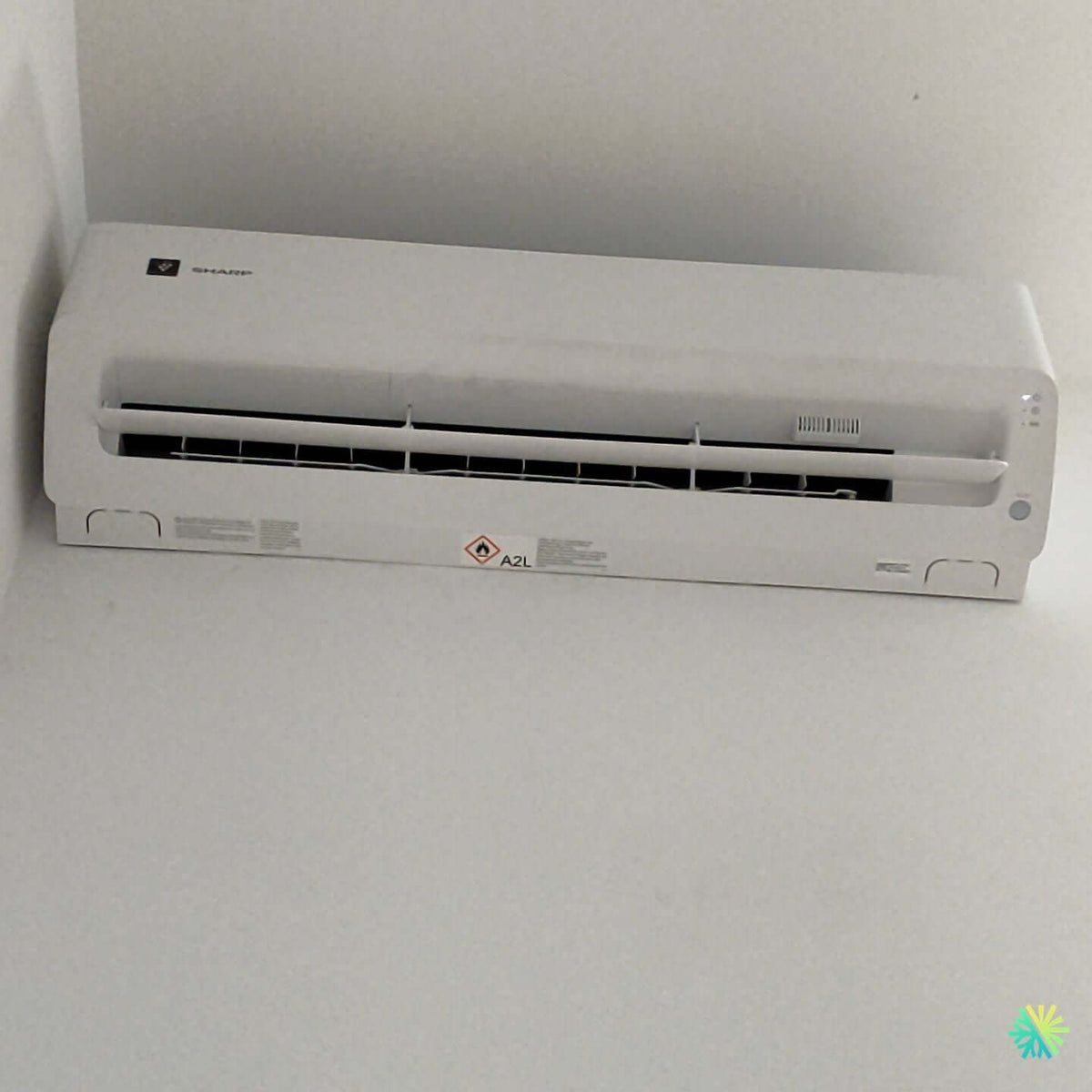
We positioned the head at the highest point of the wall , at an angle , to optimize:
-
stratification and air sweeping along the entire length of the room;
-
gentle diffusion in heating mode, which limits cold areas on the floor;
-
recovery of return air without immediate recirculation.
The top and side clearance is respected to ensure easy access to the filter and good reading of the probes.
Drilling and refrigeration connections
-
Direct wall-exterior crossing , with limited drilling and white capping to match the interior wall;
-
Insulated refrigerant lines, vapor barrier tapes at sensitive points;
-
Communication cable protected in the same conduit for a clean finish and easy maintenance.
The path was designed to be short and straight , reducing pressure losses and helping the compressor operate in its optimal efficiency zone.
Condensate management
We have chosen a gravity evacuation with a continuous slope towards the outside. This solution:
-
eliminates the noise and additional maintenance of a condensate pump ;
-
limits the risk of overflow;
-
prevents odors by ensuring regular drainage.
When gravity is not possible (interior stairwell, long distance, structural obstacles), we offer a silent pump with an overflow tray. Here, the plex configuration allowed for direct drainage , ideal for long-term reliability.
Outdoor unit and supports (courtyard side)
Even though the photo shows the inside header, our standard applies to the court side:
-
Galvanized steel wall support or slab depending on the facade;
-
Ground clearance for snow and winter air circulation;
-
Snow guard if necessary and protective awning without obstructing the intake/insufflation;
-
Position away from windows and passageways to minimize sound transmission to neighbors.
Result: stable comfort, controlled consumption
Smart space heater
In mid-season and during moderate cold weather, the heat pump significantly reduces the need for electrical backup. In a well-maintained Rosemont complex, savings can be substantial compared to resistive heating alone, thanks to a COP often higher than 2 in real-life conditions.
Uniform cooling in summer
Automatic horizontal sweeping and modulated fan speed distribute fresh air without drafts. The dehumidification function improves comfort during the humid periods typical of July and August in Montreal .
Silence and air quality
The Sharp head features easy-to-access washable filters . The low noise level allows for use in living areas, both day and night.
Technical points that make the difference
Refrigerant R-32 (A2L)
-
Performance : better volumetric capacity, more efficient heat exchange;
-
Environment : Lower GWP than R-410A;
-
Safety : compliance with A2L good installation practices (ventilation, torque tightening, leak detection with nitrogen and soap, deep vacuum test).
Rigorous commissioning
Our technicians carry out:
-
Flare /fittings to manufacturer's recommended torque ;
-
Nitrogen test (pressure test) followed by deep vacuum ;
-
Leakage check and control of evaporation/condensation temperatures in operation;
-
Comfort parameter settings (ventilation, shutter angles, auto/silent modes).
Electrical integration
-
Dedicated circuit breaker according to nameplate;
-
Compliant wiring , protective sheath, clean routing to the panel;
-
Emergency stop easily accessible near the outdoor unit.
HVAC Maintenance: Maintaining Performance
What we recommend to the client
-
Clean filters every 4 to 8 weeks during periods of heavy use;
-
Keeping the gutter and drain free;
-
Clearing snow and ice around the outdoor unit in winter;
-
Annual AirGreen inspection : inspection of the refrigeration cycle, pressure/temperature measurement, deep cleaning of the evaporator and condenser.
Regular maintenance maintains efficiency, extends compressor life and preserves the manufacturer/installation warranty .
Grants and eligibilities (general benchmarks)
High-performance R-32 wall-mounted heat pumps capable of maintaining capacities at −25°C/−30°C are generally eligible for certain assistance programs in Quebec. Eligibility depends on the exact model, certified performance, and building location. We support our clients in Montreal, Laval, Longueuil, the North Shore, and the South Shore to validate the criteria and prepare the necessary documents.
AirGreen Tips for a Successful Project
1) Think about the route of the connections
The shorter and more direct the connections, the better the performance and visual discretion. We favor cappings that match the wall for a minimalist look.
2) Choose the blowing area
For heating, aim for the depth of the room ; for air conditioning, avoid direct blowing onto areas of prolonged occupation (sofa, dining table). The high corner placement used here is an excellent compromise.
3) Preserve access for maintenance
Leave the required clearances around the indoor head and provide a safe space around the outdoor unit for seasonal cleaning.
4) Think long term
Quality equipment deserves careful commissioning and annual maintenance . This is the recipe for stable comfort, controlled bills, and a longer lifespan.
What the customer gains today
-
Quiet and consistent four-season comfort ;
-
An eco-efficient solution adapted to Montreal’s climate;
-
A clean and reversible installation, respectful of the aesthetics of the accommodation;
-
AirGreen support: advice, maintenance, monitoring and support for assistance programs when applicable.
AirGreen, your HVAC partner in Greater Montreal
Whether you are in Rosemont–La Petite-Patrie , Laval , Longueuil , on the North Shore or the South Shore , our team is proficient in Sharp wall-mounted heat pumps , as well as Gree , Fujitsu , Midea , Hitachi and other well-known brands. We operate with constant high standards: precise diagnosis , careful installation , calibrated commissioning and clear maintenance follow-up . Your comfort is not a coincidence: it is a method.
Frequently asked questions
-
Equipment type : Sharp wall-mounted heat pump , R-32 (A2L) refrigerant
-
Installation : interior head at the top of the wall , angle for optimal scanning
-
Connections : short trajectory, white capping , pressure test + deep vacuum
-
Condensates : gravity evacuation (priority)
-
Maintenance : regular filters + annual AirGreen visit
Ready for your project?
We schedule a technical visit, confirm the ideal capacity and propose a turnkey HVAC installation, designed for the climate of Montreal and its surrounding areas.
AirGreen – Attention to detail for your comfort.
The job tools
Two quick checks with real numbers: what heat costs, and what your current heaters add up to in BTU/h.
Conversion: 1 W = 3.412 BTU/h. An indication, not a load calculation: baseboards and furnaces are often stronger than the real need, and they can stay as backup. AirGreen confirms the capacity on site.
How the job unfolds
The main steps of this kind of job at AirGreen. Every house has its quirks: the estimate brings them out.
We look at the room, the outside wall, the line route and where the outdoor unit will go. That is where the capacity gets chosen.
Model, capacity and price, in writing. We also check whether the model qualifies for assistance programs.
Floors and furniture protected, wall plate position marked level, wall opening located.
A single opening, with the slope the drain needs to flow outside.
Set on a stand raised above the snow, with the clearances the manufacturer requires.
Connected, insulated and protected. The opening is then sealed against water, cold air and insects.
A dedicated circuit and an accessible disconnect near the outdoor unit.
Leak test, vacuum, then start-up and a check of heating and cooling.
Remote, modes, filters: we show you the essentials before we leave.
- The on-site estimateWe look at the room, the outside wall, the line route and where the outdoor unit will go. That is where the capacity gets chosen.
- The quoteModel, capacity and price, in writing. We also check whether the model qualifies for assistance programs.
- Getting readyFloors and furniture protected, wall plate position marked level, wall opening located.
- The wall openingA single opening, with the slope the drain needs to flow outside.
- The outdoor unitSet on a stand raised above the snow, with the clearances the manufacturer requires.
- Lines, cable and drainConnected, insulated and protected. The opening is then sealed against water, cold air and insects.
- The electrical workA dedicated circuit and an accessible disconnect near the outdoor unit.
- Tests and start-upLeak test, vacuum, then start-up and a check of heating and cooling.
- The walkthroughRemote, modes, filters: we show you the essentials before we leave.
What we check on a job like this one
Each number is a point we check on site. Switch between summer and winter to watch air and heat move.
In summer, the outdoor unit rejects the house's heat outside.
Generic illustration of this type of installation, not a survey of this job site. Tap a number.
Mounted level on a wall plate, high enough for the air to reach the whole room, with enough space around it to slide the filters out easily.
The refrigerant lines, the communication cable and the drain go through the wall in a single opening, sealed against water, cold air and insects.
Two insulated copper pipes connect the two units. Outside, a line cover can protect them from sun, knocks and weather.
A shut-off switch near the outdoor unit isolates it safely for service. It must stay accessible at all times.
The compressor and the fan. In heating mode it captures heat from the outdoor air, even in winter, and moves it inside.
On the ground or on the wall, it keeps the unit above accumulated snow. The unit stays clear and defrost water can drain away.
The fan needs to blow freely. Storage, a fence or a wall too close, and efficiency drops while noise goes up.
Is your home ready?
Check what applies at your place. A "no" is not a refusal: it is what we sort out during the estimate.
Good habits, once the unit is in place
Six simple habits that keep the unit going. Your list stays on this device.
What to do, season by season
Three habits per season for this unit. They take a few minutes and prevent many calls.
- Clean the indoor unit's filters.
- Clear leaves and debris left on the outdoor unit by winter.
- Test cooling before the first hot days.
- Clean the filters more often when the unit runs a lot.
- Keep plants away from the outdoor unit.
- Check that no water drips from the indoor unit.
- Rake the leaves around the outdoor unit.
- Test heating before the first cold days.
- Book periodic maintenance before winter.
- Keep snow away from the stand and the front of the unit.
- Let the unit defrost: it is normal.
- Never hit the ice on the fins; call us if the unit stays iced up.
The right pages, at the right time
Four statements: true or false?
It all comes down to details you have just seen.
1. In heating mode, the outdoor unit can produce water.
During defrost cycles. That water must drain away without forming ice.
2. You pick the capacity with a simple square-footage rule.
Windows, insulation, orientation and how the room is used all count. Capacity is chosen on site.
3. A multi-zone connects several indoor heads to a single condenser.
One head per room, all on the same condenser. Each room keeps its own temperature.
4. The disconnect can sit behind the patio furniture.
It must stay accessible: it is what shuts the unit off for service.
0 / 4 right answers
What people ask us about this kind of work
Does a wall-mounted heat pump heat in winter?
Wall-mounted or multi-zone: how do I choose?
Where does the outdoor unit go?
Are there grants?
Do I need a permit?
How cold can it heat?
How much can I save?
How is the LogisVert assistance calculated?
Is it noisy?
The outdoor unit is covered in ice: is that normal?
Does AirGreen hold the required licences?
Is the estimate free?
No question matches. Write to us: we answer.
More jobs to see, near you
By town, by equipment or by region: browse more than 4,700 published projects.
Each dot: a town where AirGreen has published projects. The glowing dot: this job.
An on-site estimate, the right capacity, the right equipment.
The on-site estimate is free and the quote follows within 24 hours.
Text and photo: a real AirGreen Climatisation & Chauffage job. The diagrams are generic illustrations of the type of installation, not a survey of this job site. Sources of the added figures: airgreen.ca product pages (NEEP / AHRI performance), Hydro-Québec (Heat pumps page, LogisVert, read on 13 October 2026), Régie de l’énergie (rate D as of 1 April 2026).