
Installation of a Sharp ZU1 wall-mounted heat pump in Chomedey (Laval)
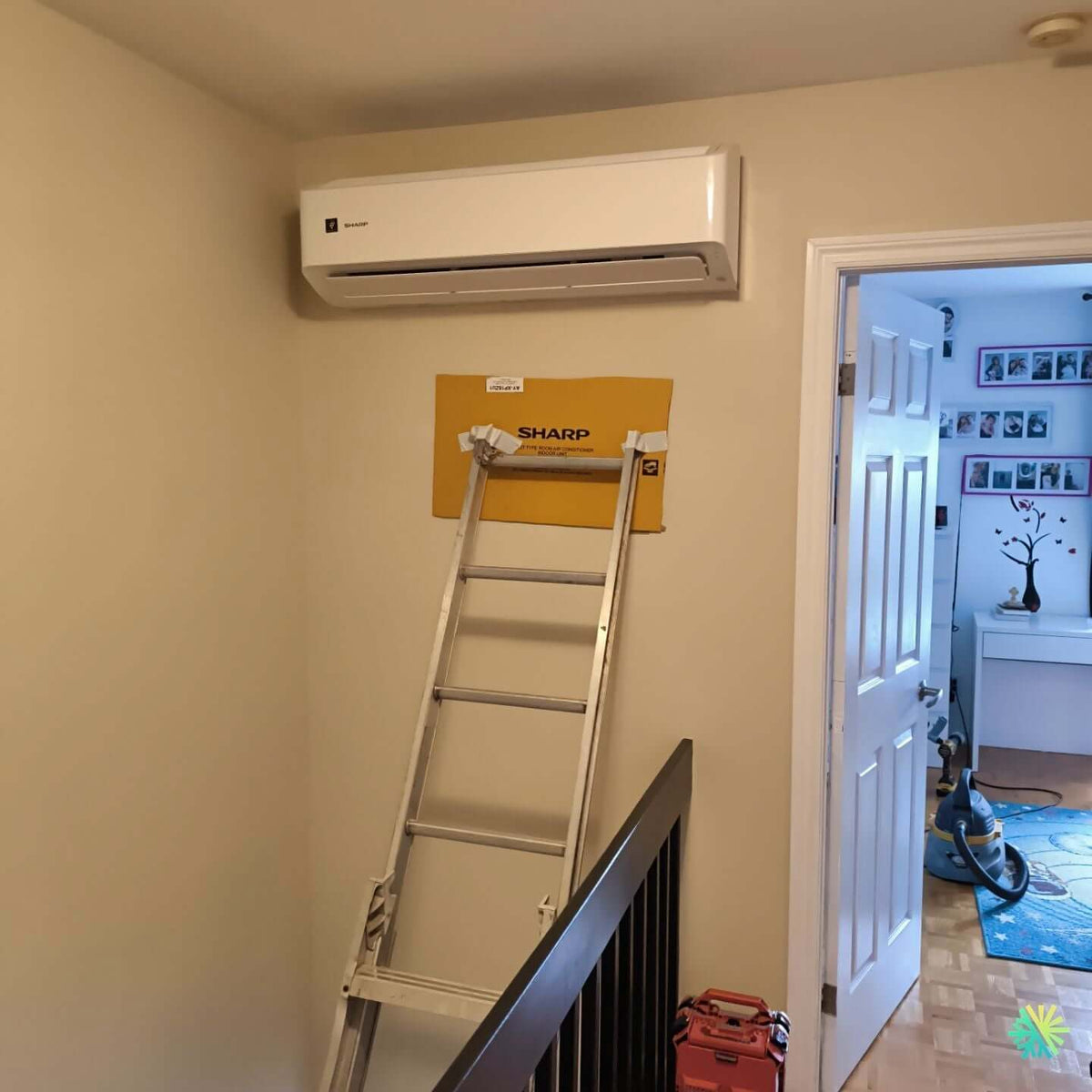
AirGreen installs a Sharp ZU1 wall-mounted heat pump at the top of a stairwell in Chomedey (Laval): direct drilling, short connections, gravity drain and careful finishing for uniform comfort. HVAC installation service Greater Montreal.
In summer, the outdoor unit rejects the house's heat outside.
Generic illustration of this type of installation, not a survey of this job site. Tap a number.
Mounted level on a wall plate, high enough for the air to reach the whole room, with enough space around it to slide the filters out easily.
The refrigerant lines, the communication cable and the drain go through the wall in a single opening, sealed against water, cold air and insects.
Two insulated copper pipes connect the two units. Outside, a line cover can protect them from sun, knocks and weather.
A shut-off switch near the outdoor unit isolates it safely for service. It must stay accessible at all times.
The compressor and the fan. In heating mode it captures heat from the outdoor air, even in winter, and moves it inside.
On the ground or on the wall, it keeps the unit above accumulated snow. The unit stays clear and defrost water can drain away.
The fan needs to blow freely. Storage, a fence or a wall too close, and efficiency drops while noise goes up.
Uniform comfort on two levels, neatly placed in a stairwell
At AirGreen , we favor HVAC solutions that respect the architecture of homes while delivering a real gain in comfort. In this residence in Chomedey (Laval) , our team installed a Sharp wall-mounted heat pump ( ZU1 range) at the top of a stairwell. The objective: to stabilize the temperature upstairs, push the air towards the ground floor and maintain a neat visual appearance in a narrow passageway.
Home context and expressed needs
The owner wanted:
-
Reliable heating for the off-season and in moderate cold, in addition to existing emitters;
-
A discreet wall-mounted air conditioner for summer, capable of lowering the heat load in rooms and the hall;
-
A clean installation in the stairwell , without visible cable ducts or obstructions for doors.
After a technical visit and a summary load calculation, we selected a capacity of 12,000 BTU/h suitable for a landing open to several rooms, with good downward air transfers.
Choosing the location of the inner head
We place our head above the flight of stairs , in the upper corner of the wall. This position has several advantages:
-
Controlled stratification in heating : the air blown from above mixes and naturally descends into the shaft, which smooths out the temperature differences between the upper floor and the ground floor.
-
Efficient diffusion in air conditioning : the flow crosses the landing and goes towards the bedrooms, limiting hot zones.
-
Safety and ergonomics : the head remains clear of openings and out of reach, while remaining accessible for HVAC maintenance (cleaning filters).
The installation height (> 2.2 m) requires a robust anchoring on a plate and precise control of horizontality to ensure condensate flow without stagnation.
Refrigeration path and drilling: invisible on the inside
The chosen wall faces a side facade. We make a through hole behind the plate, which allows:
-
Short refrigeration connections (≈ 6 to 8 m in total), a guarantee of seasonal efficiency;
-
The absence of visible capping in the stairwell;
-
A direct, watertight passage to the outside with bulkhead and UV finish cap.
The insulated copper tubes (high-density cellular) are aligned, taped, and protected to prevent abrasion at the holes. The flare fittings are tightened to the prescribed torque using a torque wrench.
Condensate management: gravity-based, simple and reliable
At this height and with an adjacent facade, we install a gravity drain with a continuous slope towards the outside (≥ 2%). The outlet is protected against frost and insect intrusion by a ventilated cap . This solution avoids the use of a pump, therefore zero noise and minimal maintenance .
Outdoor unit: wall mount and anti-vibration
Externally, the unit is fixed on galvanized brackets with anti-vibration pads. We respect the recommended clearances for suction and discharge, and we provide:
-
Sufficient elevation above the ground for snow accumulations;
-
Discreet capping for the connections, matching the facade;
-
Easy access to the service valve for future maintenance.
This assembly limits vibrations transmitted to the masonry and protects the condenser during snow removal periods.
Power supply and protections
The heat pump has a dedicated 240V circuit drawn from the main panel, with:
-
Circuit breaker conforms to the nameplate;
-
Waterproof disconnect box near the outdoor unit;
-
Grounding verified and cable routing in approved conduit.
The whole thing complies with the Code in force, facilitates interventions and secures operations.
Commissioning: AirGreen protocol
Our technicians apply a strict protocol to guarantee lasting performance:
-
Nitrogen test (≈ 300 psi) and pressure drop control;
-
Deep vacuum draw down to ≤ 500 microns with stabilization;
-
Checking the intensities, blowing temperatures and differential;
-
Shutter settings: wide horizontal sweep, moderate vertical angle in heating to encourage air to flow down the stairs.
Result: rapid response to setpoint changes, quiet operation and optimal efficiency at partial speeds.
Why the Sharp ZU1 range is suitable for this configuration
The Sharp ZU1 (wall-mounted range) is known for:
-
Its flexible inverter , efficient in maintaining a stable temperature without over-consumption;
-
A low noise level, appreciated in passage areas;
-
A heating operating range adapted to Greater Montreal winters (down to approx. -25°C depending on configuration);
-
Washable filters and an internal drying mode that limit odors and microbial proliferation after air conditioning.
Combined with the correct positioning in the stairwell, this range helps redistribute heat to the rooms and reduce vertical gradients.
Practical details that make the difference
-
Construction site protection : tarpaulin and dust cover for cutting; use of a drilling screen to keep a wall clean.
-
Working height : installation of a stable access platform and an articulated ladder to work safely above the staircase.
-
Finishing touches : localized paint touch-ups, masking of screw heads and passage of joints for a discreet finish.
Concrete benefits for the family
-
Uniform comfort upstairs and heat supply to the ground floor;
-
Effective cooling of rooms during hot weather;
-
Lower operating costs compared to basic electrical systems;
-
Improvement of indoor air quality thanks to filtration and drying of the exchanger.
Maintenance recommended by AirGreen
To maintain performance over time, we recommend:
-
Clean filters every 4 to 8 weeks during periods of heavy use;
-
Annual inspection: check of flare connections , functional test, cleaning of the evaporator and fan;
-
Checking the condensate flow (gravity) and the condition of the external cap;
-
Gentle cleaning of the external condenser (without bending the fins).
Our HVAC maintenance packages cover these steps, extending the life of the system.
Grants and support
High-efficiency wall-mounted heat pumps are generally eligible for Hydro-Québec's LogisVert programs and certain additional assistance when the SEER2/HSPF2 and low-temperature performance meet the criteria. We support our customers in Montreal, Laval, Longueuil, on the North Shore and the South Shore to verify eligibility, prepare files and optimize the net cost of HVAC installation .
Good practices and pitfalls to avoid in stairwells
-
Always validate gravity flow or provide a pump: an elbow or a counter-slope is enough to create leaks.
-
Respect the opening clearances and the minimum height recommended by the manufacturer.
-
Limit refrigerated lengths and tight bends: every extra meter reduces efficiency.
-
Plan to raise the outdoor unit for snow and leave clear access for maintenance.
Balance sheet
This Sharp wall-mounted heat pump installation in Chomedey, Laval, demonstrates that thoughtful placement in a stairwell can stabilize the temperature throughout the home without adding to the decor. With its streamlined commissioning , invisible routing, and simple condensate management, the system delivers four-season comfort with controlled operating costs.
Why choose AirGreen?
We understand the architectural realities of Greater Montreal homes and we are experts in the brands and ranges suited to our winters. Our approach: a precise diagnosis , a clean HVAC installation , accessible HVAC maintenance monitoring, and clear support on financial assistance for Montreal, Laval, Longueuil, the North Shore and the South Shore .
How it goes, from the first call to the end
The main steps of this kind of job at AirGreen. Every house has its quirks: the estimate brings them out.
We look at the room, the outside wall, the line route and where the outdoor unit will go. That is where the capacity gets chosen.
Model, capacity and price, in writing. We also check whether the model qualifies for assistance programs.
Floors and furniture protected, wall plate position marked level, wall opening located.
A single opening, with the slope the drain needs to flow outside.
Set on a stand raised above the snow, with the clearances the manufacturer requires.
Connected, insulated and protected. The opening is then sealed against water, cold air and insects.
A dedicated circuit and an accessible disconnect near the outdoor unit.
Leak test, vacuum, then start-up and a check of heating and cooling.
Remote, modes, filters: we show you the essentials before we leave.
- The on-site estimateWe look at the room, the outside wall, the line route and where the outdoor unit will go. That is where the capacity gets chosen.
- The quoteModel, capacity and price, in writing. We also check whether the model qualifies for assistance programs.
- Getting readyFloors and furniture protected, wall plate position marked level, wall opening located.
- The wall openingA single opening, with the slope the drain needs to flow outside.
- The outdoor unitSet on a stand raised above the snow, with the clearances the manufacturer requires.
- Lines, cable and drainConnected, insulated and protected. The opening is then sealed against water, cold air and insects.
- The electrical workA dedicated circuit and an accessible disconnect near the outdoor unit.
- Tests and start-upLeak test, vacuum, then start-up and a check of heating and cooling.
- The walkthroughRemote, modes, filters: we show you the essentials before we leave.
What the unit delivers when it is cold
The range as published on airgreen.ca: pick a size to see its capacity in deep cold.
| Size | Heating at −8 °C | Heating at −15 °C | Coldest certified point | COP at −15 °C | SEER | HSPF | Indicative LogisVert aid |
|---|---|---|---|---|---|---|---|
| Sharp ZU1 12 000 | 14,500 | 12,000 | −27 °C: 7,200 | 2.11 | 22.0 | 11.0 | $1,740 |
| Sharp ZU1 15 000 | 18,100 | 15,300 | −27 °C: 10,100 | 2.1 | 24.0 | 11.0 | $2,172 |
| Sharp ZU1 18 000 | 22,000 | 18,000 | −27 °C: 11,500 | 2.2 | 24.0 | 11.0 | $2,640 |
| Sharp ZU1 24 000 | 22,400 | 19,000 | −27 °C: 12,300 | 2.2 | 22.0 | 11.0 | $2,688 |
According to NEEP, it delivers 14,500 BTU/h at −8 °C (17 °F), more than at 8 °C (14,000 BTU/h). It heats as hard in moderate cold as in mild weather.
According to NEEP, its certified maximum capacity at −27 °C (−17 °F) is 7,200 BTU/h, 60% of its nominal 12,000 BTU size.
At 8 °C, its certified maximum capacity reaches 17,100 BTU/h, 42% more than its nominal 12,000 BTU size.
According to NEEP, it delivers 18,100 BTU/h at −8 °C (17 °F), more than at 8 °C (18,000 BTU/h). It heats as hard in moderate cold as in mild weather.
According to NEEP, its certified maximum capacity at −27 °C (−17 °F) is 10,100 BTU/h, 67% of its nominal 15,000 BTU size.
At 8 °C, its certified maximum capacity reaches 21,800 BTU/h, 45% more than its nominal 15,000 BTU size.
According to NEEP, it delivers 22,000 BTU/h at −8 °C (17 °F), more than at 8 °C (21,600 BTU/h). It heats as hard in moderate cold as in mild weather.
According to NEEP, its COP at −27 °C is 1.88: the highest of the ZU1 line, which ranges from 1.79 to 1.82 at that temperature.
According to NEEP, its certified maximum capacity at −27 °C (−17 °F) is 11,500 BTU/h, 64% of its nominal 18,000 BTU size.
At −27 °C, its certified minimum capacity is 3,200 BTU/h (5,500 at 8 °C). It slows down instead of cycling on and off.
According to NEEP, its certified heating capacity at −15 °C (5 °F) is 19,000 BTU/h, 79% of its nominal 24,000 BTU size. Its COP there is 2.20.
Data read live from the airgreen.ca page of each size (NEEP / AHRI certified performance). When the title names the installed size, it is highlighted; otherwise the whole range is shown. The aid shown is today’s, using Hydro-Québec’s rule ($120 per 1,000 BTU/h at −8 °C); amounts quoted in the article date from its publication. Only Hydro-Québec confirms the assistance granted.
And at your place?
Two quick checks with real numbers: what heat costs, and what your current heaters add up to in BTU/h.
Baseboards and electric furnaces turn 1 kWh of electricity into 1 kWh of heat. A heat pump delivers more: that is its COP. At Hydro-Québec’s rate D (11.142¢/kWh above 40 kWh a day, since 1 April 2026):
Hydro-Québec: a heat pump can be up to three times more efficient than baseboards for heating in the colder months.
Estimate per kWh of heat, at the chosen temperature, using the certified COP from the product page. Taxes, access charge and backup heat not included.
Conversion: 1 W = 3.412 BTU/h. An indication, not a load calculation: baseboards and furnaces are often stronger than the real need, and they can stay as backup. AirGreen confirms the capacity on site.
What to do, season by season
Three habits per season for this unit. They take a few minutes and prevent many calls.
- Clean the indoor unit's filters.
- Clear leaves and debris left on the outdoor unit by winter.
- Test cooling before the first hot days.
- Clean the filters more often when the unit runs a lot.
- Keep plants away from the outdoor unit.
- Check that no water drips from the indoor unit.
- Rake the leaves around the outdoor unit.
- Test heating before the first cold days.
- Book periodic maintenance before winter.
- Keep snow away from the stand and the front of the unit.
- Let the unit defrost: it is normal.
- Never hit the ice on the fins; call us if the unit stays iced up.
Which type of equipment for your project?
Pick what looks like your need.
Four mistakes we do not make
Flip each card to see what we do instead.
What people ask us about this kind of work
Does a wall-mounted heat pump heat in winter?
Wall-mounted or multi-zone: how do I choose?
Where does the outdoor unit go?
Are there grants?
Do I need a permit?
How cold can it heat?
How much can I save?
How is the LogisVert assistance calculated?
Is it noisy?
The outdoor unit is covered in ice: is that normal?
Does AirGreen hold the required licences?
Is the estimate free?
No question matches. Write to us: we answer.
Useful pages for what comes next
More jobs to see, near you
By town, by equipment or by region: browse more than 4,700 published projects.
Each dot: a town where AirGreen has published projects. The glowing dot: this job.
Tell us about your house. We come and see it for free.
The on-site estimate is free and the quote follows within 24 hours.
Text and photo: a real AirGreen Climatisation & Chauffage job. The diagrams are generic illustrations of the type of installation, not a survey of this job site. Sources of the added figures: airgreen.ca product pages (NEEP / AHRI performance), Hydro-Québec (Heat pumps page, LogisVert, read on 13 October 2026), Régie de l’énergie (rate D as of 1 April 2026).