
Installation of a Sharp ZU1 wall-mounted heat pump in Plateau-Mont-Royal
AirGreen installs a Sharp ZU1 wall-mounted heat pump in Plateau-Mont-Royal: discreet integration, gravity drainage, professional commissioning and guaranteed energy savings for your HVAC installation .
- City
- Region
- Equipment
- Brand
- Challenges
- Published
The job on one screen
The unit’s data sheet
The range as published on airgreen.ca: pick a size to see its capacity in deep cold.
| Size | Heating at −8 °C | Heating at −15 °C | Coldest certified point | COP at −15 °C | SEER | HSPF | Indicative LogisVert aid |
|---|---|---|---|---|---|---|---|
| Sharp ZU1 12 000 | 14,500 | 12,000 | −27 °C: 7,200 | 2.11 | 22.0 | 11.0 | $1,740 |
| Sharp ZU1 15 000 | 18,100 | 15,300 | −27 °C: 10,100 | 2.1 | 24.0 | 11.0 | $2,172 |
| Sharp ZU1 18 000 | 22,000 | 18,000 | −27 °C: 11,500 | 2.2 | 24.0 | 11.0 | $2,640 |
| Sharp ZU1 24 000 | 22,400 | 19,000 | −27 °C: 12,300 | 2.2 | 22.0 | 11.0 | $2,688 |
According to NEEP, it delivers 14,500 BTU/h at −8 °C (17 °F), more than at 8 °C (14,000 BTU/h). It heats as hard in moderate cold as in mild weather.
According to NEEP, its certified maximum capacity at −27 °C (−17 °F) is 7,200 BTU/h, 60% of its nominal 12,000 BTU size.
At 8 °C, its certified maximum capacity reaches 17,100 BTU/h, 42% more than its nominal 12,000 BTU size.
According to NEEP, it delivers 18,100 BTU/h at −8 °C (17 °F), more than at 8 °C (18,000 BTU/h). It heats as hard in moderate cold as in mild weather.
According to NEEP, its certified maximum capacity at −27 °C (−17 °F) is 10,100 BTU/h, 67% of its nominal 15,000 BTU size.
At 8 °C, its certified maximum capacity reaches 21,800 BTU/h, 45% more than its nominal 15,000 BTU size.
According to NEEP, it delivers 22,000 BTU/h at −8 °C (17 °F), more than at 8 °C (21,600 BTU/h). It heats as hard in moderate cold as in mild weather.
According to NEEP, its COP at −27 °C is 1.88: the highest of the ZU1 line, which ranges from 1.79 to 1.82 at that temperature.
According to NEEP, its certified maximum capacity at −27 °C (−17 °F) is 11,500 BTU/h, 64% of its nominal 18,000 BTU size.
At −27 °C, its certified minimum capacity is 3,200 BTU/h (5,500 at 8 °C). It slows down instead of cycling on and off.
According to NEEP, its certified heating capacity at −15 °C (5 °F) is 19,000 BTU/h, 79% of its nominal 24,000 BTU size. Its COP there is 2.20.
Data read live from the airgreen.ca page of each size (NEEP / AHRI certified performance). When the title names the installed size, it is highlighted; otherwise the whole range is shown. The aid shown is today’s, using Hydro-Québec’s rule ($120 per 1,000 BTU/h at −8 °C); amounts quoted in the article date from its publication. Only Hydro-Québec confirms the assistance granted.
The article, chapter by chapter
A careful interior installation for four-season comfort, designed for Montreal living spaces
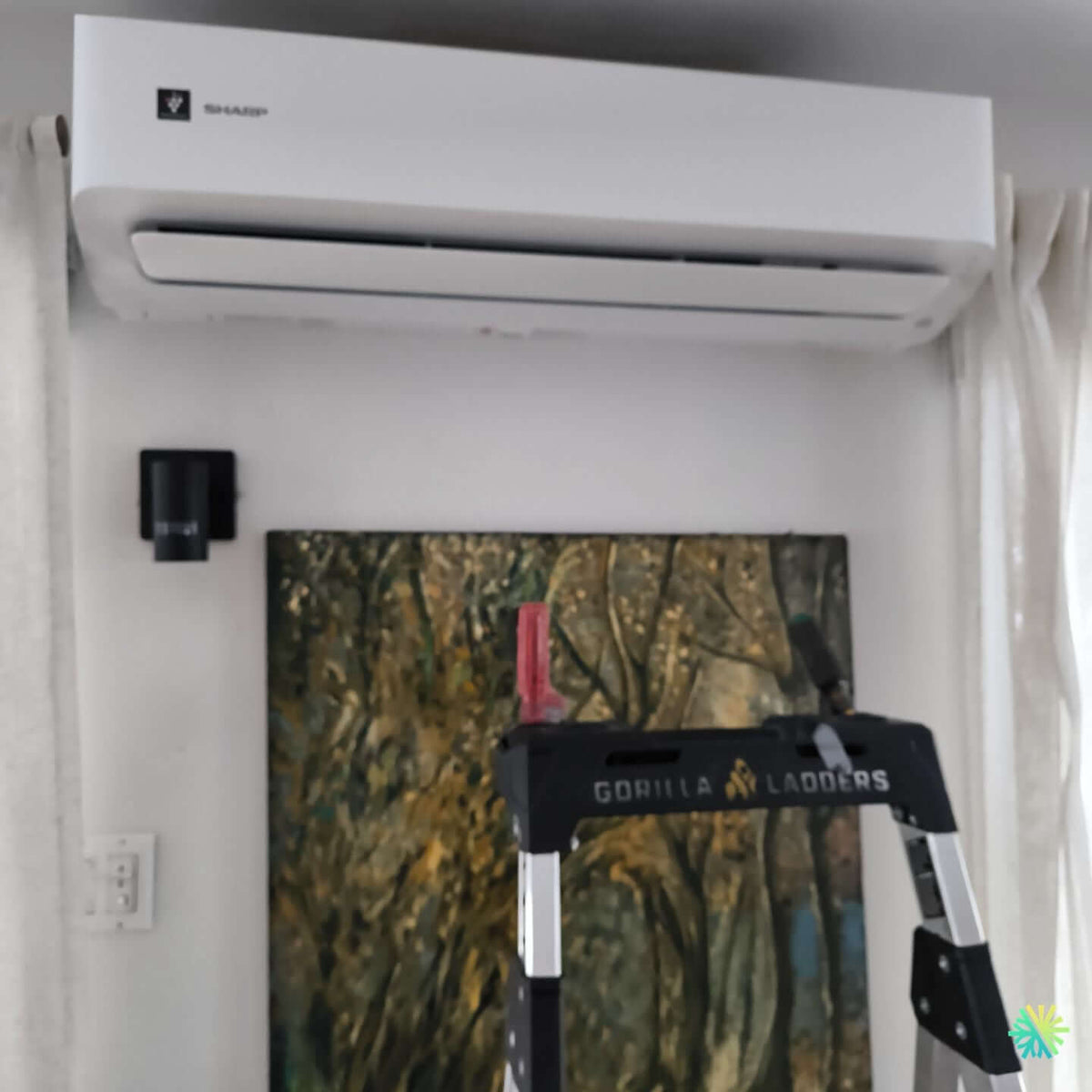
At AirGreen , we design each HVAC installation as an interior design project as much as an energy performance one. In this Plateau-Mont-Royal home, our team installed a Sharp ZU1 wall-mounted heat pump above the living area. The goal: to provide reliable heating in winter and discreet air conditioning in summer, while respecting the aesthetics of the space (full-height curtains, painting, wall lighting) and the rules of the art in future HVAC maintenance .
Choosing a Sharp ZU1: R-32 efficiency and silence in urban environments
The Sharp ZU1 series is part of the new generation of R-32: better seasonal efficiency, low GWP and sustained performance at low temperatures. For a typical Montreal apartment, it stands out for:
-
Low temperature heating sustained even in very cold weather, reducing the need for electric baseboard heaters.
-
High SEER/HSPF , resulting in tangible savings on the bill.
-
Low noise level inside and outside, appreciable in plexes and condominiums.
-
Compatibility with provincial and federal grant programs when performance criteria are met.
-
Even filtration and diffusion thanks to the motorized shutter and wide sweep, useful in deep rooms.
Interior integration: aesthetics, clearances and air diffusion
The indoor unit is installed under the ceiling , centered on the wall to water the living space without blowing directly onto the occupants. Our criteria:
-
Top clearance retained to prevent hot/cold air recirculation and facilitate filter maintenance.
-
Gap to the curtains guaranteeing free suction; we adjust the position so that the fabric does not stick to the air intake.
-
Installation height chosen to optimize sweeping: high enough to heat efficiently in winter, without excessive destratification.
-
Visual discretion : the alignment respects the axis of the painting and the frame of the furniture, so that the device blends into the decor.
Drilling, draining and connections: durability above all
Behind the facade, we create a single hole that is slightly inclined outwards to promote gravity drainage of condensate. Our best practices:
-
Clean, lined and caulked bulkhead to prevent air and moisture infiltration.
-
Drain line with continuous slope (≈1%) and accessible service point; we avoid the condensate pump when the architecture allows it.
-
Insulated copper refrigeration connections , bend radii respected, protected flanges. Lengths are optimized to limit pressure losses and maintain nominal efficiency.
-
Compliant electrical routing , dedicated circuit breaker and clear markings in the panel, to simplify any future work.
Installation methodology: measured performance, verifiable results
Our standard protocol ensures long-term reliability:
-
Brazing under nitrogen flushing to prevent internal oxidation of the tubes.
-
Nitrogen leak test (stabilized high pressure) with pressure reading.
-
Digital vacuum gauge and deep vacuum draw down to 500 microns (with hold), then release of factory refrigerant.
-
Commissioning settings : checking probes, fan speed, flap orientation, simulated defrost test when relevant.
-
Acoustic and vibration controls : no resonance noise in the partition, damped fixing and compliant silent blocks.
Context of a Montreal plex: constraints and solutions
In a plex on the Plateau, the load-bearing masonry walls, the high windows and the sometimes irregular ceilings require adjustments:
-
Respect for structures : the interior support is anchored in a load-bearing area, with dowels adapted to the substrate.
-
Facade/interior coordination : the outlet to the exterior is positioned to join the condensing unit (on brackets) by a discreet and aligned capping , without crossing the window sills.
-
Water management : no stagnation at the low point of the drain, and outlet sized for summer humidity peaks.
Comfort, savings and subsidies: what the customer gains
With this wall-mounted heat pump :
-
Supplemental heating becomes marginal on most winter days; overall electricity consumption decreases.
-
Summer comfort is clear: less humidity, a uniform temperature without direct cold air currents.
-
Equipment that meets performance criteria may be eligible for financial assistance in Quebec (depending on the configuration chosen and the programs in force).
-
HVAC maintenance is simplified: filter cleaning, annual inspection, and condensate control to prevent overflow.
Practical details appreciated by occupants
-
Remote control with temperature sensor and eco modes, useful for stable cycles.
-
Weekly programming : day/night instructions, off-season, and automatic reduction in absence.
-
Optimized defrost mode : the machine avoids overly frequent cycles and maintains a comfortable interior temperature.
Common Mistakes We Avoid
-
Installation too close to the ceiling : promotes air short circuits and reduces useful heating power.
-
Curtains stuck to the suction : increased noise, reduced flow; we expect a minimal lasting gap.
-
Forgotten access hatches : we guarantee accessibility to the connections and the condensate tray.
-
Counter-slope drain or multiple bends: source of leaks and odors; we favor a simple and inspectable route.
Recommended maintenance and longevity
To maintain performance:
-
Clean filters every 4–8 weeks during periods of heavy use.
-
Annual inspection : pressures, subcooling/superheat, electrical tightening, defrost and drain flow control.
-
Clearances around the outdoor unit (when in place): no snow obstruction, no heat source blown towards an immediate neighbor.
Why AirGreen for your project in Montreal, Laval, Longueuil, North Shore and South Shore?
Our added value is based on:
-
A detailed reading of Montreal buildings (plexes, condos, townhouses).
-
Certified teams that deliver clean, traceable, and grant-ready facilities.
-
Structured after-sales support : maintenance reminders, seasonal advice and rapid interventions.
Result: immediate comfort, controlled bill, respected interior
At the end of commissioning, the Sharp ZU1 blows quietly, the room reaches the setpoint smoothly, and the aesthetics remain intact. Occupants gain comfort all year round, with a sustainable heat pump solution, aligned with current performance and environmental standards in Greater Montreal .
The job tools
Two quick checks with real numbers: what heat costs, and what your current heaters add up to in BTU/h.
Baseboards and electric furnaces turn 1 kWh of electricity into 1 kWh of heat. A heat pump delivers more: that is its COP. At Hydro-Québec’s rate D (11.142¢/kWh above 40 kWh a day, since 1 April 2026):
Hydro-Québec: a heat pump can be up to three times more efficient than baseboards for heating in the colder months.
Estimate per kWh of heat, at the chosen temperature, using the certified COP from the product page. Taxes, access charge and backup heat not included.
Conversion: 1 W = 3.412 BTU/h. An indication, not a load calculation: baseboards and furnaces are often stronger than the real need, and they can stay as backup. AirGreen confirms the capacity on site.
How the job unfolds
The main steps of this kind of job at AirGreen. Every house has its quirks: the estimate brings them out.
We look at the room, the outside wall, the line route and where the outdoor unit will go. That is where the capacity gets chosen.
Model, capacity and price, in writing. We also check whether the model qualifies for assistance programs.
Floors and furniture protected, wall plate position marked level, wall opening located.
A single opening, with the slope the drain needs to flow outside.
Set on a stand raised above the snow, with the clearances the manufacturer requires.
Connected, insulated and protected. The opening is then sealed against water, cold air and insects.
A dedicated circuit and an accessible disconnect near the outdoor unit.
Leak test, vacuum, then start-up and a check of heating and cooling.
Remote, modes, filters: we show you the essentials before we leave.
- The on-site estimateWe look at the room, the outside wall, the line route and where the outdoor unit will go. That is where the capacity gets chosen.
- The quoteModel, capacity and price, in writing. We also check whether the model qualifies for assistance programs.
- Getting readyFloors and furniture protected, wall plate position marked level, wall opening located.
- The wall openingA single opening, with the slope the drain needs to flow outside.
- The outdoor unitSet on a stand raised above the snow, with the clearances the manufacturer requires.
- Lines, cable and drainConnected, insulated and protected. The opening is then sealed against water, cold air and insects.
- The electrical workA dedicated circuit and an accessible disconnect near the outdoor unit.
- Tests and start-upLeak test, vacuum, then start-up and a check of heating and cooling.
- The walkthroughRemote, modes, filters: we show you the essentials before we leave.
What we check on a job like this one
Each number is a point we check on site. Switch between summer and winter to watch air and heat move.
In summer, the outdoor unit rejects the house's heat outside.
Generic illustration of this type of installation, not a survey of this job site. Tap a number.
Mounted level on a wall plate, high enough for the air to reach the whole room, with enough space around it to slide the filters out easily.
The refrigerant lines, the communication cable and the drain go through the wall in a single opening, sealed against water, cold air and insects.
Two insulated copper pipes connect the two units. Outside, a line cover can protect them from sun, knocks and weather.
A shut-off switch near the outdoor unit isolates it safely for service. It must stay accessible at all times.
The compressor and the fan. In heating mode it captures heat from the outdoor air, even in winter, and moves it inside.
On the ground or on the wall, it keeps the unit above accumulated snow. The unit stays clear and defrost water can drain away.
The fan needs to blow freely. Storage, a fence or a wall too close, and efficiency drops while noise goes up.
Is your home ready?
Check what applies at your place. A "no" is not a refusal: it is what we sort out during the estimate.
Good habits, once the unit is in place
Six simple habits that keep the unit going. Your list stays on this device.
What to do, season by season
Three habits per season for this unit. They take a few minutes and prevent many calls.
- Clean the indoor unit's filters.
- Clear leaves and debris left on the outdoor unit by winter.
- Test cooling before the first hot days.
- Clean the filters more often when the unit runs a lot.
- Keep plants away from the outdoor unit.
- Check that no water drips from the indoor unit.
- Rake the leaves around the outdoor unit.
- Test heating before the first cold days.
- Book periodic maintenance before winter.
- Keep snow away from the stand and the front of the unit.
- Let the unit defrost: it is normal.
- Never hit the ice on the fins; call us if the unit stays iced up.
The right pages, at the right time
Four statements: true or false?
It all comes down to details you have just seen.
1. In heating mode, the outdoor unit can produce water.
During defrost cycles. That water must drain away without forming ice.
2. You pick the capacity with a simple square-footage rule.
Windows, insulation, orientation and how the room is used all count. Capacity is chosen on site.
3. A multi-zone connects several indoor heads to a single condenser.
One head per room, all on the same condenser. Each room keeps its own temperature.
4. The disconnect can sit behind the patio furniture.
It must stay accessible: it is what shuts the unit off for service.
0 / 4 right answers
What people ask us about this kind of work
Does a wall-mounted heat pump heat in winter?
Wall-mounted or multi-zone: how do I choose?
Where does the outdoor unit go?
Are there grants?
Do I need a permit?
How cold can it heat?
How much can I save?
How is the LogisVert assistance calculated?
Is it noisy?
The outdoor unit is covered in ice: is that normal?
Does AirGreen hold the required licences?
Is the estimate free?
No question matches. Write to us: we answer.
More jobs to see, near you
By town, by equipment or by region: browse more than 4,700 published projects.
Each dot: a town where AirGreen has published projects. The glowing dot: this job.
An on-site estimate, the right capacity, the right equipment.
The on-site estimate is free and the quote follows within 24 hours.
Text and photo: a real AirGreen Climatisation & Chauffage job. The diagrams are generic illustrations of the type of installation, not a survey of this job site. Sources of the added figures: airgreen.ca product pages (NEEP / AHRI performance), Hydro-Québec (Heat pumps page, LogisVert, read on 13 October 2026), Régie de l’énergie (rate D as of 1 April 2026).