
Installation of a HITACHI airCore 700 central heat pump in Montréal-Est
In Montréal-Est, AirGreen prepares and installs a HITACHI airCore 700 central heat pump with two fans, including an internal inspection, ductwork integration, and commissioning adapted to Quebec’s climate.
Take a tour of the installation
Each number is a point we check on site. Switch between summer and winter to watch air and heat move.
In summer, the outdoor unit rejects the house's heat outside.
Generic illustration of this type of installation, not a survey of this job site. Tap a number.
It captures or rejects heat outside. It sits on a level base, above the snow, with free space all around.
The insulated refrigerant lines enter the house through a sealed opening and run to the indoor coil.
A shut-off switch near the outdoor unit isolates it safely for service.
Sitting on the indoor module, it moves heat between the house air and the refrigerant.
Electric furnace or air handler: its fan pushes air through the ducts. The electric backup takes over in extreme cold.
Supply ducts bring air to the rooms; returns bring it back to the unit. Their condition matters as much as the unit's.
It protects the coil and the fan. A dirty filter cuts airflow, so it gets checked regularly.
It runs the heat pump and the backup heat. It must be compatible with the installed system.
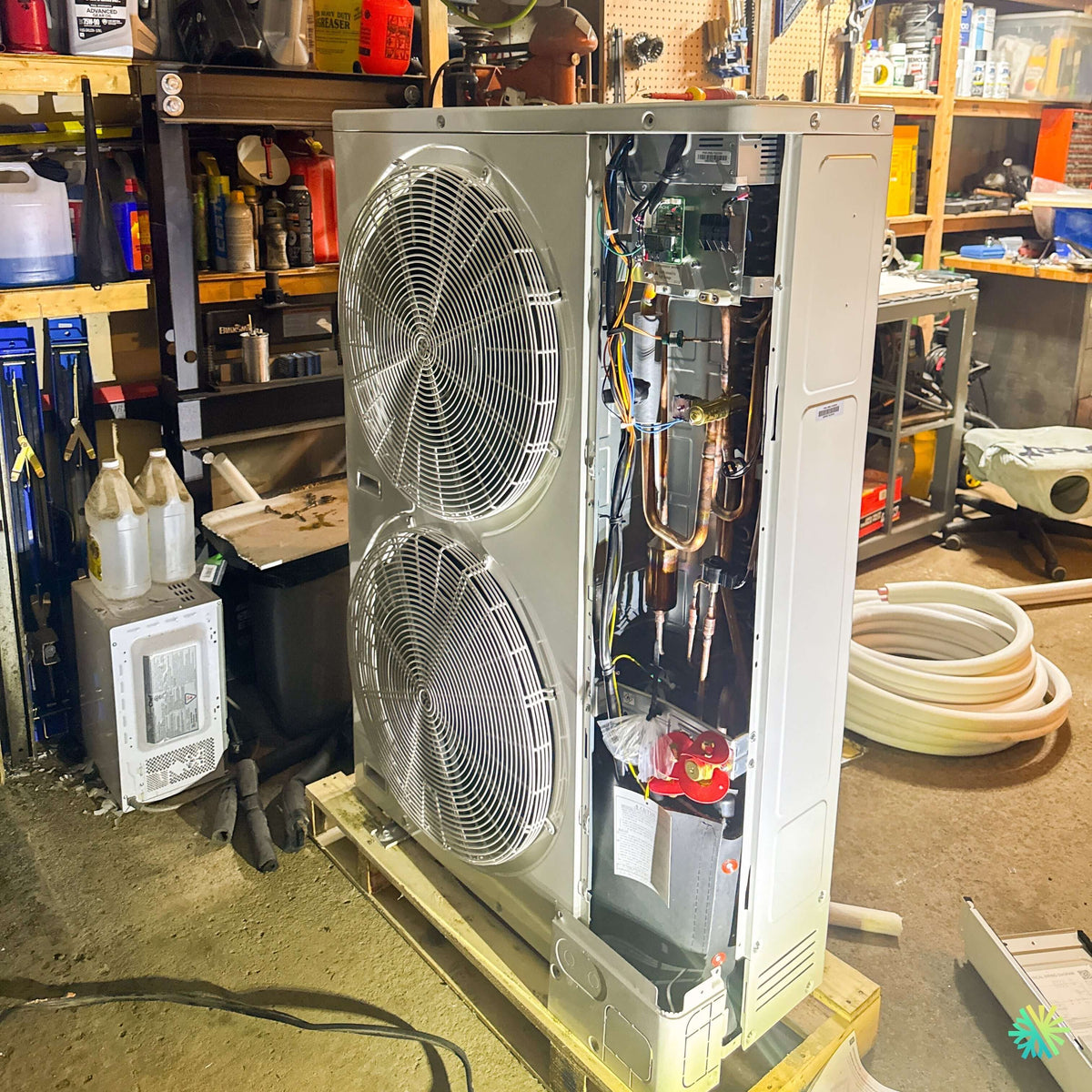
An open-panel technical inspection before integration into the central system
The photo from this project in Montréal-Est shows a step rarely presented to homeowners: inspecting the outdoor unit before its final placement. The HITACHI airCore 700 central heat pump is still resting on its wooden transport base, while its large service panel has been removed. The two front fans, electronic boards, wiring, copper lines, and several components of the refrigeration circuit are then directly accessible to our technicians.
This preparatory inspection is important for a large central unit. It allows us to confirm that the equipment was not damaged during transport, that the internal connections are intact, and that the entire assembly matches the configuration planned for the building.
The project therefore does not begin when we connect the lines. It begins with a methodical check of the machine, the location, the duct network, and the electrical supply.
Why open the outdoor unit before installation?
In the photo, the right-hand technical section of the heat pump is fully visible. We can notably observe:
- the control boards;
- the terminal blocks and electrical harnesses;
- the copper refrigerant lines;
- the internal valves and fittings;
- the separation between the ventilation area and the technical area;
- the lower part of the chassis;
- the component supports and protective elements;
- the accessibility provided for future HVAC maintenance.
Before transporting the unit to its final location, we check that the components are securely fastened and that no pipe has any abnormal deformation. We also inspect the electrical connectors, visible sensors, board protection, and the overall condition of the chassis.
This step prevents us from completing an entire HVAC installation before discovering a problem related to transport or handling. On a central-system project, a problem discovered late can require dismantling ductwork, moving a heavy unit, or postponing commissioning.
A two-fan chassis that requires precise planning
The photographed outdoor unit has two stacked fans. This vertical format is associated with the higher-capacity configurations in the airCore 700 family. It provides the necessary heat exchange while maintaining a narrower footprint than a very wide unit.
However, the photograph does not show a nameplate that is legible enough to honestly confirm the exact capacity in BTUs. The outdoor format alone should never be used to identify the tonnage of a central heat pump.
The airCore 700 range includes several capacities and different types of indoor units. HITACHI documentation notably lists central air handlers of 18,000, 24,000, 30,000, 36,000, and 48,000 BTU, depending on the selected combination. The exact model of the outdoor unit, the indoor unit, and the AHRI reference must always be verified together.
This clarification is essential for three reasons:
- two externally similar units may have different capacities;
- energy performance depends on the complete combination;
- eligibility for a subsidy is based on the model numbers and certification reference, not solely on the airCore 700 name.
Integrating a central heat pump into a building in Montréal-Est
A HITACHI airCore 700 central heat pump does not operate on its own. It must be paired with a compatible indoor unit and then integrated into a duct network capable of properly distributing air throughout all areas served.
For this project in Montréal-Est, our work included evaluating the factors that determine the actual result after installation:
- the capacity required by the building;
- the required airflow;
- the duct dimensions;
- the return-air surface area;
- the indoor unit location;
- the refrigerant line routing;
- condensate drainage;
- the available electrical capacity;
- the outdoor location and service clearances.
A high-performance machine cannot compensate for an undersized return-air opening, crushed ducts, or excessive static pressure. Comfort quality therefore depends just as much on the system design as on the heat pump itself.
Capacity determined by the building’s load
Capacity should not be selected based solely on floor area. A masonry building in Montréal-Est may have very different requirements from a newer home of comparable size located in Laval or on the South Shore.
We take several factors into account:
- wall and roof insulation;
- the number and type of windows;
- solar exposure;
- air infiltration;
- ceiling height;
- the presence of a basement;
- the number of occupants;
- heat-producing appliances;
- the distribution of rooms;
- duct losses;
- winter and summer design temperatures.
An oversized unit can cause excessively short cooling cycles. The temperature drops quickly, but dehumidification may become insufficient. The building may then feel cool without actually being comfortable.
An undersized unit may operate almost continuously during the coldest or hottest periods. The issue is not limited to energy consumption: some areas may never reach the desired temperature.
HITACHI airCore 700 technology adapted to Quebec's climate
The airCore 700 series uses an inverter-driven compressor and R-32 refrigerant. The inverter adjusts the system's operation according to the actual demand rather than operating only at full capacity or being turned off.
When the demand is moderate, the system can reduce its output. This modulation helps maintain a more consistent temperature, reduce sudden fluctuations, and limit repeated starts.
For HeatForce versions, HITACHI advertises a heating capacity maintained at 100% at approximately -15 °C and above 70% at -25 °C, without including in this graph the temporary losses associated with frost and defrost cycles. The heating operating range of the line also reaches approximately -25 °C.
These figures do not mean that every product combination delivers exactly the same number of BTUs at all temperatures. They describe the general behavior of the series. For a precise analysis, we consult the data for the installed pair, including:
- rated capacity;
- capacity at -8 °C;
- capacity at -15 °C;
- electricity consumption;
- COP at reference temperatures;
- SEER2;
- HSPF2;
- the building's balance point.
The role of defrosting during the winter
When a heat pump heats, the outdoor heat exchanger becomes cold. Moisture in the air can then form frost on the fins. The system must periodically initiate a defrost cycle to remove this buildup.
A proper installation must allow the water produced during this cycle to drain freely. The unit must not be placed directly in an area where water can refreeze beneath the chassis and form a block of ice.
The airCore 700 documentation specifies heating capacity for the lower pan to help prevent ice accumulation and support winter operation.
In Montréal-Est, we must also consider:
- the average height of snow accumulation;
- wind-created snowdrifts;
- ice falling from a roof;
- water from the gutters;
- the paths used for snow removal;
- the access required in the event of a winter service call.
An outdoor unit must never remain on its transport base
The photo was taken during preparation. The wooden structure visible beneath the unit is used for handling and transporting it. It does not represent the final installation base.
On site, the unit must be installed on a structure designed to support its weight, withstand the elements, and keep the equipment high enough above the ground.
Depending on the location, we can use:
- a wall-mounted metal bracket;
- a sturdy outdoor platform;
- a concrete base;
- stabilized slabs;
- a suitable base;
- compatible vibration-isolation components.
The choice depends on the building and the site. A poorly anchored platform can transmit vibrations. A slab installed on uncompacted soil can tilt. A support placed too low can expose the heat exchanger to snow or ice.
Clearances around the two fans
The two front fans must discharge air without encountering any significant obstruction. A fence, decorative panel, car parked too close, or objects stored in front of the unit can cause air recirculation.
In heating mode, the heat pump would then discharge cooled air in front of itself and could draw some of it back in. In cooling mode, it could draw in air that has already been heated. In both cases, operating conditions deteriorate.
We therefore check:
- clearance in front of the fans;
- space behind the heat exchanger;
- distance from the walls;
- clearance above the unit;
- the ability to remove the panels;
- access to the valves and connections;
- safe circulation around the unit.
A discreet location is not necessarily a good location. Above all, it must allow the system to breathe and the technician to work.
From an exposed outdoor unit to a winter-ready central system
The air handler and the ventilation network
The HITACHI airCore 700 platform can be paired with a central air handler. The documentation describes a five-speed ECM blower motor designed to provide the required airflow while reducing fan power consumption compared with certain conventional designs.
The indoor unit cabinet is approximately 20.5 inches wide, which can facilitate installation in certain mechanical rooms, basements, or tight spaces. An R-32 refrigerant detector is also factory-installed on the air handler.
However, these characteristics do not replace on-site adjustment. We must still determine:
- the appropriate fan speed;
- external static pressure;
- airflow in heating mode;
- airflow in cooling mode;
- filter compatibility;
- the plenum size;
- the configuration of the supplemental electric heating element;
- the control strategy.
Why measure static pressure?
Static pressure indicates the resistance the fan must overcome to move air through the network.
Excessive pressure can be caused by:
- a filter that is too restrictive;
- an undersized return air duct;
- ducts that are too small;
- tight bends;
- closed dampers;
- a dirty coil;
- a poorly designed transition.
Without measurement, the system may appear to be operating normally even though the actual airflow is insufficient. Possible consequences include noise, reduced capacity, increased consumption, and abnormal strain on the fan.
At AirGreen, we do not limit commissioning to checking whether air is coming out of the grilles. We seek to confirm that the air volume matches the machine’s capacity.
R-32 and the new safety requirements
R-32 has a lower global warming potential than R-410A, but it belongs to category A2L, meaning it is a mildly flammable refrigerant.
The installation therefore requires an appropriate work method:
- tools compatible with R-32;
- strict control of ignition sources;
- adequate ventilation of the work area;
- leak test;
- vacuum evacuation;
- compliance with load limits;
- protected connections;
- validation of the detector installed in the indoor unit.
The photo with the panel open makes it possible to see precisely why technical access must remain available. The components must not be enclosed behind a permanent structure that would prevent future inspection or repairs.
The refrigerant piping route
The airCore 700 product line offers considerable flexibility for certain complex projects. HITACHI indicates piping lengths of up to approximately 75 metres and a height difference of up to approximately 30 metres, depending on the model and applicable conditions.
However, these maximums should not be interpreted as a target. A shorter, better-designed route generally simplifies:
- evacuation;
- load calculation;
- line insulation;
- mechanical protection;
- oil return;
- future accessibility.
In Montréal-Est, some buildings require routes through a basement, garage, mechanical room, or narrow yard. We plan the route before drilling to avoid structures, electrical installations, gas lines, and areas where water infiltration could occur.
Final commissioning
After the mechanical installation, we perform a series of checks before handing the system over to the owner.
The procedure generally includes:
- pressurizing the circuit with nitrogen;
- leak detection;
- controlled release of the test pressure;
- evacuating the system;
- checking that the vacuum holds;
- opening the service valves;
- validating the electrical connections;
- starting the system in cooling mode;
- starting the system in heating mode;
- checking the defrost cycle when conditions permit;
- measuring the temperatures;
- checking the airflow;
- checking the drain;
- programming the controls;
- explaining how it works to the owner.
The product line offers different control options, including the airPoint Room 700 wall controller. Wi-Fi integration with the airCloud Go app is also possible using the adapter provided by HITACHI. These accessories must be confirmed in the quotation, as they are not automatically included in all configurations.
The errors this photo helps explain
Close the panel without inspecting it
A pre-installation inspection can detect a loose connector, a displaced part, or a line damaged during transport.
Identify the capacity solely by the number of fans
Two fans indicate a large chassis, but not a certified capacity. Only the nameplate and AHRI combination provide the exact information.
Install the unit directly on the shipping wood
The pallet must be removed. It is not designed to withstand water, snow, and freeze-thaw cycles over the long term.
Placing the unit directly against a fence
The space must comply with technical clearances and allow air to be discharged.
Automatically reusing old lines
The diameter, condition, cleanliness, and compatibility of the existing lines must be verified before they are reused.
Neglecting the ductwork
A new heat pump will not resolve an improperly balanced system or insufficient return airflow.
Promising a subsidy without validating the combination
The series’ ENERGY STAR for cold climates certification is an advantage, but the financial assistance application must correspond to the outdoor model, indoor model, capacity at the required temperature, and applicable AHRI reference.
Potential subsidies and eligibility
Eligible versions of the airCore 700 HeatForce series carry ENERGY STAR for cold climates certification, which may provide access to certain financial assistance programs when all conditions are met.
Before providing the customer with a price, we confirm:
- the complete outdoor unit number;
- the complete indoor unit number;
- the AHRI reference;
- the heating capacity at the reference temperature;
- the installation address;
- the type of building;
- the criteria in effect when the application is submitted.
This verification protects the homeowner from an estimate based solely on an advertisement or the product’s commercial name.
A method applicable throughout Greater Montréal
This central heat pump installation in Montréal-Est also represents our work method for projects completed in Montréal, Laval, Longueuil, the North Shore, and the South Shore.
We attach equal importance:
- to sizing;
- to the condition of the ductwork;
- to electrical preparation;
- to location selection;
- to defrost water management;
- to compliance of the lines;
- to component accessibility;
- to the documented commissioning.
The photo of the open unit shows part of the work the homeowner does not usually see. Behind the panels of a HITACHI airCore 700, every connection, line, and component must be inspected before the unit is secured, connected, and commissioned.
It is this attention to the preparatory steps that makes it possible to achieve a clean, durable installation suited to the winters of Montréal-Est.
The big day, step by step
The main steps of this kind of job at AirGreen. Every house has its quirks: the estimate brings them out.
We look at the ducts, the current indoor module, the electrical panel and the planned spot for the outdoor unit.
The equipment combination, capacity and price, in writing. We check whether the combination qualifies for assistance programs.
Access protected, old unit disconnected and removed when it is being replaced.
Electric furnace or air handler, with its coil, connected to the supply and return ducts.
On a level base, raised above the snow, with free space all around.
Insulated, they enter through a sealed opening and run to the indoor coil.
Dedicated circuits, accessible disconnect, a thermostat that works with the heat pump and the backup heat.
Leak test, vacuum, start-up, airflow check and a test of both modes.
Filter, thermostat, backup heat in extreme cold: what to know before winter.
- The on-site estimateWe look at the ducts, the current indoor module, the electrical panel and the planned spot for the outdoor unit.
- The quoteThe equipment combination, capacity and price, in writing. We check whether the combination qualifies for assistance programs.
- Getting readyAccess protected, old unit disconnected and removed when it is being replaced.
- The indoor moduleElectric furnace or air handler, with its coil, connected to the supply and return ducts.
- The outdoor unitOn a level base, raised above the snow, with free space all around.
- The refrigerant linesInsulated, they enter through a sealed opening and run to the indoor coil.
- Electrical and thermostatDedicated circuits, accessible disconnect, a thermostat that works with the heat pump and the backup heat.
- Tests and start-upLeak test, vacuum, start-up, airflow check and a test of both modes.
- The walkthroughFilter, thermostat, backup heat in extreme cold: what to know before winter.
What would it look like at your place?
Two quick checks with real numbers: what heat costs, and what your current heaters add up to in BTU/h.
Conversion: 1 W = 3.412 BTU/h. An indication, not a load calculation: baseboards and furnaces are often stronger than the real need, and they can stay as backup. AirGreen confirms the capacity on site.
Four mistakes we do not make
Flip each card to see what we do instead.
Your own project, step by step
What to do, season by season
Three habits per season for this unit. They take a few minutes and prevent many calls.
- Check the indoor module's filter.
- Clear winter debris from the outdoor unit.
- Test cooling before the heat arrives.
- Check the filter more often in peak season.
- Keep registers and returns clear.
- Watch condensate drainage near the coil.
- Change or clean the filter.
- Test heating and backup heat before the cold.
- Book periodic maintenance.
- Clear snow around the outdoor unit.
- Store nothing in front of the indoor module.
- Note any unusual noise or smell and call us.
Is your home ready?
Check what applies at your place. A "no" is not a refusal: it is what we sort out during the estimate.
Four statements: true or false?
It all comes down to details you have just seen.
1. A central heat pump uses the house's ducts.
It connects to the existing ducts to heat and cool everywhere.
2. In extreme cold, electric backup heat can take over.
The indoor module (furnace or air handler) works with the heat pump and takes over in extreme cold.
3. The filter only gets changed when the unit breaks down.
A dirty filter cuts airflow. It gets checked regularly.
4. You can reuse the old unit's size without checking.
The house may have changed: insulation, windows, added rooms. Capacity is confirmed on site.
0 / 4 right answers
What people ask us about this kind of work
Can I keep my current ducts?
What happens in extreme cold?
Furnace, air handler, ducted: what is the difference?
Are there grants?
Do I need a permit?
How much can I save?
How is the LogisVert assistance calculated?
Will my current thermostat work?
Central or wall units: which one?
Does AirGreen hold the required licences?
Is the estimate free?
No question matches. Write to us: we answer.
More jobs to see, near you
By town, by equipment or by region: browse more than 4,700 published projects.
Each dot: a town where AirGreen has published projects. The glowing dot: this job.
Every house has its constraints. We see them before we install.
The on-site estimate is free and the quote follows within 24 hours.
Text and photo: a real AirGreen Climatisation & Chauffage job. The diagrams are generic illustrations of the type of installation, not a survey of this job site. Sources of the added figures: airgreen.ca product pages (NEEP / AHRI performance), Hydro-Québec (Heat pumps page, LogisVert, read on 13 October 2026), Régie de l’énergie (rate D as of 1 April 2026).