
Installation of a Fujitsu Aquila XLTH dual-zone heat pump in Pierrefonds-Roxboro, Montreal
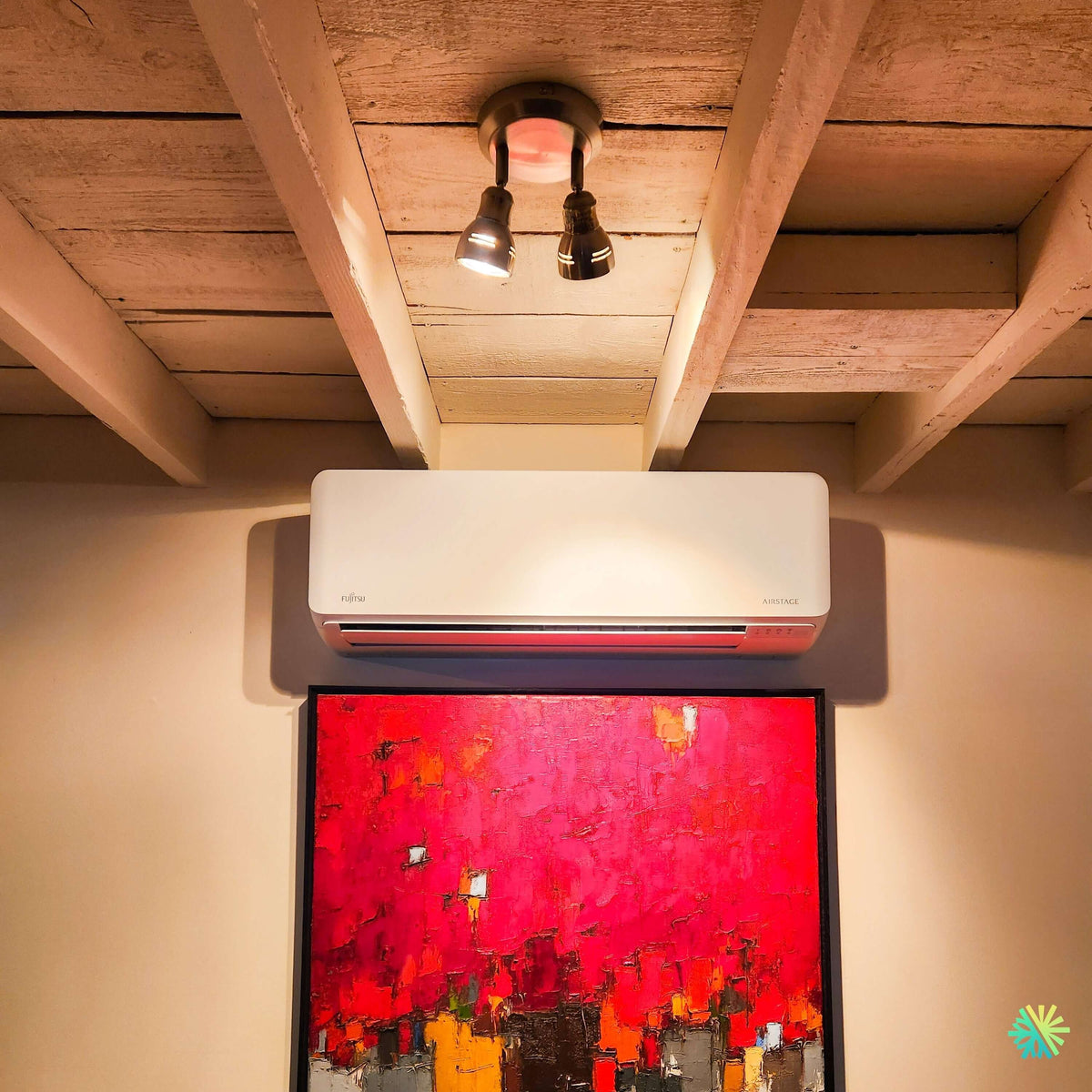
In Pierrefonds-Roxboro, AirGreen installs a Fujitsu Aquila XLTH dual-zone heat pump beneath an exposed-beam ceiling, with careful integration above a work of art.
- City
- Region
- Equipment
- Brand
- Challenges
- Published
The job on one screen
The article, chapter by chapter
A precisely integrated wall-mounted unit beneath an exposed-beam ceiling
This installation of a Fujitsu Aquila XLTH dual-zone heat pump in Pierrefonds-Roxboro presented a particularly interesting indoor constraint: integrating a modern wall-mounted unit into a room with a low ceiling, accented by exposed beams, with a large-format painting already occupying the center of the wall.
Our AirGreen team had to find a location that would provide good air circulation, reasonable access for maintenance, reliable drainage, and visual integration consistent with the existing layout. In the photograph, the Fujitsu AIRSTAGE indoor unit is installed directly above a piece of artwork in red and orange tones, centered on the wall. The result looks simple, but it is based on several technical decisions made even before the first hole was drilled.
In an installation of this type, a few centimeters can make the difference between a well-integrated unit and an appliance that blows against a beam, interferes with lighting, or becomes difficult to clean. The wood ceiling, crossbeams, and light fixture located directly above required a precise analysis of the available space.
The selected solution made it possible to preserve the artwork in place, avoid an off-center installation, and direct airflow toward the occupied area rather than toward the ceiling or decorative elements.
Why a dual-zone heat pump was suitable for this property
A dual-zone heat pump consists of a single outdoor unit connected to two indoor units. Each wall-mounted unit can be controlled separately, allowing the temperature to be adjusted according to how each room is used.
In Pierrefonds-Roxboro, several homes have additions, finished basements, family rooms with unusual ceiling heights, or spaces that do not respond in the same way to the main heating system. Two zones make it possible to better address these differences without installing two separate outdoor compressors.
A dual-zone configuration can be used, among other things, for:
- a living room and a bedroom;
- a ground floor and a basement;
- a family room and an office;
- an extension and the main part of the house;
- two areas separated by a corridor or staircase.
Each indoor unit can be adjusted independently using its remote control. However, it should be made clear that the zones must operate in the same general mode: the system can heat or cool, but it cannot heat one room while simultaneously cooling the other.
This feature is very well suited to a residence when the two spaces have compatible needs. Nevertheless, it must be clearly explained before installation so that occupants understand how the multizone system actually works.
An installation that takes the exposed beams into account
The photograph shows a ceiling made of wooden boards and protruding beams. This architecture creates a warm atmosphere, but it reduces the clear space above the wall-mounted unit.
A Fujitsu heat pump head primarily draws in air through its upper section before processing it and redistributing it through the lower louver. The appliance therefore cannot be installed too close to the ceiling or directly beneath an obstruction that would limit air intake.
We had to take several elements into account:
- the distance between the top of the unit and the beams;
- the position of the light fixture;
- the opening of the front panel;
- access to the filters;
- the projection of the airflow louver;
- the routing point for the lines;
- the available structure behind the wall.
The final choice places the appliance beneath a clear section of the ceiling, between the visible structural elements. This position allows air to enter from above without being completely blocked by the beams.
Avoiding interference from a beam with air intake
When a wall-mounted unit is installed beneath a beam, it is not enough for the appliance to physically fit in the space. Air must also be able to circulate around the upper part.
Insufficient airflow can lead to:
- reduced capacity;
- increased ventilation noise;
- less uniform temperature;
- higher energy consumption;
- prolonged operation;
- faster dust buildup on the filters.
In this room, the clearance had to be assessed according to the actual shape of the ceiling rather than by measuring only the distance between the wall and the first horizontal surface.
The light fixture above the unit: a detail that should have been considered
A two-spotlight fixture is installed directly above the heat pump. This proximity may influence the choice of location, especially if the bulbs produce a lot of heat.
Heat sources located near an indoor unit can interfere with temperature readings if they locally heat the air around the appliance. A sensor detecting artificially warmer air could alter the system’s behavior.
In this installation, the orientation of the spotlights and their use therefore had to be taken into account. It is preferable to avoid directing a hot light source continuously toward the unit's casing or air intake.
This consideration is important in rooms containing:
- halogen spotlights;
- very hot decorative light fixtures;
- fireplaces;
- cooking appliances;
- large-format televisions;
- direct sunlight on the unit.
The system must measure a representative room temperature, not that of a localized hot spot.
A unit installed above a work of art
The large red painting is the wall's main visual element. The Fujitsu unit was installed on the same axis, creating a balanced composition rather than an appliance placed arbitrarily to the side.
However, the location above the painting had to meet several technical criteria.
The supply louver must not direct air against the frame
Airflow exits from the bottom of the unit. If the unit is installed too close to a large object, the air stream may strike the obstacle directly and return toward the unit.
The painting is low enough to allow the louver to operate and let the air project forward. This clearance helps maintain effective air distribution in the room.
Poor positioning could cause:
- a return of warm or cool air toward the unit;
- uneven temperature;
- increased noise;
- a concentrated draft;
- a decrease in perceived performance.
Protecting items located beneath the unit
Every indoor unit produces condensation water in cooling mode. This water must drain properly through the drain.
When a work of art, piece of furniture, or electronic device is located beneath the heat pump, drainage quality becomes even more important. A leak from a poorly adjusted fitting, a blocked drain, or an incorrect slope could damage the objects placed below.
We therefore pay particular attention to:
- drain slope;
- fitting tightness;
- condensate pan stability;
- flow testing;
- line insulation;
- condensation prevention on the pipes.
In this project, the presence of the painting required an especially neat installation and a complete drainage check before the room was put back into service.
How the Fujitsu Aquila XLTH system operates
The Fujitsu AIRSTAGE Aquila range is designed for multi-zone applications. The manufacturer's documentation presents outdoor units of 18,000, 24,000, 36,000, and 45,000 BTU/h, compatible with various combinations of wall-mounted units, compact cassette units, and ducted units.
Cold-climate models can operate in heating mode down to -26 °C, meeting the specific requirements of Greater Montréal winters. Fujitsu also indicates that a multi-zone outdoor unit may allow connected capacity of up to 130%, depending on the permitted combinations.
However, this flexibility does not mean that any units can be combined without calculation. The manufacturer provides precise tables and recommends using its selection software to confirm the configuration.
The documentation also specifies that exceeding 100% of connected capacity does not increase the total capacity produced by the outdoor unit. When both zones operate simultaneously at high demand, the available power is distributed between them.
The Inverter compressor and capacity modulation
The Fujitsu heat pump uses a compressor with Inverter technology. Unlike a unit that operates only at full power or is switched off, the compressor can adjust its speed according to demand.
This modulation makes it possible to:
- to maintain a more stable temperature;
- to reduce differences between cycles;
- to limit repeated starts;
- to adapt energy consumption to the actual load;
- to distribute capacity between the two units;
- to improve acoustic comfort.
In a room like the one shown, where wood surfaces and a low ceiling can affect the perception of sound, modulation of the compressor and fan contributes to quieter operation.
The indoor unit’s location is nevertheless crucial. Even a quiet machine can seem noisy if it is installed in a corner that amplifies sound or directly beneath a rigid structure.
An HVAC installation where aesthetics remain secondary to performance
Choosing the installation height
The unit is installed high on the wall to promote air distribution throughout the room. Cool air tends to descend, while warm air rises. A high position therefore allows the motorized louver to direct the airflow toward the occupied area.
However, the height must remain compatible with maintenance requirements. The filters must be removable and washable without dismantling the unit or moving fixed elements.
In this room, the position was determined based on:
- of the ceiling beams;
- of the artwork’s height;
- of the light fixture;
- of the line routing;
- of the airflow range;
- of future access to the front panel.
A unit installed too low would have reduced the space above the artwork. A unit installed too high could have restricted air intake and made it more difficult to open the panel.
The discreet routing of the lines
A dual-zone wall-mounted unit must be connected to the outdoor unit by two refrigerant lines, a communication and power cable as required by the system, and a condensate drain.
The exit point must be determined before securing the wall plate. A shift of a few centimeters can result in:
- an off-center unit;
- a bend in the pipes that is too tight;
- an insufficient drain slope;
- a housing that does not sit properly;
- unnecessarily visible pipes in the room.
In an installation above a display cabinet, it is especially important to avoid an exposed interior drop that would detract from the wall design.
We therefore plan the pipe route based on the structure, outdoor access, and obstacles present in the room.
Sizing: more complex than a square-foot rule
The photograph cannot establish the exact capacity of the installed unit. Sizing must be based on an analysis of the building, not solely on the width of the room.
We consider, among other factors:
- the floor area;
- the ceiling height;
- the number of exterior walls;
- the type of insulation;
- the amount of glazing;
- solar exposure;
- air infiltration;
- the floor;
- the use of the room;
- the capacity of the other zone;
- the simultaneous demand of both units.
In a dual-zone system, each indoor head may appear properly sized when operating alone, but the combination must also be checked when both zones call for heating or cooling at the same time.
Why oversizing can compromise comfort
An oversized unit can quickly reach the desired temperature and then greatly reduce its operation or shut off. In cooling mode, this can limit dehumidification.
The room becomes cool but remains humid. Occupants may then lower the setpoint further, increasing consumption without completely resolving the humidity problem.
Proper sizing therefore seeks a balance between:
- peak capacity;
- minimum modulation;
- cycle duration;
- dehumidification;
- low-temperature performance;
- the distribution between the two zones.
Mistakes to avoid in a room with an exposed ceiling
Installing the unit beneath a beam without checking the airflow
A beam can block the upper intake even if the unit appears to fit well in the space.
Neglecting the heat produced by lighting
A hot projector near the sensor can distort the temperature reading.
Placing the unit too close to a work of art or a piece of furniture
The louver must be able to open completely and direct air beyond the objects beneath the unit.
Making the filters inaccessible
An aesthetically pleasing installation that prevents maintenance quickly becomes problematic.
Drilling before confirming the drainage
The drain must have an adequate slope. The opening should not be chosen solely based on the shortest route outside.
Using an approximate capacity
A general BTU-per-square-foot rule does not account for windows, insulation, beams, the floor of the home, or the simultaneous behavior of the zones.
Recommended maintenance for a Fujitsu wall-mounted heat pump
Filters should be inspected regularly. In a frequently used room, dust, textile fibers, and particles can accumulate quickly.
Routine maintenance includes:
- cleaning the filters;
- inspecting the indoor coil;
- checking the drain;
- examining the fan;
- checking the lines;
- inspecting the outdoor unit;
- removing leaves and debris;
- observing unusual noises.
A decrease in airflow is often caused by dirty filters. When air does not circulate properly, the system runs longer and may seem unable to deliver the same capacity.
For an installation located above a piece of artwork, it is also wise to periodically inspect the underside of the unit to quickly detect any signs of moisture.
An installation suited to the character of the home
This Fujitsu Aquila XLTH dual-zone heat pump installation in Pierrefonds-Roxboro shows that a successful HVAC project is not simply a matter of mounting a unit on an empty wall.
Here, we had to work around a low ceiling, exposed beams, a central light fixture, and a large-format artwork. Our team positioned the unit to preserve the room’s visual balance while maintaining the conditions necessary for its operation.
The unit is centered, the shutter remains unobstructed, the upper intake is not completely blocked, and the panel can remain in place. At the same time, the dual-zone system can serve a second area of the home from the same outdoor unit.
At AirGreen, we install multi-zone heat pumps, wall-mounted air conditioners, and heating systems in Montreal, Laval, Longueuil, the North Shore, and the South Shore.
Each project is planned according to the building’s structure, interior layout, heating and cooling requirements, and future maintenance needs. This approach is particularly important in homes where walls, ceilings, and decorative elements leave little room for improvisation.
A proper installation should be aesthetically pleasing on the day of the work, but also functional during a heat wave, reliable throughout the winter, and accessible several years later. It is this combination of precision, planning, and technical understanding that allows the Fujitsu heat pump to provide lasting comfort in both areas of the property.
The job tools
Two quick checks with real numbers: what heat costs, and what your current heaters add up to in BTU/h.
Conversion: 1 W = 3.412 BTU/h. An indication, not a load calculation: baseboards and furnaces are often stronger than the real need, and they can stay as backup. AirGreen confirms the capacity on site.
How the job unfolds
The main steps of this kind of job at AirGreen. Every house has its quirks: the estimate brings them out.
We look at the room, the outside wall, the line route and where the outdoor unit will go. That is where the capacity gets chosen.
Model, capacity and price, in writing. We also check whether the model qualifies for assistance programs.
Floors and furniture protected, wall plate position marked level, wall opening located.
A single opening, with the slope the drain needs to flow outside.
Set on a stand raised above the snow, with the clearances the manufacturer requires.
Connected, insulated and protected. The opening is then sealed against water, cold air and insects.
A dedicated circuit and an accessible disconnect near the outdoor unit.
Leak test, vacuum, then start-up and a check of heating and cooling.
Remote, modes, filters: we show you the essentials before we leave.
- The on-site estimateWe look at the room, the outside wall, the line route and where the outdoor unit will go. That is where the capacity gets chosen.
- The quoteModel, capacity and price, in writing. We also check whether the model qualifies for assistance programs.
- Getting readyFloors and furniture protected, wall plate position marked level, wall opening located.
- The wall openingA single opening, with the slope the drain needs to flow outside.
- The outdoor unitSet on a stand raised above the snow, with the clearances the manufacturer requires.
- Lines, cable and drainConnected, insulated and protected. The opening is then sealed against water, cold air and insects.
- The electrical workA dedicated circuit and an accessible disconnect near the outdoor unit.
- Tests and start-upLeak test, vacuum, then start-up and a check of heating and cooling.
- The walkthroughRemote, modes, filters: we show you the essentials before we leave.
What we check on a job like this one
Each number is a point we check on site. Switch between summer and winter to watch air and heat move.
In summer, the outdoor unit rejects the house's heat outside.
Generic illustration of this type of installation, not a survey of this job site. Tap a number.
Mounted level on a wall plate, high enough for the air to reach the whole room, with enough space around it to slide the filters out easily.
The refrigerant lines, the communication cable and the drain go through the wall in a single opening, sealed against water, cold air and insects.
Two insulated copper pipes connect the two units. Outside, a line cover can protect them from sun, knocks and weather.
A shut-off switch near the outdoor unit isolates it safely for service. It must stay accessible at all times.
The compressor and the fan. In heating mode it captures heat from the outdoor air, even in winter, and moves it inside.
On the ground or on the wall, it keeps the unit above accumulated snow. The unit stays clear and defrost water can drain away.
The fan needs to blow freely. Storage, a fence or a wall too close, and efficiency drops while noise goes up.
Is your home ready?
Check what applies at your place. A "no" is not a refusal: it is what we sort out during the estimate.
Good habits, once the unit is in place
Six simple habits that keep the unit going. Your list stays on this device.
What to do, season by season
Three habits per season for this unit. They take a few minutes and prevent many calls.
- Clean the indoor unit's filters.
- Clear leaves and debris left on the outdoor unit by winter.
- Test cooling before the first hot days.
- Clean the filters more often when the unit runs a lot.
- Keep plants away from the outdoor unit.
- Check that no water drips from the indoor unit.
- Rake the leaves around the outdoor unit.
- Test heating before the first cold days.
- Book periodic maintenance before winter.
- Keep snow away from the stand and the front of the unit.
- Let the unit defrost: it is normal.
- Never hit the ice on the fins; call us if the unit stays iced up.
The right pages, at the right time
Four statements: true or false?
It all comes down to details you have just seen.
1. In heating mode, the outdoor unit can produce water.
During defrost cycles. That water must drain away without forming ice.
2. You pick the capacity with a simple square-footage rule.
Windows, insulation, orientation and how the room is used all count. Capacity is chosen on site.
3. A multi-zone connects several indoor heads to a single condenser.
One head per room, all on the same condenser. Each room keeps its own temperature.
4. The disconnect can sit behind the patio furniture.
It must stay accessible: it is what shuts the unit off for service.
0 / 4 right answers
What people ask us about this kind of work
Does a wall-mounted heat pump heat in winter?
Wall-mounted or multi-zone: how do I choose?
Where does the outdoor unit go?
Are there grants?
Do I need a permit?
How cold can it heat?
How much can I save?
How is the LogisVert assistance calculated?
Is it noisy?
The outdoor unit is covered in ice: is that normal?
Does AirGreen hold the required licences?
Is the estimate free?
No question matches. Write to us: we answer.
More jobs to see, near you
By town, by equipment or by region: browse more than 4,700 published projects.
Each dot: a town where AirGreen has published projects. The glowing dot: this job.
An on-site estimate, the right capacity, the right equipment.
The on-site estimate is free and the quote follows within 24 hours.
Text and photo: a real AirGreen Climatisation & Chauffage job. The diagrams are generic illustrations of the type of installation, not a survey of this job site. Sources of the added figures: airgreen.ca product pages (NEEP / AHRI performance), Hydro-Québec (Heat pumps page, LogisVert, read on 13 October 2026), Régie de l’énergie (rate D as of 1 April 2026).