
Installation of a Hitachi airCore 700 central heat pump in Mercier–Hochelaga-Maisonneuve, Montreal
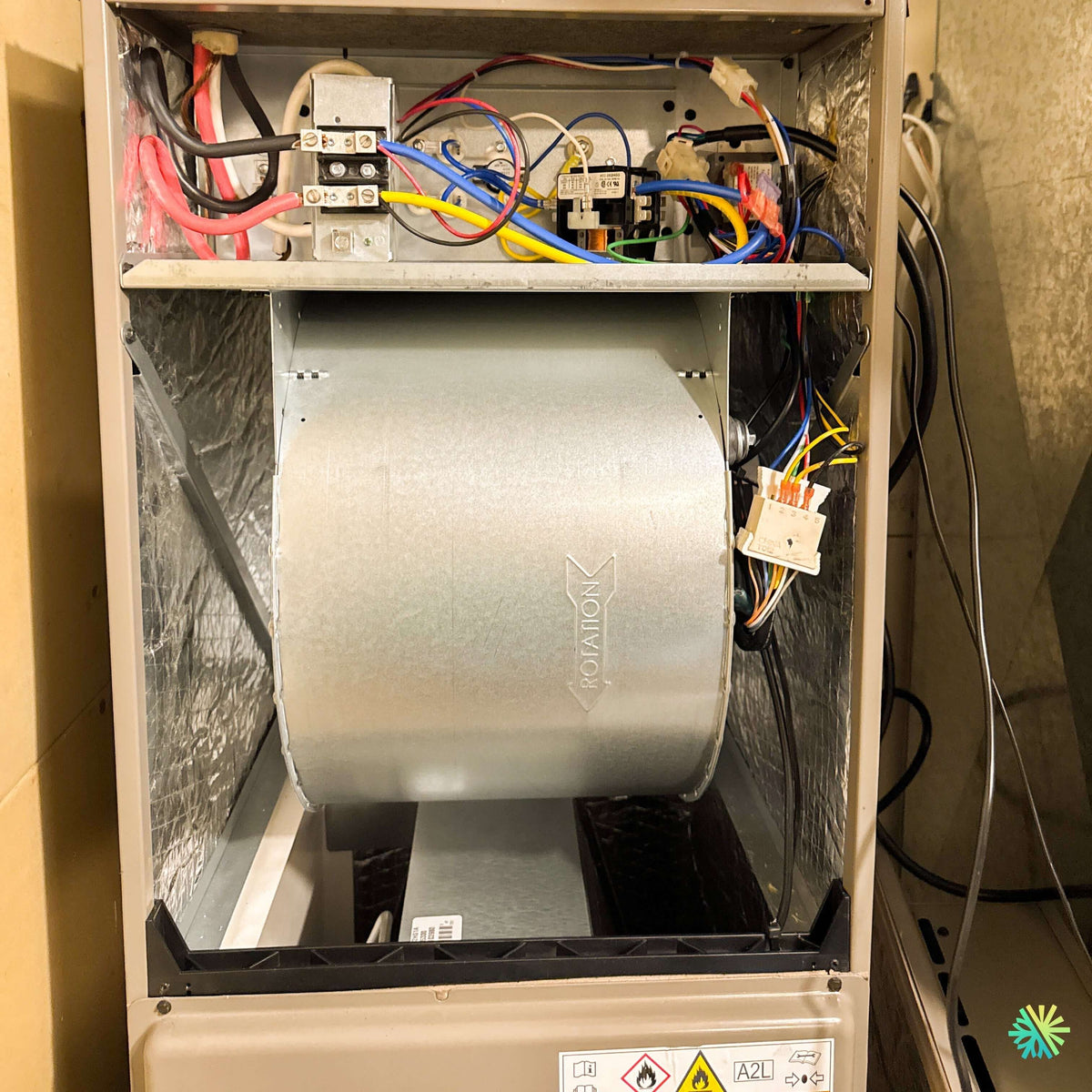
Interior view of a Hitachi airCore 700 central heat pump installed in Mercier–Hochelaga-Maisonneuve: ECM motor, electrical controls, R32 A2L refrigerant, and precise airflow adjustment.
Take a tour of the installation
Each number is a point we check on site. Switch between summer and winter to watch air and heat move.
In summer, the outdoor unit rejects the house's heat outside.
Generic illustration of this type of installation, not a survey of this job site. Tap a number.
It captures or rejects heat outside. It sits on a level base, above the snow, with free space all around.
The insulated refrigerant lines enter the house through a sealed opening and run to the indoor coil.
A shut-off switch near the outdoor unit isolates it safely for service.
Sitting on the indoor module, it moves heat between the house air and the refrigerant.
Electric furnace or air handler: its fan pushes air through the ducts. The electric backup takes over in extreme cold.
Supply ducts bring air to the rooms; returns bring it back to the unit. Their condition matters as much as the unit's.
It protects the coil and the fan. A dirty filter cuts airflow, so it gets checked regularly.
It runs the heat pump and the backup heat. It must be compatible with the installed system.
The system's inner workings revealed: a central installation where airflow, electricity, and R32 safety must work together
The photo taken during this Hitachi airCore 700 central heat pump installation in Mercier–Hochelaga-Maisonneuve shows a part that homeowners rarely see: the inside of the air handler before its access panels are fully closed.
At the center of the cabinet is the metal housing of the centrifugal fan. In the upper section, we can see the terminal blocks, relays, control wires, and power cables required for the system to operate. Lower down, a safety label clearly indicates the presence of a refrigerant in the A2L, particularly important information for an installation operating with R32.
This image clearly illustrates the difference between simply replacing a unit and carrying out a true HVAC installation. A central heat pump must communicate properly with the outdoor unit, move the correct volume of air through the ducts, handle thermostat demands, drain condensate, and comply with the new requirements associated with A2L refrigerants.
In this residence in the Mercier–Hochelaga-Maisonneuve borough of Montréal, our work therefore focused equally on the quality of the mechanical assembly, electrical controls, airflow, and commissioning.
An air handler designed to work with the home's ductwork
The Hitachi airCore 700 heat pump can be paired with several categories of indoor units. In this project, the system uses a central air handler connected to the property's ductwork.
Unlike a wall-mounted air conditioner, which mainly conditions the room in which it is installed, a central heat pump distributes heated or cooled air to multiple spaces through existing or newly adapted ductwork.
This configuration may be suitable for homes in Mercier–Hochelaga-Maisonneuve that already have:
- an old electric, gas, or oil furnace;
- a network of ducts in the walls, basement, or ceilings;
- supply grilles in several rooms;
- a central air return intake;
- a mechanical room for installing a new indoor unit.
According to Hitachi documentation, the airCore 700 air handler range is available in nominal capacities of 18,000, 24,000, 30,000, 36,000, and 48,000 BTU/h. However, the precise capacity installed in a property must never be determined from the photo or floor area alone.
We must consider the building's actual heat load, the quality of the insulation, the number of windows, sun exposure, air infiltration, and the ducts' ability to carry the required airflow.
What the photo of this installation shows precisely
The indoor unit's service panel was removed to allow our technical inspections. This step provides access to the fan compartment and the electrical section.
The centrifugal fan and its metal housing
The large metal component visible in the center is the housing of the centrifugal fan. A rotation indicator is stamped on its surface to show the intended operating direction.
The fan is a key element of comfort. It must draw in return air, pass it through the filter and coil, and then push it into the supply ducts.
An improperly configured fan can result in:
- insufficient airflow in remote rooms;
- excessive noise at the grilles;
- excessive static pressure;
- inadequate heat exchange;
- a risk of the coil freezing in cooling mode;
- an irregular discharge-air temperature;
- unnecessarily high power consumption.
The airCore 700 air handler uses a five-speed ECM motor. According to Hitachi, this design aims to improve system compatibility and reduce the power consumed by the fan by approximately 10% compared with certain conventional configurations.
The speed is not selected at random. We must adjust it based on the tonnage, ductwork, filter, static pressure, and airflow required by the manufacturer.
The upper electrical compartment
In the upper part of the photo, several conductors of different colors connect the control components, terminal blocks, and power devices.
This section manages, among other things:
- power to the fan motor;
- heating and cooling requests;
- communication with the outdoor unit;
- the wall controller signals;
- the safety devices;
- certain accessories or auxiliary heating elements, depending on the configuration.
The larger-gauge wires and terminal blocks must be tightened to the appropriate torque. A loose connection can create electrical resistance, generate heat, and potentially damage a terminal or component.
During commissioning, we therefore check the connections, voltage, polarity where applicable, continuity of the control conductors, and grounding.
The A2L label visible on the lower panel
The lower part of the unit displays safety pictograms, including the identification A2L. This classification applies to mildly flammable refrigerants, such as the R32 used by the airCore 700 range.
R32 is not handled in the same way as a common older refrigerant. Installation requires, in particular:
- tools compatible with the refrigerant used;
- adequate ventilation of the work area;
- elimination of potential ignition sources;
- procedures adapted for leak testing and evacuation;
- compliance with minimum volume requirements and applicable requirements;
- proper technician training;
- particular attention to the refrigeration connections.
Hitachi documentation specifies that the airCore 700 air handler is designed for A2L refrigerant and that a R32 detection sensor is installed at the factory. It also features a cabinet approximately 20.5 inches wide and a five-speed ECM motor, two useful characteristics when integrating it into a restricted mechanical space.
Why R32 Is Used in the Hitachi airCore 700
R32 has an announced global warming potential of 675, lower than that of several refrigerants previously used in residential systems.
Its use can help improve the unit’s efficiency and reduce the total amount of refrigerant required for certain applications. However, it requires additional discipline during installation and maintenance.
At AirGreen, we do not consider the A2L label a mere formality affixed to the cabinet. It influences the work method, job-site preparation, tools used, and final inspection.
The refrigerant sensor does not replace a leak-tight installation
An integrated detector is a safety measure, but it does not correct a faulty connection.
The first line of protection remains a properly performed refrigeration installation:
- clean cutting of the lines;
- proper flaring where required;
- tightening to the specified values;
- pressure testing with the appropriate gas;
- leak detection;
- deep evacuation;
- vacuum-hold test;
- releasing or adjusting the charge according to the installed length.
These steps reduce the risk of leaks and protect the compressor from moisture, air, and contaminants.
Adapting to homes in Mercier–Hochelaga-Maisonneuve
The borough includes a large number of duplexes, triplexes, row houses, and homes renovated at different times. As a result, ductwork systems can vary considerably from one building to another.
In some projects, we find ductwork installed for an older high-temperature furnace. In others, the ductwork has been modified several times over the course of renovations, with reduced sections, added branches, or insufficient return-air capacity.
A modern heat pump generally produces heated air at a more moderate temperature than a traditional furnace. It must therefore move an adequate volume of air during longer cycles.
A ductwork inspection before selecting the fan speed
Before the final programming of the ECM motor, we examine:
- the main duct size;
- the return-air area;
- the number of grilles;
- the condition of flexible ducts;
- restrictions near elbows;
- the filter's size and density;
- the presence of closed dampers;
- air leakage at the joints;
- the total static pressure.
An ECM motor can increase its effort to maintain the requested airflow. This does not mean it can resolve every deficiency in the system.
When resistance becomes excessive, the motor may consume more power, produce more noise, and be subjected to unnecessary strain. It is therefore preferable to correct the ductwork or return air rather than mask the problem with a higher speed.
Sizing: an independent step from the capacity of the old furnace
A common mistake is to replace an old 80,000 or 100,000 BTU/h furnace with a heat pump selected based solely on that figure.
The capacity listed on an old furnace may represent the input power rather than the heat actually delivered to the home. In addition, many older systems were oversized.
For this Hitachi central heat pump installation in Montreal, sizing should instead take into account:
- heat losses at the winter design temperature;
- summer heat gains;
- the heat pump's actual heating capacity at low temperatures;
- the ductwork capacity;
- the available auxiliary heating;
- the type of residence and number of levels;
- the occupants' comfort preferences.
An oversized heat pump may run excessively short cooling cycles, reducing humidity control. An undersized unit may rely too quickly on auxiliary heating during the winter.
Energy efficiency of the Hitachi airCore 700
The Hitachi airCore 700 range includes standard versions and HeatForce versions. Performance varies according to the outdoor unit, indoor unit, and selected capacity.
For combinations with a central air handler, the manufacturer indicates an efficiency of approximately:
- 18 SEER2;
- 11.7 EER2, depending on the capacity.
The HeatForce versions of certain configurations are designed to better maintain their capacity in low temperatures. The documentation notably presents a heating capacity of up to 100% at -15 °C and over 70% at -25 °C, under the stated test conditions.
These data must not be applied automatically to all airCore 700 units. The exact combination must be confirmed based on:
- the outdoor unit model;
- the indoor unit model;
- the AHRI number;
- the rated capacity;
- the standard or HeatForce version.
Auxiliary heating and management of cold-weather peaks
A central installation in Quebec may include an auxiliary electrical element. It may operate when the heat pump is not sufficient to meet demand, during certain defrost cycles, or when a particular setpoint requires it.
The capacity of the electrical element must be coordinated with:
- the electrical panel;
- the conductor capacity;
- the circuit breaker;
- the building's total load;
- the manufacturer's requirements;
- the calculated needs of the home.
An oversized element can place an unnecessary load on the electrical service. An undersized element may not provide the expected support if the outdoor unit fails or during a period of extreme cold.
The goal is not to operate the electrical elements continuously. The control strategy should prioritize the heat pump whenever its operating conditions allow.
Commissioning the unit after closing the panels
The photo shows the unit during an inspection phase. Before putting the panels back in place, we verify that the conductors are properly positioned and that no wire could come into contact with a moving component.
Once the unit is closed, our commissioning process generally includes:
- checking the electrical power supply;
- confirming communications;
- testing the fan;
- measuring static pressure;
- checking airflow;
- testing in cooling mode;
- testing in heating mode;
- inspecting the condensate drain;
- reading return-air and supply-air temperatures;
- checking fault codes;
- programming the controller;
- explaining how it operates to the homeowner.
Why the panels must be closed for final measurements
The fan and heat exchanger are designed to operate with a closed cabinet. Measuring airflow or pressure with a panel removed may produce a result that does not represent actual operating conditions.
We therefore perform certain visual inspections with the panel open, followed by operating measurements with the unit properly closed.
Potential eligibility for financial assistance
The Hitachi airCore 700 lineup includes ENERGY STAR-certified combinations, and certain HeatForce versions are advertised as ENERGY STAR Cold Climate certified.
This does not mean that every unit bearing the airCore 700 name is automatically eligible for all subsidies available in Quebec.
Validation must be performed using the complete references for both units and the AHRI number. We also verify:
- the program in effect on the project date;
- the type of dwelling;
- the capacity recognized by the program;
- the purchase date;
- the installation date;
- the required documents;
- the replaced system, when this criterion applies.
For the homeowner, this verification before signing is more useful than an estimate based solely on the brand or on a maximum value stated in a brochure.
The errors we seek to avoid in a central installation
Closing the unit without checking the electrical compartment
A misplaced wire, a loose connection, or a partially engaged connector can cause an intermittent failure that is difficult to diagnose.
Adjusting the fan without measuring static pressure
Selecting a speed solely by ear does not confirm the actual airflow.
Installing a filter that is too restrictive
A very dense filter installed in a holder that is too small can significantly reduce airflow. Quality filtration must be sized according to the available surface area.
Ignoring the requirements for A2L refrigerant
Using R32 requires specific methods. Old work practices cannot be applied without adaptation.
Choosing capacity based solely on the old equipment
The replacement must be based on the building's current needs, not on a nameplate dating back several decades.
Confusing the range's maximum efficiency with the efficiency of the central combination
The values obtained with a cassette or wall-mounted unit may differ from those of a central air handler.
A properly installed central heat pump starts in the cabinet, not at the thermostat
This Hitachi airCore 700 installation in Mercier–Hochelaga-Maisonneuve highlights the invisible work that supports everyday comfort.
When the homeowner adjusts the temperature, they do not see the ECM motor, relays, terminal blocks, the sensor associated with R32 refrigerant, or the airflow adjustments. Yet these are precisely the elements that determine whether the home will be comfortable, quiet, and heated efficiently.
At AirGreen, we approach every central heat pump installation as a complete system. We check the equipment, but also the ductwork, electrical system, drainage, controls, static pressure, and future maintenance requirements.
We apply this method in Montréal, particularly in Mercier–Hochelaga-Maisonneuve, as well as in Laval, Longueuil, the North Shore, and the South Shore. The goal remains the same: to install an HVAC system whose actual performance matches its stated capacity and the property's needs.
The big day, step by step
The main steps of this kind of job at AirGreen. Every house has its quirks: the estimate brings them out.
We look at the ducts, the current indoor module, the electrical panel and the planned spot for the outdoor unit.
The equipment combination, capacity and price, in writing. We check whether the combination qualifies for assistance programs.
Access protected, old unit disconnected and removed when it is being replaced.
Electric furnace or air handler, with its coil, connected to the supply and return ducts.
On a level base, raised above the snow, with free space all around.
Insulated, they enter through a sealed opening and run to the indoor coil.
Dedicated circuits, accessible disconnect, a thermostat that works with the heat pump and the backup heat.
Leak test, vacuum, start-up, airflow check and a test of both modes.
Filter, thermostat, backup heat in extreme cold: what to know before winter.
- The on-site estimateWe look at the ducts, the current indoor module, the electrical panel and the planned spot for the outdoor unit.
- The quoteThe equipment combination, capacity and price, in writing. We check whether the combination qualifies for assistance programs.
- Getting readyAccess protected, old unit disconnected and removed when it is being replaced.
- The indoor moduleElectric furnace or air handler, with its coil, connected to the supply and return ducts.
- The outdoor unitOn a level base, raised above the snow, with free space all around.
- The refrigerant linesInsulated, they enter through a sealed opening and run to the indoor coil.
- Electrical and thermostatDedicated circuits, accessible disconnect, a thermostat that works with the heat pump and the backup heat.
- Tests and start-upLeak test, vacuum, start-up, airflow check and a test of both modes.
- The walkthroughFilter, thermostat, backup heat in extreme cold: what to know before winter.
What would it look like at your place?
Two quick checks with real numbers: what heat costs, and what your current heaters add up to in BTU/h.
Conversion: 1 W = 3.412 BTU/h. An indication, not a load calculation: baseboards and furnaces are often stronger than the real need, and they can stay as backup. AirGreen confirms the capacity on site.
Four mistakes we do not make
Flip each card to see what we do instead.
Your own project, step by step
What to do, season by season
Three habits per season for this unit. They take a few minutes and prevent many calls.
- Check the indoor module's filter.
- Clear winter debris from the outdoor unit.
- Test cooling before the heat arrives.
- Check the filter more often in peak season.
- Keep registers and returns clear.
- Watch condensate drainage near the coil.
- Change or clean the filter.
- Test heating and backup heat before the cold.
- Book periodic maintenance.
- Clear snow around the outdoor unit.
- Store nothing in front of the indoor module.
- Note any unusual noise or smell and call us.
Is your home ready?
Check what applies at your place. A "no" is not a refusal: it is what we sort out during the estimate.
Four statements: true or false?
It all comes down to details you have just seen.
1. A central heat pump uses the house's ducts.
It connects to the existing ducts to heat and cool everywhere.
2. In extreme cold, electric backup heat can take over.
The indoor module (furnace or air handler) works with the heat pump and takes over in extreme cold.
3. The filter only gets changed when the unit breaks down.
A dirty filter cuts airflow. It gets checked regularly.
4. You can reuse the old unit's size without checking.
The house may have changed: insulation, windows, added rooms. Capacity is confirmed on site.
0 / 4 right answers
What people ask us about this kind of work
Can I keep my current ducts?
What happens in extreme cold?
Furnace, air handler, ducted: what is the difference?
Are there grants?
Do I need a permit?
How much can I save?
How is the LogisVert assistance calculated?
Will my current thermostat work?
Central or wall units: which one?
Does AirGreen hold the required licences?
Is the estimate free?
No question matches. Write to us: we answer.
More jobs to see, near you
By town, by equipment or by region: browse more than 4,700 published projects.
Each dot: a town where AirGreen has published projects. The glowing dot: this job.
Every house has its constraints. We see them before we install.
The on-site estimate is free and the quote follows within 24 hours.
Text and photo: a real AirGreen Climatisation & Chauffage job. The diagrams are generic illustrations of the type of installation, not a survey of this job site. Sources of the added figures: airgreen.ca product pages (NEEP / AHRI performance), Hydro-Québec (Heat pumps page, LogisVert, read on 13 October 2026), Régie de l’énergie (rate D as of 1 April 2026).