
Installation of a MIDEA EVOX G3 central heat pump in Lachine, Montreal
In Lachine, AirGreen installs a MIDEA EVOX G3 central heat pump on an elevated stand, with compact connections, inverter technology, R-454B, and a design adapted to Montreal's winter heating needs.
In summer, the outdoor unit rejects the house's heat outside.
Generic illustration of this type of installation, not a survey of this job site. Tap a number.
It captures or rejects heat outside. It sits on a level base, above the snow, with free space all around.
The insulated refrigerant lines enter the house through a sealed opening and run to the indoor coil.
A shut-off switch near the outdoor unit isolates it safely for service.
Sitting on the indoor module, it moves heat between the house air and the refrigerant.
Electric furnace or air handler: its fan pushes air through the ducts. The electric backup takes over in extreme cold.
Supply ducts bring air to the rooms; returns bring it back to the unit. Their condition matters as much as the unit's.
It protects the coil and the fan. A dirty filter cuts airflow, so it gets checked regularly.
It runs the heat pump and the backup heat. It must be compatible with the installed system.
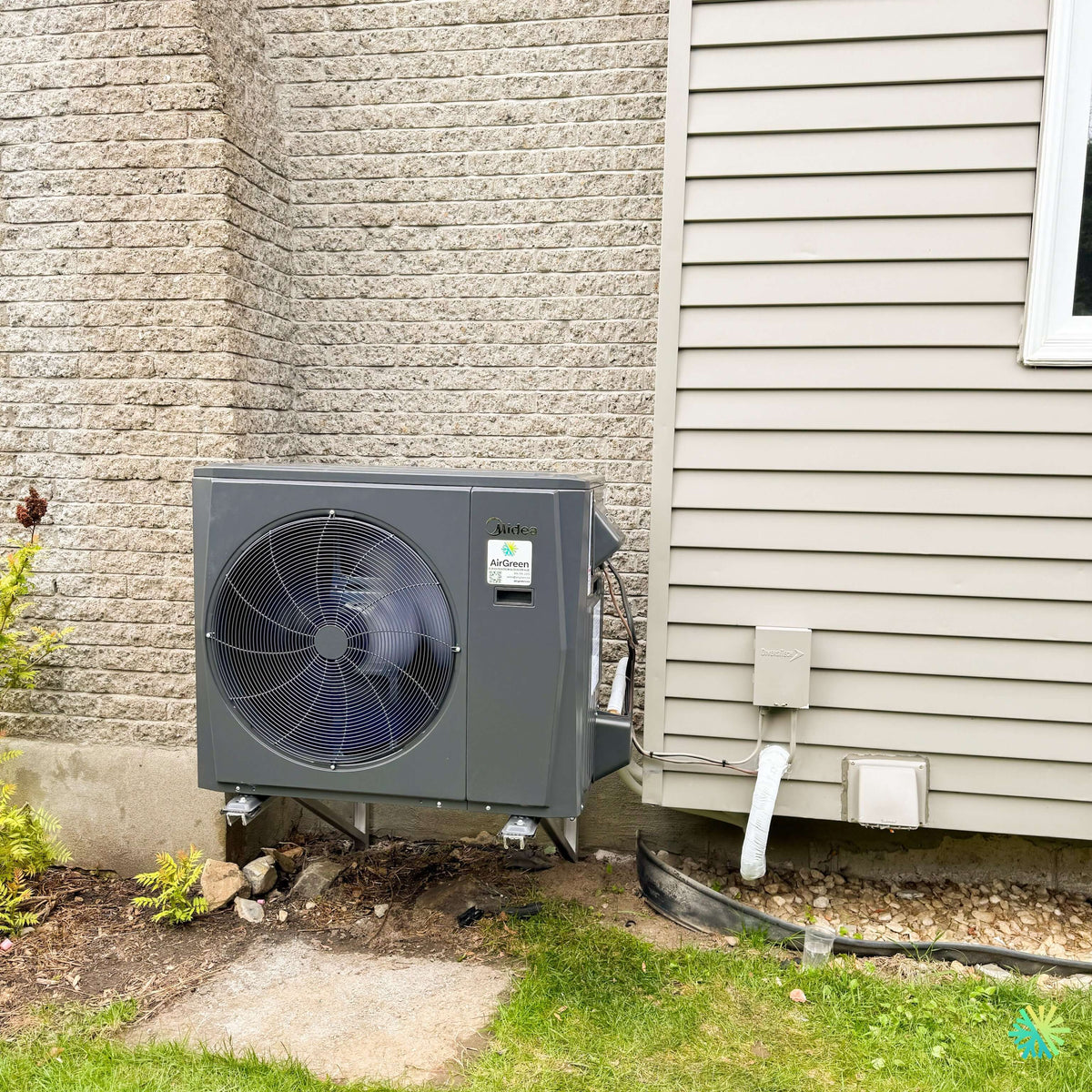
In Lachine, an EVOX G3 central installation integrated into a narrow space between masonry, vinyl siding, and existing services
On this project completed in Lachine, in western Montreal, installation quality depended as much on choosing the MIDEA EVOX G3 central heat pump as on its physical integration with the house. The project photo shows a situation typical of existing Montreal residences: no immense outdoor mechanical space is waiting for the new unit. We must work with the construction already in place, the openings, the electrical system, the architectural finishes, and the space available around the foundation.
Here, the outdoor unit is located exactly where two materials meet: a light brick façade on the left and a wall covered with vinyl on the right. Just a few feet away are the electrical disconnect, a wall outlet, and the passage for the lines leading indoors. Rather than unnecessarily moving the machine farther away and extending the refrigerant circuit, we created a compact, accessible installation adapted to Montreal winters.
The MIDEA EVOX G3 is installed on a raised metal support anchored to the foundation. This keeps the condenser away from the ground, leaving a clear area beneath the unit for snow and water produced during defrost cycles.
This EVOX G3 generation belongs to the family of MIDEA inverter ducted central systems, developed in particular to modernize existing residential systems.
A location at the junction of two façades that required careful planning
The first thing we notice about this Lachine installation is the angle of the building.
On the left, the masonry forms a return that naturally frames the mechanical space. On the right, the vinyl siding already includes several technical elements. We had to position the EVOX G3 close enough to the house to maintain a logical connection, without enclosing its heat exchanger or making its service compartment inaccessible.
The large front fan faces an open area. This detail is important because the EVOX G3 operates with a horizontal air discharge.
MIDEA explains in its documentation that its outdoor unit combines a horizontal fan with a vertical heat exchanger to produce a more uniform airflow across the heat exchanger's surface.
We must therefore never choose a location solely because the unit physically fits there. Air must be able to circulate.
In Lachine, where many properties have relatively narrow side passages, patios, fences, and nearby structures, this distinction becomes particularly important.
Why we installed the heat pump above ground level
The metal support visible beneath the unit is much more than a finishing detail.
A central heat pump designed for cold climates continues to operate when the outdoor temperature is well below freezing. During operation, frost periodically forms on the outdoor heat exchanger. The system then initiates a defrost cycle.
The water resulting from this cycle falls beneath the condenser.
If the unit sits almost at ground level, this water can refreeze and contribute to ice buildup at its base. Natural snowfall and snow moved during snow removal can then add to this buildup.
By raising the EVOX G3, we therefore create useful clearance for:
- snow accumulation;
- drainage of defrost water;
- reducing the risk of ice forming directly against the base;
- inspection of the underside of the unit;
- better access for future HVAC maintenance.
For an installation in Montreal, this height is not a luxury. It directly helps make winter use of a low-temperature heat pump practical.
A system designed to operate in heating mode down to -30 °C
Winter capabilities are precisely one of the interesting aspects of the EVOX G3 platform.
MIDEA documentation indicates continuous heating operation down to -30 °C. In the tests presented by the manufacturer for a three-ton system, MIDEA also indicates up to 100% of the rated heating capacity at around -25 °C, with a COP reaching approximately 1.9 under these conditions.
The manufacturer attributes part of this performance to its compressor technology. When temperatures become extremely low, the system uses an intermediate vapor injection to increase the amount of refrigerant being compressed and support heat production.
For a Lachine residence, these characteristics are much more relevant than a simple summer efficiency rating.
Montreal winters impose conditions on a heat pump that are completely different from those encountered in air conditioning in July.
-30 °C indicates an operating range, not the heat load of every home
However, two concepts must be distinguished.
The fact that a heat pump can operate at -30 °C does not automatically mean that it can cover 100% of the heat loss of every residence at that temperature.
Heating load varies enormously depending on:
- area;
- insulation;
- the building's airtightness;
- the windows;
- wind exposure;
- the number of floors;
- the duct configuration;
- the requested indoor temperature.
That is why sizing remains an essential step.
What EVOX G3 capacity do we have in this photo from Lachine?
The photograph clearly identifies an MIDEA EVOX G3 outdoor unit, but the complete number on its nameplate is not legible enough to confirm the precise capacity of this installation with certainty.
We therefore do not arbitrarily assign it a tonnage.
The MIDEA technical data sheet covers several EVOX G3 configurations ranging approximately from 18,000 to 54,000 BTU/h. Depending on the exact combination of outdoor unit and air handler, the range can reach 19 SEER2, 12.5 EER2, 10.8 HSPF2, and a COP of 2.14 at approximately -15 °C.
Here are some of the performance figures published by MIDEA:
| EVOX G3 configuration | SEER2 | EER2 | HSPF2 | Heating capacity at -15 °C | COP at -15 °C |
|---|---|---|---|---|---|
| 18,000 BTU/h | 19,0 | 12,5 | 10,1 | 18,600 BTU/h | 2,12 |
| 24,000 BTU/h | 18,6 | 12,0 | 10,0 | 20,600 BTU/h | 2,14 |
| 30,000 BTU/h | 17,2 | 12,0 | 10,8 | 33,200 BTU/h | 1,97 |
| 36,000 BTU/h | 17,7 | 12,0 | 10,0 | 32,600 BTU/h | 2,06 |
| 48,000 BTU/h | 17,5 | 12,0 | 9,5 | 48,000 BTU/h | 2,00 |
| 54,000 BTU/h | 17,5 | 12,0 | 9,5 | 54,000 BTU/h | 1,90 |
These data appear in the specifications table for the third-generation EVOX G3.
The very compact route of the connections is a tangible advantage of this layout
The right side of the photo shows the connections quickly reaching the building.
In particular, we can see the refrigerant lines entering the service compartment, their insulation, as well as the nearby electrical connection.
Limiting unnecessary detours has several advantages: the installation looks cleaner, the piping is easier to protect, and the route remains simpler to inspect.
This does not mean that a refrigerant line must be “as short as possible” at any cost. The minimum and maximum lengths prescribed by the manufacturer, as well as the installation requirements, must always be respected. But when a location naturally allows for a coherent route, we avoid creating dozens of extra feet of piping without reason.
The electrical disconnect was kept in an accessible area
To the right of the unit is the electrical disconnect mounted on the house siding.
It must remain accessible.
During technical service, some work requires the equipment to be electrically isolated. Positioning the condenser in front of the disconnect switch or too close to its opening would unnecessarily complicate future service.
At this job site, the equipment, disconnect switch, and ductwork are grouped in the same mechanical area while remaining identifiable and accessible.
The AirGreen label also makes it easy to identify the installer
Our identification can be seen on the front of the heat pump.
This detail is intentional. Several years after the installation, the owner or a new occupant can easily find out who carried out the work and who to contact for central heat pump maintenance, a diagnosis, or an inspection.
An HVAC installation is a system that will normally serve the building for many years. Keeping a record of the work is therefore useful.
The outdoor unit is only the visible part: a central EVOX G3 depends primarily on its integration with the home's ductwork
Computational Constant Airflow 2.0: adapting the fan to the system's actual conditions
A central heat pump does not blow directly into a room like a wall-mounted unit. Its air must pass through a complete ductwork system.
The resistance of this system is therefore decisive.
MIDEA equips the EVOX G3 with Computational Constant Airflow 2.0 technology, designed to adjust the capacity and fan speed when system resistance changes.
The documentation presents examples where an airflow of 1,200 CFM is maintained under conditions ranging from 0.4 to 1.2 in. of water column static pressure.
MIDEA also indicates up to 60 airflow adjustment levels, providing greater flexibility during commissioning.
This technology does not, however, make ductwork unimportant.
A severely undersized system, an undersized return air opening, or a crushed duct must still be corrected.
Why reusing old ductwork requires careful verification
When replacing an old furnace or central heat pump in Lachine, we should not assume that the existing ductwork is automatically suitable for the new equipment.
We look at, among other things:
- the size of the main ducts;
- return air;
- static pressure;
- transitions around the indoor unit;
- filtration;
- the airflow required by the new capacity;
- distribution to the various rooms.
A heat pump can show excellent performance figures on its AHRI sheet and deliver an average result if the actual airflow is insufficient.
A modular air-handling unit designed for existing homes
The EVOX G3 indoor unit uses a Block N Lock design that allows different orientations.
The documentation illustrates six possible installations, including vertical, left- or right-horizontal, and certain “low-boy” configurations when ceiling height is limited.
This is particularly interesting in areas such as Lachine, LaSalle, Verdun, or the rest of Montreal, where many homes have existing mechanical rooms with restrictive dimensions.
A modular unit makes the work easier when an appliance must be installed:
- under a beam;
- in a low basement;
- in a narrow mechanical room;
- with a return air connection coming in from the side;
- near a water heater or electrical panel.
A width designed to facilitate the replacement of certain furnaces
For several EVOX G3 indoor units, MIDEA indicates widths ranging approximately from 14.5 to 21.5 inches, dimensions close to those commonly found on residential furnaces.
The product line also provides for adapting the indoor unit's power supply to 115 V or 208/230 V, depending on the application.
This can simplify certain modernization projects.
However, “compatible format” never means that we can install the new unit without checking the rest. The plenum, electrical system, drain, filtration, and return air must always be verified.
Auxiliary heating of up to 25 kW
The EVOX G3 platform can accommodate a three-stage auxiliary electric heating kit, rated for up to 25 kW depending on the configuration.
The advantage of a staged system is that it does not necessarily use the full electrical capacity for every demand.
The auxiliary heat control must be configured correctly. If the electric heating elements start too easily, consumption may increase even though the heat pump would still have been able to handle a significant portion of the heating load.
485 communication, 24 V thermostat, and wireless options
The EVOX G3 offers several control strategies.
MIDEA notably provides:
- communication 485;
- compatibility with certain third-party 24 V thermostats;
- Sub-1 GHz communication between certain MIDEA components;
- automatic recognition of certain control modes.
These options are detailed in the manufacturer's documentation.
This versatility can be valuable in a renovation in Montreal when it is very difficult to run new wires between the mechanical room and the thermostat.
MERV 13 filtration: three possible thicknesses
The platform can also be paired with 1-, 2-, or 4-inch MERV 13 filters.
MIDEA states that this filtration can capture more dust, pollen, particles and pet dander, while helping keep the indoor coil cleaner.
The selection must nevertheless be consistent with the airflow.
An effective filter that is too restrictive for its available surface area can increase static pressure. That is why we analyze filtration and ventilation as a single system.
R-454B: the refrigerant used in this new generation
MIDEA states that it chose R-454B for the current range. The manufacturer gives this A2L refrigerant a global warming potential of 466.
For our technicians, this means that connection, leak-checking, evacuation and commissioning procedures must be adapted to equipment using R-454B.
The homeowner sees almost none of this difference after installation. Nevertheless, it remains important in how the work is carried out.
An inverter heat pump should not be judged by the length of its cycles
When a homeowner replaces an old furnace or an old on-off system, the EVOX G3's behaviour may seem unusual at first.
An inverter system can operate longer at a low output.
This does not necessarily mean that it struggles to reach the desired temperature. On the contrary, modulation helps reduce large temperature fluctuations and avoid repeated starts at full capacity.
This is also why proper sizing remains important: a unit that matches the home's needs can spend more time operating within its efficient range.
Midea SmartHome: scheduling, consumption and diagnostics
With compatible communicating components, the MIDEA platform offers SmartHome-related features, including scheduling, comfort management, certain consumption data, as well as diagnostic and update functions.
For homeowners who want to better understand their heating and cooling consumption, this data can be particularly useful.
LogisVert in 2026: how much could an MIDEA EVOX G3 be worth?
For an installation currently carried out in Quebec, Hydro-Québec indicates that an eligible certified ENERGY STAR heat pump may receive $50 per 1,000 BTU/h of heating capacity at -8 °C, while an appliance certified ENERGY STAR - Cold Climate may receive $120 per 1,000 BTU/h at -8 °C, when all LogisVert program requirements are met. The applicable amount depends on the installation date.
MIDEA documentation, for its part, indicates that the product line delivers performance exceeding the ENERGY STAR Most Efficient specifications illustrated by the manufacturer.
However, this is not enough to automatically announce a subsidy amount.
For our Lachine installation, the following would need to be confirmed:
- the exact model of the condenser;
- the exact model of the indoor unit;
- the certified combination;
- its presence on the applicable list;
- its recognized heating capacity at -8 °C.
It is this recognized capacity, not simply the number of nominal tons, that is used to calculate the financial assistance.
Three mistakes to avoid when installing a central system in an urban area like Lachine
Installing the unit too low
A cold-climate unit must remain sufficiently far from snow and ice accumulation. The support visible in this installation directly addresses this issue.
Neglecting service access
The disconnect switch, refrigeration compartment, and panels must remain accessible. A very compact installation should never become impossible to service.
Choosing the capacity without measuring the ductwork's performance
More BTUs do not necessarily mean greater comfort. Higher capacity also requires a corresponding airflow.
A discreet installation resulting from numerous technical decisions
In the completed photo of our project in Lachine, the overall installation appears relatively simple: the MIDEA EVOX G3 is aligned against the house, the support keeps it above the ground, and the services are grouped nearby.
That is precisely what we strive for.
A proper installation should not look improvised.
The positioning at the junction of the brick and vinyl, the compact routing of the connections, the accessibility of the disconnect switch, the height of the condenser, and the front clearance were all considered to integrate the heat pump into the existing residence.
Indoors, the same principles apply to the ductwork, static pressure, filtration, thermostat, and auxiliary heating.
At AirGreen, this is the approach we apply when installing a central heat pump in Lachine, as well as in Montreal, Laval, Longueuil, on the North Shore and on the South Shore: selecting efficient equipment, but above all providing it with the conditions necessary to truly deliver the performance for which it was designed.
How it goes, from the first call to the end
The main steps of this kind of job at AirGreen. Every house has its quirks: the estimate brings them out.
We look at the ducts, the current indoor module, the electrical panel and the planned spot for the outdoor unit.
The equipment combination, capacity and price, in writing. We check whether the combination qualifies for assistance programs.
Access protected, old unit disconnected and removed when it is being replaced.
Electric furnace or air handler, with its coil, connected to the supply and return ducts.
On a level base, raised above the snow, with free space all around.
Insulated, they enter through a sealed opening and run to the indoor coil.
Dedicated circuits, accessible disconnect, a thermostat that works with the heat pump and the backup heat.
Leak test, vacuum, start-up, airflow check and a test of both modes.
Filter, thermostat, backup heat in extreme cold: what to know before winter.
- The on-site estimateWe look at the ducts, the current indoor module, the electrical panel and the planned spot for the outdoor unit.
- The quoteThe equipment combination, capacity and price, in writing. We check whether the combination qualifies for assistance programs.
- Getting readyAccess protected, old unit disconnected and removed when it is being replaced.
- The indoor moduleElectric furnace or air handler, with its coil, connected to the supply and return ducts.
- The outdoor unitOn a level base, raised above the snow, with free space all around.
- The refrigerant linesInsulated, they enter through a sealed opening and run to the indoor coil.
- Electrical and thermostatDedicated circuits, accessible disconnect, a thermostat that works with the heat pump and the backup heat.
- Tests and start-upLeak test, vacuum, start-up, airflow check and a test of both modes.
- The walkthroughFilter, thermostat, backup heat in extreme cold: what to know before winter.
What the unit delivers when it is cold
The range as published on airgreen.ca: pick a size to see its capacity in deep cold.
| Size | Heating at −8 °C | Heating at −15 °C | Coldest certified point | COP at −15 °C | SEER | HSPF | Indicative LogisVert aid |
|---|---|---|---|---|---|---|---|
| Midea EVOX G3 · 1.5 tons | 14,700 | 18,600 | −30 °C: 11,800 | 2.12 | 19.0 | 10.1 | $1,764 |
| Midea EVOX G3 · 2 tons | 20,800 | 20,600 | −30 °C: 12,100 | 2.14 | 18.6 | 10.0 | $2,496 |
| Midea EVOX G3 · 2.5 tons | 24,000 | 33,200 | −30 °C: 17,900 | 1.97 | 17.2 | 10.8 | $2,880 |
| Midea EVOX G3 · 3 tons | 33,000 | 37,400 | −30 °C: 27,600 | 1.9 | 18.0 | 10.0 | $3,960 |
| Midea EVOX G3 · 4 tons | 39,500 | 48,000 | −30 °C: 27,200 | 2.0 | 17.5 | 9.5 | $4,740 |
| Midea EVOX G3 · 5 tons | 45,000 | 54,000 | −30 °C: 37,300 | 1.9 | 17.5 | 9.5 | $5,400 |
Data read live from the airgreen.ca page of each size (NEEP / AHRI certified performance). When the title names the installed size, it is highlighted; otherwise the whole range is shown. The aid shown is today’s, using Hydro-Québec’s rule ($120 per 1,000 BTU/h at −8 °C); amounts quoted in the article date from its publication. Only Hydro-Québec confirms the assistance granted.
And at your place?
Two quick checks with real numbers: what heat costs, and what your current heaters add up to in BTU/h.
Baseboards and electric furnaces turn 1 kWh of electricity into 1 kWh of heat. A heat pump delivers more: that is its COP. At Hydro-Québec’s rate D (11.142¢/kWh above 40 kWh a day, since 1 April 2026):
Hydro-Québec: a heat pump can be up to three times more efficient than baseboards for heating in the colder months.
Estimate per kWh of heat, at the chosen temperature, using the certified COP from the product page. Taxes, access charge and backup heat not included.
Conversion: 1 W = 3.412 BTU/h. An indication, not a load calculation: baseboards and furnaces are often stronger than the real need, and they can stay as backup. AirGreen confirms the capacity on site.
What to do, season by season
Three habits per season for this unit. They take a few minutes and prevent many calls.
- Check the indoor module's filter.
- Clear winter debris from the outdoor unit.
- Test cooling before the heat arrives.
- Check the filter more often in peak season.
- Keep registers and returns clear.
- Watch condensate drainage near the coil.
- Change or clean the filter.
- Test heating and backup heat before the cold.
- Book periodic maintenance.
- Clear snow around the outdoor unit.
- Store nothing in front of the indoor module.
- Note any unusual noise or smell and call us.
Which type of equipment for your project?
Pick what looks like your need.
Four mistakes we do not make
Flip each card to see what we do instead.
What people ask us about this kind of work
Can I keep my current ducts?
What happens in extreme cold?
Furnace, air handler, ducted: what is the difference?
Are there grants?
Do I need a permit?
How much can I save?
How is the LogisVert assistance calculated?
Will my current thermostat work?
Central or wall units: which one?
Does AirGreen hold the required licences?
Is the estimate free?
No question matches. Write to us: we answer.
Useful pages for what comes next
More jobs to see, near you
By town, by equipment or by region: browse more than 4,700 published projects.
Each dot: a town where AirGreen has published projects. The glowing dot: this job.
Tell us about your house. We come and see it for free.
The on-site estimate is free and the quote follows within 24 hours.
Text and photo: a real AirGreen Climatisation & Chauffage job. The diagrams are generic illustrations of the type of installation, not a survey of this job site. Sources of the added figures: airgreen.ca product pages (NEEP / AHRI performance), Hydro-Québec (Heat pumps page, LogisVert, read on 13 October 2026), Régie de l’énergie (rate D as of 1 April 2026).