
Installation of a MIDEA EVOX G3 central heat pump in Ormstown, in Montérégie on the South Shore
In Ormstown, AirGreen installs a MIDEA EVOX G3 central heat pump on a raised stand, with grouped lines, winter clearance, and Inverter technology suited for heating and cooling in Quebec.
Take a tour of the installation
Each number is a point we check on site. Switch between summer and winter to watch air and heat move.
In summer, the outdoor unit rejects the house's heat outside.
Generic illustration of this type of installation, not a survey of this job site. Tap a number.
It captures or rejects heat outside. It sits on a level base, above the snow, with free space all around.
The insulated refrigerant lines enter the house through a sealed opening and run to the indoor coil.
A shut-off switch near the outdoor unit isolates it safely for service.
Sitting on the indoor module, it moves heat between the house air and the refrigerant.
Electric furnace or air handler: its fan pushes air through the ducts. The electric backup takes over in extreme cold.
Supply ducts bring air to the rooms; returns bring it back to the unit. Their condition matters as much as the unit's.
It protects the coil and the fan. A dirty filter cuts airflow, so it gets checked regularly.
It runs the heat pump and the backup heat. It must be compatible with the installed system.
In Ormstown, a central installation designed around a narrow outdoor space and a true Quebec winter
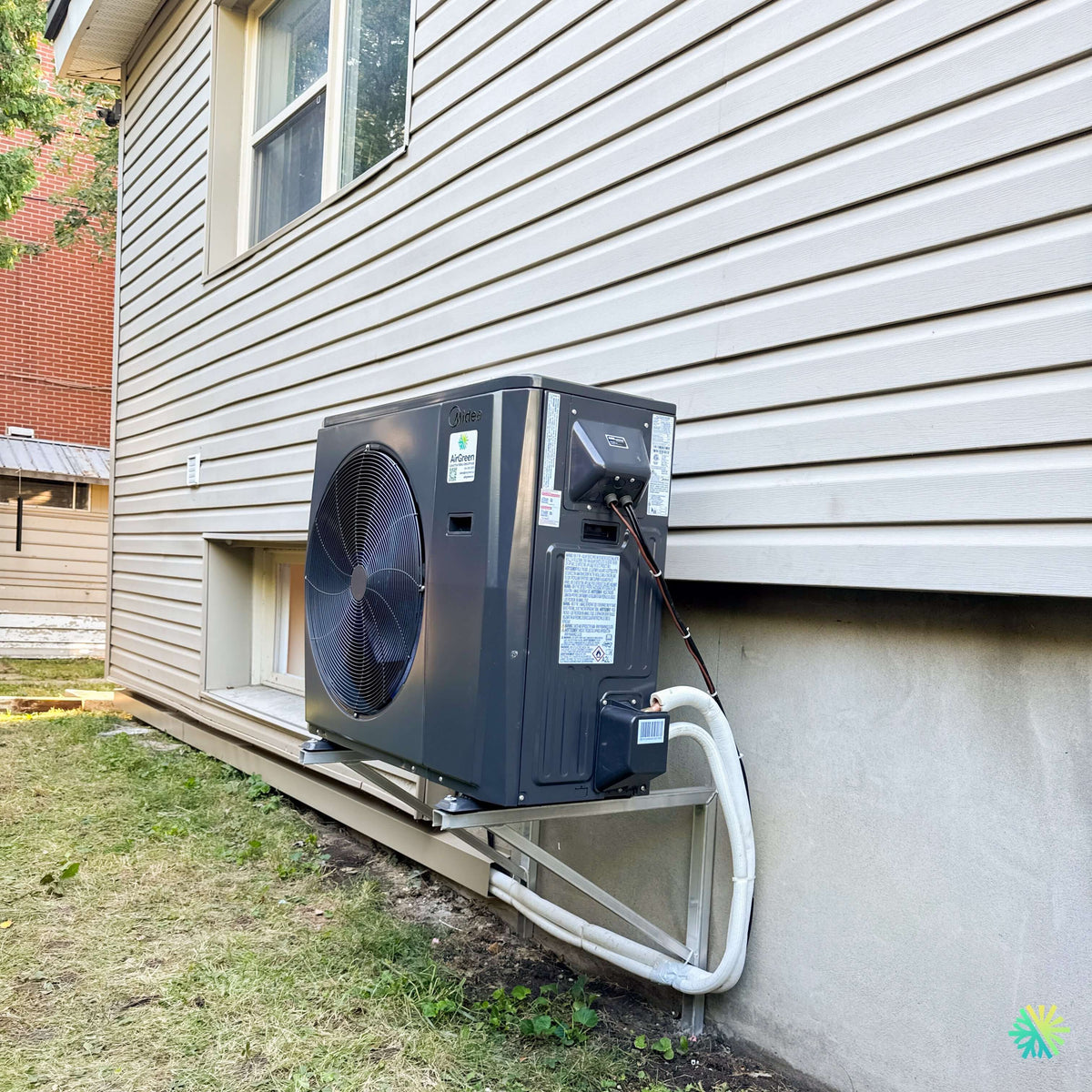
At this Ormstown project in Montérégie, we installed a MIDEA EVOX G3 central heat pump along a residence where the available outdoor space required particularly careful planning. The photograph clearly shows the result: the outdoor unit is installed on a raised metal stand against the foundation, while remaining clear of the exterior siding, basement windows, and ground.
This type of project represents exactly what we regularly encounter in HVAC installation on the South Shore. Choosing a central heat pump is never limited to the performance listed in a brochure. It is also necessary to determine where to place the outdoor unit, how to route the refrigerant lines, how to manage snow and defrost cycles, how to maintain access to the components, and how to integrate the entire system cleanly into the building.
For this Ormstown residence, the outdoor installation had to work with a facade consisting of horizontal siding, an exposed foundation, and basement windows located very close to the work area. We therefore opted for a compact, elevated installation that keeps the heat pump away from the ground without unnecessarily taking up space around the house.
The MIDEA EVOX G3 belongs to MIDEA’s family of ducted Inverter central systems, designed in particular for renovations and replacements of existing central heating systems.
The most important detail in the photo: the unit is not sitting on the ground
In Quebec, placing a central heat pump just a few centimeters above the ground can become problematic after the first major snowfalls.
Here, we installed the EVOX G3 condenser on a metal stand that keeps the chassis well above ground level.
This height offers several practical benefits:
- it reduces the risk of snow blocking the lower part of the unit;
- it provides more room for the water produced during defrost cycles;
- it keeps the heat pump base away from the ground, grass, and leaves;
- it simplifies cleaning around the equipment;
- it improves access for service work;
- it preserves the circulation space near the foundation.
The photo also shows that the support follows the facade without encroaching excessively on the yard. For a property where lateral space is limited, this is a practical advantage.
Why height is particularly important for a heat pump that heats in winter
A central heat pump used for heating operates when the outdoor temperature is low. The outdoor coil can therefore accumulate frost.
The system then automatically performs defrost cycles.
During these cycles, the ice melts and produces water. If the unit is installed too close to the ground, this water can freeze beneath the heat pump and gradually form a substantial mass.
That is why at AirGreen, we always look at the actual situation around the building before determining the support height.
In Ormstown, this approach is particularly logical given the winter conditions in Montérégie.
A horizontal fan that must remain unobstructed in front of the unit
The photograph clearly shows the large fan of the MIDEA EVOX G3.
This generation uses a horizontal discharge design. MIDEA combines this architecture with a vertical heat exchanger to promote uniform airflow across the exchanger surface. The manufacturer also indicates that this configuration contributes to heat-exchange efficiency as the outdoor temperature drops.
The heat pump's positioning is therefore directly linked to this design.
We must keep a sufficiently clear area in front of the fan to prevent the discharged air from immediately recirculating.
In this project, the fan is oriented toward the open space in the yard. It is not placed directly facing the wall of the house and is not enclosed between two closely spaced surfaces.
This decision facilitates the movement of a large volume of air and contributes to the system's proper operation.
An installation that respects the basement windows
In the photo, a basement window is located immediately to the left of the unit, and another opening is farther along the same wall.
This was a real project constraint.
We had to install the heat pump without compromising:
- access to the windows;
- natural light;
- basement use;
- traffic around the house;
- the space needed to service the unit.
The result shows that the unit occupies a relatively compact portion of the wall while remaining high enough not to sit in front of the foundation opening.
A clean, deliberately grouped refrigeration-line route
The right side of the heat pump shows the refrigerant lines protected by white insulation.
The route descends below the unit and then makes a loop before reaching the building. This geometry makes it possible to use the length required for the connection while keeping the circuit grouped near the facade.
The lines for a central heat pump should not simply be connected “from point A to point B.”
We must also consider:
- the required diameter;
- the maximum permitted lengths;
- the elevation difference;
- insulation protection;
- vibration;
- access to the service valves;
- the quality of the connections;
- the evacuation;
- the leak-tightness check.
A beautiful outdoor unit will not deliver good performance if the refrigeration circuit has been improperly prepared.
EVOX G3: a central heat pump designed to continue heating at very low temperatures
One of the reasons this family is particularly interesting for residential projects in Quebec is its winter operating range.
MIDEA advertises continuous operation down to -30 °C for the EVOX G3. The documentation also presents, under certain conditions and configurations, up to 100% heating capacity at -25 °C, with a COP of up to 1.9. Some values published in this section come from tests conducted on a 3-ton MIDEA system.
The manufacturer explains that, when the temperature becomes extremely low, its compressor technology can inject refrigerant vapor at an intermediate temperature to increase the mass of compressed refrigerant and support heat production.
For an Ormstown residence, this low-temperature behavior is far more relevant than cooling efficiency alone during the summer.
What is the BTU rating of the installed unit?
The photograph clearly identifies the MIDEA EVOX family, but the model number on the nameplate is not sufficiently legible to honestly confirm the exact capacity installed.
We therefore prefer not to turn a visual estimate into technical data.
The MIDEA-documented EVOX G3 range includes several configurations, notably around 18,000, 24,000, 30,000, 36,000, 48,000 and 54,000 BTU/h, with specific indoor and outdoor units for each capacity.
This is the exact model number of the indoor/outdoor unit pair that must be used to confirm:
- the capacity;
- the certified efficiency;
- the AHRI reference;
- heating capacity at low temperatures;
- electrical requirements;
- eligibility for financial assistance.
This way of working avoids a common error in heat pump comparisons: automatically attributing the best performance announced for the range to all units in the same series.
Up to 19 SEER2: what this value really means
The EVOX G3 documentation announces, depending on the combination, efficiencies of up to:
- 19 SEER2;
- 12.5 EER2;
- 10.8 HSPF2;
- a COP of up to 2.14 at 5 °F, or approximately -15 °C.
The phrase “up to” is essential.
An 18,000 BTU EVOX G3 and a 48,000 BTU configuration do not necessarily have the same certified values.
For example, MIDEA's documentation indicates, among other things:
- 18,000 BTU: up to 19 SEER2 in the combination presented;
- 24,000 BTU: 18.6 SEER2;
- 30,000 BTU: 17.2 SEER2;
- 36,000 BTU: 17.7 SEER2;
- 48,000 BTU: 17.5 SEER2;
- 54,000 BTU: 17.5 SEER2.
These are exactly the distinctions we check when preparing a quote or validating a configuration for a customer.
R-454B is part of this new generation of central systems
The EVOX G3 uses R-454B refrigerant.
MIDEA states that it selected this A2L refrigerant for its new product line, including its EVOX central systems. The manufacturer publishes a global warming potential, or GWP, of 466 for R-454B.
For us, this evolution means that installation must follow the procedures appropriate for the new A2L refrigerants.
This includes, among other things:
- handling practices;
- tools used;
- recovery;
- evacuation;
- connections;
- commissioning tests.
For homeowners, the key point is that these new generations of equipment must be installed by a team familiar with their technology and specific requirements.
Behind Ormstown's outdoor unit: the duct network, airflow, and commissioning make all the difference
A central heat pump works with the entire home
Unlike a wall-mounted heat pump, a central EVOX G3 does not heat only the room where the unit is located.
It uses an air handler and a duct network to distribute air throughout the different areas of the home.
That is why we never consider the outdoor unit as an independent piece of equipment.
Performance also depends on:
- air return;
- duct size;
- transition quality;
- filtration;
- the blower setting;
- the supply grilles;
- the thermostat;
- the auxiliary heating.
A high-performance unit connected to a highly restrictive ductwork system may deliver results below what its technical data might suggest.
Computational Constant Airflow 2.0: an interesting feature of the EVOX G3
The EVOX G3 uses a technology called Computational Constant Airflow 2.0.
According to MIDEA, the system automatically adjusts the fan power and speed to compensate for certain variations in resistance within the ductwork.
In the documentation, MIDEA illustrates maintaining an airflow of 1,200 CFM in different scenarios, including from 0.4 to 1.2 in. of total static pressure.
The manufacturer also indicates up to 60 airflow adjustment levels, allowing the technician to fine-tune the unit’s operation.
This is particularly relevant when replacing a system in an existing home.
Advanced technology does not replace a good ductwork system
However, it remains important to distinguish between compensation and correction.
An advanced blower can adapt its operation to certain pressure variations. It cannot make a ductwork system with the following issues perfect:
- a return air duct that is much too small;
- several crushed ducts;
- blocked dampers;
- a completely clogged filter;
- improperly sized transitions;
- significant leaks.
At AirGreen, we therefore always examine the existing ductwork before concluding that the replacement will be completely straightforward.
An indoor unit designed to make renovations easier
One of the goals of the EVOX G3 design is precisely to make central system upgrades easier.
MIDEA indicates that the indoor unit can be used with a 115 V or 208/230 V power supply, depending on the configuration, and that its width was designed to match several common sizes of existing furnaces.
This can reduce the amount of modifications required when replacing an older unit.
But we must always confirm the site dimensions and configuration before ordering.
A useful modular design when the mechanical room is difficult
The EVOX G3 brochure also describes a modular design that allows for multiple mounting positions.
The indoor unit can be configured for different orientations, including:
- upflow;
- downflow;
- left horizontal;
- right horizontal;
- low-boy configurations when available height is limited.
This flexibility becomes particularly valuable in the basements of existing homes, where ductwork, plumbing, and the structure limit the available options.
MERV 13 filtration: useful, but it must be integrated intelligently
MIDEA supports 1-, 2-, or 4-inch MERV 13 filters, depending on the module used. The manufacturer states that this filtration can help capture more dust, pollen, particles, and pet hair while keeping the coil cleaner.
Better filtration can be beneficial, but it also adds resistance to airflow.
We must therefore always check the static pressure and blower performance after installation.
Communicating thermostat or 24 V control
The EVOX G3 platform also offers several control options.
The documentation presents Sub-1 GHz wireless communication between certain system components, as well as compatibility with 485 and 24 V configurations.
This offers greater flexibility during a renovation, particularly when the old thermostat wiring is difficult to replace.
The final choice nevertheless depends on the complete system installed and the level of control desired.
Auxiliary heating: size it according to the home, not the maximum available
MIDEA documentation mentions three-stage auxiliary electric heating kits that can reach 25 kW, depending on the configuration.
It would nevertheless be incorrect to conclude that 25 kW is automatically the best choice.
We take into account:
- of the home’s heat loss;
- of the heat pump’s output in cold weather;
- of the electrical panel capacity;
- of the backup heating desired;
- of the control strategy.
A properly sized auxiliary heating system is preferable to a heating element selected solely because it represents the maximum possible output.
What we particularly like about Ormstown’s outdoor installation
The final photo shows an installation that is clear and easy to understand visually.
The unit is:
- raised;
- clear of the ground;
- accessible from the front and service side;
- placed a reasonable distance from the windows;
- oriented toward an open area;
- connected with grouped piping;
- positioned without unnecessarily taking up space in the yard.
These details may seem simple, but each one addresses a real constraint.
Mistakes to avoid with a central heat pump in Montérégie
Installing the unit too close to the ground
A heat pump expected to heat in the middle of winter must be able to handle snow and defrost water.
Ignoring the duct network
The quality of the indoor airflow is just as important as the condenser's performance.
Using the product line's maximum SEER2 for all capacities
Performance varies according to the exact combination.
Choosing the tonnage based solely on floor area
Insulation, windows, exposure, airtightness, and heat loss completely change the building's actual load.
Neglecting future access
The system will need to be maintained and possibly repaired throughout its service life.
Compressing the piping into an overly tight route
Refrigerant connections must comply with the appropriate radii, lengths, and practices for the system.
And what about rebates for the MIDEA EVOX G3?
Eligibility for financial assistance should never be determined simply from the commercial name EVOX G3.
A product line may include several capacities and several equipment combinations, each with its own technical documentation.
To properly determine whether an installation in Ormstown is eligible, we must confirm:
- the outdoor unit model;
- the indoor unit model;
- the corresponding AHRI combination;
- the certified heating capacity;
- the requirements of the program in effect on the installation date.
This is the only reliable way to provide the homeowner with a realistic amount rather than an estimate based on another version of the same product.
AirGreen: installing the machine, but above all, installing the system correctly
This MIDEA EVOX G3 central heat pump installation in Ormstown illustrates our approach at AirGreen very well.
The condenser is visible in the photo. However, the project's actual quality depends just as much on the inside of the home as on the exterior wall.
We must make the following work together:
the heat pump, the air handler, the duct network, filtration, controls, auxiliary heating, and electrical installation.
It is this comprehensive vision of HVAC that makes it possible to achieve a comfortable, coherent system.
We install central heat pumps in Ormstown, Montreal, Laval, Longueuil, on the North Shore and the South Shore, with the same attention to the actual constraints of each property.
In this case, the space along the facade, the proximity of the windows, the terrain, and the winter climate directly influenced how we installed the EVOX G3.
The result is a compact, elevated, and accessible installation, designed so this central heat pump can do what is truly expected of it in Quebec: cool efficiently in summer and continue contributing to heating when winter becomes severe.
The unit on this job, in figures
The range as published on airgreen.ca: pick a size to see its capacity in deep cold.
| Size | Heating at −8 °C | Heating at −15 °C | Coldest certified point | COP at −15 °C | SEER | HSPF | Indicative LogisVert aid |
|---|---|---|---|---|---|---|---|
| Midea EVOX G3 · 1.5 tons | 14,700 | 18,600 | −30 °C: 11,800 | 2.12 | 19.0 | 10.1 | $1,764 |
| Midea EVOX G3 · 2 tons | 20,800 | 20,600 | −30 °C: 12,100 | 2.14 | 18.6 | 10.0 | $2,496 |
| Midea EVOX G3 · 2.5 tons | 24,000 | 33,200 | −30 °C: 17,900 | 1.97 | 17.2 | 10.8 | $2,880 |
| Midea EVOX G3 · 3 tons | 33,000 | 37,400 | −30 °C: 27,600 | 1.9 | 18.0 | 10.0 | $3,960 |
| Midea EVOX G3 · 4 tons | 39,500 | 48,000 | −30 °C: 27,200 | 2.0 | 17.5 | 9.5 | $4,740 |
| Midea EVOX G3 · 5 tons | 45,000 | 54,000 | −30 °C: 37,300 | 1.9 | 17.5 | 9.5 | $5,400 |
Data read live from the airgreen.ca page of each size (NEEP / AHRI certified performance). When the title names the installed size, it is highlighted; otherwise the whole range is shown. The aid shown is today’s, using Hydro-Québec’s rule ($120 per 1,000 BTU/h at −8 °C); amounts quoted in the article date from its publication. Only Hydro-Québec confirms the assistance granted.
The big day, step by step
The main steps of this kind of job at AirGreen. Every house has its quirks: the estimate brings them out.
We look at the ducts, the current indoor module, the electrical panel and the planned spot for the outdoor unit.
The equipment combination, capacity and price, in writing. We check whether the combination qualifies for assistance programs.
Access protected, old unit disconnected and removed when it is being replaced.
Electric furnace or air handler, with its coil, connected to the supply and return ducts.
On a level base, raised above the snow, with free space all around.
Insulated, they enter through a sealed opening and run to the indoor coil.
Dedicated circuits, accessible disconnect, a thermostat that works with the heat pump and the backup heat.
Leak test, vacuum, start-up, airflow check and a test of both modes.
Filter, thermostat, backup heat in extreme cold: what to know before winter.
- The on-site estimateWe look at the ducts, the current indoor module, the electrical panel and the planned spot for the outdoor unit.
- The quoteThe equipment combination, capacity and price, in writing. We check whether the combination qualifies for assistance programs.
- Getting readyAccess protected, old unit disconnected and removed when it is being replaced.
- The indoor moduleElectric furnace or air handler, with its coil, connected to the supply and return ducts.
- The outdoor unitOn a level base, raised above the snow, with free space all around.
- The refrigerant linesInsulated, they enter through a sealed opening and run to the indoor coil.
- Electrical and thermostatDedicated circuits, accessible disconnect, a thermostat that works with the heat pump and the backup heat.
- Tests and start-upLeak test, vacuum, start-up, airflow check and a test of both modes.
- The walkthroughFilter, thermostat, backup heat in extreme cold: what to know before winter.
What would it look like at your place?
Two quick checks with real numbers: what heat costs, and what your current heaters add up to in BTU/h.
Baseboards and electric furnaces turn 1 kWh of electricity into 1 kWh of heat. A heat pump delivers more: that is its COP. At Hydro-Québec’s rate D (11.142¢/kWh above 40 kWh a day, since 1 April 2026):
Hydro-Québec: a heat pump can be up to three times more efficient than baseboards for heating in the colder months.
Estimate per kWh of heat, at the chosen temperature, using the certified COP from the product page. Taxes, access charge and backup heat not included.
Conversion: 1 W = 3.412 BTU/h. An indication, not a load calculation: baseboards and furnaces are often stronger than the real need, and they can stay as backup. AirGreen confirms the capacity on site.
Four mistakes we do not make
Flip each card to see what we do instead.
Your own project, step by step
What to do, season by season
Three habits per season for this unit. They take a few minutes and prevent many calls.
- Check the indoor module's filter.
- Clear winter debris from the outdoor unit.
- Test cooling before the heat arrives.
- Check the filter more often in peak season.
- Keep registers and returns clear.
- Watch condensate drainage near the coil.
- Change or clean the filter.
- Test heating and backup heat before the cold.
- Book periodic maintenance.
- Clear snow around the outdoor unit.
- Store nothing in front of the indoor module.
- Note any unusual noise or smell and call us.
Is your home ready?
Check what applies at your place. A "no" is not a refusal: it is what we sort out during the estimate.
Four statements: true or false?
It all comes down to details you have just seen.
1. A central heat pump uses the house's ducts.
It connects to the existing ducts to heat and cool everywhere.
2. In extreme cold, electric backup heat can take over.
The indoor module (furnace or air handler) works with the heat pump and takes over in extreme cold.
3. The filter only gets changed when the unit breaks down.
A dirty filter cuts airflow. It gets checked regularly.
4. You can reuse the old unit's size without checking.
The house may have changed: insulation, windows, added rooms. Capacity is confirmed on site.
0 / 4 right answers
What people ask us about this kind of work
Can I keep my current ducts?
What happens in extreme cold?
Furnace, air handler, ducted: what is the difference?
Are there grants?
Do I need a permit?
How much can I save?
How is the LogisVert assistance calculated?
Will my current thermostat work?
Central or wall units: which one?
Does AirGreen hold the required licences?
Is the estimate free?
No question matches. Write to us: we answer.
More jobs to see, near you
By town, by equipment or by region: browse more than 4,700 published projects.
Each dot: a town where AirGreen has published projects. The glowing dot: this job.
Every house has its constraints. We see them before we install.
The on-site estimate is free and the quote follows within 24 hours.
Text and photo: a real AirGreen Climatisation & Chauffage job. The diagrams are generic illustrations of the type of installation, not a survey of this job site. Sources of the added figures: airgreen.ca product pages (NEEP / AHRI performance), Hydro-Québec (Heat pumps page, LogisVert, read on 13 October 2026), Régie de l’énergie (rate D as of 1 April 2026).