
Installation of a Samsung WindFree™ MaxHeat wall-mounted heat pump in Montréal-Est, in the eastern part of the Island of Montréal
AirGreen installs a Samsung WindFree™ MaxHeat above a patio door in Montréal-Est: precise placement, cold-climate heating, gentle cooling, and potential eligibility for LogisVert.
Take a tour of the installation
Each number is a point we check on site. Switch between summer and winter to watch air and heat move.
In summer, the outdoor unit rejects the house's heat outside.
Generic illustration of this type of installation, not a survey of this job site. Tap a number.
Mounted level on a wall plate, high enough for the air to reach the whole room, with enough space around it to slide the filters out easily.
The refrigerant lines, the communication cable and the drain go through the wall in a single opening, sealed against water, cold air and insects.
Two insulated copper pipes connect the two units. Outside, a line cover can protect them from sun, knocks and weather.
A shut-off switch near the outdoor unit isolates it safely for service. It must stay accessible at all times.
The compressor and the fan. In heating mode it captures heat from the outdoor air, even in winter, and moves it inside.
On the ground or on the wall, it keeps the unit above accumulated snow. The unit stays clear and defrost water can drain away.
The fan needs to blow freely. Storage, a fence or a wall too close, and efficiency drops while noise goes up.
An installation above a patio door where every centimeter had to be used intelligently
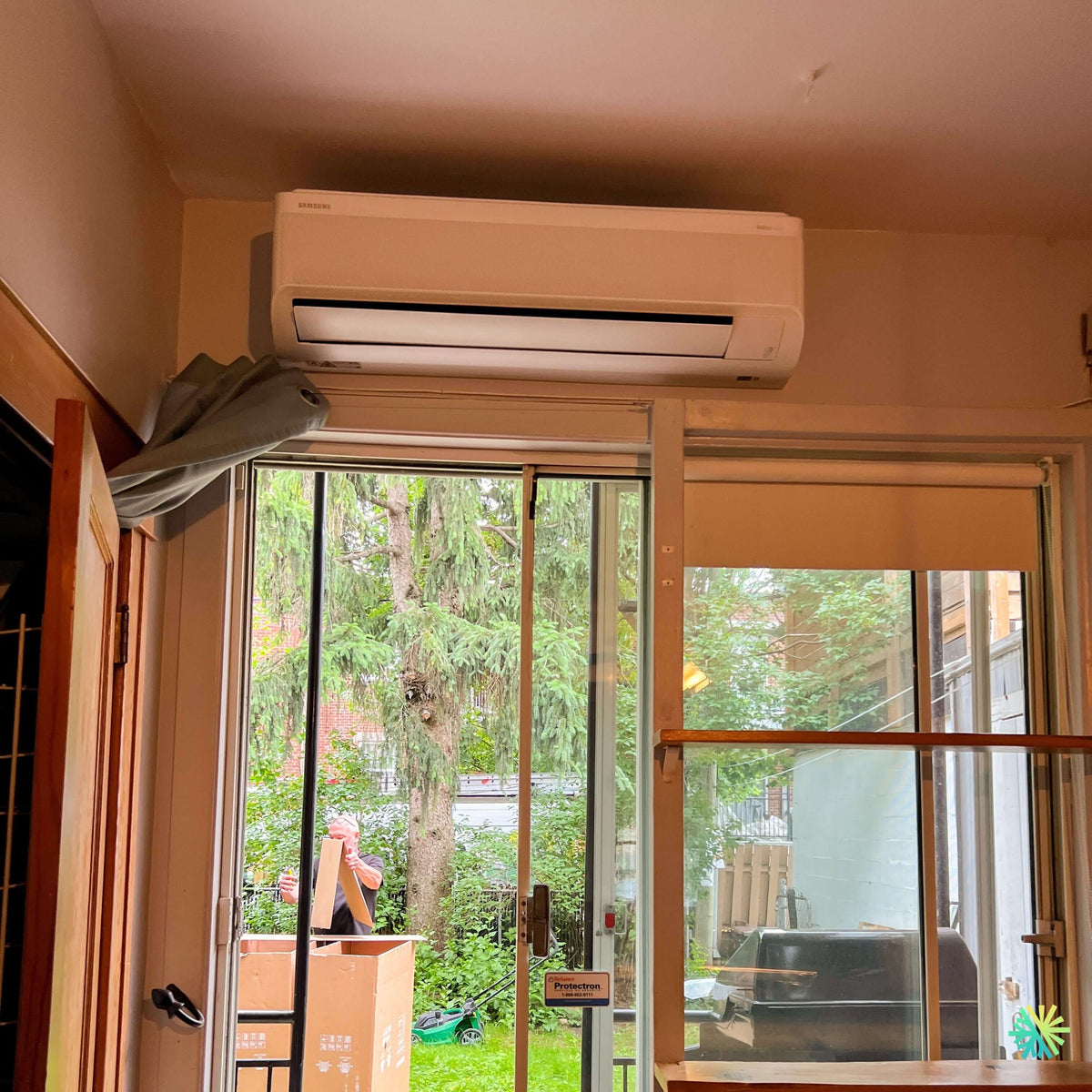
This wall-mounted heat pump installation in Montréal-Est presented an immediately visible constraint: the indoor unit had to fit within a narrow strip of wall, directly above a large glazed patio door and near a second window.
In this room, the available wall space was limited. The exterior door, large glazed sections, blinds, curtains, and the occupants’ daily movement considerably reduced the placement options. Installing the Samsung WindFree™ MaxHeat on another wall could have occupied useful space, directed the air toward a less favorable area, or required a much more visible piping route.
We therefore made use of the space above the patio door while respecting three essential elements:
- the required clearance around the indoor unit;
- the door’s normal opening and the movement of the curtains;
- air distribution capable of effectively covering the room.
The photograph clearly shows the result: the heat pump is installed very high, yet remains sufficiently clear of the ceiling to allow air intake from above. It is also positioned above the door frame, without obstructing the doorway or the glazed section.
This configuration requires more precision than an installation on a large, unobstructed wall. An error of a few centimeters could have interfered with opening the front panel, made filter removal more difficult, or created a conflict with the curtains.
Why the space above the patio door was strategic
A large glazed surface often represents a significant area of heat gain in summer and heat loss in winter. Even when the windows are high quality, solar radiation and temperature variations near the glazing can affect the room’s comfort.
By installing the Samsung heat pump in this area, we allow the unit to quickly treat the air near the patio door. The airflow is then directed toward the interior of the room rather than against a nearby wall.
This placement offers several practical advantages:
- the conditioned air can travel a greater distance before descending;
- the warm air can be directed downward during the winter;
- the side walls remain available for furniture;
- the unit is not located directly above a bed, sofa, or workstation;
- the lines can be routed outdoors along a relatively short path when the building’s configuration allows it.
The goal was not simply to find a place where the unit could fit. We had to select a location where it could operate properly for many years without interfering with the use of the room.
An installation adapted to Montréal-Est buildings
The properties of Montréal-Est and eastern Montreal have very diverse configurations. We work in single-family homes, duplexes, older apartments, renovated buildings, and constructions where openings occupy a large portion of the exterior walls.
In this type of building, the installer often has to work around:
- structural lintels above doors and windows;
- walls with multiple layers of finish;
- existing electrical runs;
- limited space between the framing and the ceiling;
- trim, blinds, and curtain rods;
- limited outdoor access due to a balcony, yard, or side passage.
Before securing the mounting plate, we must determine where to drill, where to route the pipes, and how to maintain an adequate slope for the condensate drain. An installation that looks visually simple may therefore require detailed preparation.
The main challenge: maintaining full access to the unit
A wall-mounted heat pump must remain accessible after the work is completed. The owner must be able to lift the front panel, remove the filters, and clean them periodically. During professional maintenance, our technicians must also be able to access the heat exchanger, drain pan, sensors, and blower wheel.
In this installation, it was therefore necessary to avoid placing the unit too close to the ceiling. A unit installed without sufficient clearance can lead to several complications:
- partially obstructed air intake;
- front panel difficult to open;
- inconvenient filter cleaning;
- faster dust accumulation;
- longer in-depth maintenance;
- less efficient airflow.
We also checked the relationship between the unit, the blind, and the curtain visible on the left side of the door. Fabric moving in front of a heat pump can disrupt airflow, be drawn toward the top of the unit, or lift due to the air.
Curtains should never become an obstacle to airflow
When a unit is installed above a window or patio door, we recommend keeping the curtains to the sides while it is operating. They must not cover the upper air intake or be positioned in front of the lower louver.
This precaution improves:
- airflow reach;
- temperature readings from the sensors;
- operating stability;
- filter cleanliness;
- the distribution of cooling and heating.
Samsung WindFree™ MaxHeat: a heat pump designed for comfort without a concentrated draft
The most recognizable feature of the Samsung WindFree™ MaxHeat is its microperforated front panel. As the room approaches the desired temperature, WindFree™ mode allows air to be distributed through thousands of small openings rather than continuously maintaining a concentrated stream from the large lower louver.
Samsung states that the air velocity produced in WindFree™ mode is below 0.15 m/s, corresponding to the concept of “still air” used in ASHRAE 55. This distribution is intended to maintain the temperature with less sensation of direct drafts.
This feature is particularly useful in a room where the unit is installed above a large opening. After an initial period of faster cooling, the unit can maintain comfort with gentler air distribution.
WindFree™ mode does not mean that the main louver will never be used. When a rapid temperature drop is requested, the unit may blow normally to reach the setpoint. Microperforated air distribution is mainly useful during the maintenance phase.
A 12,000 BTU configuration suited to precise residential sizing
In its 12,000 BTU configuration, the Samsung WindFree™ MaxHeat generally uses the following references:
- indoor unit: AR12DXDABWKNCV;
- outdoor unit: AR12DXDACWKXCV;
- AHRI number: 215399291;
- refrigerant: R-32;
- ENERGY STAR® certification for cold climates;
- SEER2: 24.0;
- HSPF2: 10.5;
- EER2: 14.1;
- COP at −15 °C: approximately 2.09;
- heating operation down to approximately −30 °C.
Samsung's technical documentation confirms the series models and the main performance ratings for the 12,000 BTU configuration.
A SEER2 of 24.0 indicates high seasonal cooling efficiency. The HSPF2 of 10.5, meanwhile, represents seasonal heating performance. These values make it possible to compare the heat pump with other units, but they do not replace proper sizing for the building.
Why we do not choose capacity based solely on floor area
Two rooms with the same floor area can have very different needs. In this project, the presence of large glazed areas had to be taken into account in particular.
We analyze, among other factors:
- window orientation;
- sun exposure;
- the quality of the glazing;
- wall and ceiling insulation;
- the room height;
- air infiltration;
- the presence of adjacent rooms;
- the use of interior doors;
- the number of occupants;
- heat-generating appliances.
An oversized heat pump can quickly reach its setpoint and reduce the time available for dehumidification. An undersized unit may run continuously during the hottest days or periods of intense cold.
The right choice is therefore not automatically the unit with the highest BTU rating. It is the capacity that actually matches the space's heat losses and gains.
Heating performance designed for the Quebec climate
The WindFree™ MaxHeat range is available in capacities from 9,000 to 24,000 BTU. Samsung states that it provides low-temperature heating, with operation designed down to −22 °F, or approximately −30 °C.
However, it is important to distinguish between the minimum operating temperature and the capacity actually available. As the outdoor temperature drops, heating output and the coefficient of performance may decrease.
For the 12,000 BTU configuration, the technical data used by AirGreen indicate, among other things:
- approximately 10,600 BTU/h at −8 °C;
- approximately 9,000 BTU/h at −15 °C;
- a maximum capacity of approximately 6,800 BTU/h at −30 °C.
These values are important for determining whether the existing electric baseboard heaters should be kept as supplemental heating. A wall-mounted heat pump can significantly reduce their use, but we generally do not recommend removing a backup heating source without a comprehensive assessment of the building's needs.
The technical steps behind this HVAC installation
Locating and fastening the wall plate
The first step is to locate the structural elements and verify the strength of the support. Above a patio door, the presence of a lintel may affect how the plate should be drilled or fastened.
We must achieve a rigid, perfectly level mounting. A slightly warped plate can cause:
- improper seating of the unit;
- vibrations;
- a visibly tilted casing;
- abnormal pressure on certain fasteners;
- less predictable drainage.
Drilling and routing of connections
A wall-mounted heat pump requires several connections between the indoor and outdoor units:
- a liquid refrigerant line;
- a vapor refrigerant line;
- an electrical and communication cable;
- a condensate drain pipe;
- a properly insulated and sealed wall penetration.
For this 12,000 BTU Samsung configuration, the pipe diameters used are generally 1/4 in. and 3/8 in.. The integrity of the flared connections, continuous insulation, and pipe bend radius directly affect installation reliability.
Drain management above the door
Drainage was a particularly important consideration. A unit installed above an opening must be protected against any risk of water leaking indoors.
The pipe must maintain a consistent downward slope whenever gravity drainage is possible. We avoid:
- back-pitched sections;
- crushed sections;
- unnecessary fittings;
- pipes rising after the outlet;
- drains that could freeze or back up.
After installation, we perform a drainage test to confirm that water leaves the condensate pan properly.
Leak testing and evacuation
Before opening the service valves, the circuit must be checked and evacuated. This operation removes air and moisture from the lines.
Residual moisture can interfere with the refrigeration system, contaminate the oil, and reduce compressor reliability. Evacuation is therefore not a formality: it is an essential step in any professional HVAC installation.
Complete commissioning
Our final checks include, among other things:
- starting the cooling mode;
- starting the heating mode;
- checking the vertical louver;
- checking the horizontal direction;
- testing WindFree™ mode;
- checking the drainage;
- listening for vibrations and unusual noises;
- checking the electrical connections;
- checking the outdoor unit’s operation;
- explaining the controls to the homeowner.
Mistakes to avoid with a heat pump installed above a window
Choose the location only because the unit fits there
The fact that the unit physically fits does not guarantee proper operation. You must also maintain clearances, allow for servicing, and plan the routing of the connections.
Install the unit against the ceiling
This mistake can restrict air intake and make cleaning difficult.
Allow a curtain to hang in front of the unit
The fabric can block the airflow, interfere with the sensor, or accumulate dust near the air intake.
Consistently direct the louver toward the window glazing
In cooling mode, the main objective is generally to distribute air throughout the room. Air directed solely toward the window reduces the useful range.
Neglecting the drain slope
Poorly designed drainage can cause water to run over the patio door, a situation that is particularly damaging to frames and finishes.
Overlooking solar heat gains
A room with extensive glazing may require a more thorough analysis than a simple rule based on square footage.
How to use the Samsung WindFree™ MaxHeat effectively
To achieve stable comfort, we recommend avoiding continual temperature adjustments. A variable-speed compressor heat pump operates efficiently when it can modulate its capacity and maintain a relatively constant setpoint.
In summer, a moderate temperature combined with WindFree™ mode can reduce the sensation of drafts. On very humid days, sufficient time must be allowed for the system to remove moisture.
In winter, it is preferable to avoid turning the unit off completely during long cold periods and then requesting a rapid increase of several degrees. A stable setpoint generally allows for more consistent modulation.
The series also offers Wi-Fi connectivity and compatibility with the SmartThings app, which allows users to view and modify certain settings remotely.
The maintenance required in a room facing outdoors
A frequently opened patio door can allow more dust, pollen, and particles from the yard to enter. The indoor unit’s filters should therefore be inspected periodically.
We recommend:
- wash the filters when visible dust accumulates on them;
- keep the upper part of the unit clear;
- watch for the appearance of an unusual odor;
- check that the drain does not produce a backflow noise;
- have the heat exchanger and fan wheel cleaned when necessary.
Washing the filters is basic maintenance, but it does not clean the tangential fan wheel or the condensate pan. After several seasons, in-depth HVAC maintenance may be necessary to restore airflow and prevent odors.
An AirGreen project combining interior integration, performance, and subsidy eligibility
A potential LogisVert financial incentive of $1,272
For heat pumps installed since November 26, 2025, Hydro-Québec requires ENERGY STAR® certification for the equipment to be eligible for the heat pump measure under the LogisVert program.
The regular subsidy is calculated according to the heating capacity at −8 °C:
- $50 per 1,000 BTU/h for an eligible ENERGY STAR® heat pump;
- $120 per 1,000 BTU/h for a cold-climate ENERGY STAR® appliance.
The system must be new, include both the indoor and outdoor units, have a minimum nominal cooling capacity of 12,000 BTU/h and be installed by a company holding the appropriate licences.
With a declared capacity of approximately 10,600 BTU/h at −8 °C, the Samsung 12,000 BTU configuration may qualify for an indicative financial incentive of $1,272, subject to eligibility at the time of application and compliance with all program conditions.
The invoice must indicate the models, installation date, address, contractor’s RBQ number, tax numbers and AHRI or ENERGY STAR® number. A clear photograph of the outdoor unit’s rating plate is also required.
In some eligible multi-unit buildings, an incentive may increase the assistance to $220 per 1,000 BTU/h at −8 °C. The building must have at least two units, have been built in 1995 or earlier, have one meter per unit and be located in an area recognized by Hydro-Québec.
Why this Montréal-Est installation is particularly successful
The result is based on a succession of coherent technical decisions:
- the wall area above the patio door was used without blocking the opening;
- the unit maintains functional clearance above;
- the airflow can travel throughout the room;
- the useful wall space remains available;
- the unit fits within the width of the window opening;
- access to the filters remains possible;
- WindFree™ technology reduces the sensation of drafts while maintaining the temperature.
This installation shows that a limited space does not necessarily require a compromise on comfort. It mainly calls for more precise analysis before drilling.
At AirGreen, we apply this method to every wall-mounted heat pump project in Montréal, as well as in Laval, Longueuil, the North Shore and the South Shore. We assess the positioning, sizing, drainage, line routing and the building’s actual needs before confirming the solution.
In this Montréal-Est residence, the Samsung WindFree™ MaxHeat makes it possible to cool the room without taking over an interior wall while providing efficient heating for much of the winter. Its location above the patio door transforms an otherwise unused area into a central distribution point while preserving the room’s flow and layout.
The big day, step by step
The main steps of this kind of job at AirGreen. Every house has its quirks: the estimate brings them out.
We look at the room, the outside wall, the line route and where the outdoor unit will go. That is where the capacity gets chosen.
Model, capacity and price, in writing. We also check whether the model qualifies for assistance programs.
Floors and furniture protected, wall plate position marked level, wall opening located.
A single opening, with the slope the drain needs to flow outside.
Set on a stand raised above the snow, with the clearances the manufacturer requires.
Connected, insulated and protected. The opening is then sealed against water, cold air and insects.
A dedicated circuit and an accessible disconnect near the outdoor unit.
Leak test, vacuum, then start-up and a check of heating and cooling.
Remote, modes, filters: we show you the essentials before we leave.
- The on-site estimateWe look at the room, the outside wall, the line route and where the outdoor unit will go. That is where the capacity gets chosen.
- The quoteModel, capacity and price, in writing. We also check whether the model qualifies for assistance programs.
- Getting readyFloors and furniture protected, wall plate position marked level, wall opening located.
- The wall openingA single opening, with the slope the drain needs to flow outside.
- The outdoor unitSet on a stand raised above the snow, with the clearances the manufacturer requires.
- Lines, cable and drainConnected, insulated and protected. The opening is then sealed against water, cold air and insects.
- The electrical workA dedicated circuit and an accessible disconnect near the outdoor unit.
- Tests and start-upLeak test, vacuum, then start-up and a check of heating and cooling.
- The walkthroughRemote, modes, filters: we show you the essentials before we leave.
What would it look like at your place?
Two quick checks with real numbers: what heat costs, and what your current heaters add up to in BTU/h.
Conversion: 1 W = 3.412 BTU/h. An indication, not a load calculation: baseboards and furnaces are often stronger than the real need, and they can stay as backup. AirGreen confirms the capacity on site.
Four mistakes we do not make
Flip each card to see what we do instead.
Your own project, step by step
What to do, season by season
Three habits per season for this unit. They take a few minutes and prevent many calls.
- Clean the indoor unit's filters.
- Clear leaves and debris left on the outdoor unit by winter.
- Test cooling before the first hot days.
- Clean the filters more often when the unit runs a lot.
- Keep plants away from the outdoor unit.
- Check that no water drips from the indoor unit.
- Rake the leaves around the outdoor unit.
- Test heating before the first cold days.
- Book periodic maintenance before winter.
- Keep snow away from the stand and the front of the unit.
- Let the unit defrost: it is normal.
- Never hit the ice on the fins; call us if the unit stays iced up.
Is your home ready?
Check what applies at your place. A "no" is not a refusal: it is what we sort out during the estimate.
Four statements: true or false?
It all comes down to details you have just seen.
1. In heating mode, the outdoor unit can produce water.
During defrost cycles. That water must drain away without forming ice.
2. You pick the capacity with a simple square-footage rule.
Windows, insulation, orientation and how the room is used all count. Capacity is chosen on site.
3. A multi-zone connects several indoor heads to a single condenser.
One head per room, all on the same condenser. Each room keeps its own temperature.
4. The disconnect can sit behind the patio furniture.
It must stay accessible: it is what shuts the unit off for service.
0 / 4 right answers
What people ask us about this kind of work
Does a wall-mounted heat pump heat in winter?
Wall-mounted or multi-zone: how do I choose?
Where does the outdoor unit go?
Are there grants?
Do I need a permit?
How cold can it heat?
How much can I save?
How is the LogisVert assistance calculated?
Is it noisy?
The outdoor unit is covered in ice: is that normal?
Does AirGreen hold the required licences?
Is the estimate free?
No question matches. Write to us: we answer.
More jobs to see, near you
By town, by equipment or by region: browse more than 4,700 published projects.
Each dot: a town where AirGreen has published projects. The glowing dot: this job.
Every house has its constraints. We see them before we install.
The on-site estimate is free and the quote follows within 24 hours.
Text and photo: a real AirGreen Climatisation & Chauffage job. The diagrams are generic illustrations of the type of installation, not a survey of this job site. Sources of the added figures: airgreen.ca product pages (NEEP / AHRI performance), Hydro-Québec (Heat pumps page, LogisVert, read on 13 October 2026), Régie de l’énergie (rate D as of 1 April 2026).