
Installation of a MIDEA EVOX G3 central heat pump in Saint-Édouard, in Montérégie on Montreal’s South Shore
In Saint-Édouard, AirGreen installs an elevated MIDEA EVOX G3 central heat pump adapted to Quebec’s climate: heating down to -30 °C, inverter technology, R-454B, and central system optimization.
Take a tour of the installation
Each number is a point we check on site. Switch between summer and winter to watch air and heat move.
In summer, the outdoor unit rejects the house's heat outside.
Generic illustration of this type of installation, not a survey of this job site. Tap a number.
It captures or rejects heat outside. It sits on a level base, above the snow, with free space all around.
The insulated refrigerant lines enter the house through a sealed opening and run to the indoor coil.
A shut-off switch near the outdoor unit isolates it safely for service.
Sitting on the indoor module, it moves heat between the house air and the refrigerant.
Electric furnace or air handler: its fan pushes air through the ducts. The electric backup takes over in extreme cold.
Supply ducts bring air to the rooms; returns bring it back to the unit. Their condition matters as much as the unit's.
It protects the coil and the fan. A dirty filter cuts airflow, so it gets checked regularly.
It runs the heat pump and the backup heat. It must be compatible with the installed system.
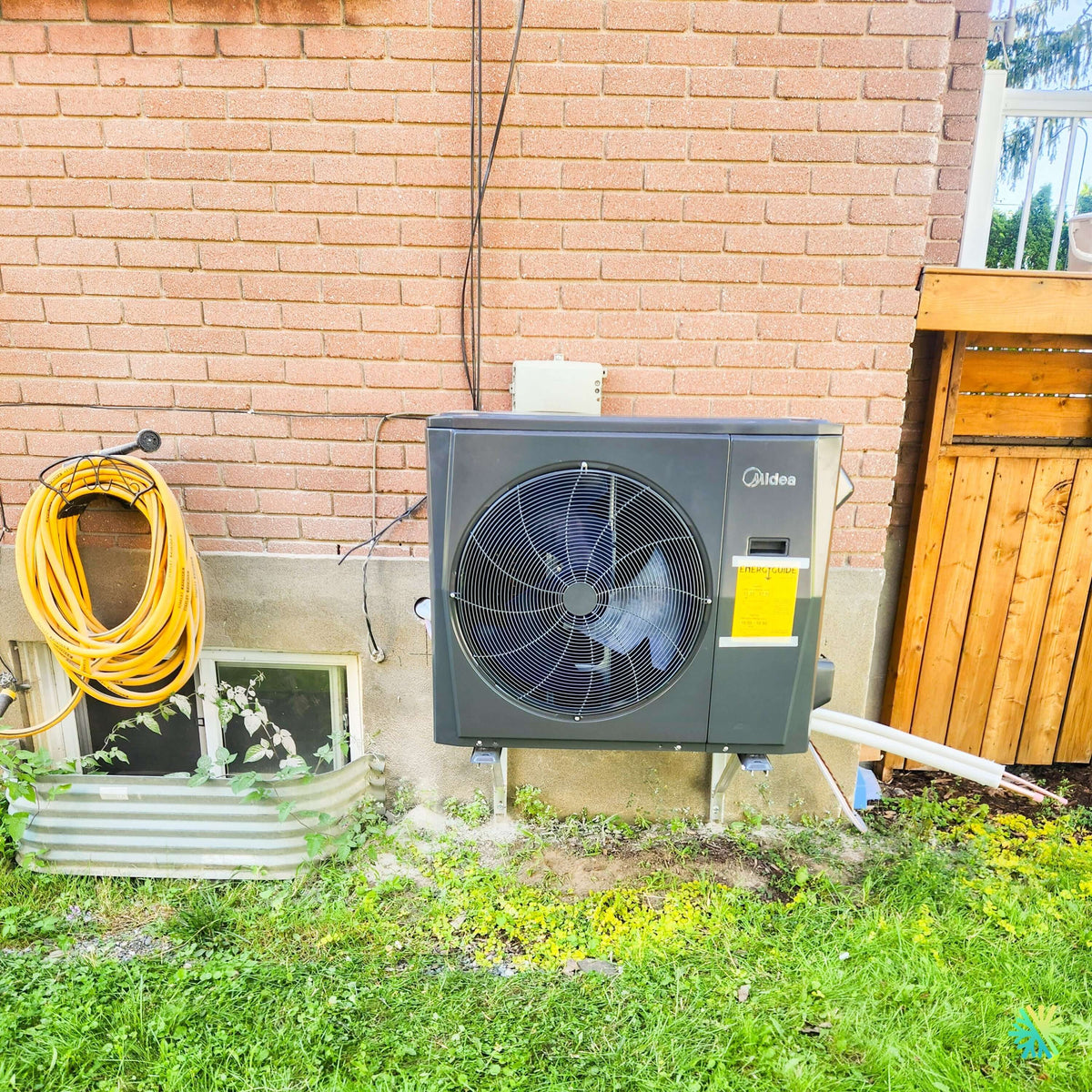
A MIDEA EVOX G3 installed against a brick wall: a central system project where the outdoor location matters just as much as performance
In Saint-Édouard, in Montérégie, in the Jardins-de-Napierville RCM, we completed an installation that clearly illustrates what a central heating modernization should be in Quebec: a MIDEA EVOX G3 central heat pump integrated into the building with particular attention paid to winter performance, airflow, service accessibility, and exterior finish.
The job-site photo immediately shows several interesting elements. The Midea outdoor unit, with its dark gray casing and large front fan, is installed along a brick wall, in a residential yard where several constraints already existed: a basement window on the left, a wooden fence on the right, electrical services against the wall, and an outdoor area used every day.
It was therefore not enough to place the condenser in the easiest location. A central heat pump installation must take into account what will happen in January under the snow, in July during a period of intense heat, but also several years later when a refrigeration technician needs access to the unit's components.
This is precisely where the EVOX G3 becomes interesting. Midea presents this generation as a central inverter system designed both for upgrading existing installations and for new residential applications.
A clean outdoor installation despite several existing constraints
On this Saint-Édouard installation, the outdoor unit is elevated on metal supports. This arrangement is particularly relevant in our climate.
A condenser installed too close to the ground can be more easily affected by:
- snow accumulation;
- ice;
- leaves and debris;
- water from defrost cycles;
- vegetation that gradually encroaches around the unit.
The unit is also positioned to keep its front horizontal airflow unobstructed. The large fan visible in the photo discharges air directly toward the open yard rather than toward the brick wall.
This detail is fundamental. A heat pump can deliver excellent performance on a technical data sheet and perform poorly if its location causes the discharged air to recirculate.
Midea designed the EVOX G3 with a vertical heat exchanger and a horizontal-discharge fan, an architecture intended to promote uniform heat exchange.
Why we did not place the unit directly on the ground
During winter heating, the outdoor heat exchanger becomes cold and must periodically run a defrost cycle. Water is then produced beneath the condenser.
In the Montreal, Laval, Longueuil and South Shore areas, this water can quickly turn into ice when temperatures drop again.
Properly raising the unit therefore helps preserve usable space beneath the heat pump and reduce the risks associated with ice buildup directly against the base.
In the photographed installation, this height also keeps the bottom of the unit well above the soil and vegetation surrounding the foundation.
The basement window was part of the equation
The small window to the left of the condenser is a good example of a constraint an installer must consider even before drilling or mounting the supports.
We must ensure that a heat pump does not unnecessarily interfere with:
- the use of a window;
- required clearance;
- drainage;
- foundation maintenance;
- future access to the building.
A central unit of this size cannot be moved like a small household appliance. Its placement must therefore be carefully considered from the outset.
Refrigerant lines routed together along the side of the house
To the right of the unit, the lines leave the condenser inside white line-hide covers that neatly route the connections toward the building.
This part of an installation is sometimes overlooked when homeowners compare quotes. However, the quality of the outdoor routing directly affects the project’s finish and the mechanical protection of the lines.
A proper installation requires, among other things:
properly sized piping, continuous insulation, connections made according to the manufacturer’s requirements, consistent drainage, and sufficient protection for exposed lines.
We also pay attention to the location of penetrations into the building. The goal is to obtain the necessary route without adding detours simply to make the installation work easier.
The electrical enclosure must remain accessible
We can also see the electrical disconnect installed against the brick behind the heat pump.
The outdoor appearance matters, but never at the expense of technical access. An appliance must be able to be electrically isolated for diagnosis and maintenance.
In a central HVAC installation, we therefore plan the unit, refrigerant lines, wiring, and disconnect as one system rather than as four independent jobs.
EVOX G3: a heat pump truly designed for Quebec's cold
The most important point for a Saint-Édouard homeowner is probably not the color of the condenser. It is what happens when the temperature drops well below freezing.
Midea documentation states that the EVOX G3 Extreme Heat offers continuous operation down to -30 °C. It also indicates heating capacity of up to 100% at -25 °C, depending on the configuration and test conditions presented by the manufacturer.
These temperatures are particularly relevant for our installations in Saint-Édouard, Montreal, Laval, Longueuil, on the North Shore and on the South Shore, where choosing a heat pump cannot rely solely on its performance at +8 °C.
M-Powevi compressor technology
Midea attributes part of its cold-weather performance to its M-Powevi compressor technology.
According to the manufacturer, the system uses, among other features, intermediate-temperature vapor injection when conditions become very cold, increasing the total amount of compressed refrigerant to support heating.
For the homeowner, the benefit is not the name of the technology, but its practical result: reducing the capacity loss usually associated with heat pumps when the outdoor temperature drops sharply.
This does not mean that auxiliary heating becomes unnecessary in every home. System sizing, building heat loss, and the backup heating strategy remain essential.
EVOX G3 capabilities: why we need to identify the exact combination
The third-generation brochure does not present a single universal EVOX G3. The range covers several central capacities, including 18,000, 24,000, 30,000, 36,000, 48,000 and 54,000 BTU/h for cooling, depending on the configurations listed.
Here are some published figures for the Extreme Heat configurations in this range:
| Rated cooling capacity | Published heating capacity | SEER2 | EER2 | HSPF2 |
|---|---|---|---|---|
| 18,000 BTU/h | 18,000 BTU/h | 19,0 | 12,5 | 10,1 |
| 24,000 BTU/h | 24,000 BTU/h | 18,6 | 12,0 | 10,0 |
| 30,000 BTU/h | 33,000 BTU/h | 17,2 | 12,0 | 10,8 |
| 36,000 BTU/h | 36,000 BTU/h | 17,7 | 12,0 | 10,0 |
| 48,000 BTU/h | 48,000 BTU/h | 17,5 | 12,0 | 9,5 |
| 54,000 BTU/h | 55,000 BTU/h | 17,5 | 12,0 | 9,5 |
These figures come from Midea's EVOX G3 specification table.
The nameplate is not sufficiently legible in the provided photo to reliably attribute one of these specific capacities to the Saint-Édouard unit. We therefore prefer not to invent a tonnage based solely on the apparent dimensions of the condenser.
This distinction is important for homeowners shopping for a heat pump: EVOX G3 refers to a family of systems, not a single capacity.
Efficiency is about more than SEER2
SEER2 remains an important figure for comparing cooling consumption, but in Quebec we also pay close attention to HSPF2, low-temperature COP, and the heating capacity actually available in cold weather.
Midea's documentation states that the EVOX G3 range offers up to:
- 19 SEER2;
- 12.5 EER2;
- 10.8 HSPF2;
- a COP of up to 2.14 at 5 °F, or approximately -15 °C, depending on the model and combination.
For us, these figures must be considered together. Buying a heat pump solely because its SEER2 is high can lead to overlooking the most important part of the equation for a Quebec home: its heating performance.
Why the EVOX G3 is particularly appealing when replacing an existing central system
An indoor unit designed for renovations where every inch counts
A central heat pump generally involves much more than an outdoor condenser. It works with an indoor air handler and the home's ductwork.
This is often where renovations become complex.
In a finished basement, a cramped mechanical room, or a home equipped with an older furnace, a few inches can determine whether a conversion is simple or requires a major duct modification.
Midea designed its EVOX G3 indoor unit with a modular approach. The brochure presents several installation configurations, including:
- upflow;
- downflow;
- right horizontal;
- left horizontal;
- “low-boy” configurations when available height is limited.
The manufacturer also indicates widths intended to facilitate the replacement of certain existing furnaces, with sizes ranging approximately from 14.5 to 21.5 inches depending on capacity.
For an installer, this modularity can avoid unnecessarily modifying a large part of the ventilation system.
Up to 1.2 in. of static pressure: a very interesting specification for a central system
A central heat pump must actually circulate its air through the existing ductwork.
This is where a system can be excellent on paper and disappointing in a real home if the fan and ductwork do not work properly together.
The EVOX G3 uses Computational Constant Airflow 2.0 technology. Midea indicates that its system can adapt to ductwork variations and operate at up to 1.2 in. of static pressure, according to the application presented.
The control adjusts the capacity and fan speed according to the resistance encountered. The manufacturer also provides up to 60 airflow adjustment levels.
For us, this does not mean that it is acceptable to ignore a poor ductwork system. An undersized, crushed, or excessively restrictive duct must always be evaluated.
This rather means that the indoor unit offers more latitude to be adjusted correctly to an existing installation.
A dirty filter is still a dirty filter
The system’s ability to compensate for certain pressure variations never replaces HVAC maintenance.
A homeowner must still replace or clean the filters at the appropriate time and keep the air returns and registers clear.
The EVOX G3 documentation also provides for an enhanced filtration module that can accommodate 1-, 2-, or 4-inch filters, including MERV 13 configurations.
A higher-quality filter can help capture more dust, pollen, and particles, but it must be selected and sized with the system’s airflow in mind.
Communicating thermostat or 24 V thermostat: useful flexibility for renovations
During a central system replacement, the wiring of the existing thermostat can strongly influence the complexity of the work.
The EVOX G3 supports different control strategies. Midea indicates compatibility with 485 communication as well as a 24 V mode, allowing the use of third-party thermostats in certain configurations.
The Midea system can also be paired with its communicating thermostat and the SmartHome app to manage scheduling, comfort, and certain consumption and diagnostic information.
This flexibility is particularly useful when a home already has thermostat wiring that would be difficult to replace without opening the walls.
R-454B and A2L classification: the new generation is already here
The EVOX G3 uses R-454B refrigerant.
Midea indicates a global warming potential, or GWP, of 466 and classifies this refrigerant in the A2L family.
For homeowners, the key point is to understand that installing and servicing this equipment requires procedures and equipment adapted to the refrigerant used.
Therefore, it is not only the condenser that changes with each generation of heat pumps. HVAC contractors’ work methods are also evolving.
LogisVert: verify the exact combination before promising an amount
The question of the Hydro-Québec LogisVert rebate comes up almost systematically when a customer compares central heat pumps in Saint-Édouard or elsewhere in Greater Montreal.
At present, Hydro-Québec indicates that when a residential installation meets all program criteria, the assistance is $50 per 1,000 BTU/h at -8 °C for an ENERGY STAR-certified heat pump, and $120 per 1,000 BTU/h at -8 °C for an ENERGY STAR - Cold Climate heat pump.
The essential detail is “at -8 °C”.
Therefore, you should not automatically multiply $120 by the nominal capacity listed in the product name. The amount depends on the exact combination of equipment, its recognized capacity at -8 °C, and its official eligibility at the time of installation.
Hydro-Québec also allows searches using the AHRI number or the ENERGY STAR model number, and specifies that the official list of eligible heat pumps takes precedence if it differs from the search tool.
This is the method we prefer at AirGreen: verify the combination before confirming a rebate.
The mistakes we want to avoid during a central installation
This Saint-Édouard installation serves as a reminder of several errors that can have a much greater impact than the price difference between two units:
- Choosing the tonnage solely based on floor area. The building's heating load must be considered.
- Installing the condenser too low. Snow, ice, and defrosting must be taken into account.
- Neglecting the ductwork. A central heat pump cannot distribute air properly through an inadequate duct network.
- Blocking access to the service panel or disconnect switch.
- Promising a LogisVert amount without verifying the exact combination.
- Installing a filter that is too restrictive without taking static pressure into account.
- Keeping the default airflow settings without adapting them to the home.
These aspects are less visible than a Midea logo on a new condenser, but they are precisely what largely determines the day-to-day result.
What the Saint-Édouard photo summarizes in a single image
This installation shows a central EVOX G3 heat pump well integrated into an existing residential environment: an elevated outdoor unit, an unobstructed discharge side, lines grouped along the side, preserved access, and placement adapted to the yard's obstacles.
It also reminds us that a central installation should never be evaluated solely by looking at the outdoor unit.
Behind this condenser are the sizing, air handler, CFM airflow, static pressure, ductwork, thermostat, auxiliary heating settings, refrigerant connections, and commissioning.
At AirGreen, this is the full set of factors we consider when installing a central heat pump in Saint-Édouard, Montreal, Laval, Longueuil, on the North Shore, or on the South Shore.
A well-selected MIDEA EVOX G3 has features particularly suited to the Quebec climate: operation rated down to -30 °C, inverter technology, flexible indoor unit configurations, advanced airflow control, 24 V and communications compatibility, advanced filtration, and R-454B refrigerant.
But these possibilities are only valuable if the system is properly sized and installed.
That is why, on a project like this, we pay as much attention to the brick wall, the height of the supports, the clearance in front of the fan, and the routing of the lines as we do to the SEER2 figures listed in the documentation.
The unit on this job, in figures
The range as published on airgreen.ca: pick a size to see its capacity in deep cold.
| Size | Heating at −8 °C | Heating at −15 °C | Coldest certified point | COP at −15 °C | SEER | HSPF | Indicative LogisVert aid |
|---|---|---|---|---|---|---|---|
| Midea EVOX G3 · 1.5 tons | 14,700 | 18,600 | −30 °C: 11,800 | 2.12 | 19.0 | 10.1 | $1,764 |
| Midea EVOX G3 · 2 tons | 20,800 | 20,600 | −30 °C: 12,100 | 2.14 | 18.6 | 10.0 | $2,496 |
| Midea EVOX G3 · 2.5 tons | 24,000 | 33,200 | −30 °C: 17,900 | 1.97 | 17.2 | 10.8 | $2,880 |
| Midea EVOX G3 · 3 tons | 33,000 | 37,400 | −30 °C: 27,600 | 1.9 | 18.0 | 10.0 | $3,960 |
| Midea EVOX G3 · 4 tons | 39,500 | 48,000 | −30 °C: 27,200 | 2.0 | 17.5 | 9.5 | $4,740 |
| Midea EVOX G3 · 5 tons | 45,000 | 54,000 | −30 °C: 37,300 | 1.9 | 17.5 | 9.5 | $5,400 |
Data read live from the airgreen.ca page of each size (NEEP / AHRI certified performance). When the title names the installed size, it is highlighted; otherwise the whole range is shown. The aid shown is today’s, using Hydro-Québec’s rule ($120 per 1,000 BTU/h at −8 °C); amounts quoted in the article date from its publication. Only Hydro-Québec confirms the assistance granted.
The big day, step by step
The main steps of this kind of job at AirGreen. Every house has its quirks: the estimate brings them out.
We look at the ducts, the current indoor module, the electrical panel and the planned spot for the outdoor unit.
The equipment combination, capacity and price, in writing. We check whether the combination qualifies for assistance programs.
Access protected, old unit disconnected and removed when it is being replaced.
Electric furnace or air handler, with its coil, connected to the supply and return ducts.
On a level base, raised above the snow, with free space all around.
Insulated, they enter through a sealed opening and run to the indoor coil.
Dedicated circuits, accessible disconnect, a thermostat that works with the heat pump and the backup heat.
Leak test, vacuum, start-up, airflow check and a test of both modes.
Filter, thermostat, backup heat in extreme cold: what to know before winter.
- The on-site estimateWe look at the ducts, the current indoor module, the electrical panel and the planned spot for the outdoor unit.
- The quoteThe equipment combination, capacity and price, in writing. We check whether the combination qualifies for assistance programs.
- Getting readyAccess protected, old unit disconnected and removed when it is being replaced.
- The indoor moduleElectric furnace or air handler, with its coil, connected to the supply and return ducts.
- The outdoor unitOn a level base, raised above the snow, with free space all around.
- The refrigerant linesInsulated, they enter through a sealed opening and run to the indoor coil.
- Electrical and thermostatDedicated circuits, accessible disconnect, a thermostat that works with the heat pump and the backup heat.
- Tests and start-upLeak test, vacuum, start-up, airflow check and a test of both modes.
- The walkthroughFilter, thermostat, backup heat in extreme cold: what to know before winter.
What would it look like at your place?
Two quick checks with real numbers: what heat costs, and what your current heaters add up to in BTU/h.
Baseboards and electric furnaces turn 1 kWh of electricity into 1 kWh of heat. A heat pump delivers more: that is its COP. At Hydro-Québec’s rate D (11.142¢/kWh above 40 kWh a day, since 1 April 2026):
Hydro-Québec: a heat pump can be up to three times more efficient than baseboards for heating in the colder months.
Estimate per kWh of heat, at the chosen temperature, using the certified COP from the product page. Taxes, access charge and backup heat not included.
Conversion: 1 W = 3.412 BTU/h. An indication, not a load calculation: baseboards and furnaces are often stronger than the real need, and they can stay as backup. AirGreen confirms the capacity on site.
Four mistakes we do not make
Flip each card to see what we do instead.
Your own project, step by step
What to do, season by season
Three habits per season for this unit. They take a few minutes and prevent many calls.
- Check the indoor module's filter.
- Clear winter debris from the outdoor unit.
- Test cooling before the heat arrives.
- Check the filter more often in peak season.
- Keep registers and returns clear.
- Watch condensate drainage near the coil.
- Change or clean the filter.
- Test heating and backup heat before the cold.
- Book periodic maintenance.
- Clear snow around the outdoor unit.
- Store nothing in front of the indoor module.
- Note any unusual noise or smell and call us.
Is your home ready?
Check what applies at your place. A "no" is not a refusal: it is what we sort out during the estimate.
Four statements: true or false?
It all comes down to details you have just seen.
1. A central heat pump uses the house's ducts.
It connects to the existing ducts to heat and cool everywhere.
2. In extreme cold, electric backup heat can take over.
The indoor module (furnace or air handler) works with the heat pump and takes over in extreme cold.
3. The filter only gets changed when the unit breaks down.
A dirty filter cuts airflow. It gets checked regularly.
4. You can reuse the old unit's size without checking.
The house may have changed: insulation, windows, added rooms. Capacity is confirmed on site.
0 / 4 right answers
What people ask us about this kind of work
Can I keep my current ducts?
What happens in extreme cold?
Furnace, air handler, ducted: what is the difference?
Are there grants?
Do I need a permit?
How much can I save?
How is the LogisVert assistance calculated?
Will my current thermostat work?
Central or wall units: which one?
Does AirGreen hold the required licences?
Is the estimate free?
No question matches. Write to us: we answer.
More jobs to see, near you
By town, by equipment or by region: browse more than 4,700 published projects.
Each dot: a town where AirGreen has published projects. The glowing dot: this job.
Every house has its constraints. We see them before we install.
The on-site estimate is free and the quote follows within 24 hours.
Text and photo: a real AirGreen Climatisation & Chauffage job. The diagrams are generic illustrations of the type of installation, not a survey of this job site. Sources of the added figures: airgreen.ca product pages (NEEP / AHRI performance), Hydro-Québec (Heat pumps page, LogisVert, read on 13 October 2026), Régie de l’énergie (rate D as of 1 April 2026).