
Installation of a MIDEA EVOX G3 central heat pump in Ville Mont-Royal, on the Island of Montreal
Real installation of a MIDEA EVOX G3 in Ville Mont-Royal: wall-mounted unit, protected lines, R454B, and careful integration for a central system replacement suited to Quebec’s climate.
- City
- Region
- Equipment
- Brand
- Challenges
- Published
The job on one screen
The unit’s data sheet
The range as published on airgreen.ca: pick a size to see its capacity in deep cold.
| Size | Heating at −8 °C | Heating at −15 °C | Coldest certified point | COP at −15 °C | SEER | HSPF | Indicative LogisVert aid |
|---|---|---|---|---|---|---|---|
| Midea EVOX G3 · 1.5 tons | 14,700 | 18,600 | −30 °C: 11,800 | 2.12 | 19.0 | 10.1 | $1,764 |
| Midea EVOX G3 · 2 tons | 20,800 | 20,600 | −30 °C: 12,100 | 2.14 | 18.6 | 10.0 | $2,496 |
| Midea EVOX G3 · 2.5 tons | 24,000 | 33,200 | −30 °C: 17,900 | 1.97 | 17.2 | 10.8 | $2,880 |
| Midea EVOX G3 · 3 tons | 33,000 | 37,400 | −30 °C: 27,600 | 1.9 | 18.0 | 10.0 | $3,960 |
| Midea EVOX G3 · 4 tons | 39,500 | 48,000 | −30 °C: 27,200 | 2.0 | 17.5 | 9.5 | $4,740 |
| Midea EVOX G3 · 5 tons | 45,000 | 54,000 | −30 °C: 37,300 | 1.9 | 17.5 | 9.5 | $5,400 |
Data read live from the airgreen.ca page of each size (NEEP / AHRI certified performance). When the title names the installed size, it is highlighted; otherwise the whole range is shown. The aid shown is today’s, using Hydro-Québec’s rule ($120 per 1,000 BTU/h at −8 °C); amounts quoted in the article date from its publication. Only Hydro-Québec confirms the assistance granted.
The article, chapter by chapter
In Ville Mont-Royal, a central installation where outdoor positioning makes all the difference
In Ville Mont-Royal, projects replacing a central system often require much more than simply changing the equipment. Homes frequently feature brick construction, a finished basement, existing ventilation ductwork, and an outdoor area that must be preserved both for aesthetics and for access to the equipment.
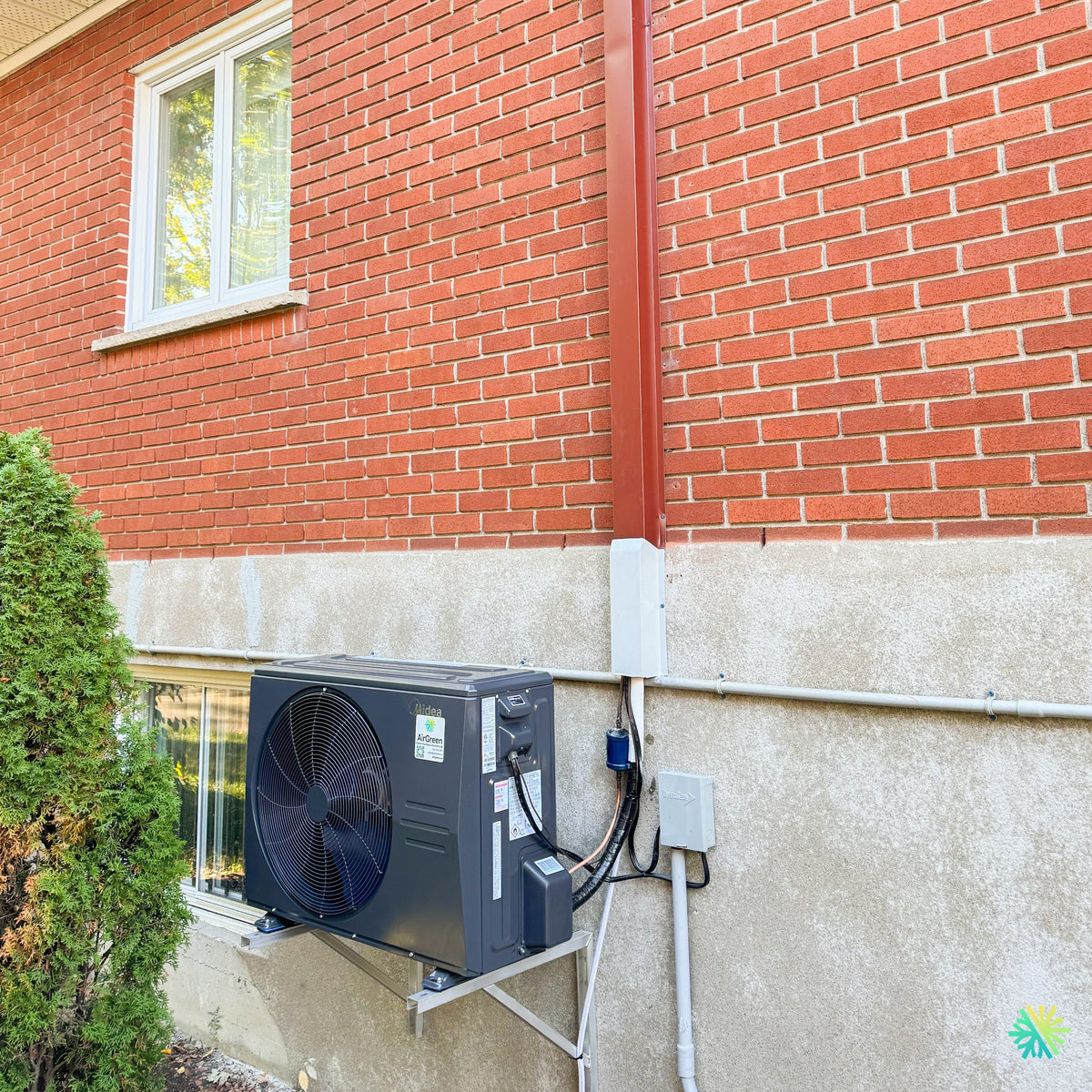
This is exactly what this installation of a MIDEA EVOX G3 central heat pump carried out by our AirGreen team demonstrates. In the jobsite photo, the outdoor unit was installed against the foundation wall, beneath the brick masonry, on a raised metal wall bracket. The refrigerant lines, wiring, and electrical disconnect were arranged to maintain clear access for servicing while minimizing the visual impact on the property.
The result seems simple when looking at the completed installation. Yet every visible detail addresses a specific technical constraint.
A central heat pump designed for Quebec's climate
The MIDEA EVOX G3 is part of a range of variable-speed central heat pumps designed to operate with a ductwork system. Unlike a wall-mounted heat pump, heated or cooled air is distributed throughout the different rooms from the home's central system.
MIDEA technical documentation indicates a capacity range that includes configurations of 18,000, 24,000, 30,000, 36,000, 48,000, and 54,000 BTU/h, with performance ratings of up to 19 SEER2, 12.5 EER2, and 10.8 HSPF2, depending on the indoor-outdoor combination selected.
Because the exact capacity of the photographed unit cannot be read on its nameplate, we prefer not to arbitrarily assign it a tonnage. This is important when comparing quotes: the name “EVOX G3” is not enough. The exact combination of indoor and outdoor models, nominal capacity, and applicable certification number must be verified.
Heating down to -30 °C: what the technical specifications actually mean
For an installation in Ville Mont-Royal, Montreal, Laval, Longueuil, on the North Shore or the South Shore, winter performance is obviously one of the first criteria to consider.
MIDEA announces continuous operation down to -30 °C for this platform. The documentation also presents, for a three-ton system tested by the manufacturer, a heating capacity reaching 100% of the rated capacity at -25 °C, with a COP indicated at around 1.9 under these conditions.
This information deserves to be understood correctly. It does not mean that a central system should be selected simply based on the number of tons of the old unit. Sizing must take into account the building's heat loss, area, insulation, windows, available airflow and ductwork design.
At AirGreen, we pay particular attention to this point. An oversized heat pump is not necessarily a better heat pump. Excessive capacity can create improper operating cycles, less uniform comfort and air distribution problems. Conversely, an undersized unit may place excessive demands on auxiliary heating during the coldest periods.
What this installation photo shows us
This installation in Ville Mont-Royal presents several details that we consider important for a central HVAC installation:
- An elevated wall bracket keeps the outdoor unit off the ground, away from standing water and some of the winter snow. Supports are visible beneath the unit's feet to stabilize the assembly. The heat pump also remains accessible without unnecessarily taking up ground space.
- The unit's front is unobstructed. With a horizontal-discharge unit, obstacles must be kept directly in front of the fan. Nearby vegetation must also be maintained and trimmed so that it does not gradually encroach on the air exchange area.
- The refrigerant lines run up the side of the building inside a vertical line cover. The reddish-brown upper section blends much better with the brick and existing architectural elements than a bundle of completely exposed pipes.
- The electrical disconnect is installed near the unit, making it easier to disconnect the power during maintenance or technical service.
- The filter drier visible on the refrigerant line is one of the important components of the circuit. Its role includes helping protect the system from moisture and contaminants present in the refrigerant circuit.
- The lines are grouped and protected rather than simply left against the wall. In a durable installation, the finish of the refrigerant lines matters almost as much as their mechanical connection.
This arrangement is particularly relevant in the context of many properties in Ville Mont-Royal: a brick wall above a concrete foundation, basement windows and relatively few places to position an outdoor unit without obstructing walkways or detracting from the appearance of the house.
Why we chose a wall bracket
In Montreal, installing a heat pump directly near ground level without taking snow into account is a mistake we still encounter on some existing installations.
A central heat pump must be able to draw in and discharge enough air even in the middle of winter. A significant accumulation of snow around the heat exchanger reduces the available space and can interfere with the unit's operation.
The wall bracket used here keeps the unit at a practical height while leaving the lower space clear. This also makes it easier to inspect the lines and the underside of the machine.
However, the support must be selected and secured properly. A central heat pump is significantly heavier than a small wall-mounted unit. Anchoring it to the appropriate structure, the support's capacity and vibration control must therefore be verified before installation.
A finish for the lines that respects the house
The vertical line cover is a particularly visible detail in this photo.
When the refrigerant line has to run along a significant portion of an exterior wall, we look for a route that is both short, accessible, protected and visually consistent with the building.
On a brick facade like this one, leaving several meters of exposed copper, black insulation and wires would have produced a much less tidy result. The line cover also protects the insulation from UV rays, the elements and mechanical damage.
This is the kind of detail that does not change the SEER2 listed on a technical data sheet, but that significantly affects the perceived quality and durability of a central heat pump installation.
EVOX G3: why this platform is interesting when replacing an existing central system
An interior design suited to renovations
An interesting feature of the EVOX G3 is located inside the home. MIDEA designed its air handler as a modular unit, with several configuration options.
The manufacturer's documentation specifically presents six installation orientations, including upflow, downflow, right-horizontal, left-horizontal, and low-boy-type arrangements adapted to height constraints.
This flexibility can be particularly useful in the basements of older homes in Ville Mont-Royal and Montreal, where the space available around the old furnace is sometimes limited by finished walls, a compact mechanical room, or existing ducts that are difficult to move.
The range also offers widths close to those of many traditional furnaces, which can facilitate certain replacements without unnecessarily rebuilding a large part of the air distribution system.
The ductwork must be part of the diagnosis
Installing a high-performance central heat pump on inadequate ductwork can limit the results.
An undersized duct, an excessively restrictive filter, a dirty coil, or improper airflow adjustments can increase static pressure and reduce the amount of air actually distributed throughout the home.
The EVOX G3 uses constant-airflow technology that allows its fan to adapt to variations in ductwork pressure. MIDEA indicates an operating capacity of up to 1.2 in. of water column static pressure, with an airflow setting offering up to 60 levels.
However, this never replaces a ductwork inspection.
When replacing a central system, we check, among other things, the dimensions of the return and supply ducts, the cleanliness of the ductwork, filtration, the plenum configuration, and the airflow required for the selected capacity. This is particularly important when an old furnace or heat pump is replaced with a modern inverter system.
R454B: now an important component in new installations
The MIDEA EVOX G3 uses R454B refrigerant. MIDEA states that this A2L refrigerant was selected for its EVOX range and assigns it a global warming potential of 466.
In the photo of our installation in Ville Mont-Royal, the A2L labeling is also visible on the side of the outdoor unit.
The transition to A2L refrigerants changes certain work methods. Tools, installation procedures, and service practices must be adapted to the refrigerant concerned. That is why we recommend not comparing only the purchase price of two central heat pumps: the installer’s actual experience with the installed equipment generation also matters.
Filtration and comfort control
The EVOX G3 indoor unit can accommodate 1-, 2-, or 4-inch filter configurations, and the documentation mentions compatibility with MERV 13 filtration. The system can also operate with the MIDEA communicating thermostat and the SmartHome app for scheduling, comfort control, and monitoring certain operating data.
In practice, filter selection should always be based on the ductwork system. Automatically installing the most restrictive filter possible without measuring static pressure is not a good approach. More advanced filtration must remain compatible with the airflow the system requires.
Subsidy eligibility: verify the exact combination before promising an amount
In Québec, caution is required with subsidy claims displayed around a heat pump model.
MIDEA documentation indicates that the range exceeds the ENERGY STAR “Most Efficient” specifications presented by the manufacturer. However, this is not enough to automatically confirm a Québec subsidy for every combination.
In September 2026, Hydro-Québec specifies, among other things, that heat pumps installed as of November 26, 2025, must be ENERGY STAR certified to be eligible for the LogisVert program and directs homeowners to its official tool for checking eligible models.
That is why, at AirGreen, we recommend verifying the indoor model number, the outdoor model number, and the exact AHRI combination before confirming the applicable financial assistance. Criteria and amounts may change, and two systems bearing the same commercial name may have different certifications.
The mistakes this installation helps avoid
The photo of this installation is a good example of what we try to avoid when replacing a central system: a unit installed too close to the ground, refrigerant lines exposed along the entire facade, a disconnect switch that is difficult to access, wires suspended without protection, a blocked air outlet, or a heat pump placed where shrubs will eventually obstruct the coil.
Another point is often overlooked: future maintenance.
An installation is not finished simply because the system works on startup day. A technician must be able to return several years later, remove the panels, access the connections, check the pressures, inspect the filter-drier, and work on the electrical components without having to dismantle half of the outdoor installation.
That is why we place so much importance on the location and organization of the components.
A central installation must be designed as a complete system
A central heat pump such as the MIDEA EVOX G3 is never just an outdoor box mounted against a house.
Final performance depends on the outdoor unit, indoor module, selected capacity, ductwork quality, thermostat, filtration, auxiliary heating, refrigeration installation, and adjustments made during commissioning.
On this Mont-Royal project, the outdoor portion clearly illustrates our approach: keeping the equipment elevated, protecting the lines, maintaining access to the disconnect switch, respecting the existing architecture, and leaving the heat pump enough space to operate and be serviced properly.
For a homeowner considering replacing an old electric furnace, an aging heat pump, or a complete central system in Mont-Royal, Montreal, Laval, Longueuil, the North Shore, or the South Shore, we can assess the existing installation, inspect the ductwork, and propose the MIDEA EVOX G3 capacity that is actually suited to the building rather than simply reproducing the old unit's tonnage.
Contact AirGreen for an estimate for installing a central heat pump. We can inspect your existing system, determine the appropriate configuration, and confirm the models and eligibility for applicable financial assistance programs before the work begins.
The job tools
Two quick checks with real numbers: what heat costs, and what your current heaters add up to in BTU/h.
Baseboards and electric furnaces turn 1 kWh of electricity into 1 kWh of heat. A heat pump delivers more: that is its COP. At Hydro-Québec’s rate D (11.142¢/kWh above 40 kWh a day, since 1 April 2026):
Hydro-Québec: a heat pump can be up to three times more efficient than baseboards for heating in the colder months.
Estimate per kWh of heat, at the chosen temperature, using the certified COP from the product page. Taxes, access charge and backup heat not included.
Conversion: 1 W = 3.412 BTU/h. An indication, not a load calculation: baseboards and furnaces are often stronger than the real need, and they can stay as backup. AirGreen confirms the capacity on site.
How the job unfolds
The main steps of this kind of job at AirGreen. Every house has its quirks: the estimate brings them out.
We look at the ducts, the current indoor module, the electrical panel and the planned spot for the outdoor unit.
The equipment combination, capacity and price, in writing. We check whether the combination qualifies for assistance programs.
Access protected, old unit disconnected and removed when it is being replaced.
Electric furnace or air handler, with its coil, connected to the supply and return ducts.
On a level base, raised above the snow, with free space all around.
Insulated, they enter through a sealed opening and run to the indoor coil.
Dedicated circuits, accessible disconnect, a thermostat that works with the heat pump and the backup heat.
Leak test, vacuum, start-up, airflow check and a test of both modes.
Filter, thermostat, backup heat in extreme cold: what to know before winter.
- The on-site estimateWe look at the ducts, the current indoor module, the electrical panel and the planned spot for the outdoor unit.
- The quoteThe equipment combination, capacity and price, in writing. We check whether the combination qualifies for assistance programs.
- Getting readyAccess protected, old unit disconnected and removed when it is being replaced.
- The indoor moduleElectric furnace or air handler, with its coil, connected to the supply and return ducts.
- The outdoor unitOn a level base, raised above the snow, with free space all around.
- The refrigerant linesInsulated, they enter through a sealed opening and run to the indoor coil.
- Electrical and thermostatDedicated circuits, accessible disconnect, a thermostat that works with the heat pump and the backup heat.
- Tests and start-upLeak test, vacuum, start-up, airflow check and a test of both modes.
- The walkthroughFilter, thermostat, backup heat in extreme cold: what to know before winter.
What we check on a job like this one
Each number is a point we check on site. Switch between summer and winter to watch air and heat move.
In summer, the outdoor unit rejects the house's heat outside.
Generic illustration of this type of installation, not a survey of this job site. Tap a number.
It captures or rejects heat outside. It sits on a level base, above the snow, with free space all around.
The insulated refrigerant lines enter the house through a sealed opening and run to the indoor coil.
A shut-off switch near the outdoor unit isolates it safely for service.
Sitting on the indoor module, it moves heat between the house air and the refrigerant.
Electric furnace or air handler: its fan pushes air through the ducts. The electric backup takes over in extreme cold.
Supply ducts bring air to the rooms; returns bring it back to the unit. Their condition matters as much as the unit's.
It protects the coil and the fan. A dirty filter cuts airflow, so it gets checked regularly.
It runs the heat pump and the backup heat. It must be compatible with the installed system.
Is your home ready?
Check what applies at your place. A "no" is not a refusal: it is what we sort out during the estimate.
Good habits, once the unit is in place
Six simple habits that keep the unit going. Your list stays on this device.
What to do, season by season
Three habits per season for this unit. They take a few minutes and prevent many calls.
- Check the indoor module's filter.
- Clear winter debris from the outdoor unit.
- Test cooling before the heat arrives.
- Check the filter more often in peak season.
- Keep registers and returns clear.
- Watch condensate drainage near the coil.
- Change or clean the filter.
- Test heating and backup heat before the cold.
- Book periodic maintenance.
- Clear snow around the outdoor unit.
- Store nothing in front of the indoor module.
- Note any unusual noise or smell and call us.
The right pages, at the right time
Four statements: true or false?
It all comes down to details you have just seen.
1. A central heat pump uses the house's ducts.
It connects to the existing ducts to heat and cool everywhere.
2. In extreme cold, electric backup heat can take over.
The indoor module (furnace or air handler) works with the heat pump and takes over in extreme cold.
3. The filter only gets changed when the unit breaks down.
A dirty filter cuts airflow. It gets checked regularly.
4. You can reuse the old unit's size without checking.
The house may have changed: insulation, windows, added rooms. Capacity is confirmed on site.
0 / 4 right answers
What people ask us about this kind of work
Can I keep my current ducts?
What happens in extreme cold?
Furnace, air handler, ducted: what is the difference?
Are there grants?
Do I need a permit?
How much can I save?
How is the LogisVert assistance calculated?
Will my current thermostat work?
Central or wall units: which one?
Does AirGreen hold the required licences?
Is the estimate free?
No question matches. Write to us: we answer.
More jobs to see, near you
By town, by equipment or by region: browse more than 4,700 published projects.
Each dot: a town where AirGreen has published projects. The glowing dot: this job.
An on-site estimate, the right capacity, the right equipment.
The on-site estimate is free and the quote follows within 24 hours.
Text and photo: a real AirGreen Climatisation & Chauffage job. The diagrams are generic illustrations of the type of installation, not a survey of this job site. Sources of the added figures: airgreen.ca product pages (NEEP / AHRI performance), Hydro-Québec (Heat pumps page, LogisVert, read on 13 October 2026), Régie de l’énergie (rate D as of 1 April 2026).