
Installation of a MIDEA EVOX G3 central heat pump in Les Cèdres, Montérégie
In Cèdres, AirGreen installs a MIDEA EVOX G3 central heat pump on a raised stand with compact connections: heating down to -30 °C, inverter, R-454B, airflow optimization, and LogisVert eligibility to be verified.
- City
- Region
- Equipment
- Brand
- Challenges
- Published
The job on one screen
The unit’s data sheet
The range as published on airgreen.ca: pick a size to see its capacity in deep cold.
| Size | Heating at −8 °C | Heating at −15 °C | Coldest certified point | COP at −15 °C | SEER | HSPF | Indicative LogisVert aid |
|---|---|---|---|---|---|---|---|
| Midea EVOX G3 · 1.5 tons | 14,700 | 18,600 | −30 °C: 11,800 | 2.12 | 19.0 | 10.1 | $1,764 |
| Midea EVOX G3 · 2 tons | 20,800 | 20,600 | −30 °C: 12,100 | 2.14 | 18.6 | 10.0 | $2,496 |
| Midea EVOX G3 · 2.5 tons | 24,000 | 33,200 | −30 °C: 17,900 | 1.97 | 17.2 | 10.8 | $2,880 |
| Midea EVOX G3 · 3 tons | 33,000 | 37,400 | −30 °C: 27,600 | 1.9 | 18.0 | 10.0 | $3,960 |
| Midea EVOX G3 · 4 tons | 39,500 | 48,000 | −30 °C: 27,200 | 2.0 | 17.5 | 9.5 | $4,740 |
| Midea EVOX G3 · 5 tons | 45,000 | 54,000 | −30 °C: 37,300 | 1.9 | 17.5 | 9.5 | $5,400 |
Data read live from the airgreen.ca page of each size (NEEP / AHRI certified performance). When the title names the installed size, it is highlighted; otherwise the whole range is shown. The aid shown is today’s, using Hydro-Québec’s rule ($120 per 1,000 BTU/h at −8 °C); amounts quoted in the article date from its publication. Only Hydro-Québec confirms the assistance granted.
The article, chapter by chapter
A compact installation against the foundation where every connection had to find its place
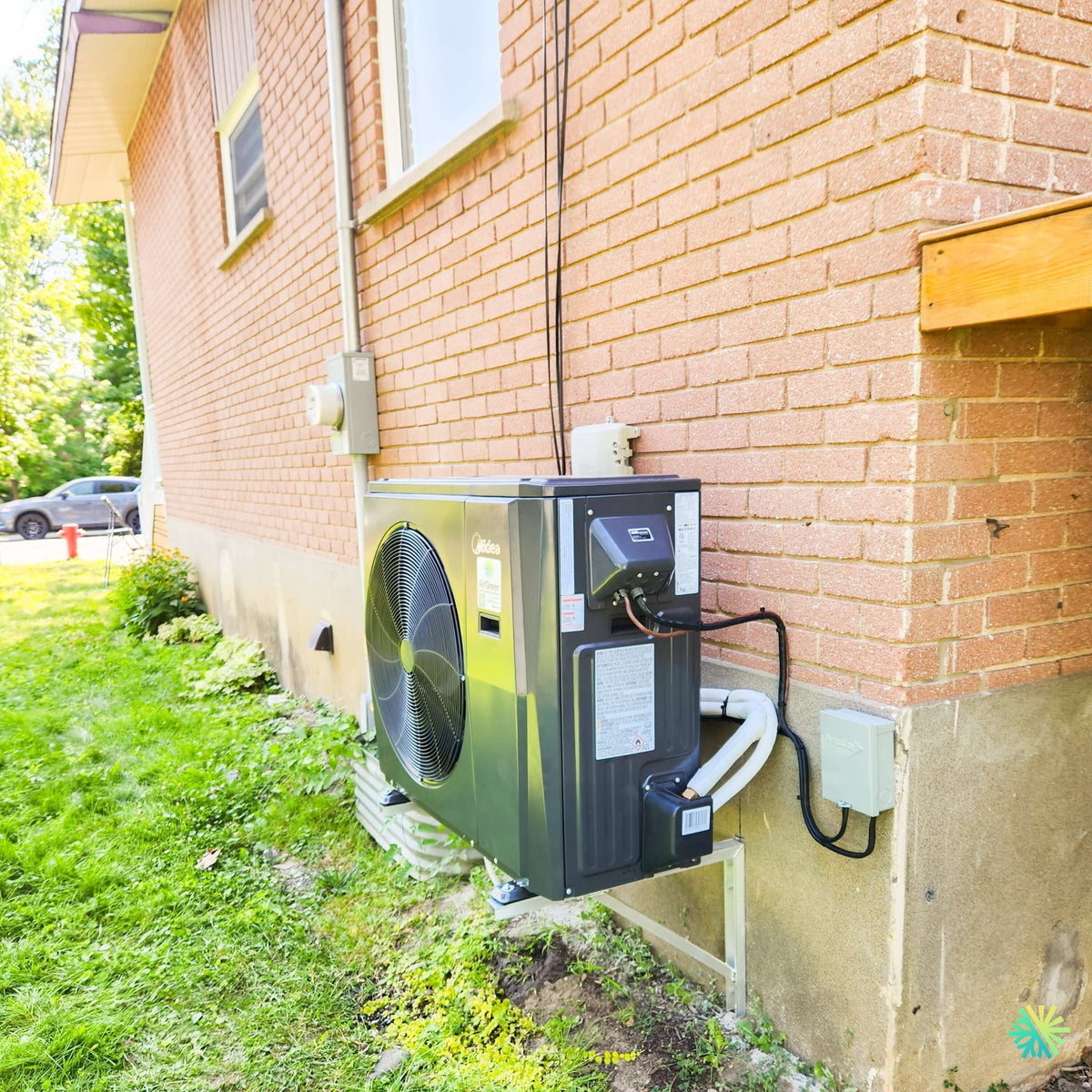
In Les Cèdres, we completed this installation of a MIDEA EVOX G3 central heat pump at a residence where the outdoor environment required particularly precise planning. The job-site photo shows what technical sheets never do: a heat pump must fit into a real home, with its openings, electrical service entrance, existing lines, landscaping, and access constraints that will remain long after we leave.
The Midea outdoor unit is positioned against a concrete foundation topped by a brick wall. Several building elements are already nearby: a meter or service equipment farther along the facade, various vertical cables, a wall outlet, the heat pump’s electrical disconnect, and a wooden structure at the corner of the house.
We had to integrate the new equipment without turning this part of the property into a tangle of pipes and cables.
The result is based on a simple but decisive choice: installing the EVOX G3 on a raised metal support, with the technical connections grouped on the right side and a very short refrigerant line to the house. The fan face remains directed toward the open area of the property.
Midea’s documentation presents the EVOX G3 as a range of inverter ducted central systems designed in particular to facilitate the modernization of residential heating.
Why this location in Les Cèdres required more than just an open space
A first look at the photo shows that the condenser was not placed randomly in the middle of the wall.
We had a relatively well-suited area between the residence’s various services. Choosing this location allowed us to simultaneously:
- keep the front discharge clear;
- limit the length of the outdoor piping;
- keep the service panel accessible;
- place the electrical disconnect nearby;
- keep the unit sufficiently clear of the ground;
- reduce the visual impact on the facade;
- avoid monopolizing a significant portion of the yard.
This approach is particularly important for a central heat pump, because the condenser is generally larger than a small outdoor unit intended for a single room.
Its operation must therefore be anticipated before the first support is secured.
An elevated support rather than an installation directly on the ground
In the photo, the MIDEA EVOX G3 rests on a metal structure that keeps the bottom of the chassis well above the ground.
In our climate, this choice serves several purposes.
In winter, the outdoor unit must contend with snow and, above all, the water produced during defrost cycles. A central heat pump installed too close to the ground can gradually become surrounded by ice if drainage beneath the unit has not been properly anticipated.
Elevation also helps limit interactions with:
vegetation, leaves, soil, water splashes, and snow accumulation.
In Les Cèdres, where this unit must provide a significant portion of the home's winter heating, we prefer to think about January from the day of installation, even when the project is photographed with green grass.
The clearance beneath the unit is not wasted space
It may be tempting to lower an outdoor unit as close to the ground as possible to make it less visible.
On a heat pump intended for extreme-cold heating, this can be a false economy of space.
During defrosting, ice must form away from the base of the unit rather than directly beneath the heat exchanger. The additional height also makes it easier to periodically clean the area and to better see what accumulates around the unit.
A truly open discharge side facing the property
The MIDEA EVOX G3 visible in this installation uses a large front fan.
It faces the open part of the property. No fence panel, wall, or other condenser is immediately in front of it.
This installation feature directly relates to the unit's design. On page 4 of its documentation, Midea presents an outdoor architecture with a horizontal-discharge fan and vertical heat exchanger, designed to further even out airflow across the heat exchanger.
This air circulation is fundamental.
A heat pump exchanges energy with the outdoor air. If the discharged air immediately returns to the unit because the space is too enclosed, its operating conditions deteriorate.
That is why a location that seems aesthetically convenient is not always a good HVAC location.
A short refrigerant line and exterior finishing concentrated in the same place
One of the most interesting details of this installation is located behind the right side of the condenser.
The refrigerant lines enter the home only a few feet from the outdoor unit. The visible sections are protected and grouped together rather than running horizontally across the entire façade.
A short route can offer several advantages when it is compatible with the location of the indoor unit:
- less exposed piping;
- fewer line covers on the façade;
- fewer changes of direction;
- a more discreet finish;
- simpler access in the event of future service.
However, we never seek to achieve the shortest route at the expense of the heat pump's location. Clearances, service access, and airflow remain priorities.
Here, the two objectives could be reconciled.
The technical panel remains accessible without moving the unit
The right side of the EVOX G3 is particularly visible in the photo: refrigerant connections, service panels, and labels remain accessible.
This matters because an installation must be designed for the system's entire service life.
A refrigeration technician may one day need to access the service valves, measure operating parameters, or open the unit to perform a diagnosis. If the technical side is installed almost against a fence, downspout, or perpendicular wall, every service call becomes unnecessarily complex.
At AirGreen, we prefer to plan for this future service from the very first installation.
The disconnect completes a cohesive outdoor installation
To the right of the condenser, the outdoor electrical disconnect is mounted directly to the foundation.
The wiring between the disconnect and the heat pump follows a short, clearly identifiable route. This arrangement makes it easier to isolate the unit for service and prevents a large amount of wiring from being spread across the façade.
These are relatively unremarkable details in a quote, but they matter greatly to the finish of a professional HVAC installation.
The A2L label visible on the side also signals a new generation of systems
Looking at the side of the outdoor unit, you can see the pictogram associated with the category refrigerant A2L.
The EVOX G3 lineup uses R-454B. Midea states that this refrigerant was selected for its EVOX central lineup and assigns it a global warming potential, or GWP, of 466.
For the homeowner, this change is almost invisible during everyday use.
For the installer, however, it requires appropriate procedures, tools, and knowledge of R-454B. Replacing an older central system therefore no longer necessarily means exactly reproducing the methods used with an older generation of refrigerant.
EVOX G3 Extreme Heat: a system designed to keep heating when the temperature drops
In Les Cèdres, as elsewhere in the greater Montreal area, the value of a central heat pump is measured mainly in winter.
Page 3 of the EVOX G3 brochure presents continuous operation down to -30 °C for the Extreme Heat platform. The manufacturer also indicates significant heating performance at very low temperatures for the system used in its three-ton tests.
Midea notably uses its M-Powevi compressor technology. When conditions become very cold, the documentation describes intermediate-temperature vapor injection to increase the amount of compressed refrigerant and support heating performance.
This does not mean that a heat pump, simply because it operates at -30 °C, can automatically cover the needs of every home on its own at that temperature.
We must always compare the equipment's available capacity with the building's heat loss.
What EVOX G3 capacity are we looking at?
The photograph clearly identifies the Midea EVOX family, but the complete model number on the nameplate is not clear enough to reliably assign a specific capacity to this installation.
We therefore prefer not to guess the tonnage.
The EVOX G3 documentation provided for this range presents several Extreme Heat configurations:
| Rated cooling capacity | Published rated heating | SEER2 | EER2 | HSPF2 | Published heating at -15 °C |
|---|---|---|---|---|---|
| 18,000 BTU/h | 18,000 BTU/h | 19,0 | 12,5 | 10,1 | 18,600 BTU/h |
| 24,000 BTU/h | 24,000 BTU/h | 18,6 | 12,0 | 10,0 | 20,600 BTU/h |
| 30,000 BTU/h | 33,000 BTU/h | 17,2 | 12,0 | 10,8 | 33,200 BTU/h |
| 36,000 BTU/h | 36,000 BTU/h | 17,7 | 12,0 | 10,0 | 32,600 BTU/h |
| 48,000 BTU/h | 48,000 BTU/h | 17,5 | 12,0 | 9,5 | 48,000 BTU/h |
| 54,000 BTU/h | 55,000 BTU/h | 17,5 | 12,0 | 9,5 | 54,000 BTU/h |
These figures come from the specifications table for the 3rd-generation EVOX G3 Extreme Heat.
Depending on the combination, the range therefore reaches up to 19 SEER2, 12.5 EER2, and 10.8 HSPF2.
For a homeowner comparing two quotes, this distinction is important: the name EVOX G3 is not enough to determine the exact performance. The outdoor model number, indoor unit, and certified combination must be compared.
A high-performance central heat pump in Les Cèdres also depends on everything the photo does not show
The ductwork is part of the system
The condenser is the visible part of the system, but comfort in the home largely depends on what happens inside.
A central heat pump must move enough air through the existing ductwork to properly supply each room.
We therefore need to consider both:
BTU capacity, CFM airflow, air returns, static pressure, filtration, and ductwork balancing.
A highly efficient heat pump connected to a highly restrictive ductwork system can produce disappointing results.
Computational Constant Airflow 2.0: up to 1.2 in. of static pressure in Midea’s example
Page 8 of the brochure presents the Computational Constant Airflow 2.0 technology.
Midea specifically illustrates an airflow rate of 1,200 CFM maintained under conditions of up to 1.2 in. of static pressure, and explains that the fan adjusts its power and speed according to the ductwork conditions.
The system also allows up to 60 levels of airflow adjustment.
This is particularly useful when replacing an older furnace or heat pump with an EVOX G3, since the ductwork was often built several decades before the new equipment was installed.
This technology provides greater flexibility for adjustment, but it does not eliminate the need for static pressure measurements and ductwork inspection.
An air handler designed for renovations
Midea also designed the EVOX G3 indoor unit for multiple installation orientations.
The brochure shows upflow, downflow, right- and left-horizontal configurations, as well as “low-boy” installations when available height is limited.
This modularity is particularly useful in basements, where the unit often has to work around:
- beams;
- plumbing lines;
- a water heater;
- the electrical panel;
- existing plenums;
- an already finished ceiling.
The product line also uses different indoor unit widths, approximately 14.5 to 21.5 in. depending on capacity, to facilitate certain conversions from older furnaces.
The auxiliary heating must be set up as carefully as the heat pump
The EVOX G3 can be paired with a multi-stage auxiliary heating system reaching up to 25 kW, depending on the application. Midea provides for activation and adjustment based on heating needs.
This part of the system should not be overlooked.
If the electric auxiliary heat comes on too early, some of the savings enabled by the heat pump may be lost. If it comes on too late or is improperly sized, comfort may be affected during cold snaps.
We must therefore configure the entire setup as a single heating system, rather than as a heat pump to which electrical components are simply added.
Midea communication or 24 V thermostat: useful when the house already exists
Replacing a central system often presents a very practical constraint: the wiring between the thermostat and the mechanical room.
Midea provides 485 communication on the EVOX G3, as well as 24 V compatibility for certain configurations with a third-party thermostat.
The platform can also use the Midea communicating thermostat and the SmartHome app, including programming, monitoring of certain comfort and consumption parameters, and diagnostic functions.
This flexibility can prevent turning an HVAC upgrade into an unnecessarily invasive project in an already finished home.
MERV 13 filtration: useful only if the system can breathe
The product line also includes modules for 1-, 2-, or 4-inch filters, including MERV 13 options.
A higher-performance filter can capture more dust and particles. But proper filtration must always be combined with sufficient filter surface area.
Installing a highly restrictive filter without checking airflow can create more problems than it solves.
That is why we assess filtration and ventilation together.
LogisVert: an EVOX G3 must be verified by its exact combination
For a heat pump installation in Les Cèdres, Hydro-Québec's financial assistance can represent an important part of the project.
The LogisVert program currently provides, when all requirements are met, assistance of $50 per 1,000 BTU/h at -8 °C for an ENERGY STAR-certified heat pump and $120 per 1,000 BTU/h at -8 °C when it is classified ENERGY STAR - Cold Climate.
However, the exact installed combination must be verified. Hydro-Québec allows searches using the AHRI number or the unique ENERGY STAR number and states that its official list of eligible heat pumps takes precedence.
In other words, the fact that an EVOX G3 series reaches certain ENERGY STAR efficiencies in the manufacturer's documentation does not authorize us to automatically advertise a subsidy for any combination.
We verify the file using the equipment's exact references.
The mistakes this installation reminds us to avoid
On a central heat pump project in Les Cèdres, several mistakes may seem minor on installation day but become costly later:
- Placing the condenser almost at ground level, without anticipating snow and defrosting.
- Positioning the fan facing an obstacle solely to hide the equipment.
- Choosing the tonnage based solely on floor area, without analyzing the heating load.
- Ignoring the static pressure of the existing ductwork.
- Installing a filter that is too restrictive for the available surface area.
- Blocking the service side with a wall, fence or future landscaping.
- Running the lines unnecessarily across the entire facade.
- Confirming a LogisVert incentive without an AHRI number or verified eligible combination.
These are precisely the details we incorporate into the way we work at AirGreen.
Why this installation in Les Cèdres represents our approach so well
This installation is interesting because it does not depend on a spectacular project.
Rather, it shows a series of coherent decisions.
The MIDEA EVOX G3 condenser found its place in an area already occupied by several of the home's services. It was raised without obstructing the property, its fan faces an open space, the refrigerant connections are concentrated near their entry point, the disconnect remains accessible and the technical side can still be serviced.
Indoors, the same level of attention must continue: capacity selection, airflow, static pressure, filtration, auxiliary heating and controls.
It is this comprehensive vision of the HVAC installation that we apply in Les Cèdres, as we do in our central heat pump projects in Montreal, Laval, Longueuil, on the South Shore and on the North Shore.
An MIDEA EVOX G3 can provide an excellent technical foundation with its inverter compressor, its advertised operation down to -30 °C, its high efficiencies, its modular indoor unit, its advanced airflow control and its R-454B refrigerant.
Our job is to ensure that these features are genuinely usable once the equipment is installed in the home.
The job tools
Two quick checks with real numbers: what heat costs, and what your current heaters add up to in BTU/h.
Baseboards and electric furnaces turn 1 kWh of electricity into 1 kWh of heat. A heat pump delivers more: that is its COP. At Hydro-Québec’s rate D (11.142¢/kWh above 40 kWh a day, since 1 April 2026):
Hydro-Québec: a heat pump can be up to three times more efficient than baseboards for heating in the colder months.
Estimate per kWh of heat, at the chosen temperature, using the certified COP from the product page. Taxes, access charge and backup heat not included.
Conversion: 1 W = 3.412 BTU/h. An indication, not a load calculation: baseboards and furnaces are often stronger than the real need, and they can stay as backup. AirGreen confirms the capacity on site.
How the job unfolds
The main steps of this kind of job at AirGreen. Every house has its quirks: the estimate brings them out.
We look at the ducts, the current indoor module, the electrical panel and the planned spot for the outdoor unit.
The equipment combination, capacity and price, in writing. We check whether the combination qualifies for assistance programs.
Access protected, old unit disconnected and removed when it is being replaced.
Electric furnace or air handler, with its coil, connected to the supply and return ducts.
On a level base, raised above the snow, with free space all around.
Insulated, they enter through a sealed opening and run to the indoor coil.
Dedicated circuits, accessible disconnect, a thermostat that works with the heat pump and the backup heat.
Leak test, vacuum, start-up, airflow check and a test of both modes.
Filter, thermostat, backup heat in extreme cold: what to know before winter.
- The on-site estimateWe look at the ducts, the current indoor module, the electrical panel and the planned spot for the outdoor unit.
- The quoteThe equipment combination, capacity and price, in writing. We check whether the combination qualifies for assistance programs.
- Getting readyAccess protected, old unit disconnected and removed when it is being replaced.
- The indoor moduleElectric furnace or air handler, with its coil, connected to the supply and return ducts.
- The outdoor unitOn a level base, raised above the snow, with free space all around.
- The refrigerant linesInsulated, they enter through a sealed opening and run to the indoor coil.
- Electrical and thermostatDedicated circuits, accessible disconnect, a thermostat that works with the heat pump and the backup heat.
- Tests and start-upLeak test, vacuum, start-up, airflow check and a test of both modes.
- The walkthroughFilter, thermostat, backup heat in extreme cold: what to know before winter.
What we check on a job like this one
Each number is a point we check on site. Switch between summer and winter to watch air and heat move.
In summer, the outdoor unit rejects the house's heat outside.
Generic illustration of this type of installation, not a survey of this job site. Tap a number.
It captures or rejects heat outside. It sits on a level base, above the snow, with free space all around.
The insulated refrigerant lines enter the house through a sealed opening and run to the indoor coil.
A shut-off switch near the outdoor unit isolates it safely for service.
Sitting on the indoor module, it moves heat between the house air and the refrigerant.
Electric furnace or air handler: its fan pushes air through the ducts. The electric backup takes over in extreme cold.
Supply ducts bring air to the rooms; returns bring it back to the unit. Their condition matters as much as the unit's.
It protects the coil and the fan. A dirty filter cuts airflow, so it gets checked regularly.
It runs the heat pump and the backup heat. It must be compatible with the installed system.
Is your home ready?
Check what applies at your place. A "no" is not a refusal: it is what we sort out during the estimate.
Good habits, once the unit is in place
Six simple habits that keep the unit going. Your list stays on this device.
What to do, season by season
Three habits per season for this unit. They take a few minutes and prevent many calls.
- Check the indoor module's filter.
- Clear winter debris from the outdoor unit.
- Test cooling before the heat arrives.
- Check the filter more often in peak season.
- Keep registers and returns clear.
- Watch condensate drainage near the coil.
- Change or clean the filter.
- Test heating and backup heat before the cold.
- Book periodic maintenance.
- Clear snow around the outdoor unit.
- Store nothing in front of the indoor module.
- Note any unusual noise or smell and call us.
The right pages, at the right time
Four statements: true or false?
It all comes down to details you have just seen.
1. A central heat pump uses the house's ducts.
It connects to the existing ducts to heat and cool everywhere.
2. In extreme cold, electric backup heat can take over.
The indoor module (furnace or air handler) works with the heat pump and takes over in extreme cold.
3. The filter only gets changed when the unit breaks down.
A dirty filter cuts airflow. It gets checked regularly.
4. You can reuse the old unit's size without checking.
The house may have changed: insulation, windows, added rooms. Capacity is confirmed on site.
0 / 4 right answers
What people ask us about this kind of work
Can I keep my current ducts?
What happens in extreme cold?
Furnace, air handler, ducted: what is the difference?
Are there grants?
Do I need a permit?
How much can I save?
How is the LogisVert assistance calculated?
Will my current thermostat work?
Central or wall units: which one?
Does AirGreen hold the required licences?
Is the estimate free?
No question matches. Write to us: we answer.
More jobs to see, near you
By town, by equipment or by region: browse more than 4,700 published projects.
Each dot: a town where AirGreen has published projects. The glowing dot: this job.
An on-site estimate, the right capacity, the right equipment.
The on-site estimate is free and the quote follows within 24 hours.
Text and photo: a real AirGreen Climatisation & Chauffage job. The diagrams are generic illustrations of the type of installation, not a survey of this job site. Sources of the added figures: airgreen.ca product pages (NEEP / AHRI performance), Hydro-Québec (Heat pumps page, LogisVert, read on 13 October 2026), Régie de l’énergie (rate D as of 1 April 2026).