
Installation of a Fujitsu AIRSTAGE Aquila XLTH dual-zone heat pump in Plateau-Mont-Royal, Montreal
AirGreen installs a Fujitsu Aquila XLTH dual-zone heat pump in Plateau-Mont-Royal, on anti-vibration wall brackets, for reliable heating, efficient cooling, and two independent comfort zones.
- City
- Region
- Equipment
- Brand
- Challenges
- Published
The job on one screen
The article, chapter by chapter
An outdoor multi-zone installation designed for a Montréal building where every detail matters
At Plateau-Mont-Royal, installing a Fujitsu AIRSTAGE Aquila XLTH dual-zone heat pump often requires more preparation than a project carried out on a completely unobstructed façade. Buildings are close together, side passages can be narrow, exterior walls feature various claddings, and the available space must be used precisely.
For this installation, we selected a multi-zone configuration capable of powering two indoor units from a single outdoor unit. This choice addressed a specific need: providing separate control in two areas of the property while limiting the number of compressors visible outside.
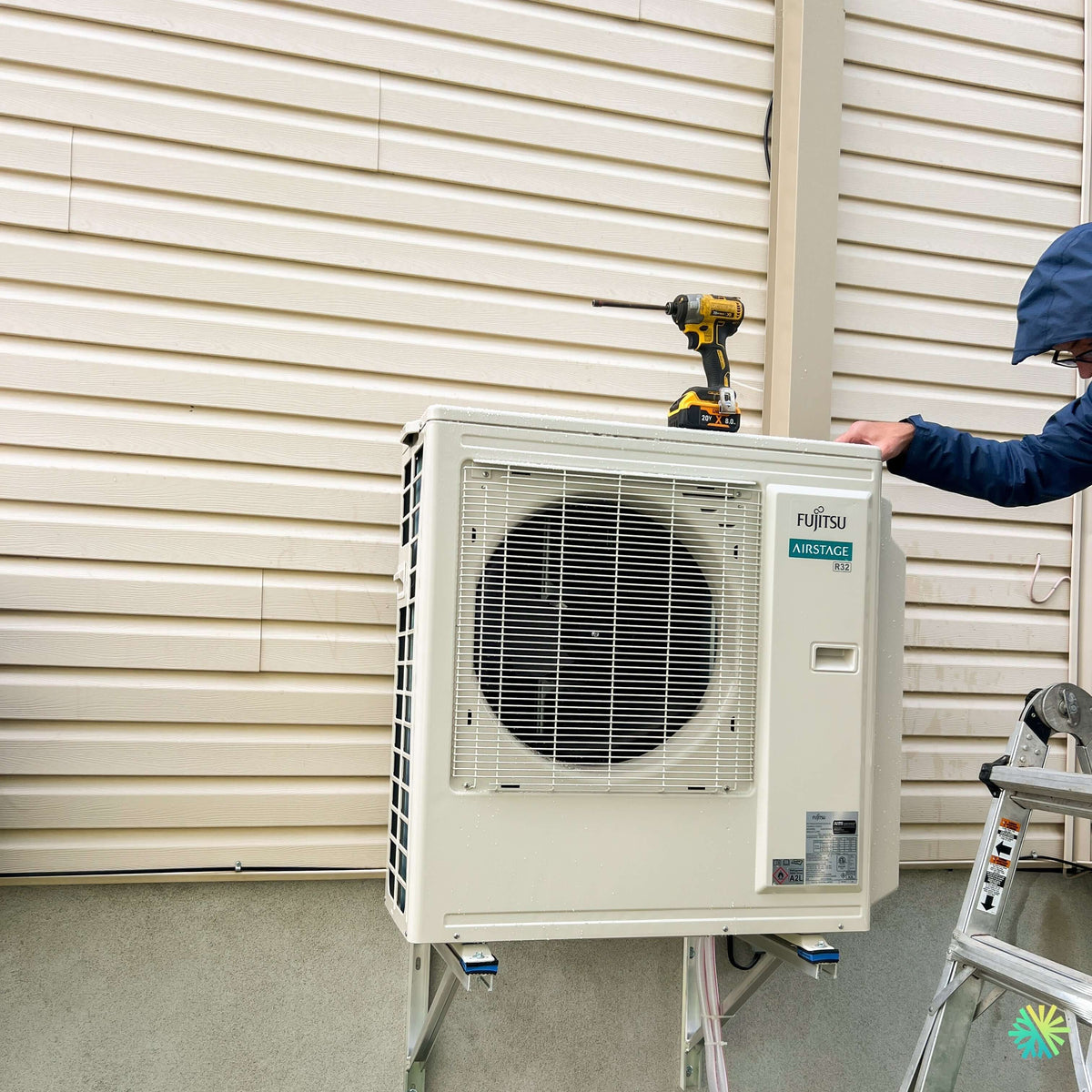
The photograph taken during the work shows the Fujitsu AIRSTAGE outdoor unit installed against a wall covered with light-colored horizontal siding. The compressor is already positioned on metal wall brackets, but the connection and finishing work is still underway. Our technician is working near the unit with the tools needed to complete the mounting and prepare the connections.
The image reveals several important aspects of this HVAC installation: the unit is elevated, the brackets are equipped with anti-vibration pads, and sufficient space is maintained around the unit to allow air circulation and future maintenance work.
Why a dual-zone heat pump was the right choice for this project
A dual-zone heat pump is particularly useful when a property has two areas with different needs. This could be, for example, a living room and a bedroom, two floors, a main area and an office, or two units served by a carefully planned configuration.
Each indoor unit can be controlled independently. Occupants can therefore adjust the temperature in each zone according to its use, sun exposure, and occupancy level.
This configuration offers several advantages:
- a single outdoor compressor for two zones;
- a separately adjustable temperature in each space;
- less obstruction on the façade or in the side passage;
- consumption better suited to actual needs;
- a more discreet installation than with two separate systems;
- greater flexibility for properties without central ductwork.
Fujitsu documentation for the H series indicates that Aquila multi-zone outdoor units can be combined with different types of indoor units, including wall-mounted models, compact duct units, cassettes, and certain ducted units. Depending on the selected capacity, an outdoor unit can power two to five indoor units. The outdoor model intended for two zones connects to a maximum of two indoor units.
In this Le Plateau-Mont-Royal project, the system was designed as a whole. We did not consider only the nominal capacity of the wall-mounted units. We also took into account the heating demand of the two spaces, the likely simultaneity of their needs, and the outdoor unit’s ability to distribute its capacity.
An elevated outdoor unit for better protection against Montreal conditions
One of the most visible details in the photo is the positioning of the outdoor unit on metal wall brackets. It is not placed directly on the ground.
This installation method offers significant advantages in a borough like Le Plateau-Mont-Royal:
- it keeps the unit above normal snow accumulation;
- it reduces the risk of obstruction around the coil;
- it avoids taking up floor space;
- it facilitates drainage of the water produced during defrost cycles;
- it helps protect the unit from leaves, debris, and certain splashes;
- it provides more convenient access to several components during maintenance.
A heat pump operating in heating mode during the winter extracts heat from the outdoor air. When conditions promote frost formation on the coil, the unit periodically runs a defrost cycle. The water produced must be able to drain freely beneath the compressor.
A unit placed too close to the ground can become surrounded by ice. This buildup can hinder drainage, block certain openings, or reduce airflow. Elevating the unit therefore directly contributes to winter reliability.
Vibration-isolation pads placed between the unit and the supports
The photo shows vibration-isolation components installed at the support points of the outdoor unit. These pads create separation between the metal structure and the compressor cabinet.
This step is particularly important when the unit is mounted on the wall of a building. A compressor contains moving mechanical parts and a large-diameter fan. Even when the unit is operating normally, a small amount of vibration can be transmitted to the structure.
Without adequate isolation, this vibration may become more noticeable indoors, especially:
- in a room located behind the wall;
- in a lightweight-structure building;
- when a bracket is tightened directly against the cabinet;
- when certain frequencies resonate with the structure;
- during periods when the compressor operates at a higher speed.
At AirGreen, we do not treat vibration-damping components as a merely aesthetic accessory. Their positioning, thickness, and fastening contribute to the installation’s acoustic comfort.
Airflow that must be preserved around the heat pump
The outdoor unit visible in the photo has a large front fan. It exhausts air through the grille at the front of the unit.
To operate properly, the system must be able to draw air through its heat exchanger and then exhaust it without excessive recirculation. A unit installed too close to an obstacle may draw back some of the air it has just discharged. This can reduce efficiency and increase operating pressure.
In this project, we paid attention to the surrounding elements:
- the wall siding behind the unit;
- the nearby vertical post;
- the free space in front of the fan;
- the side clearance required for servicing;
- the refrigerant line routing;
- access to the nameplate and service panels.
The quality of a heat pump installation often depends on these distances, which may appear minor in a photograph but have a real effect on performance and ease of maintenance.
Installing on exterior siding requires an appropriate mounting method
The wall visible in the photo is covered with horizontal siding. A compressor must never be supported solely by this siding.
The bracket must be securely anchored to a structure capable of supporting the unit’s static weight and the forces generated by vibration, wind, and temperature changes. The siding serves as the exterior finish; by itself, it is not a load-bearing element.
Before mounting, we must notably:
- locate the structural elements behind the siding;
- select the appropriate anchors;
- keep the bracket level;
- limit compression or deformation of the siding;
- protect penetrations against water;
- check the strength and stability of the assembly.
An imprecise mounting job can result in a tilted unit, excessive vibration, or gradual deterioration of the siding. It can also complicate drainage from the outdoor unit.
Choosing a Fujitsu Aquila XLTH for cold-weather heating
The Fujitsu Aquila XLTH range is designed for applications where winter heating is a priority. Documentation for the Aquila series intended for cold climates indicates heating operation down to -26 °C for the CTEB units presented by Fujitsu.
This feature addresses the realities of Montreal, where a heat pump may be required to operate for long periods below freezing.
However, this data must be interpreted correctly. A minimum operating temperature does not necessarily mean that the unit maintains its full rated capacity at that temperature. The available heat output varies with outdoor conditions.
Therefore, we always analyze:
- low-temperature heating capacity;
- the building's heat loss;
- the condition of the insulation;
- window area;
- air infiltration;
- the existing primary or auxiliary heating system;
- the desired indoor temperature;
- the required capacity in each of the two zones.
This analysis avoids choosing a heat pump solely based on the number of square feet. Two rooms of the same size may have very different needs depending on their exposure and thermal envelope.
The R32 refrigerant visible on the unit
The label affixed to the front of the outdoor unit clearly indicates the presence of R32 refrigerant. This information is important for installation, commissioning, and future technical service.
R32 must be handled with the appropriate equipment and according to the procedures specified for this refrigerant. Refrigerant connections must be made precisely and then subjected to a leak test before the unit's charge is released.
The refrigerant circuit generally includes:
- a liquid line;
- an insulated gas line;
- flared fittings or connections specified by the manufacturer;
- power and communication cables;
- a protected route between the outdoor unit and each indoor unit.
On a dual-zone heat pump, the connections must be clearly identified. Reversing the communications and piping connections associated with each zone can cause operating errors that are difficult to diagnose.
Indoor unit combinations must be validated
Fujitsu documentation does not allow all indoor unit capacities to be combined arbitrarily.
For a dual-zone outdoor unit in the H series, Fujitsu lists the following combinations in particular:
- 7 000 + 7 000 BTU/h;
- 7 000 + 9 000 BTU/h;
- 7 000 + 12 000 BTU/h;
- 7 000 + 15 000 BTU/h;
- 9 000 + 9 000 BTU/h;
- 9 000 + 12 000 BTU/h;
- 9 000 + 15 000 BTU/h;
- 12 000 + 12 000 BTU/h.
These values describe permitted combinations, but they do not replace a selection based on the building's actual loads. Fujitsu specifies that its combination tables should not be used alone to determine system capacity and recommends using its Design Simulator software to select H-series AIRSTAGE equipment.
The sum of the rated capacities of the indoor units may also exceed the rated capacity of the outdoor unit. This does not mean that the compressor will produce more than its actual capacity. When both zones demand high output simultaneously, the outdoor unit distributes its available output.
Independent operation involves an important rule
Each indoor unit can be adjusted using its own remote control. Occupants can therefore choose a different temperature and fan speed for each space.
However, the two zones connected to the same compressor cannot operate simultaneously in opposite modes. Fujitsu documentation specifies that the system provides heating and cooling, but not both at the same time.
In other words, one indoor unit cannot heat while the other is cooling. This rule must be clearly explained to the owner, particularly during spring and fall, when sunlight may warm one room while another remains cool.
Thorough commissioning after the mechanical installation
The photo shows an intermediate step. The unit is installed on its support, but the project's final quality also depends on everything that follows.
A complete commissioning includes, among other things:
- checking the tightness of the supports;
- checking clearances;
- inspecting the lines;
- a leak test;
- evacuating the circuit under vacuum;
- checking vacuum stability;
- opening the service valves;
- checking the electrical connections;
- verifying communication with both zones;
- testing in cooling mode;
- testing in heating mode;
- checking the defrost cycle and drainage;
- explaining the controls to the client.
Vacuum evacuation is essential. It removes air and moisture that may remain in the lines. Starting up an installation without an adequate vacuum can lead to circuit contamination, reduced performance, and a shorter compressor lifespan.
Mistakes to avoid when installing a multi-zone system in Montreal
Securing the compressor only to the siding
The support must be anchored to a solid structure, not simply to the exterior finish.
Neglecting vibrations
A wall-mounted heat pump without vibration isolation can transmit noise inside the building.
Install the unit too close to the ground
Snow and ice can block the lower clearance and complicate defrost cycles.
Positioning the fan directly in front of a nearby obstacle
Recirculation of discharged air can reduce performance.
Choosing two indoor units without validating the combination
The models and capacities must comply with the Fujitsu tables.
Confusing connected capacity with delivered capacity
A combination exceeding 100% of the nominal capacity does not create additional power.
Forgetting to provide service access
The panels, connections, and components must remain accessible for HVAC maintenance.
Recommended maintenance to preserve system performance
A dual-zone heat pump consists of one outdoor unit and two indoor units. Each component must be maintained.
Homeowners should, in particular:
- clean the indoor unit filters regularly;
- keep the front of the outdoor unit clear;
- remove leaves and debris around the compressor;
- monitor snow accumulation;
- avoid damaging the coil fins;
- check for any unusual noise or vibration;
- have the system inspected when its performance declines.
The heat pump should not be hermetically covered during winter. A unit used for heating must remain completely unobstructed to allow air intake and discharge.
A Fujitsu installation adapted to the real constraints of Plateau-Mont-Royal
This project highlights the elements that distinguish a standard installation from one that has been carefully prepared: an elevated unit, a mounting system suited to the building, anti-vibration supports, functional clearances, and a validated dual-zone configuration.
For homeowners in Plateau-Mont-Royal, space constraints do not mean accepting a bulky or poorly positioned installation. Instead, they require better planning.
At AirGreen, we adapt every HVAC installation to the existing structure, how the rooms are used, and the occupants’ comfort goals. We carry out this type of project in Montréal, Laval, Longueuil, the North Shore, and the South Shore, giving equal importance to sizing, finish, and commissioning.
The Fujitsu Aquila XLTH dual-zone heat pump installed here provides a practical solution for heating and cooling two spaces from a single outdoor unit. Its wall-mounted position frees up floor space, improves protection from snow, and allows for a clean integration with the façade.
The desired outcome is not limited to getting the equipment to work on the day of installation. We want the system to remain stable, accessible, quiet, and efficient through the following seasons.
The job tools
Two quick checks with real numbers: what heat costs, and what your current heaters add up to in BTU/h.
Conversion: 1 W = 3.412 BTU/h. An indication, not a load calculation: baseboards and furnaces are often stronger than the real need, and they can stay as backup. AirGreen confirms the capacity on site.
How the job unfolds
The main steps of this kind of job at AirGreen. Every house has its quirks: the estimate brings them out.
We look at the room, the outside wall, the line route and where the outdoor unit will go. That is where the capacity gets chosen.
Model, capacity and price, in writing. We also check whether the model qualifies for assistance programs.
Floors and furniture protected, wall plate position marked level, wall opening located.
A single opening, with the slope the drain needs to flow outside.
Set on a stand raised above the snow, with the clearances the manufacturer requires.
Connected, insulated and protected. The opening is then sealed against water, cold air and insects.
A dedicated circuit and an accessible disconnect near the outdoor unit.
Leak test, vacuum, then start-up and a check of heating and cooling.
Remote, modes, filters: we show you the essentials before we leave.
- The on-site estimateWe look at the room, the outside wall, the line route and where the outdoor unit will go. That is where the capacity gets chosen.
- The quoteModel, capacity and price, in writing. We also check whether the model qualifies for assistance programs.
- Getting readyFloors and furniture protected, wall plate position marked level, wall opening located.
- The wall openingA single opening, with the slope the drain needs to flow outside.
- The outdoor unitSet on a stand raised above the snow, with the clearances the manufacturer requires.
- Lines, cable and drainConnected, insulated and protected. The opening is then sealed against water, cold air and insects.
- The electrical workA dedicated circuit and an accessible disconnect near the outdoor unit.
- Tests and start-upLeak test, vacuum, then start-up and a check of heating and cooling.
- The walkthroughRemote, modes, filters: we show you the essentials before we leave.
What we check on a job like this one
Each number is a point we check on site. Switch between summer and winter to watch air and heat move.
In summer, the outdoor unit rejects the house's heat outside.
Generic illustration of this type of installation, not a survey of this job site. Tap a number.
Mounted level on a wall plate, high enough for the air to reach the whole room, with enough space around it to slide the filters out easily.
The refrigerant lines, the communication cable and the drain go through the wall in a single opening, sealed against water, cold air and insects.
Two insulated copper pipes connect the two units. Outside, a line cover can protect them from sun, knocks and weather.
A shut-off switch near the outdoor unit isolates it safely for service. It must stay accessible at all times.
The compressor and the fan. In heating mode it captures heat from the outdoor air, even in winter, and moves it inside.
On the ground or on the wall, it keeps the unit above accumulated snow. The unit stays clear and defrost water can drain away.
The fan needs to blow freely. Storage, a fence or a wall too close, and efficiency drops while noise goes up.
Is your home ready?
Check what applies at your place. A "no" is not a refusal: it is what we sort out during the estimate.
Good habits, once the unit is in place
Six simple habits that keep the unit going. Your list stays on this device.
What to do, season by season
Three habits per season for this unit. They take a few minutes and prevent many calls.
- Clean the indoor unit's filters.
- Clear leaves and debris left on the outdoor unit by winter.
- Test cooling before the first hot days.
- Clean the filters more often when the unit runs a lot.
- Keep plants away from the outdoor unit.
- Check that no water drips from the indoor unit.
- Rake the leaves around the outdoor unit.
- Test heating before the first cold days.
- Book periodic maintenance before winter.
- Keep snow away from the stand and the front of the unit.
- Let the unit defrost: it is normal.
- Never hit the ice on the fins; call us if the unit stays iced up.
The right pages, at the right time
Four statements: true or false?
It all comes down to details you have just seen.
1. In heating mode, the outdoor unit can produce water.
During defrost cycles. That water must drain away without forming ice.
2. You pick the capacity with a simple square-footage rule.
Windows, insulation, orientation and how the room is used all count. Capacity is chosen on site.
3. A multi-zone connects several indoor heads to a single condenser.
One head per room, all on the same condenser. Each room keeps its own temperature.
4. The disconnect can sit behind the patio furniture.
It must stay accessible: it is what shuts the unit off for service.
0 / 4 right answers
What people ask us about this kind of work
Does a wall-mounted heat pump heat in winter?
Wall-mounted or multi-zone: how do I choose?
Where does the outdoor unit go?
Are there grants?
Do I need a permit?
How cold can it heat?
How much can I save?
How is the LogisVert assistance calculated?
Is it noisy?
The outdoor unit is covered in ice: is that normal?
Does AirGreen hold the required licences?
Is the estimate free?
No question matches. Write to us: we answer.
More jobs to see, near you
By town, by equipment or by region: browse more than 4,700 published projects.
Each dot: a town where AirGreen has published projects. The glowing dot: this job.
An on-site estimate, the right capacity, the right equipment.
The on-site estimate is free and the quote follows within 24 hours.
Text and photo: a real AirGreen Climatisation & Chauffage job. The diagrams are generic illustrations of the type of installation, not a survey of this job site. Sources of the added figures: airgreen.ca product pages (NEEP / AHRI performance), Hydro-Québec (Heat pumps page, LogisVert, read on 13 October 2026), Régie de l’énergie (rate D as of 1 April 2026).