
Installation of a Broan-NuTone AI Series V180H75RT air exchanger in Baie-D'Urfé
Replacing a first-generation air exchanger in the West Island is primarily about deciding what to do with the inherited ductwork. Here is our audit method, applied to a Broan-NuTone V180H75RT installation in Baie-D'Urfé.
Take a tour of the installation
Each number is a point we check on site. Switch between summer and winter to watch air and heat move.
Generic illustration of this type of installation, not a survey of this job site. Tap a number.
It removes stale air and brings in fresh air. The two airflows cross in the core without mixing.
It recovers part of the heat from the outgoing air to temper the incoming air. Depending on the model, it also manages humidity.
An outdoor hood, kept away from the exhaust so the house does not pull back the air it just removed.
Humid, stale air leaves through its own hood, fitted with a damper.
The ducts that connect to the outside are insulated to prevent condensation inside the house.
Stale air is drawn from humid rooms and fresh air is sent to living areas. The airflows are balanced.
It sets the mode and speed. You use it more when the house is humid or full of people.
Depending on the model and the season, the core produces condensation, removed through a drain with its loop.
Replace a first-generation air exchanger without inheriting its flaws
On the West Island, a large proportion of homes received their first air exchanger between the late 1980s and the mid-2000s. These units are now reaching the end of their service lives, one after another. And when a homeowner calls us for a replacement, the real question is almost never which unit to choose: it is what to do with the ductwork left behind.
At Baie-D'Urfé, we replaced an aging air exchanger with a Broan-NuTone AI Series V180H75RT in a basement where an original network coexisted with successive additions. Here is the method we apply to this type of project, and the decisions that make the difference between a successful replacement and a new unit connected to the old system's flaws.
A mature housing stock, networks from another era
Baie-D'Urfé and the neighboring municipalities along Lac Saint-Louis share a fairly consistent combination: homes built on large wooded lots, full-height basements, mechanical systems installed in successive layers over forty years, and homeowners who know their houses well.
Ventilation networks from that era share a few recognizable traits:
- Uninsulated or poorly insulated flexible duct along runs that pass through cold areas.
- Reduced diameters, sometimes 4 inches where 6 inches would be required.
- Return-air grilles placed based on ease of drilling rather than the rooms they are meant to serve.
- A unit that has never been rebalanced since it was initially commissioned.
None of this is visible at a glance. Everything must be measured.
Audit the network before deciding anything
Before proposing a price, we inspect the existing network point by point. This audit takes one to two hours and determines half the project cost.
What we are happy to keep
- Rigid sections in good condition, clean, properly sealed, and of sufficient diameter. A properly installed rigid duct lasts as long as the house.
- Existing wall penetrations if their position meets safety clearances and the sealing can be properly redone. Avoiding two new openings in a stone façade has real value.
- Well-positioned grilles in bedrooms and bathrooms when their location still suits the home's current use.
What we replace without question
- Collapsed, soft, or cracked flexible duct. A duct that has spent twenty years slack between two joists no longer delivers the airflow it claims, and its insulation has often become compressed.
- Uninsulated flexible duct passing through an unheated area. This is a guaranteed source of condensation and, consequently, ceiling stains over time.
- Any section with an insufficient diameter on a main circuit.
- The original exterior hoods, which are almost always at the end of their service life and often poorly positioned by current standards.
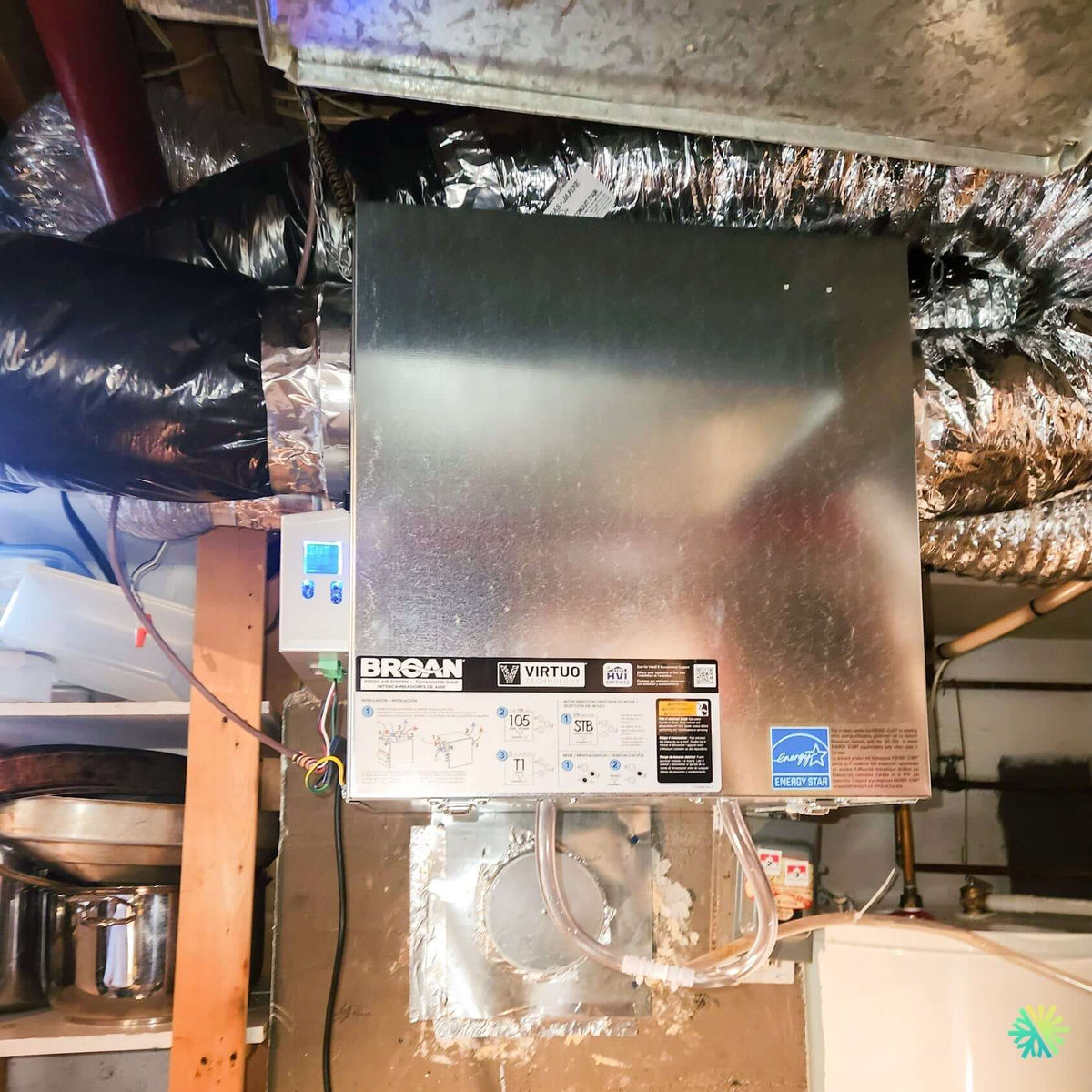
On this project, the final ductwork combines retained and new sections. You can see it clearly: the original flexible duct and the newer sections have neither the same finish nor the same color. This is not a workmanship defect; it is the deliberate result of an audit — replacing what needed to be replaced, keeping what was still sound, and measuring at the end to prove it.
The selected unit: Broan-NuTone AI Series V180H75RT
The features that guided the selection for this spacious home:
- Airflow rates of 65 to 193 CFM (31 to 91 L/s) at 0.4 in. w.g., and 65 to 184 CFM at 0.6 in. w.g. — the latter figure mattered here because part of the existing ductwork imposes greater resistance than a new system.
- Sensible recovery efficiency of 78% at 0°C (at 64 CFM) and 68% at -25°C (at 83 CFM), with an apparent sensible efficiency of 82% at 0°C.
- ENERGY STAR certification and HVI certification.
- PMSM ECM motors, 120 V / 60 Hz / 3 A / 200 W at maximum speed.
- 6-inch collars, washable MERV 8 filter included, MERV 13 option.
- Homeshield defrost, active from -5 °C.
- Approximately 47 lb (21.4 kg), suspended here from the joists using the supplied chains.
The integrated airflow measurement is especially useful in a replacement. On a new duct network, the design is known. On a partially inherited network, it can only be measured—and the appliance does this itself, continuously, on each of the two circuits.
The suspended installation and vibration isolation
The appliance was suspended from the joists rather than mounted on a partition wall. In a basement where living areas are directly above, this is the installation that transmits the least structural noise.
Three execution details matter more than the choice itself:
- Balanced chains. An appliance suspended at an angle poorly directs its condensate and places uneven stress on its anchor points.
- Flexible connections to the collars. A section of taut flex duct at the outlet of each collar prevents vibrations from traveling into the rigid ductwork, which would otherwise redistribute them throughout the house.
- Anchoring to the structure, never to simple furring strips or drywall.
The drain to the laundry tub
An HRV produces condensate during the cold season. In this basement, the nearest drain was the laundry tub, a common configuration in the West Island.
Three rules apply:
- A siphon-forming loop in the tube, with at least 2 inches between the appliance and the bottom of the loop. Without it, the appliance draws drain odors into the system.
- A continuous slope to the basin, with no low point where water can collect and eventually freeze.
- An end that is not submerged. The tube must terminate above the water level, never immersed, to prevent siphon backflow.
It's a ten-minute detail during installation and the cause of one in five service calls for ventilation HVAC maintenance.
Balance, negative pressure, and combustion appliances
This is the section we consider the most important in this article, and the one most content about air exchangers leaves out.
A house where exhaust exceeds supply becomes depressurized. Air has to enter somewhere: it comes in through cracks, wire penetrations, and—in some cases—through the exhaust flue of a naturally vented combustion appliance. This is called backdrafting, and combustion gases, including carbon monoxide, return to the house instead of being vented outside.
The risk increases when several elements combine: a naturally vented water heater or furnace, a high-flow range hood, a dryer, a fireplace, and an unbalanced air exchanger.
What we do systematically:
- Verify the actual airflow balance upon commissioning, with supply and exhaust measured separately. An appliance that continuously measures both circuits and self-corrects significantly reduces this risk over time.
- Inventory the combustion appliances present and their venting type.
- Notify the owner of any risky configuration, and recommend an inspection by the relevant trade professional when the situation warrants it.
- Recommend carbon monoxide detectors on every floor where there is a combustion appliance or bedroom.
A properly balanced air exchanger is part of the solution. A poorly adjusted air exchanger is part of the risk. This is precisely why measuring the system upon commissioning is not an administrative formality.
Exterior hoods beneath large trees
Baie-D'Urfé is one of the most heavily wooded areas on the island. This creates a specific seasonal constraint: the exterior hood grilles become clogged with leaves, samaras, and seeds in the fall, exactly when the house is sealed up for the winter.
Our recommendations for this type of terrain:
- Position the intake away from dominant tree lines whenever possible.
- Maintain a separation of at least 6 feet between intake and exhaust, the required height above the expected snow level, and a distance of at least 10 feet from a dryer vent, chimney, or vent.
- Inspect the grilles twice a year in a wooded area rather than just once: once in November and once in the spring.
An obstructed hood causes a gradual imbalance. On a unit with integrated measurement, this discrepancy becomes visible on the screen before the homeowner notices anything.
Commissioning, maintenance, and compliance
Commissioning is carried out with the system sealed, doors and windows closed, and clean filters: measuring the maximum achievable airflow, identifying the limiting circuit, programming the settings, and selecting the installation configuration corresponding to the system as actually built.
Routine maintenance involves very little: wash the interior filters four times a year in warm, soapy water and let them dry completely, clean the core once a year, inspect the hoods, and rerun the airflow test after any modification to the ducts.
From a regulatory standpoint, this unit's 68% recovery at -25 °C far exceeds the 54% minimum required by the Quebec Construction Code in the applicable dwellings.
AirGreen on the West Island and in Greater Montréal
A successful air exchanger replacement is not judged by the brand installed. It is judged by what was done with the existing system, the balance measured at the end, and what the homeowner understood about their own system before leaving.
We provide residential ventilation services in Baie-D'Urfé, Sainte-Anne-de-Bellevue, Beaconsfield, Kirkland, Pointe-Claire, and Dollard-des-Ormeaux, in the central neighbourhoods of Montréal, in Laval and on the North Shore, as well as in Longueuil, Brossard, and Saint-Hubert on the South Shore. Our teams serve clients in the West Island in both French and English.
Every HVAC installation we deliver includes an audit of the existing system detailing what is being kept and what is being replaced, airflow calculations according to CSA F326, the actual airflow rates measured during commissioning, and a complete maintenance demonstration.
If your air exchanger is more than fifteen years old, noisy, or has never been rebalanced since installation, write to us. We start by measuring what you already have.
The big day, step by step
The main steps of this kind of job at AirGreen. Every house has its quirks: the estimate brings them out.
We locate the wall for the two outdoor hoods, the unit's spot, service access and the drain.
The unit, its location and the price, in writing.
Hung or set level, with clear access to the filters and the core.
Fresh air intake and exhaust, kept apart and sealed.
The ones connected to the outside are insulated to prevent condensation inside the house.
Connected with its loop, when the unit needs one.
Installed where you will see it and use it.
Incoming and outgoing airflows are adjusted so the house is neither pressurized nor depressurized.
Speeds, filters, core: how to use it through the seasons.
- The on-site estimateWe locate the wall for the two outdoor hoods, the unit's spot, service access and the drain.
- The quoteThe unit, its location and the price, in writing.
- The unitHung or set level, with clear access to the filters and the core.
- The outdoor hoodsFresh air intake and exhaust, kept apart and sealed.
- The ductsThe ones connected to the outside are insulated to prevent condensation inside the house.
- The drainConnected with its loop, when the unit needs one.
- The wall controlInstalled where you will see it and use it.
- BalancingIncoming and outgoing airflows are adjusted so the house is neither pressurized nor depressurized.
- The walkthroughSpeeds, filters, core: how to use it through the seasons.
Four mistakes we do not make
Flip each card to see what we do instead.
Your own project, step by step
What to do, season by season
Three habits per season for this unit. They take a few minutes and prevent many calls.
- Clean the filters and core as the manufacturer specifies.
- Check the outdoor hoods: nests, debris, dampers.
- Lower the speed if the outdoor air gets humid.
- Adjust the speed to the humidity in the house.
- Check that the drain flows.
- Keep the outdoor hoods clear.
- Clean the filters before the closed-house season.
- Check the exhaust damper.
- Book a full cleaning if the unit has not had one in a long time.
- Clear snow from both outdoor hoods.
- Raise the speed if condensation appears on windows.
- Let the unit run: with the house closed, humidity builds up.
Is your home ready?
Check what applies at your place. A "no" is not a refusal: it is what we sort out during the estimate.
Four statements: true or false?
It all comes down to details you have just seen.
1. In an air exchanger, fresh air and stale air mix.
The two airflows cross in the core without mixing.
2. The two outdoor hoods must be kept apart.
Otherwise the exchanger pulls back the air it just removed.
3. An air exchanger can help with condensation on windows.
It renews the air and helps keep humidity in the right range.
4. An exchanger never needs maintenance.
Filters and core get dirty and need regular cleaning.
0 / 4 right answers
What people ask us about this kind of work
What does an air exchanger do?
Does fresh air cool the house in winter?
What speed should it run at?
Does an exchanger need cleaning?
What are the signs of poor ventilation?
HRV or ERV: what is the difference?
Should it run in winter?
Does AirGreen hold the required licences?
Is the estimate free?
No question matches. Write to us: we answer.
More jobs to see, near you
By town, by equipment or by region: browse more than 4,700 published projects.
Each dot: a town where AirGreen has published projects. The glowing dot: this job.
Every house has its constraints. We see them before we install.
The on-site estimate is free and the quote follows within 24 hours.
Text and photo: a real AirGreen Climatisation & Chauffage job. The diagrams are generic illustrations of the type of installation, not a survey of this job site. Sources of the added figures: airgreen.ca product pages (NEEP / AHRI performance), Hydro-Québec (Heat pumps page, LogisVert, read on 13 October 2026), Régie de l’énergie (rate D as of 1 April 2026).