
Installation of a Fujitsu Aquila XLTH dual-zone heat pump in Saint-Eustache, on the North Shore
In Saint-Eustache, AirGreen is installing a Fujitsu Aquila XLTH dual-zone heat pump in a room undergoing renovations, with precise wall positioning, two independent zones, and cold-climate heating.
Take a tour of the installation
Each number is a point we check on site. Switch between summer and winter to watch air and heat move.
In summer, the outdoor unit rejects the house's heat outside.
Generic illustration of this type of installation, not a survey of this job site. Tap a number.
Mounted level on a wall plate, high enough for the air to reach the whole room, with enough space around it to slide the filters out easily.
The refrigerant lines, the communication cable and the drain go through the wall in a single opening, sealed against water, cold air and insects.
Two insulated copper pipes connect the two units. Outside, a line cover can protect them from sun, knocks and weather.
A shut-off switch near the outdoor unit isolates it safely for service. It must stay accessible at all times.
The compressor and the fan. In heating mode it captures heat from the outdoor air, even in winter, and moves it inside.
On the ground or on the wall, it keeps the unit above accumulated snow. The unit stays clear and defrost water can drain away.
The fan needs to blow freely. Storage, a fence or a wall too close, and efficiency drops while noise goes up.
A wall-mounted installation designed for two zones, in a room under renovation
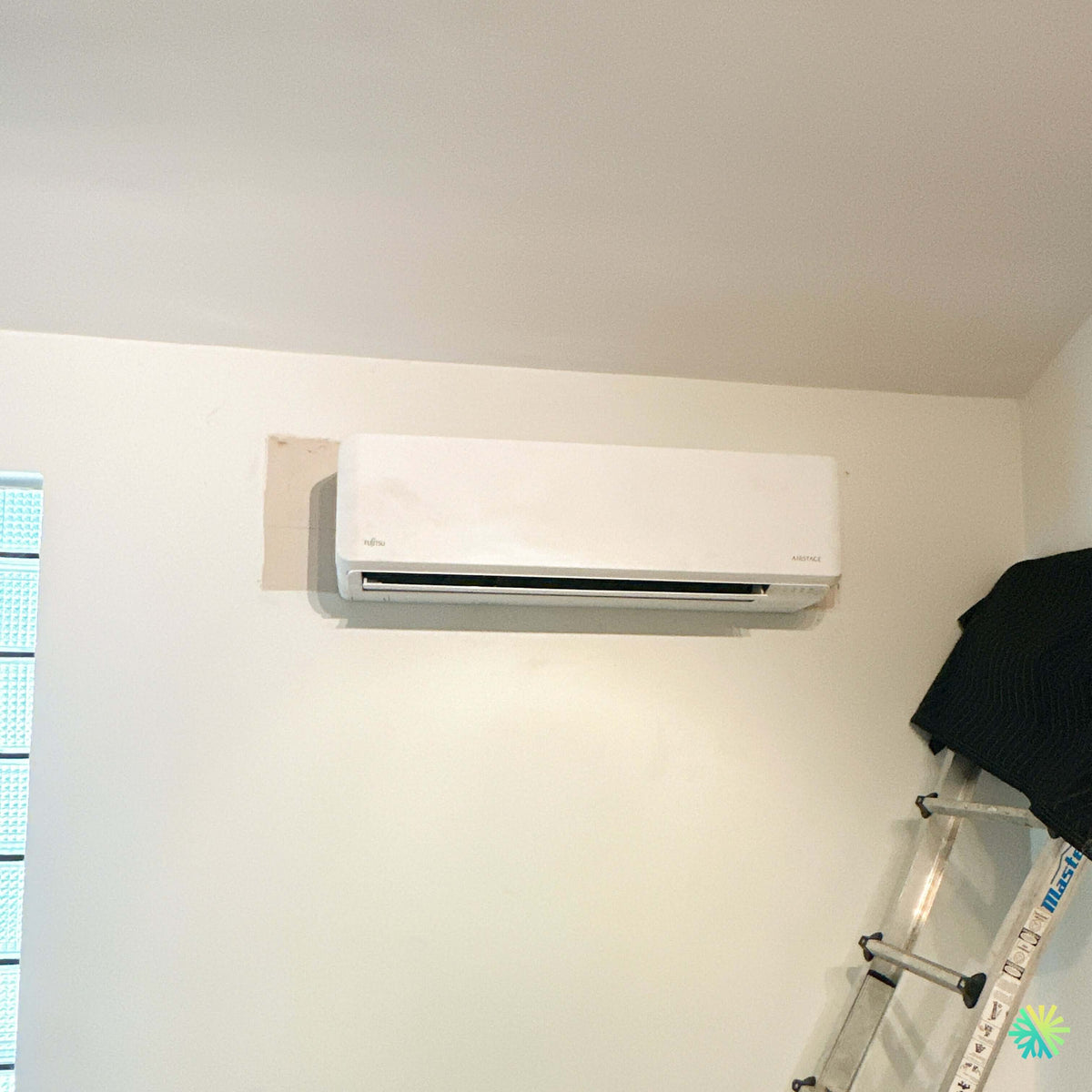
At Saint-Eustache, we installed a Fujitsu Aquila XLTH dual-zone heat pump to provide heating and cooling for two distinct areas of the property from a single outdoor unit. The photograph shows one of the newly installed Fujitsu AIRSTAGE indoor units in a room where finishing work was still underway.
Several details help explain the worksite context: a ladder is nearby, part of the wall around the unit has not yet received its final finish, and some surfaces still need to be redone. This situation is common when a wall-mounted heat pump installation is integrated into a larger renovation project.
Our role was to coordinate the HVAC installation with the existing work, choose a functional location for the indoor unit, and prepare a multi-zone system capable of meeting the needs of two rooms or levels with different heating and cooling loads.
The wall-mounted unit was installed high on an unobstructed wall. This position promotes good air projection while keeping the lower space available for arranging the room. The unit also remains accessible for filter removal and maintenance.
Why choose a dual-zone heat pump?
A dual-zone heat pump consists of one outdoor unit supplying two indoor units. This configuration is particularly well suited to properties where a single wall-mounted head cannot distribute air efficiently throughout all the spaces.
In Saint-Eustache, many homes include layouts where natural air circulation is limited:
- a ground floor separated from the basement;
- bedrooms separated by a corridor;
- an addition that is newer than the rest of the building;
- a floor whose temperature rises quickly in summer;
- an open-concept area and an enclosed room;
- two areas occupied at different times.
Installing a single unit in the corridor or living room does not guarantee that the air will properly reach the second zone. Walls, doors, and stairways create barriers that reduce circulation.
With two indoor units, each area receives heated or cooled air directly. The owner can therefore adjust the temperature according to how each room is used rather than trying to compensate with a single general setting.
A single outdoor unit to limit the space required
One of the main advantages of a dual-zone system is the reduced number of outdoor units. Two independent systems would require two compressors, two sets of supports, and two separate power supplies or connections.
The Fujitsu multizone solution brings operation together around a single outdoor unit. This approach often simplifies integration around the property, particularly when space is limited by a fence, deck, driveway, or side passage.
It can also provide a more discreet exterior finish, provided that the lines for both zones are properly planned.
Separate control in each room
Each Fujitsu indoor unit can be controlled independently using its remote control. Occupants can adjust:
- the setpoint temperature;
- the fan speed;
- the louver direction;
- the operating periods;
- certain comfort features depending on the controller used.
One zone can be turned off while the other is operating. This helps reduce demand in an unoccupied room without completely interrupting heating or cooling in the other area.
There is nevertheless an important rule with multizone systems: the two units cannot operate simultaneously in opposite modes. The system can heat or cool, but it cannot provide heating in one zone while the other requires cooling. Fujitsu specifies this operation in its documentation on the H-series AIRSTAGE systems.
In a residence, this constraint is generally easy to manage, since both areas usually require the same mode depending on the season.
Fujitsu Aquila XLTH and cold-climate heating
The designation Aquila XLTH refers to a solution designed for applications where winter heating is important. Fujitsu documentation associated with the Aquila and Aquila CTEB systems indicates that the versions intended for cold climates can operate in heating mode down to -26 °C.
This characteristic is relevant in Saint-Eustache and throughout the North Shore, where winter temperatures can drop very low.
However, it is important to distinguish the minimum operating temperature from the capacity actually available. A heat pump does not necessarily provide the same output at -20 °C as it does at a milder outdoor temperature.
To select a system properly, we analyze, among other factors:
- the area of each zone;
- the interior volume;
- the ceiling height;
- the level of insulation;
- the number of windows;
- the orientation of the rooms;
- air infiltration;
- the simultaneous needs of both zones;
- the presence of supplemental heating.
A rough rule based solely on square footage is not sufficient. A room with extensive glazing or one located above a garage may have considerably greater requirements than an interior room of the same size.
A range of multi-zone capacities
Fujitsu documentation presents multi-zone outdoor units rated at 18,000, 24,000, 36,000 and 45,000 BTU/h. Depending on the model, they can accommodate two to five indoor units.
For a dual-zone configuration, several capacity combinations are possible. The outdoor unit intended for two zones can be paired with different wall-mounted units according to the needs of each area.
The manufacturer’s combination tables make it possible to confirm whether an arrangement is permitted. They also show that some combinations may have a nominal total greater than the outdoor capacity.
Fujitsu nevertheless specifies that exceeding 100% in the combination of indoor units does not increase the system’s actual production capacity.
For example, two indoor units whose nominal capacities add up to more than that of the outdoor compressor do not turn it into a more powerful appliance. When both zones require their maximum output at the same time, the available capacity must be shared.
For this reason, the tables do not replace a complete technical selection. Fujitsu recommends using its Design Simulator software to validate H-series AIRSTAGE systems.
What the indoor installation shows
The photograph taken in Saint-Eustache makes it possible to observe several important features.
A unit installed on a largely unobstructed wall
The appliance occupies an upper section of the wall, with a clear area in front of it. This arrangement allows the airflow to project into the room without immediately encountering a cabinet, bookcase, or other obstacle.
The choice of wall directly affects comfort. A poorly positioned unit can blow directly onto a bed, desk, or sofa, creating a draft-like sensation even when the overall temperature is comfortable.
In this project, the space in front of the appliance provides good airflow potential.
A height that promotes air circulation
The wall-mounted heat pump is installed near the ceiling, but there is still space above the appliance. This clearance is necessary because room air is drawn in through the top of the unit.
An appliance installed too close to the ceiling may not get enough air, become noisier, and be more difficult to clean. The front panel must also be able to open so the filters can be removed.
An installation integrated into the finishing work
The wall around the unit has an area that has not yet been fully repainted or repaired. This suggests that the installation was carried out during a renovation phase.
This coordination can be beneficial. It allows the openings to be made and the pipes routed before the surfaces receive their final finish.
To achieve a good result, however, the responsibility of each party must be clearly defined:
- the HVAC installer handles the fastening and necessary routing;
- the openings are technically sealed;
- plaster or paint repairs are coordinated;
- the trim and finishes are adjusted after testing;
- the unit must remain accessible despite the decorative work.
Poor coordination can lead to unnecessary touch-ups or the obstruction of a service panel.
A room that remains accessible to technicians
The visible ladder in the room highlights the importance of access. A wall-mounted unit must be safely reachable for cleaning and repairs.
After the renovation, no permanent furniture should be installed that prevents the panel from being opened or the unit from being removed from its wall plate.
The technical steps behind a reliable dual-zone installation
Plan the route for each circuit
Two indoor units mean two refrigerant-pipe circuits, two communication routes, and two drainage systems.
Before drilling, we plan:
- the location of each indoor unit;
- the route to the outdoor unit;
- height differences;
- the total pipe length;
- gravity-drainage options;
- areas to avoid in the walls;
- the elements visible after finishing.
The shortest route is not always the best. Aesthetics, access, and material protection must also be considered.
Check the wall structure
The mounting plate must be securely anchored. An indoor unit must not rest solely on drywall without adequate support.
We must locate the studs or use fastening methods compatible with the structure. The wall must remain stable despite normal fan vibrations and future handling of the panel.
Leveling is also important. A tilted unit can interfere with condensate drainage.
Prepare continuous drainage
In cooling mode, the indoor heat exchanger produces condensation. This water flows into a pan and then to a drain.
A proper slope must be maintained along the entire length of the pipe. Backflow slopes, crushed sections, or improperly positioned fittings can cause:
- drops on the wall;
- an overflowing drain pan;
- odors;
- water noise;
- a buildup of dirt;
- damage to the interior finish.
In a dual-zone installation, each unit has its own drain. We therefore test both circuits separately.
Do not cross the two zones
The pipes and cables for each indoor unit must correspond to the correct port on the outdoor unit.
Reversing zone A and zone B can cause erratic operation or communication errors.
To prevent this problem, we identify the circuits during installation and then carry out separate tests:
- starting the first zone;
- communication confirmation;
- airflow check;
- testing of the second zone;
- simultaneous operation;
- drainage validation;
- supply air temperature check.
Performing vacuum evacuation correctly
After the refrigerant connections are made, the circuit must be tested and evacuated before commissioning.
Vacuum evacuation removes the air and moisture present in the lines. Residual moisture can affect the compressor oil, create contaminants, and reduce system reliability.
This step is not visible in the final photo, but it is one of the most important elements of a professional installation.
Protecting the finish around the unit
In a room under renovation, prevent plaster, sanding, or paint dust from entering the unit.
A unit installed before all work is complete must be temporarily protected when dusty operations continue in the room. However, it must never be operated while covered.
Before final commissioning, we verify that the filters, coil, and air openings are clean.
Common mistakes to avoid
A quality heat pump can produce disappointing results if it is not installed or used properly.
Among the most common mistakes:
- install the unit too close to the ceiling;
- block the intake with a shelf;
- place a tall piece of furniture directly beneath the unit;
- neglect the drain slope;
- choose the capacity based solely on floor area;
- use an unauthorized combination;
- incorrectly pair the circuits of the two zones;
- blow directly onto the occupied area;
- finish the plaster around the unit without leaving access;
- operate the unit during very dusty work.
During a renovation, coordination between the HVAC technician, painter, and other contractors is essential.
How to use the two zones effectively
The owner can improve comfort and limit differences between rooms by adopting a few good practices.
It is preferable to avoid extremely different settings between the two zones. For example, maintaining one room at a very high temperature and the other at a very low temperature can create a demand that is difficult to balance.
A moderate difference generally allows the inverter compressor to adjust its capacity more efficiently.
It is also preferable to explicitly select heating or cooling mode rather than letting both remote controls send conflicting commands.
Fujitsu indoor unit maintenance
Filters should be checked regularly. A clogged filter reduces airflow and can lead to reduced performance.
We recommend:
- monthly inspection during periods of intensive use;
- gentle vacuum cleaning;
- rinsing with water when necessary;
- complete drying before reinstalling;
- the absence of harsh chemicals;
- professional maintenance when the blower wheel or heat exchanger is dirty.
The owner should also monitor:
- unusual noises;
- odors;
- water droplets;
- reduced airflow;
- error codes;
- abnormal temperature fluctuations.
Regular HVAC maintenance helps preserve air quality and the performance of both zones.
Winter heating and defrosting
During heating, frost may form on the outdoor unit. The system then runs a defrost cycle.
During this cycle, the indoor unit may slow down or temporarily stop blowing air. The owner may hear a change in operation or observe steam outside.
These phenomena are generally normal. A significant accumulation of ice that persists, however, should be inspected.
Subsidy eligibility
A cold-climate heat pump may be eligible for certain financial assistance programs, but eligibility depends on the exact combination.
The following must be verified:
- the exact model of the outdoor unit;
- the model of each indoor unit;
- the complete combination;
- the recognized performance reference;
- the purchase date;
- the installation date;
- the requirements of the program in effect.
The interior photograph does not show the complete model number or confirm the BTU capacity. It would therefore be inaccurate to announce an energy rating or a specific subsidy amount based solely on the image.
The result achieved in Saint-Eustache
This Fujitsu Aquila XLTH dual-zone heat pump installation in Saint-Eustache now makes it possible to heat two areas of the building with a single outdoor unit.
The owner now benefits from:
- two separately controlled indoor units;
- a solution suited to cold-climate heating;
- better air distribution;
- an indoor unit integrated into the renovation;
- a lower wall left available;
- an installation that is accessible for maintenance;
- with capacity modulated by the inverter compressor.
At AirGreen, we install wall-mounted and multi-zone heat pumps in Saint-Eustache, throughout the North Shore, as well as in Montreal, Laval, Longueuil, and on the South Shore.
Every project has its own constraints: renovated walls, limited space, windows, doors, staircases, balconies, or pipes to conceal. We adapt the installation to the building without neglecting drainage, air circulation, service access, or the proper selection of the Fujitsu combination.
The big day, step by step
The main steps of this kind of job at AirGreen. Every house has its quirks: the estimate brings them out.
We look at the room, the outside wall, the line route and where the outdoor unit will go. That is where the capacity gets chosen.
Model, capacity and price, in writing. We also check whether the model qualifies for assistance programs.
Floors and furniture protected, wall plate position marked level, wall opening located.
A single opening, with the slope the drain needs to flow outside.
Set on a stand raised above the snow, with the clearances the manufacturer requires.
Connected, insulated and protected. The opening is then sealed against water, cold air and insects.
A dedicated circuit and an accessible disconnect near the outdoor unit.
Leak test, vacuum, then start-up and a check of heating and cooling.
Remote, modes, filters: we show you the essentials before we leave.
- The on-site estimateWe look at the room, the outside wall, the line route and where the outdoor unit will go. That is where the capacity gets chosen.
- The quoteModel, capacity and price, in writing. We also check whether the model qualifies for assistance programs.
- Getting readyFloors and furniture protected, wall plate position marked level, wall opening located.
- The wall openingA single opening, with the slope the drain needs to flow outside.
- The outdoor unitSet on a stand raised above the snow, with the clearances the manufacturer requires.
- Lines, cable and drainConnected, insulated and protected. The opening is then sealed against water, cold air and insects.
- The electrical workA dedicated circuit and an accessible disconnect near the outdoor unit.
- Tests and start-upLeak test, vacuum, then start-up and a check of heating and cooling.
- The walkthroughRemote, modes, filters: we show you the essentials before we leave.
What would it look like at your place?
Two quick checks with real numbers: what heat costs, and what your current heaters add up to in BTU/h.
Conversion: 1 W = 3.412 BTU/h. An indication, not a load calculation: baseboards and furnaces are often stronger than the real need, and they can stay as backup. AirGreen confirms the capacity on site.
Four mistakes we do not make
Flip each card to see what we do instead.
Your own project, step by step
What to do, season by season
Three habits per season for this unit. They take a few minutes and prevent many calls.
- Clean the indoor unit's filters.
- Clear leaves and debris left on the outdoor unit by winter.
- Test cooling before the first hot days.
- Clean the filters more often when the unit runs a lot.
- Keep plants away from the outdoor unit.
- Check that no water drips from the indoor unit.
- Rake the leaves around the outdoor unit.
- Test heating before the first cold days.
- Book periodic maintenance before winter.
- Keep snow away from the stand and the front of the unit.
- Let the unit defrost: it is normal.
- Never hit the ice on the fins; call us if the unit stays iced up.
Is your home ready?
Check what applies at your place. A "no" is not a refusal: it is what we sort out during the estimate.
Four statements: true or false?
It all comes down to details you have just seen.
1. In heating mode, the outdoor unit can produce water.
During defrost cycles. That water must drain away without forming ice.
2. You pick the capacity with a simple square-footage rule.
Windows, insulation, orientation and how the room is used all count. Capacity is chosen on site.
3. A multi-zone connects several indoor heads to a single condenser.
One head per room, all on the same condenser. Each room keeps its own temperature.
4. The disconnect can sit behind the patio furniture.
It must stay accessible: it is what shuts the unit off for service.
0 / 4 right answers
What people ask us about this kind of work
Does a wall-mounted heat pump heat in winter?
Wall-mounted or multi-zone: how do I choose?
Where does the outdoor unit go?
Are there grants?
Do I need a permit?
How cold can it heat?
How much can I save?
How is the LogisVert assistance calculated?
Is it noisy?
The outdoor unit is covered in ice: is that normal?
Does AirGreen hold the required licences?
Is the estimate free?
No question matches. Write to us: we answer.
More jobs to see, near you
By town, by equipment or by region: browse more than 4,700 published projects.
Each dot: a town where AirGreen has published projects. The glowing dot: this job.
Every house has its constraints. We see them before we install.
The on-site estimate is free and the quote follows within 24 hours.
Text and photo: a real AirGreen Climatisation & Chauffage job. The diagrams are generic illustrations of the type of installation, not a survey of this job site. Sources of the added figures: airgreen.ca product pages (NEEP / AHRI performance), Hydro-Québec (Heat pumps page, LogisVert, read on 13 October 2026), Régie de l’énergie (rate D as of 1 April 2026).