
Installation of a FANTECH HERO 150H-EC Air Exchanger in Beaconsfield, in Montreal's West Island
An overly airtight cottage in Beaconsfield, fogged-up windows, and heavy air: here’s how we integrated a FANTECH HERO 150H-EC air exchanger (84% SRE, ECM motors) into a central heat pump system in two days.
Generic illustration of this type of installation, not a survey of this job site. Tap a number.
It removes stale air and brings in fresh air. The two airflows cross in the core without mixing.
It recovers part of the heat from the outgoing air to temper the incoming air. Depending on the model, it also manages humidity.
An outdoor hood, kept away from the exhaust so the house does not pull back the air it just removed.
Humid, stale air leaves through its own hood, fitted with a damper.
The ducts that connect to the outside are insulated to prevent condensation inside the house.
Stale air is drawn from humid rooms and fresh air is sent to living areas. The airflows are balanced.
It sets the mode and speed. You use it more when the house is humid or full of people.
Depending on the model and the season, the core produces condensation, removed through a drain with its loop.
When the Air in a Beaconsfield Home Goes Around in Circles for Twenty Years
Some homes breathe, while others simply recycle. The cottage we visited last April, a few streets from the Beaurepaire area, clearly belonged to the second category. Built in the early 1980s, expanded once toward the rear, and recently reinsulated with sprayed urethane at the rim joist, it showed all the signs of an envelope that had become too airtight for its original ventilation system: windows fogged halfway up on January mornings, a persistent musty smell in the basement, and a primary bedroom on the second floor where the CO₂ level rose well beyond what we consider acceptable after a night of sleep with the doors closed.
The homeowners contacted us after having a central heat pump installed the previous summer. Their observation was simple: the house was finally comfortable temperature-wise, but the air still felt heavy. This is a comment we hear often in the West Island, where the housing stock from the 1970s and 1980s has undergone extensive airtightness renovations without corresponding upgrades to mechanical ventilation. At AirGreen, we responded by installing a FANTECH HERO 150H-EC heat recovery ventilator, connected to the existing central ductwork.
Why an HRV, and Why This One
An air exchanger, or HRV (heat recovery ventilator), does two things at once: it exhausts stale air from the bathrooms, kitchen, and basement, and introduces an equivalent volume of fresh outdoor air into the living areas. Between the two, a counterflow core transfers heat from the outgoing air to the incoming air without allowing the two air streams to mix.
The choice of model is not incidental in a home that already has a central heat pump and an electric furnace. We selected the HERO 150H-EC for specific reasons.
The Numbers That Really Matter
- Airflow: from 28 to 172 cfm at 0.4 in. w.g. — more than sufficient for a 2,100 sq. ft. home with three levels, with a comfortable margin for high-speed operation.
- Sensible recovery efficiency (SRE): 84% at 0 °C and 68% at -25 °C. The second figure is the one that interests us most in Quebec. Many units display an impressive number at 0 °C and collapse when the mercury drops. Here, performance holds up.
- Electronically commutated motors (ECM): consumption of 23 W at low speed and 110 W at high speed, for a ventilation efficiency of 3.0 cfm per watt. In continuous ventilation — which we recommend almost every time — the difference on an annual Hydro-Québec bill is far from theoretical compared with a unit using conventional motors that draws 60 to 90 W continuously.
- 6-inch top connections, MERV-8 supply filter, two washable electrostatic filters, 14.4-inch core, 51 lb. weight.
Recirculation Defrost: The Real Criterion When Connecting to the Central System
This is the technical point we want to emphasize because it is frequently misunderstood. FANTECH offers two main defrosting families: supply fan shutdown and recirculation defrost.
On a unit with fan shutdown, when the outdoor temperature falls below the threshold, the unit stops bringing in fresh air and continues exhausting air from the home to defrost the core. Simple, robust, and entirely acceptable in a fully dedicated installation.
But as soon as an HRV is connected to the duct network of a central heat pump, the logic changes. The manufacturer explicitly recommends models with recirculation defrost for integration with a central air handler because they are equipped with a mechanical backdraft damper interlocked with the unit: when the HRV is not operating, the outdoor air duct is closed. Without this damper, the central heat pump fan can literally draw untempered outdoor air through a stopped HRV in the middle of February. We have corrected this exact scenario in more than one home in Laval and on the North Shore, where a poorly selected unit had turned the central system into a permanent cold-air intake.
The HERO 150H-EC uses recirculation defrost, which activates at approximately -5 °C. This was the decisive criterion.
The Project, Step by Step
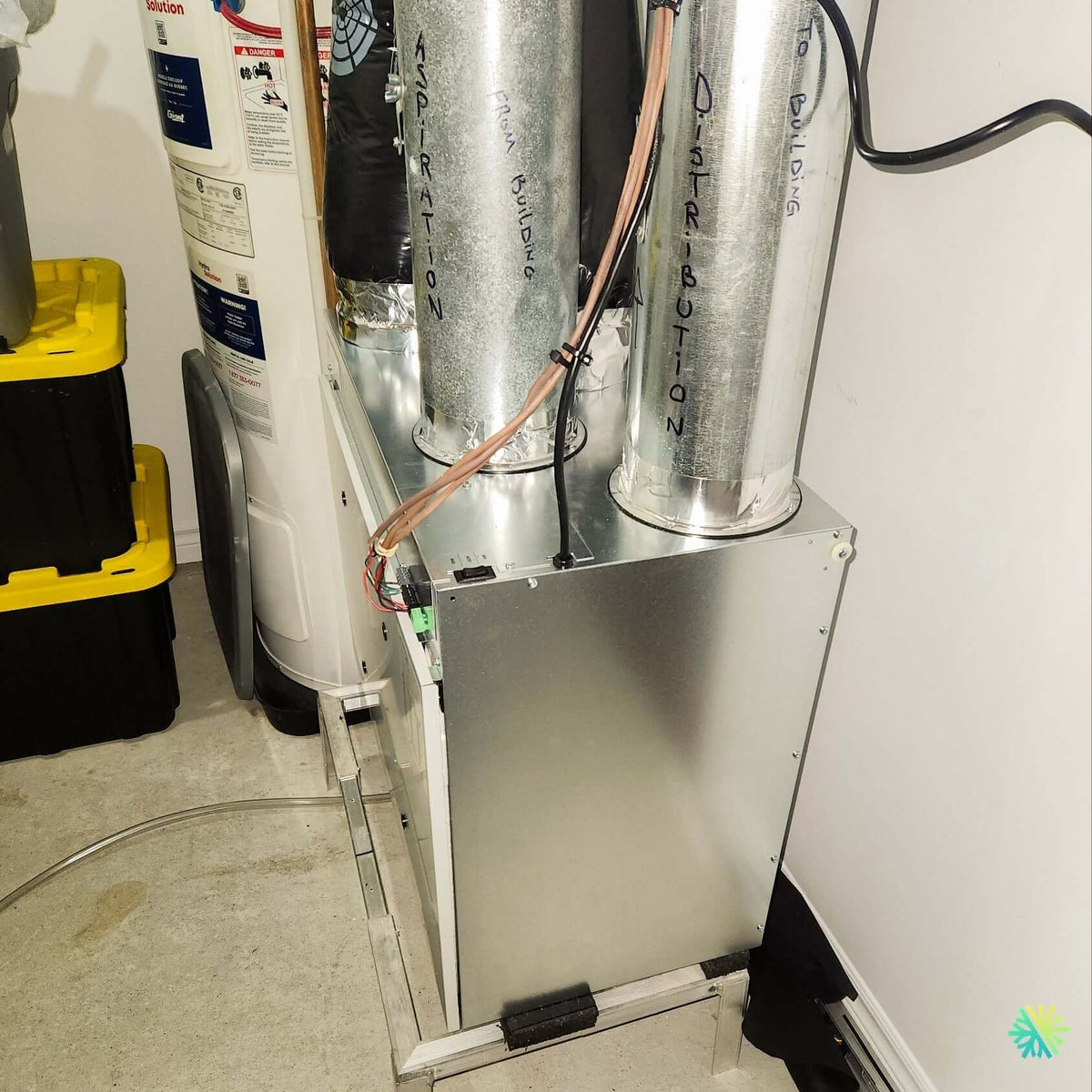
The mechanical room was in the basement, in a finished space shared with a Giant electric water heater and the central heat pump air handler, mounted on an aluminum base with its main ducts clearly labeled with marker — “suction, from building” on one side and “distribution, to building” on the other. We insist on this labeling: it is a job-site habit that takes thirty seconds and saves the next technician an hour, both during maintenance and troubleshooting.
Day One: Drilling and Exterior Ductwork
We started outside. Two aluminum wall hoods, one for fresh-air intake and the other for stale-air exhaust, were drilled through the side wall, with adequate clearance between them to prevent air short-circuiting and sufficient height above the anticipated snow level. On the South Shore as well as in the West Island, we see far too many hoods installed 12 inches above the ground that end up buried during the first January snowstorm. The two exterior ducts were then insulated and vapor-sealed along their entire interior length, without exception, to prevent condensation from forming on the cold galvanized steel.
Day Two: Connections, Drain, and Balancing
The HRV was suspended on vibration isolators, away from the joists, to decouple structural vibrations. The connection to the central system followed a partially dedicated configuration:
- Dedicated exhaust from the two bathrooms and laundry room, using rigid 6-inch ducts, to remove stale air at the source rather than capturing it only from the return.
- Fresh-air supply into the central heat pump return duct, more than four feet upstream of the unit, allowing the air to mix before reaching the coil.
- Electrical interlock between the HRV and the central unit fan, so the blower runs at low speed whenever the air exchanger operates. Without this interlock, the fresh air remains trapped in the plenum and never reaches the bedrooms.
- Condensate drain with a loop trap, connected to the floor drain and tested with water in front of the customer before closing everything up.
- Wall control installed on the main floor, programmed for continuous low-speed ventilation with a timed high-speed boost from the bathroom.
The final step, and the one most often neglected in the industry, is balancing. We measured the supply and exhaust airflow at the unit's pressure taps, then adjusted the dampers until the difference between the two was less than 10%. An unbalanced HRV puts the home under negative or positive pressure, and a home under negative pressure draws air from the crawl space, garage, and drains. Here, because the water heater was electric, there was no combustion appliance at risk of backdrafting — but we systematically check this point before leaving a job because, in a natural-gas home, an imbalance becomes a safety issue rather than a comfort issue.
Two days of work, two technicians, with 90% of the existing ductwork retained.
The Mistakes We Correct Most Often in West Island Basements
A poorly installed air exchanger costs more than no air exchanger at all: it consumes energy, makes noise, and does not ventilate. Here is what we encounter most frequently during service calls in Montreal, Laval, Longueuil, and on both shores.
- The unit connected only to the return, without dedicated exhaust. Stale bathroom air is never captured at the source, and moisture migrates through the home before reaching the HRV.
- No interlock with the central fan. The unit runs, the bill rises, and the fresh air goes nowhere.
- Crushed insulated flex duct behind a partition. A 6-inch duct pinched down to an effective 4 inches means 40% of the airflow is lost.
- Drain without a trap. The unit draws air through the drain, and sewer odor rises into the home.
- Installation never balanced. Without airflow measurement, commissioning is just a guess.
- Interior filters forgotten for five years. A clogged MERV-8 filter reduces airflow and strains the motors.
Rebates: What Your Installation May Qualify For
The Quebec government's Rénoclimat program provides financial assistance of $500 for the installation or replacement of an HRV or ERV, provided the unit appears in the directory of products certified by the Home Ventilating Institute (HVI) and the home undergoes an energy evaluation before and after the work. This last requirement is what causes most homeowners to lose the rebate: the initial evaluation, including a blower-door test, must be completed before the first tool comes out of the truck. We remind customers of this systematically during the quote because no retroactive application is possible. Program amounts and conditions change, and we always encourage our customers to verify the current requirements when planning their work.
Maintenance in Three Steps Per Year
A well-maintained HRV can easily last fifteen years.
- Every three months: rinse the washable electrostatic filters with lukewarm water and replace the MERV-8 supply filter as needed based on how dirty it is.
- Once a year: remove the core, vacuum it, wash it with lukewarm soapy water, and check the drain trap.
- Once a year as well: clean the grilles on the exterior hoods, which are often blocked by lint from nearby dryers and maple seeds in the spring.
Why Entrust Your Air Exchanger to AirGreen
We have been installing residential ventilation and air conditioning systems in Greater Montreal long enough to know that the difference between a good and a bad air exchanger almost never comes down to the brand, but rather to the connections, interlock, and balancing. Our teams serve Beaconsfield, Baie-D'Urfé, Kirkland, Pointe-Claire, and the entire West Island, as well as Montreal, Laval, Longueuil, the North Shore, and the South Shore. Every HVAC installation is measured, balanced, and documented before we leave the site, and every customer receives the airflow values in writing.
If moisture is accumulating on your windows, if the air in your bedrooms feels heavy when you wake up, or if your current air exchanger dates back to when the house was built, contact us. We will assess your existing ductwork, tell you what can be kept, and provide a clear quote — without guesswork.
How it goes, from the first call to the end
The main steps of this kind of job at AirGreen. Every house has its quirks: the estimate brings them out.
We locate the wall for the two outdoor hoods, the unit's spot, service access and the drain.
The unit, its location and the price, in writing.
Hung or set level, with clear access to the filters and the core.
Fresh air intake and exhaust, kept apart and sealed.
The ones connected to the outside are insulated to prevent condensation inside the house.
Connected with its loop, when the unit needs one.
Installed where you will see it and use it.
Incoming and outgoing airflows are adjusted so the house is neither pressurized nor depressurized.
Speeds, filters, core: how to use it through the seasons.
- The on-site estimateWe locate the wall for the two outdoor hoods, the unit's spot, service access and the drain.
- The quoteThe unit, its location and the price, in writing.
- The unitHung or set level, with clear access to the filters and the core.
- The outdoor hoodsFresh air intake and exhaust, kept apart and sealed.
- The ductsThe ones connected to the outside are insulated to prevent condensation inside the house.
- The drainConnected with its loop, when the unit needs one.
- The wall controlInstalled where you will see it and use it.
- BalancingIncoming and outgoing airflows are adjusted so the house is neither pressurized nor depressurized.
- The walkthroughSpeeds, filters, core: how to use it through the seasons.
What to do, season by season
Three habits per season for this unit. They take a few minutes and prevent many calls.
- Clean the filters and core as the manufacturer specifies.
- Check the outdoor hoods: nests, debris, dampers.
- Lower the speed if the outdoor air gets humid.
- Adjust the speed to the humidity in the house.
- Check that the drain flows.
- Keep the outdoor hoods clear.
- Clean the filters before the closed-house season.
- Check the exhaust damper.
- Book a full cleaning if the unit has not had one in a long time.
- Clear snow from both outdoor hoods.
- Raise the speed if condensation appears on windows.
- Let the unit run: with the house closed, humidity builds up.
Which type of equipment for your project?
Pick what looks like your need.
Four mistakes we do not make
Flip each card to see what we do instead.
What people ask us about this kind of work
What does an air exchanger do?
Does fresh air cool the house in winter?
What speed should it run at?
Does an exchanger need cleaning?
What are the signs of poor ventilation?
HRV or ERV: what is the difference?
Should it run in winter?
Does AirGreen hold the required licences?
Is the estimate free?
No question matches. Write to us: we answer.
Useful pages for what comes next
More jobs to see, near you
By town, by equipment or by region: browse more than 4,700 published projects.
Each dot: a town where AirGreen has published projects. The glowing dot: this job.
Tell us about your house. We come and see it for free.
The on-site estimate is free and the quote follows within 24 hours.
Text and photo: a real AirGreen Climatisation & Chauffage job. The diagrams are generic illustrations of the type of installation, not a survey of this job site. Sources of the added figures: airgreen.ca product pages (NEEP / AHRI performance), Hydro-Québec (Heat pumps page, LogisVert, read on 13 October 2026), Régie de l’énergie (rate D as of 1 April 2026).