
Installation of a MIDEA MIDEA28 27,000 BTU dual-zone heat pump in Otterburn Park, on Montreal’s South Shore
In Otterburn Park, AirGreen installs a 27,000 BTU MIDEA MIDEA28 dual-zone heat pump: heating down to -30 °C, neat outdoor installation, and independent comfort in two zones.
- City
- Region
- Equipment
- Brand
- Challenges
- Published
The job on one screen
The article, chapter by chapter
In Otterburn Park, two comfort zones brought together around a clean outdoor installation designed for Quebec winters
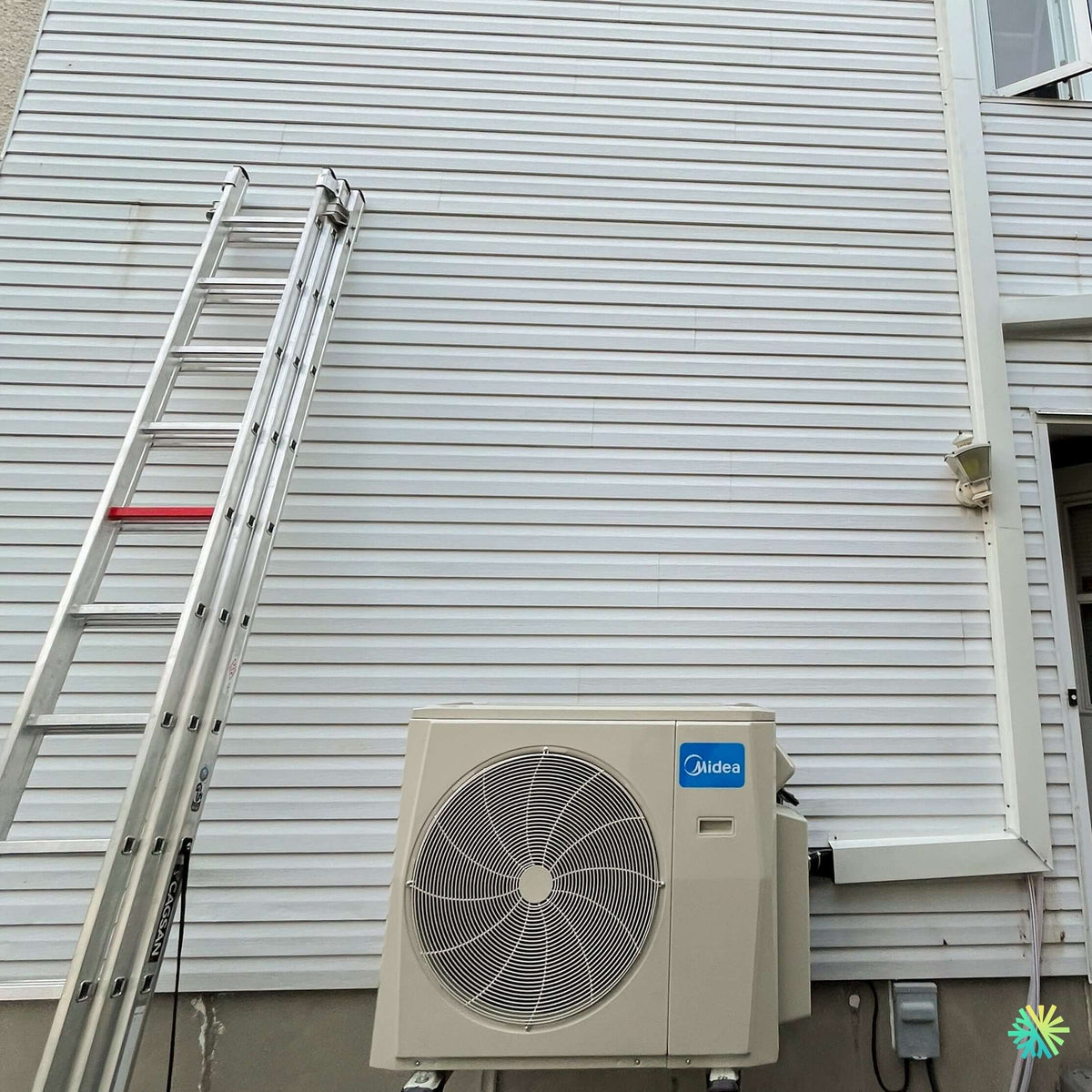
For this installation completed in Otterburn Park, in Montérégie, the exterior result clearly reflects what we look for at AirGreen when a dual-zone heat pump must be integrated into an existing home: an accessible outdoor unit, protected lines, a clean route along the façade, and an installation that takes into account both the equipment’s operation and the building’s appearance.
The photo taken during our work shows several details that often go unnoticed once the project is complete. The MIDEA MIDEA28 condenser is positioned against the foundation on a raised metal support. To its right, the refrigerant lines and cables are grouped inside a white line-set cover that blends in with the vinyl siding. The electrical disconnect is installed near the unit. Finally, the ladder extended along the façade shows the work at height required to route some of the lines to the areas served inside.
In this case, we worked with a 27,000 BTU MIDEA28 dual-zone system, based on the MO4HX-H27B-2A outdoor unit. This platform is particularly interesting in a home where two spaces have different needs, because a single outdoor unit can power multiple indoor units while allowing each zone to be regulated separately.
Why a dual-zone heat pump is particularly relevant in a multi-level home
The principle of a multi-zone system is quite different from that of a traditional central system. MIDEA indicates that a single outdoor unit can be connected to several indoor units, and that each can have its own set temperature and schedule. This makes it possible to heat or cool only the areas in use instead of treating the entire house uniformly.
In a dual-zone installation, for example, we can treat a ground floor and an upper floor separately, a living area and a bedroom section, or a main part of the house and a room that has always been more difficult to heat or cool.
This point is important in many homes in Otterburn Park, Longueuil, Montreal, Laval, the South Shore, and the North Shore. Heating and cooling needs are not always distributed evenly. Sun exposure, window area, insulation, the floor where the room is located, and even an open staircase can create significant differences.
The multizone system can address these differences without installing two separate outdoor condensers. MIDEA documentation also specifies that the inverter modulates compressor and fan capacity according to the load, particularly when all zones do not require their full capacity at the same time.
The heart of the system: the MIDEA28 MO4HX-H27B-2A
For this 27,000 BTU MIDEA28 configuration, the technical specifications provide a much more precise idea of what the unit can offer:
- Outdoor unit: MO4HX-H27B-2A
- Rated capacity: 27,000 BTU/h
- AHRI reference: 215471460
- SEER2: 23.0
- EER2: 12.5
- HSPF2: 10.5
- Heating capacity indicated at -15 °C: 27,000 BTU/h
- COP at approximately -15 °C: 2.0
- Power supply: 208/230 V, single-phase, 60 Hz
- Maximum outdoor airflow: approximately 2,148 CFM
- Indicated outdoor sound pressure: 61 dB(A)
- Outdoor dimensions: approximately 37 1/4 in × 16 1/8 in × 31 7/8 in
- Net weight: approximately 168 lb
- Refrigerant: R-454B
- Heating operation advertised down to -30 °C
- MCA: 30 A; maximum overcurrent protection: 35 A
The MIDEA brochure does associate the MO4HX-H27B-2A model with AHRI reference 215471460 and the Extreme Heat multizone platform. The published performance figures for this unit include 27,000 BTU/h, a SEER2 of 23, an EER2 of 12.5, a seasonal heating rating of 10.5, and an outdoor sound level of 61 dB(A).
The Canadian documentation for the MIDEA28 series also confirms the use of R-454B, cold-climate certification, and a heating operating range that can go down to -30 °C.
A 27,000 BTU unit does not mean 27,000 BTU available simultaneously in each zone
This is an essential detail when sizing a multizone heat pump.
A 27,000 BTU outdoor unit can be paired with various combinations of indoor units. MIDEA documentation also shows that a condenser of this capacity can serve up to four zones, depending on the selected configuration.
However, this does not mean that each indoor unit automatically has access to its maximum rated capacity when all zones simultaneously demand 100% of their output. MIDEA specifies that when the sum of the indoor capacities exceeds the condenser’s rated capacity, the actual capacity delivered to each unit may decrease, a phenomenon that is particularly noticeable in heating mode.
That is precisely why we do not select a combination simply by adding up the figures listed on the wall-mounted units. During an HVAC installation, the actual heating and cooling loads, room dimensions, exposure, insulation, and the likelihood that both zones will demand high output simultaneously must all be considered.
A properly sized dual-zone system generally delivers a much more satisfactory result than a deliberately oversized system chosen in the hope of getting “more power.”
A piping route that respects the façade
In the photo of our Otterburn Park project, the white exterior siding made the aesthetic goal obvious: avoid leaving the refrigerant lines exposed or creating several visible routes across the façade.
We therefore grouped the lines in a white line-set cover. This finish serves several purposes. It protects the pipe insulation from UV rays and the elements, reduces the risk of mechanical damage, and makes the overall installation much more discreet.
For a dual-zone heat pump, this step requires more planning than for a single-zone heat pump. Two refrigerant circuits must converge at the same outdoor unit. The bend radii, the space available behind the covers, drainage from the indoor units, and the possibility of accessing the lines again if HVAC maintenance is required several years later must all be taken into account.
The presence of the ladder in our photo also shows a very practical aspect of the project: when one of the areas is located higher up in the building, the exterior routing may require working at height. We therefore plan the route before drilling through the façade to limit the number of changes in direction and achieve an even finish.
The positioning of the condenser is just as important as the model selection
The outdoor unit visible in this installation was not simply placed directly on the ground. It is secured on a raised metal support.
In Quebec, this decision is particularly important. A heat pump expected to provide heating during the winter must be able to breathe despite snow accumulation. Space must also be left for the drainage of water produced during defrost cycles.
The support must account for the weight of the unit. MIDEA documentation lists approximately 168 lb for the MO4HX-H27B-2A. An inadequate mounting system can transmit vibrations to the structure or deform over time. We therefore pay particular attention to the support, anchoring, contact points, and the necessary clearances around the condenser.
We also maintain access to the service panels. An installation can look very good on the day it is completed and become problematic a few years later if a technician can no longer access the valves, electronics, or connections without dismantling part of the exterior setup.
The electrical connection visible at the job site is not a minor detail
On the right of the condenser, the photo shows the electrical box installed near the unit. For the AirGreen configuration of the MO4HX-H27B-2A, the technical data indicates a minimum circuit ampacity of 30 A and a maximum fuse or circuit breaker of 35 A.
These values are used to size the circuit according to the applicable requirements and the unit’s nameplate. We check the electrical panel, conductor gauge, protection, and disconnect before commissioning.
With a new generation of equipment using R-454B, following the prescribed work methods is also essential. It is an A2L refrigerant, and its installation requires appropriate procedures and tools.
SynchroConnect: an interesting feature when connecting multiple zones
A dual-zone or multi-zone system has more opportunities for mismatching than a simple 1-to-1 unit. The refrigerant circuit of each indoor unit must correctly match its electrical connection and its port on the condenser.
MIDEA integrates SynchroConnect technology into this platform. According to the manufacturer, the system can diagnose the status of the connections and synchronize the refrigerant lines with their wiring when they do not correspond to the same port number.
This function obviously does not replace methodical installation, a leak test, proper evacuation, and a complete startup inspection. Rather, it provides additional protection that is particularly valuable on a system with multiple circuits.
Winter performance, LogisVert, and details to verify before choosing a dual-zone MIDEA28
A heat pump truly designed for cold-weather heating
In Otterburn Park, as elsewhere on the South Shore, summer cooling capacity is only part of choosing a heat pump. Winter performance is often even more important.
The MIDEA28 Extreme Heat is advertised as operating in heating mode down to -30 °C. For the MO4HX-H27B-2A, the technical documentation still indicates a nominal heating capacity of approximately 27,000 BTU/h at 5 °F, or approximately -15 °C, with a COP of approximately 2.0.
A COP of 2 means that, under these test conditions, the machine provides approximately two units of heat for one unit of electricity consumed. This is very different from electric resistance heating, whose principle essentially consists of directly converting electricity into heat.
Nevertheless, the heat pump must always be sized according to the building. The statement “heating down to -30 °C” indicates an operating temperature, not a guarantee that the heat pump alone will be able to cover the entire heat loss of any home at that temperature.
LogisVert in 2026: potential assistance that depends on the eligible combination
For currently installed heat pumps, Hydro-Québec indicates that an ENERGY STAR – Cold Climate certified heat pump may be eligible, when all LogisVert program conditions are met, for $120 per 1,000 BTU/h of recognized capacity at -8 °C.
The AHRI 215471460 reference, associated with the ductless MO4HX-H27B-2A, was listed by Hydro-Québec with an eligible heating capacity of 25,000 BTU/h at -8 °C.
Applying the current rate of $120 to this capacity, the potential financial assistance is therefore $3,000. However, the amount must be confirmed according to the list and rules in effect on the exact installation date, the selected combination of indoor units, and the home's eligibility. Since November 26, 2025, Hydro-Québec has also required ENERGY STAR certification for newly installed heat pumps seeking to qualify for the program.
That is why we place as much importance on the AHRI number as on the heat pump's commercial name. Two systems bearing the same brand or using the same condenser are not necessarily eligible for the same amount.
The mistakes we seek to avoid in a dual-zone installation
The first mistake is selecting the indoor units solely according to their rated capacity, without analyzing the heating load of the two zones. The second is choosing the indoor locations before determining how the drains and lines can actually reach the outdoors.
A third common mistake is prioritizing the most discreet outdoor location without checking clearances, service access, and winter conditions. A unit wedged under a deck, too close to an obstacle, or installed directly in an area where snow accumulates can become much more difficult to operate and maintain.
Finally, it is important not to neglect the finishing of the lines. On a light vinyl facade like the one in this project in Otterburn Park, a difference of a few inches in the positioning of a line-set cover can have a significant visual impact.
After installation: preserving the performance of both zones
A MIDEA28 dual-zone heat pump needs regular maintenance to maintain its airflow and efficiency.
In particular, we recommend keeping the indoor unit filters clean, periodically checking that the outdoor unit's air inlets and outlets are not blocked, and keeping the area around the condenser clear during the winter.
The condition of the drains also deserves particular attention. Each indoor unit produces condensate in cooling mode. A clogged or improperly sloped drain can eventually cause water to leak indoors, even when the rest of the system is functioning normally.
During a more comprehensive HVAC maintenance service, we can also check temperatures, pressures, coil condition, electrical connections, fan operation and the behavior of both zones.
One platform, several ways to condition a home
MIDEA documentation clearly illustrates the flexibility of this generation of systems. The manufacturer offers wall-mounted units, consoles, cassettes, ducted units and even air-handling units that can be combined in different applications.
We also used the 27,000 BTU MO4HX-H27B-2A on other multi-zone projects in the Montérégie region, including triple-zone configurations in Mont-Saint-Grégoire and Venise-en-Québec. These installations demonstrate the value of the same platform when the number of areas and line routing vary from one house to another.
In Otterburn Park, the appeal of the dual-zone system was precisely that it preserved the simplicity of a single outdoor condenser while providing greater control indoors.
What this Otterburn Park installation represents for our projects in Montreal, Laval, Longueuil, the North Shore and the South Shore
A good heat pump installation is never limited to mounting an indoor unit on the wall and placing a condenser outside.
On this project, several details reflect the work carried out: the MIDEA unit installed on its bracket, the vertical route requiring elevated access, the white line-set cover matched to the facade, the accessible electrical connection and the grouping of both zones to a single outdoor unit.
This is the approach we apply at AirGreen for our HVAC installations in Montreal, Laval, Longueuil, Otterburn Park, the South Shore and the North Shore. We assess the building, the needs of each room, sizing, line routing, electrical requirements, winter clearances and the possibility of servicing the system properly in the future.
For a homeowner currently comparing a single-zone heat pump and a dual-zone heat pump, the 27,000 BTU MIDEA28 is a particularly attractive option when two areas need to be controlled separately and it is preferable to keep a single outdoor unit.
Our goal remains the same: install the right equipment in the right place, with an exterior finish that makes the system look as though it was planned with the house rather than added afterward.
The job tools
Two quick checks with real numbers: what heat costs, and what your current heaters add up to in BTU/h.
Conversion: 1 W = 3.412 BTU/h. An indication, not a load calculation: baseboards and furnaces are often stronger than the real need, and they can stay as backup. AirGreen confirms the capacity on site.
How the job unfolds
The main steps of this kind of job at AirGreen. Every house has its quirks: the estimate brings them out.
We look at the room, the outside wall, the line route and where the outdoor unit will go. That is where the capacity gets chosen.
Model, capacity and price, in writing. We also check whether the model qualifies for assistance programs.
Floors and furniture protected, wall plate position marked level, wall opening located.
A single opening, with the slope the drain needs to flow outside.
Set on a stand raised above the snow, with the clearances the manufacturer requires.
Connected, insulated and protected. The opening is then sealed against water, cold air and insects.
A dedicated circuit and an accessible disconnect near the outdoor unit.
Leak test, vacuum, then start-up and a check of heating and cooling.
Remote, modes, filters: we show you the essentials before we leave.
- The on-site estimateWe look at the room, the outside wall, the line route and where the outdoor unit will go. That is where the capacity gets chosen.
- The quoteModel, capacity and price, in writing. We also check whether the model qualifies for assistance programs.
- Getting readyFloors and furniture protected, wall plate position marked level, wall opening located.
- The wall openingA single opening, with the slope the drain needs to flow outside.
- The outdoor unitSet on a stand raised above the snow, with the clearances the manufacturer requires.
- Lines, cable and drainConnected, insulated and protected. The opening is then sealed against water, cold air and insects.
- The electrical workA dedicated circuit and an accessible disconnect near the outdoor unit.
- Tests and start-upLeak test, vacuum, then start-up and a check of heating and cooling.
- The walkthroughRemote, modes, filters: we show you the essentials before we leave.
What we check on a job like this one
Each number is a point we check on site. Switch between summer and winter to watch air and heat move.
In summer, the outdoor unit rejects the house's heat outside.
Generic illustration of this type of installation, not a survey of this job site. Tap a number.
Mounted level on a wall plate, high enough for the air to reach the whole room, with enough space around it to slide the filters out easily.
The refrigerant lines, the communication cable and the drain go through the wall in a single opening, sealed against water, cold air and insects.
Two insulated copper pipes connect the two units. Outside, a line cover can protect them from sun, knocks and weather.
A shut-off switch near the outdoor unit isolates it safely for service. It must stay accessible at all times.
The compressor and the fan. In heating mode it captures heat from the outdoor air, even in winter, and moves it inside.
On the ground or on the wall, it keeps the unit above accumulated snow. The unit stays clear and defrost water can drain away.
The fan needs to blow freely. Storage, a fence or a wall too close, and efficiency drops while noise goes up.
Is your home ready?
Check what applies at your place. A "no" is not a refusal: it is what we sort out during the estimate.
Good habits, once the unit is in place
Six simple habits that keep the unit going. Your list stays on this device.
What to do, season by season
Three habits per season for this unit. They take a few minutes and prevent many calls.
- Clean the indoor unit's filters.
- Clear leaves and debris left on the outdoor unit by winter.
- Test cooling before the first hot days.
- Clean the filters more often when the unit runs a lot.
- Keep plants away from the outdoor unit.
- Check that no water drips from the indoor unit.
- Rake the leaves around the outdoor unit.
- Test heating before the first cold days.
- Book periodic maintenance before winter.
- Keep snow away from the stand and the front of the unit.
- Let the unit defrost: it is normal.
- Never hit the ice on the fins; call us if the unit stays iced up.
The right pages, at the right time
Four statements: true or false?
It all comes down to details you have just seen.
1. In heating mode, the outdoor unit can produce water.
During defrost cycles. That water must drain away without forming ice.
2. You pick the capacity with a simple square-footage rule.
Windows, insulation, orientation and how the room is used all count. Capacity is chosen on site.
3. A multi-zone connects several indoor heads to a single condenser.
One head per room, all on the same condenser. Each room keeps its own temperature.
4. The disconnect can sit behind the patio furniture.
It must stay accessible: it is what shuts the unit off for service.
0 / 4 right answers
What people ask us about this kind of work
Does a wall-mounted heat pump heat in winter?
Wall-mounted or multi-zone: how do I choose?
Where does the outdoor unit go?
Are there grants?
Do I need a permit?
How cold can it heat?
How much can I save?
How is the LogisVert assistance calculated?
Is it noisy?
The outdoor unit is covered in ice: is that normal?
Does AirGreen hold the required licences?
Is the estimate free?
No question matches. Write to us: we answer.
More jobs to see, near you
By town, by equipment or by region: browse more than 4,700 published projects.
Each dot: a town where AirGreen has published projects. The glowing dot: this job.
An on-site estimate, the right capacity, the right equipment.
The on-site estimate is free and the quote follows within 24 hours.
Text and photo: a real AirGreen Climatisation & Chauffage job. The diagrams are generic illustrations of the type of installation, not a survey of this job site. Sources of the added figures: airgreen.ca product pages (NEEP / AHRI performance), Hydro-Québec (Heat pumps page, LogisVert, read on 13 October 2026), Régie de l’énergie (rate D as of 1 April 2026).