
Installation of a Samsung Premium FJM dual-zone heat pump in Repentigny, in Lanaudière
In Repentigny, AirGreen installs a Samsung Premium FJM dual-zone heat pump: two spaces with better climate control, a single outdoor unit, and rigorous HVAC commissioning.
In summer, the outdoor unit rejects the house's heat outside.
Generic illustration of this type of installation, not a survey of this job site. Tap a number.
Mounted level on a wall plate, high enough for the air to reach the whole room, with enough space around it to slide the filters out easily.
The refrigerant lines, the communication cable and the drain go through the wall in a single opening, sealed against water, cold air and insects.
Two insulated copper pipes connect the two units. Outside, a line cover can protect them from sun, knocks and weather.
A shut-off switch near the outdoor unit isolates it safely for service. It must stay accessible at all times.
The compressor and the fan. In heating mode it captures heat from the outdoor air, even in winter, and moves it inside.
On the ground or on the wall, it keeps the unit above accumulated snow. The unit stays clear and defrost water can drain away.
The fan needs to blow freely. Storage, a fence or a wall too close, and efficiency drops while noise goes up.
Two comfort zones powered by a single Samsung outdoor unit
This Samsung Premium FJM dual-zone heat pump installation in Repentigny addressed a very specific objective: improving the comfort of two distinct areas of the residence without multiplying the number of outdoor units along the building. By choosing a multi-zone configuration, the owner could power two wall-mounted units from a single outdoor unit while maintaining precise temperature and airflow control in each room.
At AirGreen, we planned this installation while considering several factors that directly affect the performance of a multi-zone heat pump: room layout, temperature differences between floors, refrigerant line length, condensate drainage, accessibility for maintenance, and the location of the outdoor unit.
The result is a heating and cooling solution adapted to the property’s actual needs, with a clean appearance and simple operation thanks to the Samsung remote controls supplied with the indoor units.
Why a dual-zone heat pump was the right choice for this Repentigny home
In many homes in Repentigny, particularly those with multiple levels, a single wall-mounted unit may struggle to distribute air evenly. Cold air does not always move efficiently through hallways, stairwells, or closed doors. In winter, temperature differences between the ground floor and the bedrooms also become more noticeable.
A dual-zone heat pump makes it possible to treat two strategic areas separately. Depending on the building’s layout, these may include:
- the living room and the upper floor;
- the open-concept area and the primary bedroom;
- the ground floor and the basement;
- two dwellings or differently occupied spaces;
- a home office and the residential area.
In this project, the Samsung FJM configuration made it possible to avoid installing two independent condensers. A single outdoor unit powers both wall-mounted evaporators, reducing clutter around the residence and simplifying the outdoor layout.
However, this choice remains appropriate only when the system is sized correctly. A multizone outdoor unit should not be selected solely based on the theoretical sum of the floor areas. We must also consider the thermal load of each zone, window orientation, insulation, sun exposure, ceiling height, and the rooms’ daily use.
A Samsung FJM platform designed for multizone installations
The Samsung FJM range, which stands for “Free Joint Multi,” is designed to connect multiple compatible indoor units to a single outdoor unit. In this installation, two zones were created to achieve more consistent heating and cooling distribution.
One of the main advantages of an FJM system is the flexibility it offers during the design phase. Depending on the building’s needs and the combinations approved by the manufacturer, different indoor unit formats and capacities can be used.
This flexibility does not mean that all combinations are interchangeable. At AirGreen, we verify, among other things:
- the exact compatibility between the indoor units and the outdoor unit;
- the permitted total connected capacity;
- the capacity assigned to each zone;
- the required pipe diameters;
- the minimum and maximum piping lengths;
- the permitted elevation difference;
- electrical requirements;
- commissioning parameters.
These checks are essential. An unsuitable combination can reduce efficiency, cause irregular cycles, or limit available capacity on very cold or very hot days.
A Samsung remote control designed for simple everyday adjustments
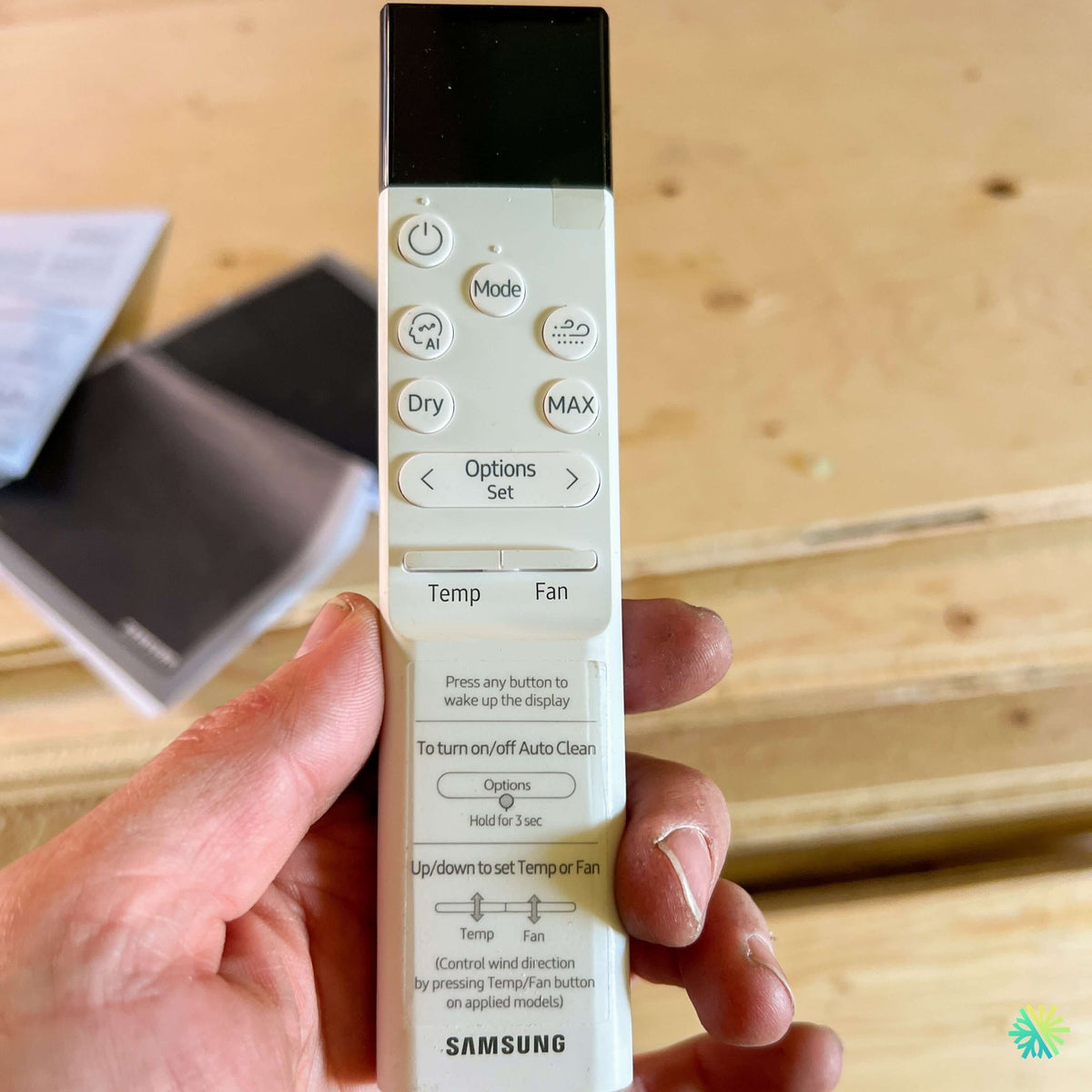
The photograph taken during the project shows the Samsung remote control associated with the system. Its interface provides access to the main functions without overwhelming the user with complex controls.
They include, among other things:
- powering on and off;
- mode selection;
- temperature adjustment;
- fan speed control;
- the “Dry” dehumidification mode;
- the “MAX” function for reaching the set temperature more quickly;
- additional system options;
- airflow direction adjustment;
- the automatic cleaning function, depending on the system configuration.
The lower part of the remote control features practical instructions printed beneath the sliding panel. This allows the user to quickly find the procedure for adjusting the temperature, fan, and certain maintenance functions.
This detail may seem minor, but a successful HVAC installation does not end with installing the equipment. The owner must also understand how to use the system. During commissioning, we explain the recommended modes, louver adjustment, fan operation, and habits that promote a stable temperature.
An important point about multi-zone systems
Each indoor unit can generally have its own set temperature and fan speed. However, units connected to the same outdoor unit must operate in compatible modes.
In practice, a conventional multi-zone system normally cannot cool one room while heating another at the same time. Both zones must be used in heating or cooling mode. One unit can be turned off while the other operates, but opposing requests should be avoided.
We always explain this operation to the customer to prevent a common situation: one remote control left in heating mode in one room while the other is set to cooling. This conflict can prevent one zone from starting or create confusion about how the system operates.
Dry mode for managing humidity without excessive cooling
The “Dry” setting, clearly visible on the Samsung remote control, helps reduce indoor humidity on muggy days. This function can be useful in Repentigny during humid summer periods, especially when the outdoor temperature is not extremely high but the indoor air remains uncomfortable.
However, dehumidification mode does not replace a whole-home or portable dehumidifier in a basement with a persistent humidity problem. Rather, it is a practical setting for improving occasional comfort while limiting excessive cooling.
To maintain good humidity control, we also recommend:
- to keep doors and windows closed while the system is operating;
- to clean the filters regularly;
- to avoid choosing a capacity that is much too high;
- to check that the condensate drain flows freely;
- to let the system run long enough to complete a full cycle.
An oversized unit can cool the room quickly and then shut off before removing enough moisture. Proper sizing therefore affects both comfort and electricity consumption.
The MAX function for rapid temperature recovery
The “MAX” function temporarily increases operating power to reach the requested temperature more quickly. It can be useful when occupants return after an absence or when a room has accumulated significant solar heat.
However, we recommend using it occasionally. For stable comfort and better modulation, it is generally preferable to choose a reasonable setting and let the Samsung heat pump gradually maintain this temperature.
Setting a unit to 16 °C does not necessarily cool a room faster than a 22 °C setting. Instead, it may prolong operation at full capacity and make the space uncomfortably cold. The same principle applies to heating: a very high setting does not increase the appliance's rated capacity.
The technical steps for a properly executed dual-zone installation
Choose the locations for the two indoor units
The placement of wall-mounted units directly affects airflow and perceived comfort. A unit should not simply be installed where the wall is easiest to drill.
Instead, we look for a location that allows:
- air distribution across the greatest possible length of the room;
- sufficient clearance around the unit;
- convenient access to the filters;
- a logical route for the lines;
- an adequate drain slope;
- a clean visual integration;
- a reasonable distance between the indoor units and the outdoor unit.
In a bedroom, we avoid directing the airflow straight toward the bed whenever possible. In a living room, we aim to push the air toward the open area rather than toward a nearby wall. In a stairwell, we assess the natural movement of warm and cool air before confirming the position.
Prepare the refrigerant lines and drains
A dual-zone installation requires two sets of lines between the indoor units and the outdoor unit. Each zone generally has its own refrigerant lines, communication wiring, and condensate drainage system.
The quality of the routing is crucial. Poorly planned routing can cause:
- overly visible exterior trim;
- unnecessary bends;
- an insufficient drain slope;
- the risk of water backing up;
- lines that are difficult to service;
- an excessive refrigerant line length;
- vibrations against the structure.
We plan the layout before drilling to avoid improvisation. Openings are made with an appropriate outward slope when the drain operates by gravity. The penetrations are then carefully sealed to limit air, moisture, and insect infiltration.
Protecting the lines outdoors
The refrigeration and electrical lines are grouped inside a protective covering. When the route remains visible on the exterior wall, we can install a finish molding suited to the building’s configuration.
This protection is not intended solely to improve appearance. It also helps protect the pipe insulation from:
- ultraviolet rays;
- the elements;
- impacts;
- birds and small animals;
- premature deterioration.
Damaged insulation around the vapor line can cause condensation, heat loss, and reduced efficiency. A clean exterior finish also makes future inspection of the installation easier.
Positioning the outdoor unit for Repentigny winters
The outdoor unit must have sufficient clearance to draw in and discharge air. It must not be installed in an area where snow, ice, or water from the roof could block the heat exchanger.
In the Repentigny and Lanaudière region, we must plan for winter accumulation. Depending on the building, the unit may be installed on a wall bracket, a raised base, or a structure designed to keep the appliance above the usual snow level.
We also check:
- the sturdiness of the support;
- vibration control;
- access for servicing;
- the proximity of windows;
- air circulation around the condenser;
- the location of the electrical disconnect;
- water drainage during defrost cycles.
In heating mode, a heat pump produces water during its defrost cycles. This water must be able to drain away without creating a dangerous sheet of ice on a walkway or damaging a sensitive surface.
The refrigeration connection: an invisible but decisive step
After the pipes are connected, the circuit must be prepared according to the applicable technical standards. This part of the installation is rarely visible to the customer, but it directly affects the compressor’s service life.
Our technicians pay particular attention to:
- quality of the flares;
- alignment of the connections;
- application of the appropriate tightening torque;
- protection against contamination;
- leak testing;
- evacuation;
- vacuum stability before releasing the refrigerant;
- complete insulation of the connections.
A simple, approximate tightening can cause a slow leak that only becomes apparent several months later. Insufficient evacuation can leave air and moisture in the refrigeration circuit. These contaminants reduce efficiency and can damage internal components.
Commissioning of the two zones
A dual-zone heat pump must be tested as a complete system, not as two independent units. We start the units, verify their communication with the outdoor unit, and observe the system's behavior under different settings.
The check includes, among other things:
- startup of the first zone;
- startup of the second zone;
- response to temperature controls;
- variation in fan speeds;
- louver movement;
- drainage;
- absence of unusual noise;
- compatibility of operating demands;
- electrical stability;
- explaining the controls to the owner.
We also make sure that each remote controls the correct unit. In an installation where the two indoor units are close together, this check prevents one remote from accidentally changing the settings of the other zone.
Mistakes to avoid with a multi-zone heat pump
Choosing capacity based solely on area
Area is a starting point, but it is not enough to determine the correct capacity. Two rooms of the same size can have very different needs depending on their windows, orientation, and insulation.
Installing the units facing an obstacle
A bookcase, beam, partition, or cabinet placed in front of the unit reduces the reach of the airflow. The system may then maintain a comfortable temperature near the unit while leaving the far end of the room uncomfortable.
Neglecting the drain slope
An improperly sloped drain can cause indoor leaks, odors, or water accumulation in the condensate pan. The routing must be checked before the trim is closed up.
Using opposite modes
Simultaneous heating and cooling demands are incompatible with most residential multi-zone systems. Occupants must coordinate the modes between the two remotes.
Constantly turning off the system
A variable-capacity heat pump generally operates more efficiently when it maintains a stable temperature. Prolonged shutdowns followed by maximum demand can increase discomfort and slow the return to the setpoint.
Forgetting to maintain both units
Each indoor unit has its own filters. Cleaning only the one in the living room while neglecting the one upstairs gradually reduces the airflow of the second zone.
Recommended maintenance after installation
To preserve the performance of this Samsung dual-zone heat pump, we recommend checking the filters regularly. The frequency depends on the presence of pets, the amount of dust, and the number of hours of operation.
Routine maintenance includes:
- washing the filters;
- visually inspecting the indoor units;
- checking the drains;
- clearing the area around the outdoor unit;
- removing leaves and debris;
- monitoring snow accumulation;
- professional cleaning when the blower wheel or heat exchanger becomes dirty.
Cleaning the filters does not replace professional HVAC maintenance. Over time, dust can pass through the filters and settle on the evaporator, blower wheel, and condensate pan. Deep cleaning helps restore airflow and limit odors.
An installation tailored to homeowners in Repentigny and Greater Montréal
This project illustrates the value of a multi-zone solution when two areas of a home have different needs. The Samsung Premium FJM system provides better comfort distribution while limiting the number of outdoor units.
At AirGreen, we install wall-mounted and multi-zone heat pumps in Repentigny, as well as in Montréal, Laval, Longueuil, on the North Shore, and on the South Shore. Every project begins with an analysis of the building, because the brand and capacity are only part of the solution.
We evaluate the entire project: location, heating load, piping, drainage, electrical supply, noise, exterior appearance, future maintenance, and usage habits. This approach makes it possible to install a system that works properly from a technical standpoint while remaining practical every day.
What this Samsung installation brings to everyday life
The value of a dual-zone installation is most apparent in everyday use. Occupants can adjust the setpoint for each area, reduce ventilation in a rarely used room, and maintain more evenly distributed comfort between levels.
The Samsung remote photographed during the installation reflects this simplicity: essential controls remain directly accessible, while additional options are grouped in a separate menu. Dry mode, the MAX function, fan speed, and airflow direction can be adjusted without technical assistance.
A Samsung heat pump installation in Repentigny must nevertheless be considered as a whole: equipment selection, installation quality, commissioning, and the explanations provided to the owner all contribute to the final result.
How it goes, from the first call to the end
The main steps of this kind of job at AirGreen. Every house has its quirks: the estimate brings them out.
We look at the room, the outside wall, the line route and where the outdoor unit will go. That is where the capacity gets chosen.
Model, capacity and price, in writing. We also check whether the model qualifies for assistance programs.
Floors and furniture protected, wall plate position marked level, wall opening located.
A single opening, with the slope the drain needs to flow outside.
Set on a stand raised above the snow, with the clearances the manufacturer requires.
Connected, insulated and protected. The opening is then sealed against water, cold air and insects.
A dedicated circuit and an accessible disconnect near the outdoor unit.
Leak test, vacuum, then start-up and a check of heating and cooling.
Remote, modes, filters: we show you the essentials before we leave.
- The on-site estimateWe look at the room, the outside wall, the line route and where the outdoor unit will go. That is where the capacity gets chosen.
- The quoteModel, capacity and price, in writing. We also check whether the model qualifies for assistance programs.
- Getting readyFloors and furniture protected, wall plate position marked level, wall opening located.
- The wall openingA single opening, with the slope the drain needs to flow outside.
- The outdoor unitSet on a stand raised above the snow, with the clearances the manufacturer requires.
- Lines, cable and drainConnected, insulated and protected. The opening is then sealed against water, cold air and insects.
- The electrical workA dedicated circuit and an accessible disconnect near the outdoor unit.
- Tests and start-upLeak test, vacuum, then start-up and a check of heating and cooling.
- The walkthroughRemote, modes, filters: we show you the essentials before we leave.
And at your place?
Two quick checks with real numbers: what heat costs, and what your current heaters add up to in BTU/h.
Conversion: 1 W = 3.412 BTU/h. An indication, not a load calculation: baseboards and furnaces are often stronger than the real need, and they can stay as backup. AirGreen confirms the capacity on site.
What to do, season by season
Three habits per season for this unit. They take a few minutes and prevent many calls.
- Clean the indoor unit's filters.
- Clear leaves and debris left on the outdoor unit by winter.
- Test cooling before the first hot days.
- Clean the filters more often when the unit runs a lot.
- Keep plants away from the outdoor unit.
- Check that no water drips from the indoor unit.
- Rake the leaves around the outdoor unit.
- Test heating before the first cold days.
- Book periodic maintenance before winter.
- Keep snow away from the stand and the front of the unit.
- Let the unit defrost: it is normal.
- Never hit the ice on the fins; call us if the unit stays iced up.
Which type of equipment for your project?
Pick what looks like your need.
Four mistakes we do not make
Flip each card to see what we do instead.
What people ask us about this kind of work
Does a wall-mounted heat pump heat in winter?
Wall-mounted or multi-zone: how do I choose?
Where does the outdoor unit go?
Are there grants?
Do I need a permit?
How cold can it heat?
How much can I save?
How is the LogisVert assistance calculated?
Is it noisy?
The outdoor unit is covered in ice: is that normal?
Does AirGreen hold the required licences?
Is the estimate free?
No question matches. Write to us: we answer.
Useful pages for what comes next
More jobs to see, near you
By town, by equipment or by region: browse more than 4,700 published projects.
Each dot: a town where AirGreen has published projects. The glowing dot: this job.
Tell us about your house. We come and see it for free.
The on-site estimate is free and the quote follows within 24 hours.
Text and photo: a real AirGreen Climatisation & Chauffage job. The diagrams are generic illustrations of the type of installation, not a survey of this job site. Sources of the added figures: airgreen.ca product pages (NEEP / AHRI performance), Hydro-Québec (Heat pumps page, LogisVert, read on 13 October 2026), Régie de l’énergie (rate D as of 1 April 2026).