
Installation of a Hitachi airHome 600 wall-mounted heat pump in Brossard on Montreal’s South Shore
In Brossard, AirGreen installs a Hitachi airHome 600 wall-mounted heat pump in a confined space near a window, with a discreet finish, reliable low-temperature heating, and advanced purification features.
- City
- Region
- Equipment
- Brand
- Challenges
- Published
The job on one screen
The article, chapter by chapter
A discreet integration in a room where every inch of wall space mattered
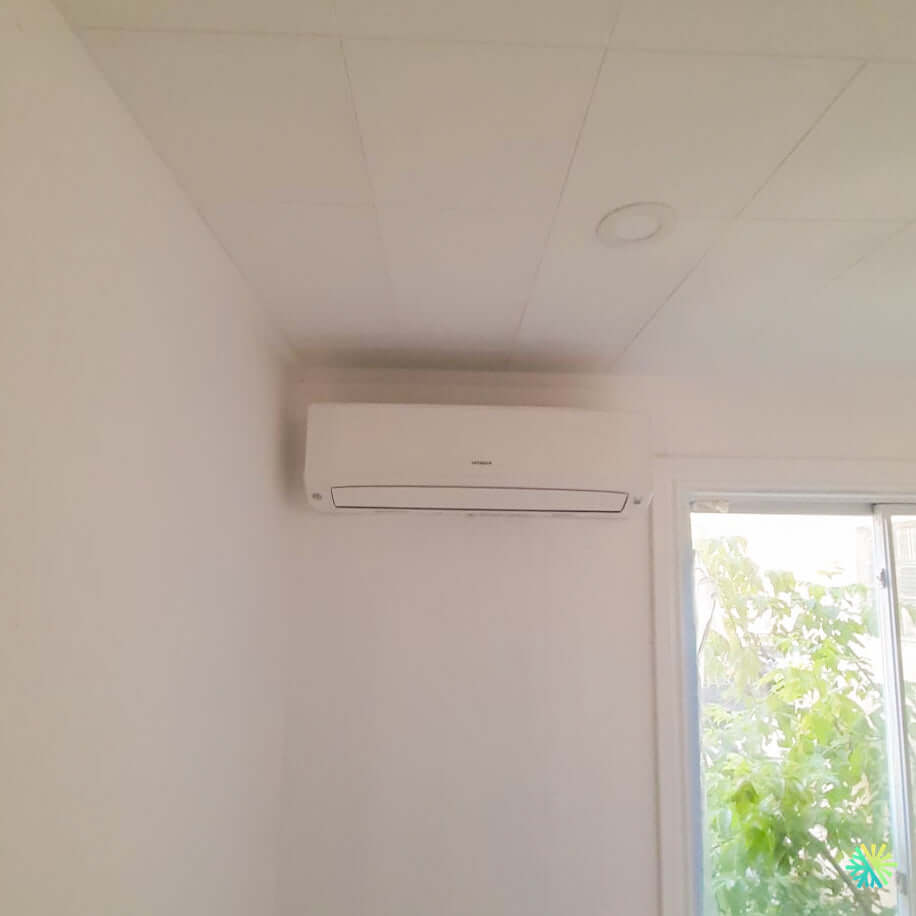
In this Brossard residence, the goal was not simply to add air conditioning and heating. A Hitachi airHome 600 wall-mounted heat pump had to be integrated into a room where the available height was limited by the proximity of a large sliding window, a side wall, and a ceiling made of acoustic tiles.
The photograph taken after the work shows a discreet installation: the white indoor unit blends into the wall without making the room feel heavy, while the connections remain virtually invisible in the photographed area. This clean result nevertheless relies on several important technical decisions. The location had to allow good air intake from above, effective airflow toward the center of the room, and sufficient access for future HVAC maintenance.
At AirGreen, we regularly encounter this type of configuration in Brossard, Saint-Lambert, Greenfield Park, Saint-Hubert and Longueuil. Homeowners want to keep their windows, storage spaces, and the room’s overall appearance while maintaining stable comfort during the humid summers and cold winters of the South Shore.
A unit positioned near the window without blocking airflow
The window visible to the right of the unit significantly reduces the available wall width. The unit could not be moved too far to the right, since its side clearance and service access would have been compromised. Nor could it be installed too close to the left wall, which could have hindered opening the front panel and servicing the filters.
We therefore sought a balanced position that would provide:
- sufficient air intake above the unit;
- unobstructed airflow in front of the louver;
- convenient access to the filters;
- a reasonable distance from the window frame;
- a harmonious visual finish;
- a discreet route for refrigeration lines, wiring, and the drain.
A wall-mounted heat pump installation should never be decided solely based on where the unit appears least visible. An overly confined location can cause air recirculation, inaccurate readings of the ambient temperature, or reduced airflow.
In this Brossard room, the selected wall allows the heat pump to project air into the living space rather than directly toward the window. This orientation helps distribute heating or cooling over a greater distance.
The particular challenge of an acoustic tile ceiling
The ceiling visible in the photo consists of acoustic panels or tiles. This configuration requires different attention than a traditional drywall ceiling.
Before securing the indoor unit, we must check:
- The actual nature of the load-bearing wall behind the finish.
- The position of the studs.
- The stability of the surface.
- The available space above the unit.
- The possibility of routing the lines without weakening the ceiling panels.
- The possible presence of wiring, plumbing, or ducts in the cavity.
The mounting plate of a heat pump must be perfectly level and firmly anchored. Even slight deformation can complicate condensate drainage or cause vibrations. In a room with a low ceiling, a few centimeters can also determine whether the front cover can be opened properly during cleaning.
The Hitachi airHome 600 series was designed to facilitate installation and maintenance. Its optimized mounting plate promotes secure fastening, while certain internal components are accessible or removable to simplify cleaning and technical servicing.
A finish where the technical components remain discreet
On the visible section of the wall, no long exterior molding diverts attention from the unit. This discretion is important in a bright room where the walls, ceiling, and indoor unit are all white.
A clean finish depends on planning carried out before drilling. The best exit angle must be determined for:
- the liquid line;
- the gas line;
- the communication cable;
- the power supply;
- the drain hose.
The drain must maintain a sufficient slope when operating by gravity. A pipe that rises, collapses, or forms a low spot can retain water and cause gurgling noises, odors, or an overflow of the condensate pan.
When the building configuration requires a condensate pump, it must be selected and installed carefully. Otherwise, we generally favor gravity drainage, which is simpler and less dependent on a mechanical component.
Why we do not estimate capacity from a photograph
The photo confirms the presence of a Hitachi airHome 600 indoor unit, but it does not make it possible to determine its exact capacity with certainty. We therefore avoid claiming that it is a 9,000, 12,000, 15,000, 18,000, or 24,000 BTU/h unit without access to the model numbers.
The airHome 600 range includes several nominal cooling capacities, approximately:
- 9,000 BTU/h;
- 12,000 BTU/h;
- 15,000 BTU/h;
- 18,000 BTU/h;
- 22,000 BTU/h for the model commercially associated with the 24,000 BTU/h category.
Proper sizing depends on the actual load of the room and building. We consider the floor area, of course, but also the insulation, windows, sun exposure, ceiling height, floor, air circulation, and the presence of other heating sources.
In Brossard, large glazed surfaces can significantly increase the cooling load in the afternoon. A window facing the sun does not have the same impact as a shaded window. Simply calculating the square footage is therefore not enough to select a reliable heat pump.
Consequences of an oversized unit
An oversized unit can quickly cool the air around the unit, then reduce its output before removing enough humidity. The room may then feel cool but slightly damp or uncomfortable.
Consequences of an undersized unit
An undersized heat pump may operate at full capacity for extended periods, particularly during heat waves or periods of extreme cold. It may then have difficulty reaching the requested temperature in areas farther from the unit.
The airHome 600’s Inverter technology enables effective modulation, but it cannot correct an initially incorrect system size.
Checks performed after installation
A polished appearance alone does not guarantee that a system is functioning properly. Once the indoor and outdoor units have been installed, we perform a series of checks before handing the equipment over to the customer.
Refrigeration system inspection
The piping must comply with the diameters required for the specific appliance combination. Depending on the capacity of the airHome 600, the liquid connection is generally 1/4 in, while the gas line may be 3/8 in, 1/2 in, or 5/8 in.
We check the quality of the flares, the tightness of the connections, and the circuit's leak-tightness. Proper evacuation is then required to remove air and moisture from the lines before releasing the refrigerant.
This series operates on R32, a refrigerant that requires compatible procedures, tools, and practices.
Drainage inspection
We circulate water or run the appliance in cooling mode to confirm that condensate drains properly. We also inspect the indoor pan, connections, and outlet point.
This step is particularly important when the unit is installed in a finished room. A small undetected leak could eventually damage the paint, wall, floor, or ceiling of a lower level.
Electrical inspection
Electrical requirements vary according to capacity. The manufacturer's data indicates a minimum circuit ampacity between 12 and 20 A, with maximum protection generally of 15 or 25 A, depending on the model.
The circuit breaker, wiring, disconnect switch, and connections must meet the requirements of the installed combination. We never select electrical protection solely based on job-site habit.
Heating and cooling test
We check:
- the unit's response to commands;
- the opening and movement of the louvers;
- fan stability;
- cold air production;
- heat production;
- the absence of abnormal vibration;
- remote control operation;
- communication between the units;
- the sound level.
These tests make it possible to immediately detect a connection error, a sensor problem, or a communication fault.
What the Hitachi airHome 600 brings to a Brossard residence
Choosing this Hitachi wall-mounted heat pump meets several common needs on the South Shore: cooling during hot periods, reducing the use of electric heating, and better controlling the air quality in the room.
Heating down to -25 °C
The airHome 600 series is designed to continue operating in heating mode when the outdoor temperature reaches approximately -25 °C. Hitachi also indicates heating capacity that can remain at 100% at -15 °C, depending on the conditions and selected combination.
This does not mean that all capacities produce the same amount of heat at -25 °C. As with any heat pump, the available capacity gradually decreases as the outdoor temperature drops.
Depending on the model, the stated maximum capacity at -25 °C ranges approximately from 7,200 to 15,000 BTU/h. The existing supplemental heating therefore remains relevant during certain periods, especially if the wall-mounted unit serves only part of the home.
High energy efficiency
Depending on the capacity selected, the range can reach approximately 23.0 SEER2 and up to 9.2 HSPF2 for climate region 5. These ratings make it possible to compare seasonal efficiency more accurately among different heat pumps.
Actual performance nevertheless depends on several factors:
- the outdoor temperature;
- the indoor setpoint;
- filter maintenance;
- the cleanliness of the coils;
- the length of the piping;
- the quality of the installation;
- the frequency with which doors and windows are opened.
An efficient unit that is not properly maintained may lose some of its benefits. We therefore recommend cleaning the filters regularly and having the unit inspected when visible buildup appears on the fan or coil.
FrostWash 3.0 to limit internal buildup
The FrostWash 3.0 technology uses a heating, freezing, and thawing cycle to help remove contaminants accumulated on the indoor coil.
The process consists of three phases:
- The coil is heated to help loosen certain particles.
- It is cooled until ice forms, trapping contaminants.
- The ice melts and carries some of the residue toward the drain.
This feature provides useful support for keeping the unit clean, but it does not replace a thorough manual cleaning. Dust can also accumulate on the tangential fan, louvers, and drain pan.
Activated carbon filtration and PM2.5 particles
The AirHome 600 includes a stainless steel prefilter and an activated carbon filter designed to target fine PM2.5 particles. This device may help reduce certain particles and odors in the air passing through the unit.
However, it is important to keep expectations realistic. A wall-mounted heat pump primarily treats the air in the room where it is installed. It does not replace an air exchanger, range hood, humidity control system, or central filtration system.
In a residence in Brossard, the best strategy generally combines:
- adequate ventilation;
- periodic filter cleaning;
- humidity control;
- heat pump maintenance;
- the proper use of exhaust fans.
Mold protection
The mold protection function helps dry the internal components after certain cycles. The system can circulate air and heat the coil to reduce residual moisture.
This feature is particularly useful in summer, when the heat pump operates frequently in cooling mode. It helps limit conditions that promote odors, but does not eliminate contamination that is already present.
Smart Eco, SleepSense, and Wi-Fi control
The airHome 600 offers several smart features designed to improve comfort and reduce unnecessary operating periods.
Smart Eco uses a motion sensor to detect when the room is unoccupied. After a period without anyone present, the unit can adjust its operation to save energy.
SleepSense adjusts the temperature during sleep to avoid excessive fluctuations throughout the night.
The airCloud Go app notably allows you to:
- to control the temperature remotely;
- to create a weekly schedule;
- to track estimated consumption;
- to manage certain smart functions;
- to use compatible voice commands.
These options are especially practical when the heat pump is installed in a basement, office, apartment, or room used on a variable schedule.
A sound level suited to living spaces
The indoor unit's sound level varies depending on its capacity and fan speed. Hitachi documentation indicates that operation can reach around 27 dB(A) for a specific configuration in quiet mode.
The location shown in the photo is advantageous because the unit is installed on a clear wall, with no furniture directly in front of the air outlet. This helps maintain a steady airflow without having to constantly use the maximum speed.
Rebate eligibility: verify the exact combination
Hitachi airHome 600 series units are ENERGY STAR certified according to the combinations specified by the manufacturer and may qualify for certain financial assistance programs.
Eligibility must nevertheless be confirmed based on:
- the exact numbers of the indoor and outdoor units;
- the AHRI number;
- the capacity recognized at low temperatures;
- the type of dwelling;
- the program available on the date of the work;
- the primary heating source;
- the required documents.
The name “airHome 600” is not enough to automatically confirm the amount of a rebate. At AirGreen, we verify the actual combination rather than presenting an unfounded estimate.
Mistakes to avoid in a similar room
This Brossard installation illustrates several useful precautions for homeowners planning a similar project.
Installing the unit too close to the ceiling
Air is drawn in primarily through the upper section. Insufficient clearance can reduce airflow and complicate filter maintenance.
Centering the unit on the wall without considering the window
An installation that is visually centered is not always technically appropriate. The window frame, curtains, air distribution and wall structure must be taken into account.
Directing the airflow straight at occupants
A heat pump installed facing a bed, sofa or workstation can create a draft-like sensation. The location and louver adjustment should minimize this discomfort.
Neglecting the drain route
An improperly sloped drain can cause leaks several weeks after installation, when outdoor humidity increases.
Choosing the capacity based solely on price
A difference in capacity affects comfort, energy consumption, noise and operation at low temperatures. The choice must be technical before it is financial.
A clean installation designed to remain accessible
The visible result in this Brossard residence shows a Hitachi airHome 600 heat pump integrated into a restricted space without compromising the window or overloading the wall.
The quality of an installation is measured as much by what is visible as by what remains hidden: the mounting plate’s anchoring, the drain slope, the flares, the vacuuming, the electrical connections and the operating tests.
At AirGreen, we install wall-mounted heat pumps throughout Brossard, Longueuil, Saint-Lambert, Saint-Hubert, Montréal, Laval, the South Shore and the North Shore. Each location is assessed based on the building’s constraints, air circulation, heating needs and long-term ease of maintenance.
The job tools
Two quick checks with real numbers: what heat costs, and what your current heaters add up to in BTU/h.
Conversion: 1 W = 3.412 BTU/h. An indication, not a load calculation: baseboards and furnaces are often stronger than the real need, and they can stay as backup. AirGreen confirms the capacity on site.
How the job unfolds
The main steps of this kind of job at AirGreen. Every house has its quirks: the estimate brings them out.
We look at the room, the outside wall, the line route and where the outdoor unit will go. That is where the capacity gets chosen.
Model, capacity and price, in writing. We also check whether the model qualifies for assistance programs.
Floors and furniture protected, wall plate position marked level, wall opening located.
A single opening, with the slope the drain needs to flow outside.
Set on a stand raised above the snow, with the clearances the manufacturer requires.
Connected, insulated and protected. The opening is then sealed against water, cold air and insects.
A dedicated circuit and an accessible disconnect near the outdoor unit.
Leak test, vacuum, then start-up and a check of heating and cooling.
Remote, modes, filters: we show you the essentials before we leave.
- The on-site estimateWe look at the room, the outside wall, the line route and where the outdoor unit will go. That is where the capacity gets chosen.
- The quoteModel, capacity and price, in writing. We also check whether the model qualifies for assistance programs.
- Getting readyFloors and furniture protected, wall plate position marked level, wall opening located.
- The wall openingA single opening, with the slope the drain needs to flow outside.
- The outdoor unitSet on a stand raised above the snow, with the clearances the manufacturer requires.
- Lines, cable and drainConnected, insulated and protected. The opening is then sealed against water, cold air and insects.
- The electrical workA dedicated circuit and an accessible disconnect near the outdoor unit.
- Tests and start-upLeak test, vacuum, then start-up and a check of heating and cooling.
- The walkthroughRemote, modes, filters: we show you the essentials before we leave.
What we check on a job like this one
Each number is a point we check on site. Switch between summer and winter to watch air and heat move.
In summer, the outdoor unit rejects the house's heat outside.
Generic illustration of this type of installation, not a survey of this job site. Tap a number.
Mounted level on a wall plate, high enough for the air to reach the whole room, with enough space around it to slide the filters out easily.
The refrigerant lines, the communication cable and the drain go through the wall in a single opening, sealed against water, cold air and insects.
Two insulated copper pipes connect the two units. Outside, a line cover can protect them from sun, knocks and weather.
A shut-off switch near the outdoor unit isolates it safely for service. It must stay accessible at all times.
The compressor and the fan. In heating mode it captures heat from the outdoor air, even in winter, and moves it inside.
On the ground or on the wall, it keeps the unit above accumulated snow. The unit stays clear and defrost water can drain away.
The fan needs to blow freely. Storage, a fence or a wall too close, and efficiency drops while noise goes up.
Is your home ready?
Check what applies at your place. A "no" is not a refusal: it is what we sort out during the estimate.
Good habits, once the unit is in place
Six simple habits that keep the unit going. Your list stays on this device.
What to do, season by season
Three habits per season for this unit. They take a few minutes and prevent many calls.
- Clean the indoor unit's filters.
- Clear leaves and debris left on the outdoor unit by winter.
- Test cooling before the first hot days.
- Clean the filters more often when the unit runs a lot.
- Keep plants away from the outdoor unit.
- Check that no water drips from the indoor unit.
- Rake the leaves around the outdoor unit.
- Test heating before the first cold days.
- Book periodic maintenance before winter.
- Keep snow away from the stand and the front of the unit.
- Let the unit defrost: it is normal.
- Never hit the ice on the fins; call us if the unit stays iced up.
The right pages, at the right time
Four statements: true or false?
It all comes down to details you have just seen.
1. In heating mode, the outdoor unit can produce water.
During defrost cycles. That water must drain away without forming ice.
2. You pick the capacity with a simple square-footage rule.
Windows, insulation, orientation and how the room is used all count. Capacity is chosen on site.
3. A multi-zone connects several indoor heads to a single condenser.
One head per room, all on the same condenser. Each room keeps its own temperature.
4. The disconnect can sit behind the patio furniture.
It must stay accessible: it is what shuts the unit off for service.
0 / 4 right answers
What people ask us about this kind of work
Does a wall-mounted heat pump heat in winter?
Wall-mounted or multi-zone: how do I choose?
Where does the outdoor unit go?
Are there grants?
Do I need a permit?
How cold can it heat?
How much can I save?
How is the LogisVert assistance calculated?
Is it noisy?
The outdoor unit is covered in ice: is that normal?
Does AirGreen hold the required licences?
Is the estimate free?
No question matches. Write to us: we answer.
More jobs to see, near you
By town, by equipment or by region: browse more than 4,700 published projects.
Each dot: a town where AirGreen has published projects. The glowing dot: this job.
An on-site estimate, the right capacity, the right equipment.
The on-site estimate is free and the quote follows within 24 hours.
Text and photo: a real AirGreen Climatisation & Chauffage job. The diagrams are generic illustrations of the type of installation, not a survey of this job site. Sources of the added figures: airgreen.ca product pages (NEEP / AHRI performance), Hydro-Québec (Heat pumps page, LogisVert, read on 13 October 2026), Régie de l’énergie (rate D as of 1 April 2026).