
Installation of a Samsung Premium FJM dual-zone heat pump in Sainte-Thérèse
In Sainte-Thérèse, AirGreen installs a Samsung Premium FJM dual-zone heat pump on a suitable balcony bracket, with protected lines, accessible connections, and a layout designed for winter comfort.
In summer, the outdoor unit rejects the house's heat outside.
Generic illustration of this type of installation, not a survey of this job site. Tap a number.
Mounted level on a wall plate, high enough for the air to reach the whole room, with enough space around it to slide the filters out easily.
The refrigerant lines, the communication cable and the drain go through the wall in a single opening, sealed against water, cold air and insects.
Two insulated copper pipes connect the two units. Outside, a line cover can protect them from sun, knocks and weather.
A shut-off switch near the outdoor unit isolates it safely for service. It must stay accessible at all times.
The compressor and the fan. In heating mode it captures heat from the outdoor air, even in winter, and moves it inside.
On the ground or on the wall, it keeps the unit above accumulated snow. The unit stays clear and defrost water can drain away.
The fan needs to blow freely. Storage, a fence or a wall too close, and efficiency drops while noise goes up.
A multi-zone installation carefully integrated into a residential wooden balcony
Installing a dual-zone heat pump on a balcony requires much more than simply finding an open spot for the outdoor unit. Airflow, vibration, refrigerant line routing, service access, electrical connections, and the visual impact on the building must all be considered. During this project in Sainte-Thérèse, our AirGreen team installed a Samsung Premium FJM heat pump in a narrow space between a brick wall and the railing of a wooden balcony.
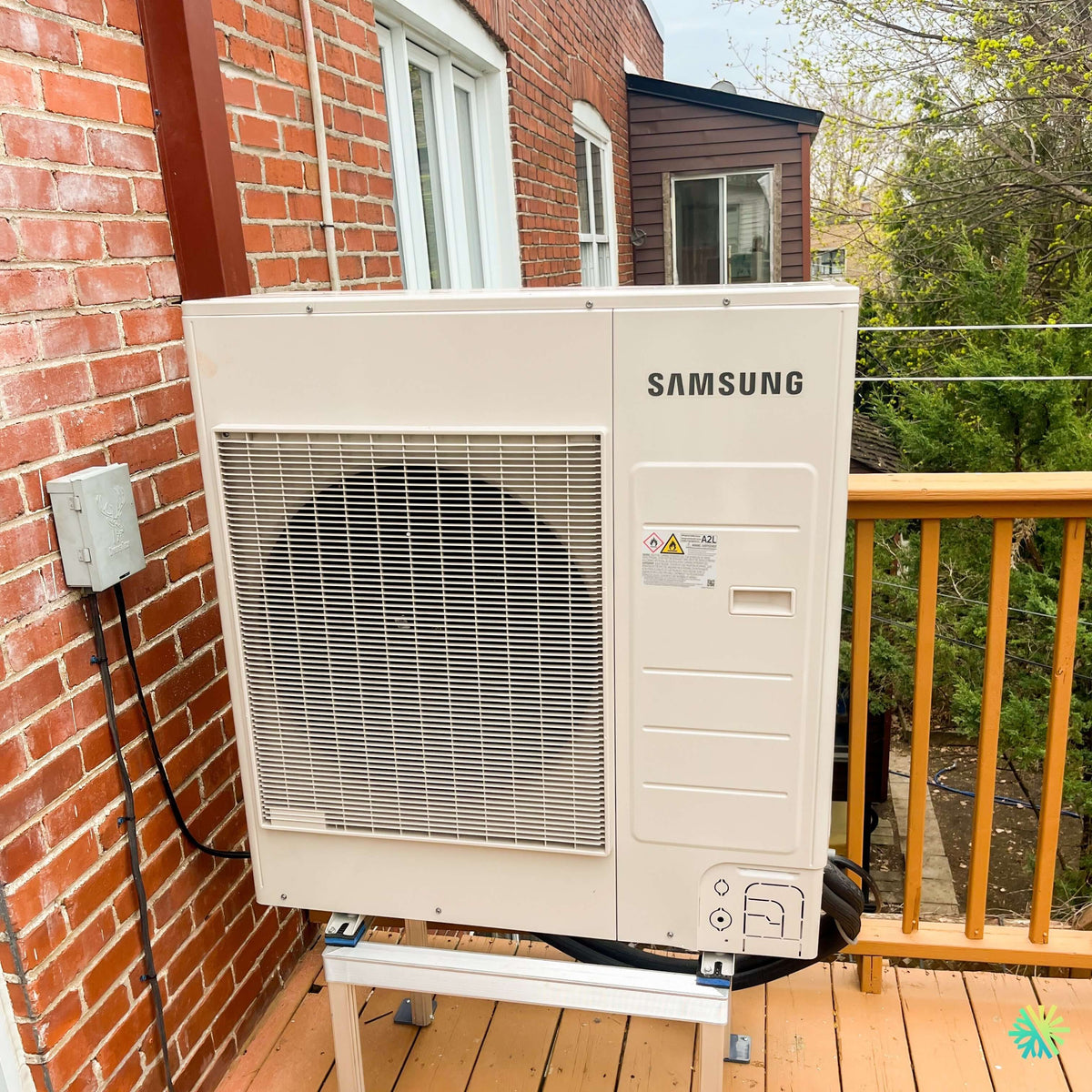
The project photo shows a Samsung outdoor unit installed on an aluminum floor stand, rather than directly on the balcony boards. The lines were routed vertically along the wall and protected by a rigid cover matching the masonry. The electrical disconnect is mounted on the brick wall near the unit, with protected outdoor wiring.
This compact configuration can power two separate indoor zones from a single outdoor unit. It is particularly suitable for homes where certain rooms are difficult to heat evenly, properties with multiple floors, or buildings where outdoor space is limited.
Why choose a Samsung Premium FJM dual-zone heat pump?
A multi-zone heat pump uses a single outdoor unit to power multiple indoor units. For this installation in Sainte-Thérèse, the selected configuration is a dual-zone system, meaning that two indoor units are connected to the same outdoor unit.
Each zone can generally be adjusted separately. This allows occupants to adapt the temperature according to how the rooms are actually used, rather than heating or cooling the entire building uniformly.
The Samsung Free Joint Multi Premium system, often referred to by the abbreviation FJM Premium, is designed for residential and light commercial installations. Depending on the selected combination, this product family can connect multiple indoor units to a single outdoor unit. The current Premium lineup can support up to four zones and uses R-32 refrigerant. Samsung also indicates maintained heating capacity at low temperatures, with full heating performance rated at −15 °C and heat output still available at −25 °C.
For this installation, the number of zones was limited to two to precisely meet the building’s needs without unnecessarily multiplying the number of indoor units.
A capacity that must be determined based on the building
A heat pump’s capacity should never be selected solely according to the home’s total area. To properly size a dual-zone heat pump, we analyze in particular:
- the area and volume of each zone;
- the number of windows and their orientation;
- the quality of the insulation;
- the floor where the rooms are located;
- the building’s heat loss;
- sun exposure;
- the presence of an existing heating system;
- the distance between the indoor units and the outdoor unit.
The Samsung FJM Premium range includes several rated capacities. The exact output of the unit installed in Sainte-Thérèse must be confirmed using the complete model number and the rating plate, which are not sufficiently legible in the photograph. We avoid inferring the capacity in BTUs solely from the unit’s physical dimensions.
This detail is important. An oversized heat pump can quickly reach the requested temperature and then run excessively short cycles. An undersized unit, on the other hand, may operate continuously without providing the expected comfort during the coldest periods.
A complex installation between the brick wall and the railing
One of the distinctive features of this project was the location of the outdoor unit. The balcony has a relatively narrow surface, bordered on one side by a brick wall and on the other by a railing.
We positioned the heat pump to preserve several essential elements:
Airflow in front of the fan
The large front grille must remain unobstructed. The fan must be able to expel air without encountering an obstacle immediately in front of the unit. A railing that is too close, a poorly designed decorative screen, or objects stored in front of the heat pump could cause air recirculation and reduce its performance.
In this installation, the front of the unit faces the open balcony area and the backyard. This orientation promotes efficient air discharge.
Access to the service panel
The right-hand section of the unit includes the panel providing access to several technical components. We must always allow enough space for a technician to carry out inspections, maintenance, or any necessary repairs without having to remove the guardrail or completely move the heat pump.
Protecting the brick cladding
The anchors, cable routing, and line passage must be planned to avoid unnecessary damage to the masonry. Openings made in the wall are sealed to limit water, air, and insect infiltration.
Why install the unit on an aluminum support?
In the photograph, the outdoor unit rests on a raised metal structure installed directly on the balcony. This choice is particularly important on a wooden deck.
The support allows you to:
- distribute the unit's weight more evenly;
- avoid direct contact between the cabinet and the boards;
- facilitate drainage beneath the heat pump;
- reduce the risks associated with the accumulation of leaves or debris;
- maintain space beneath the unit for inspection;
- limit the direct transmission of vibrations to the balcony.
A heat pump installed directly on a wooden floor can transmit a noticeable humming sound into the house. Vibrations can sometimes travel through the structure, particularly when the balcony is attached to the building's joists.
To reduce this issue, we check the support's rigidity, the unit's level, and the presence of contact points that could vibrate. Appropriate vibration-damping elements may also be added depending on the structure and the unit's weight.
Useful clearance beneath the unit in heating mode
When a heat pump operates in winter, the outdoor unit produces water during its defrost cycles. This water must be able to drain freely.
On a balcony, poor defrost management can lead to:
- ice buildup beneath the unit;
- a slippery surface;
- a block of ice touching the underside of the unit;
- premature wood deterioration;
- unwanted drainage toward a lower patio or driveway.
The raised support facilitates water drainage. However, the owner must monitor the area during the winter and avoid blocking the underside of the heat pump with boxes, furniture, a tarp, or compacted snow.
A clean, protected line route
The refrigerant lines visible at this site run vertically along the brick wall inside an exterior line-set cover. This covering serves several purposes.
It protects:
- the insulated copper pipes;
- the communication wiring;
- certain electrical connections;
- the lines from impacts and ultraviolet rays;
- the insulation from birds and small animals.
The line cover also considerably improves the appearance of the installation. On a brick façade, a straight, securely fastened vertical route provides a more discreet result than exposed lines.
The bend radius must be checked to avoid crushing the pipes. The lines are then connected to the outdoor unit, pressurized with nitrogen to check for leaks, and evacuated before the refrigerant contained in the unit is released.
An accessible and safe electrical connection
The disconnect switch visible on the wall allows the heat pump’s power supply to be shut off near the outdoor unit. Its location facilitates technical work and contributes to safety during maintenance.
The electrical circuit must be sized according to the information shown on the unit’s nameplate, including the minimum circuit ampacity and the maximum permitted overcurrent protection. The circuit breaker should not be selected solely based on the BTU capacity.
In a multi-zone installation, the electrical connection and communication between the devices must also comply with the manufacturer’s wiring diagram. Reversed conductors, incorrect port pairing, or improper wiring can cause communication errors or prevent certain zones from operating properly.
How a multi-zone system works
A dual-zone heat pump provides individual room control, but both indoor units share the same outdoor compressor. This creates a few particularities that we explain to homeowners.
The zones can request different temperatures, but they generally have to operate in the same main mode. One indoor unit normally cannot cool one room while the other heats at the same time.
The outdoor unit’s capacity is also distributed among the active zones. When only one indoor unit is operating, the compressor modulates according to demand. When both zones require a lot of heating or cooling, the available capacity is distributed according to the system configuration.
This modulation is one of the main advantages of variable-speed technology. Samsung indicates that its FJM systems adjust compressor operation to maintain the temperature more precisely and limit fluctuations.
What this installation in Sainte-Thérèse can teach homeowners
Do not choose the location solely to hide the heat pump
It is common to want to completely conceal the outdoor unit behind a railing, a wooden screen, or a fence. However, this approach can hinder ventilation.
An outdoor unit must have sufficient airflow around its air intake and in front of its fan. A visually discreet space is not necessarily a technically suitable location.
In this project, the unit remains visible but benefits from a functional and accessible position. A durable installation should always prioritize performance, maintenance, and safety over completely concealing the equipment.
Avoid storing items near the unit
A balcony is often used to store furniture, bins, bicycles, or seasonal accessories. After installation, it is essential to keep the area around the heat pump clear.
The most common mistakes include:
- place a barbecue in front of the fan;
- lean a chair against the grille;
- cover the unit with a waterproof tarp;
- allow leaves to accumulate behind the unit;
- block the drainage beneath the support;
- install a decorative screen without sufficient clearance.
An outdoor heat pump is designed to withstand the elements. It should not be sealed airtight during the winter.
Check for vibrations before completing the work
Once the system has started, we check its operation at different speeds. A slight vibration at startup may become more noticeable as the compressor increases its power.
On a wooden structure, we pay particular attention to:
- the support feet;
- bolts and anchors;
- pipes touching the structure;
- the line-set cover;
- wiring that could strike the wall;
- loose metal parts.
This inspection helps eliminate several sources of noise before they become disruptive to occupants.
Recommended maintenance for a dual-zone heat pump
A quality installation should be accompanied by regular maintenance. Both indoor units have their own filters. These filters should be inspected and cleaned according to usage, the presence of pets, dust levels, and the season.
For the outdoor unit, we recommend:
- regularly remove leaves from around the grille;
- keep the area beneath the unit clear;
- check for ice buildup during the winter;
- never use a sharp object to remove ice;
- monitor unusual noises;
- have the system inspected when performance declines.
A professional HVAC maintenance service also checks the supply-air temperatures, electrical connections, coil condition, drainage from the indoor units, and operating codes recorded by the system.
LogisVert grant: eligibility depends on the complete combination
A Samsung heat pump is not automatically eligible for financial assistance simply because it belongs to a high-efficiency product line. Eligibility must be verified based on the complete combination of the indoor and outdoor models, as well as the reference number recognized by the program.
Hydro-Québec currently indicates that a heat pump eligible for the LogisVert program may receive assistance calculated at $120 per 1,000 BTU/h of heating capacity at −8 °C. The amount therefore depends on the system’s certified low-temperature performance, not only on its nominal cooling capacity.
Before signing a contract, we verify in particular:
- the exact model of the outdoor unit;
- the models of both indoor units;
- the certified combination;
- the recognized heating capacity at −8 °C;
- the system’s presence on the applicable list;
- the documents required for the application.
Hydro-Québec itself recommends checking the heat pump’s eligibility in its official tool before purchasing.
The AirGreen approach to a durable multi-zone installation
At AirGreen, we do not consider an HVAC installation complete when the unit has simply been secured and turned on. We examine the entire project: comfort distribution, unit placement, building structure, noise, drainage, electrical work, future maintenance, and visual presentation.
This installation of a Samsung Premium FJM dual-zone heat pump in Sainte-Thérèse illustrates the importance of these details. The outdoor unit was integrated into a limited space without blocking the balcony’s main passage. The metal bracket keeps the unit above the wooden floor, the line set remains neatly arranged, and the electrical disconnect stays easily accessible.
The same rigor applies to our heat pump projects in Montreal, Laval, Longueuil, the North Shore, and the South Shore. Every building has its own constraints. A brick house, condominium, duplex, multi-story residence, or property with a balcony does not require the same installation strategy.
Choosing a high-performance Samsung heat pump is one part of the project. Its sizing, placement, and installation quality then determine the actual comfort occupants can enjoy year after year.
How it goes, from the first call to the end
The main steps of this kind of job at AirGreen. Every house has its quirks: the estimate brings them out.
We look at the room, the outside wall, the line route and where the outdoor unit will go. That is where the capacity gets chosen.
Model, capacity and price, in writing. We also check whether the model qualifies for assistance programs.
Floors and furniture protected, wall plate position marked level, wall opening located.
A single opening, with the slope the drain needs to flow outside.
Set on a stand raised above the snow, with the clearances the manufacturer requires.
Connected, insulated and protected. The opening is then sealed against water, cold air and insects.
A dedicated circuit and an accessible disconnect near the outdoor unit.
Leak test, vacuum, then start-up and a check of heating and cooling.
Remote, modes, filters: we show you the essentials before we leave.
- The on-site estimateWe look at the room, the outside wall, the line route and where the outdoor unit will go. That is where the capacity gets chosen.
- The quoteModel, capacity and price, in writing. We also check whether the model qualifies for assistance programs.
- Getting readyFloors and furniture protected, wall plate position marked level, wall opening located.
- The wall openingA single opening, with the slope the drain needs to flow outside.
- The outdoor unitSet on a stand raised above the snow, with the clearances the manufacturer requires.
- Lines, cable and drainConnected, insulated and protected. The opening is then sealed against water, cold air and insects.
- The electrical workA dedicated circuit and an accessible disconnect near the outdoor unit.
- Tests and start-upLeak test, vacuum, then start-up and a check of heating and cooling.
- The walkthroughRemote, modes, filters: we show you the essentials before we leave.
And at your place?
Two quick checks with real numbers: what heat costs, and what your current heaters add up to in BTU/h.
Conversion: 1 W = 3.412 BTU/h. An indication, not a load calculation: baseboards and furnaces are often stronger than the real need, and they can stay as backup. AirGreen confirms the capacity on site.
What to do, season by season
Three habits per season for this unit. They take a few minutes and prevent many calls.
- Clean the indoor unit's filters.
- Clear leaves and debris left on the outdoor unit by winter.
- Test cooling before the first hot days.
- Clean the filters more often when the unit runs a lot.
- Keep plants away from the outdoor unit.
- Check that no water drips from the indoor unit.
- Rake the leaves around the outdoor unit.
- Test heating before the first cold days.
- Book periodic maintenance before winter.
- Keep snow away from the stand and the front of the unit.
- Let the unit defrost: it is normal.
- Never hit the ice on the fins; call us if the unit stays iced up.
Which type of equipment for your project?
Pick what looks like your need.
Four mistakes we do not make
Flip each card to see what we do instead.
What people ask us about this kind of work
Does a wall-mounted heat pump heat in winter?
Wall-mounted or multi-zone: how do I choose?
Where does the outdoor unit go?
Are there grants?
Do I need a permit?
How cold can it heat?
How much can I save?
How is the LogisVert assistance calculated?
Is it noisy?
The outdoor unit is covered in ice: is that normal?
Does AirGreen hold the required licences?
Is the estimate free?
No question matches. Write to us: we answer.
Useful pages for what comes next
More jobs to see, near you
By town, by equipment or by region: browse more than 4,700 published projects.
Each dot: a town where AirGreen has published projects. The glowing dot: this job.
Tell us about your house. We come and see it for free.
The on-site estimate is free and the quote follows within 24 hours.
Text and photo: a real AirGreen Climatisation & Chauffage job. The diagrams are generic illustrations of the type of installation, not a survey of this job site. Sources of the added figures: airgreen.ca product pages (NEEP / AHRI performance), Hydro-Québec (Heat pumps page, LogisVert, read on 13 October 2026), Régie de l’énergie (rate D as of 1 April 2026).